

Humpty Dumpty sat on a wall,
Humpty Dumpty had a great fall;
All the king’s horses and all the king’s men
Couldn’t put Humpty together again.
From her mouth to our ears.
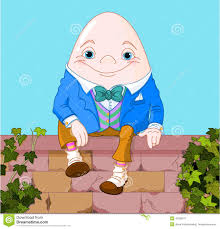 You see that kid sitting over there on the wall? The one wearing the Jester’s hand-me-down suit? The Jester also gave him that funny name. That kid is looking for his father. That kid is my son.
My father the King is a tyrant, and he has more bastards than any other king in our nation’s history except for one other King, a long time ago. (Maybe these Kings try to populate the land all by themselves.) I’m one of his bastards. My mama travels with the Players, and after I was born, she traveled on and left me here. Oh, the Players come back every year, and she always tells me about her adventures, like when they went to visit that Prince up north, the one who was pretending to be crazy and got killed in a duel. My father the King lets his sons take the name Fitzroy, but us girls? What do we get? We’re lucky we get to live in the palace. That’s thanks to the Queen, who is kind and protective of all the King’s children, legitimate or not. I’m part of her court. A minuscule part, but she knows who I am and has answered my prayers several times. I’ll never rise in society. But I’m making plans for my son. Continue reading “Humpty Had A Mother by Barbara Ardinger”
 Recently I saw
  As a child, I learned all about my religion from my grandmother, in her small and remote Romanian village. She told me many Bible stories from our Christian Orthodox tradition, often disguised as bedtime fairytales, but it was not doctrine that I learned from her, as much as ritual. She taught me the prayers to say at night so I don’t have nightmares, the candles to light in church for luck, the list of dead and living to give the priest for blessings, the making and delivering of food as offerings in memory of the recently deceased.
  As a teenager, I grew up wondering where exactly I belonged. Aside from the confusion resulting from straddling two entirely different, perhaps even opposing, cultures, my main concern seemed to center on which country was I from – India or Zambia? Or was I inherently British because of an education and upbringing enveloped by things English – values, books, magazines, not to mention people? Was I American because I grew up on TV shows like Charlie’s Angles, Wonder Woman, Six Million Dollar Man and Dallas that played a major role in fashioning my idea of the world around me? Perhaps I was Zambian because I had been living in that part of the world since the age of one. Or maybe I was from India because that was after all the land of my birth, to where I returned as an utterly confused and disjointed teenager who believed she now had to be “Indian” even though I could not relate so much as an iota to my immediate surroundings.
 It is a difficult thing to wake up and realize you are living a life you do not recognize. This happens for all sorts of reasons. Sometimes, it happens dramatically as in the case of death, job loss, personal trauma, or illness. Other times it is a slow and insidious transition from what you knew to what you have become, as you find yourself looking at your workplace and recognizing no one or wondering who these people are in your home. Sometimes it is as simple as getting a haircut or a pair of contact lenses, when suddenly you see some wrinkle or skin mark you didn’t know had been forming while you slept.
 Have you ever wondered why it has to been so important for the Roman Catholic church to disempower women and suppress their rightful place in history? And have you ever questioned why it was so important to distort symbols and legends, which for thousands of years BC, had been connected to women and our innate spirituality?
 Recently, a commercial made by the clothing line, BIBA, hit the Indian market. Its significance lay in its “Change the Convention, Change is Beautiful” tag. The message was straightforward – we need to change Indian attitudes regarding gender roles. At the outset, let me say there are many things wrong with the ad, especially when one stops to think how it could possibly bring about a change when the young woman in question is voiceless. In fact, when I first watched it, my own reaction was: “And just what change are we talking about here?” Upon deeper reflection, however, I realized why the commercial may indeed be a step forward, albeit a tiny one.
  For the last year, I have been scheduled and planning a trip to Brazil, having been invited to speak, plus do a workshop at a conference in Sao Paulo and then two workshops in Brasilia. Four weeks ago, and three days after a Pertussis vaccine (needed before I could see my new great-granddaughter), I was hit with bronchitis which exacerbated an acute flare of my asthma. I was in the ER three weeks ago, but went home trusting that the steroids would work. They did not. So Sunday (the 15th), I once more bit the bullet and headed to the ER, now in a panic, unable to breathe.
  Normally—and I mean normally as in the past thirty-seven years of my life, this is the time of year when I start thinking about the upcoming Michigan Womyn’s Music Festival and the fact that I will be seeing friends of mine from around the world for our one ten-day excursion deep into “womyn’s land.” Where I will howl at the moon with thousands of women. Where I will stay up late around my favorite campfire –the DART fire pit—where the physically challenged folks camp and where I am unofficial DART support. One of my best friends at Fest is a fabulous moonshine maker from Appalachia. Every year we have a date in the back of night stage—where literally this past year 7,000 women were dancing and singing and listening to a world class concert/rock n’ roll show under the moonlight. Way in the back my friend H. and I toasted on our annual “date” with her latest brew…that she trucked in by wagon next to her chair and her service dog. “So raise a glass,” we toasted with red cups high in the air, singing along with the woman way down front on the stage, performing in synchronicity with our toast.
 After reading my essay (
 Feminism and Religion