

Part 1 was posted yesterday
The mud mothers, ancestors, began to make themselves visible to her when she was a girl, in the movie theater, on one of the walls in a cave like indentation, “with enormous teeth painting themselves with long hair brushes, painting pictures on the walls of the cave”( SE 254), at church, and in her attic. “In the attic they came in the mirror once. Ten or more women with mud hair, storing yams in gourds and pebbles in cracked calabash. And tucking babies in hairy hides. They came like a Polaroid. Stepping out of the mouth of the cave, they tried to climb out of the speckled glass, talk to her, tell her what must be done all over again, all over again, all over again. But she hung an old velvet drape over the mirror and smothered them. They were not going to run her off her own place, Not the attic “(SE 255). In church and at the theater she avoided looking at them.
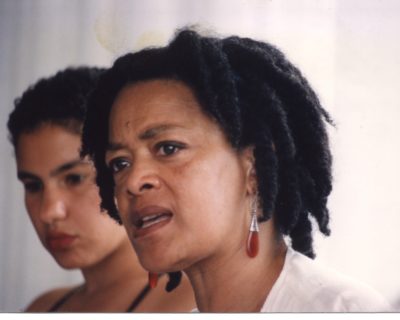
For Velma and for Bambara, it is the spiritual roots of her ancestors and ancestry from Africa that come calling, the mud mothers. In Velma’s town there are mentors and guides and Aunties and godmothers, all levels of support and care available in claiming her gifts that Velma has left behind, rejected. Yet, when the book ends she will return to this, she has agreed to take up the mantle in order to be well.
For African Americans in particular, Bambara believes reconnecting with the ancestors—the ancestors that their ancestors were taken from— is part of the healing wanting to happen. That this was left out of the civil rights movement. That honoring ancestors is part of this lineage and that the ancestors are there and waiting. That slavery often disrupted this connection but it is there, the ancestors are there, for the reconnection if one is willing.
This book was awesome to read for so many reasons, but I wish to strongly acknowledge the powerful, independent, smart, self-identified and self-affirming female characters, the portrayal of healthy female friendships, the portrayal of powerful women activists, women with passion acting on their passions, women employed in good jobs and educated women talking about issues of importance, with each other! Only upon reading a book that features this so prominently is it evident how few include this. Velma has friends, lots of them and they are also well-rounded characters with lives and independent interests separate from men. This book passes the Bechdel-Wallace test (For a given work of fiction to pass the test, the work must 1) have at least two women in it, who 2) talk to each other, about 3) something other than a man.) in flying colors and it was written in 1980.
Bambara broke all kinds of barriers with this book. What is also stunning and even a bit shocking to read are the passages where Velma is leading a meeting WHILE having her period and needing to change her tampon or out on a protest and having a similar need. I honestly do not think I have read about that in a book before. It was so amazing to read it and to ponder how I can’t remember having read it. For me it was so affirming. The famous trope thrown around how Ginger had to do everything Fred did but do it backwards: how about backwards while also bleeding and leaking and maybe not having proper supplies to attend to oneself at hand?
Velma does that!
How many times have women who bleed had these similar experiences? A common occurrence for most and yet, NEVER written about. She captures it so well. I absolutely must include the passages here.
While leading a meeting:
“She felt uncomfortable, damp. There’d been nothing in the machines—no tampons, no napkins, no paper towels, no roll of tissue she could unravel and stuff her panties with. So she slid carefully into the wide bowl of the wooden chair, the wad of rally flyers scratching against her panty hose”(SE 26)…. “She stood up again, certain that she was leaving a red-brown smear on the chair”(SE 36).
A memory of a day of protest:
“It had been a Gulf station. Of course she remembered that, the boycott had been still in effect and she’d felt funny going in there, even if it was just to use the bathroom. Mounting a raggedy tampon fished from the bottom of her bag, paper unraveled, stuffing coming loose, and in a nasty bathroom with no stall doors, and in a Gulf station too, to add to the outrage. She’d been reeking of wasted blood and rage. They’d marched all morning, all afternoon and most of early evening to get there. Shot at, spit on, nearly run down by a cement mixer, murder mouthed, lobbed with everything from stones to eggs, they’d kept the group intact and suffered no casualties or arrests. But when they got to the park, renamed People’s Park for the occasion, the host group hadn’t set up yet . . . and Velma clenching her thighs tight, aware that a syrupy clot was oozing down her left leg and she needed to see about herself.
Exhausted, she was squinting through the dust and grit of her lashes when the limousines pulled up, eye-stinging, shiny, black, sleek. And the door opened and the cool blue of the air-conditioned interior billowed out into the yellow and rust-red of evening. Her throat was splintered wood. Then the shiny black boots stepping onto the parched grass, the knife-creased pants straightening taut, the jacket hanging straight, the blinding white shirt, the sky-blue tie. And the roar went up and the marshals gripped wrists and hoarsely, barely heard, pleaded with the crowd to move back and make way for the speaker. Flanked by the coal-black men in shiny sunglasses and silk-and-steel suits, he made toward the platform. She carried herself out of the park in search of a toilet . . . And no soap. No towels. No tissue. No machine. Just a spurt and then a trickle of rusty water in the clogged sink then no water at all. And like a cat she’d had to lick herself clean of grit, salt, blood and rage”(33-35).
Mic drop.
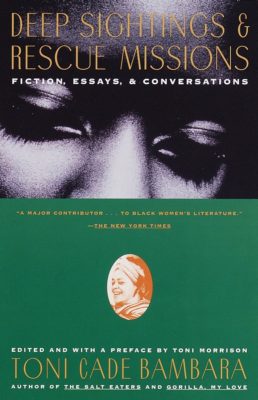
Bambara grew up in Harlem, New York, attended Queens College (1959) and City College of New York (MA 1963), edited the now infamous collection, The Black Woman, published two collections of her own short stories: Gorilla, My Love and The Sea Birds Are Still Alive, wrote essays, worked as a teacher and worked tirelessly as an activist for civil rights and cultural change.
She was also deeply committed to film and was aiming to put more of her energy there when she passed. Her film W.E.B. Du Bois: A Biography in Four Voices received great acclaim.
Bambara’s editor at Random House was Toni Morrison. In the preface to Deep Sightings and Rescue Missions, Morrison writes:
“I don’t know if she knew the heart cling of her fiction. Its pedagogy, its use, she knew very well, but I have often wondered if she knew how brilliant at it she was. There was no division in her mind between optimism and ruthless vigilance; between aesthetic obligation and the aesthetics of obligation. There was no doubt whatsoever that the work she did had work to do. She always knew what her work was for. Any hint that art was over there and politics was over here would break her up into tears of laugher, or elicit a look so withering it made silence the only intelligent response. More often she met the art/politics fake debate with a slight wave-away of the fingers on her beautiful hand, like the dismissal of a mindless, desperate fly who had maybe two little hours of life left” (DSRM ix-x).
In The Salt Eaters when Velma’s old friend Barbara Sweetpea comes to visit she prods Velma:
“‘And still into the same idealistic nonsense, I gather,” sounding edgy, irritable. “You honestly think you can change anything in this country?’ Her anger flaring now, bewildering.
‘I try to live,’ Velma said, surprised at her evenness, ‘so it doesn’t change me too much.’
‘You’ll learn,’ she snapped back and seemed to be getting up to go, except she wasn’t, just changing positions. And Velma was waiting for the bedroom clock to go off so she would announce she had meeting to attend.
‘You’ll learn,’ she said again.
‘I want to learn to grow, to become…’ no longer talking to Barbara Sweetpea Watson. Her lips soft against each other, Velma was searching for a way to finish the sentence, wondering if indeed it was already complete”(SE 261).
Toni Cade Bambara is a #NastyWomanWriter and Activist.
©Theresa C. Dintino 2020
Works Cited, Consulted and Recommended
Bambara, Toni Cade. The Salt Eaters. N.Y. Vintage, 1980.
brown, adrienne maree. Pleasure Activism: the Politics of Feeling Good. AK Press, 2019.
Gumbs, Alexis Pauline. “One Thing: Toni Cade Bambara in the Speaking Everyday.” the feminist wire, November 23, 2014. https://thefeministwire.com/2014/11/well-being-of-the-community/
Morrison, Toni, Ed. Toni Cade Bambara: Deep Sightings and Rescue Missions, Fiction, Essays & Conversations. N.Y.: Random House, 1996.
Patton, Venetria K. The Grasp That Reaches Beyond the Grave: The Ancestral Call in Black Women’s Texts. Albany: SUNY Press, 2013.
Washington, Mary Helen, Ed. Black-Eyed Susans: Classic Stories By and About Black Women. New York: Anchor Books, 1975.
Discover more from Feminism and Religion
Subscribe to get the latest posts sent to your email.


I bought the book thanks to you!!!!
LikeLike
I am so happy to hear that, Sara. Bambara is a treasure.
LikeLike