

Carla Power, a prolific journalist, has written a long-awaited, insightful biography of amina wadud (b. 1952) titled THE LADY IMAM HOW AMINA WADUD’S LIFE AND FAITH CHANGED THE WORLD (One World 2026). (Because the Arabic alphabet uses no capital lettering, amina chooses to be consistent with that script by not capitalizing her name.)
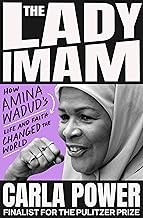
amina and I were colleagues from the mid-1990s through the mid-2000s at Virginia Commonwealth University, Richmond, Virginia, where she was a Professor of Islamic Studies. In this essay, I want to highlight some anecdotes from Carla’s book as well as offer some of my own reflections about amina. This essay is not intended to be a book review, but a tribute to someone who learned to navigate her life with grace in spite of myriad difficulties which included diagnoses of bipolar disorder and ADD/ADHD.
Notwithstanding the many words written and videos made about amina, she herself (in addition to chapters in books and essays) has written the following two books:
QUR’AN AND WOMAN REREADING THE SACRED TEXT FROM A WOMAN’S PERSPECTIVE, Oxford University Press 1999.
INSIDE THE GENDER JIHAD: WOMEN’S REFORM IN ISLAM, a book that demonstrates that “jihad” (to struggle) encompasses something well beyond the popular understanding of “holy war.” Oxford: Oneworld, 2006.
In the US, amina is probably most famous (infamous?) for leading Friday prayer at Cathedral of Saint John the Divine in Manhattan (2005). A progressive website—Muslim WakeUp!—announced the event “…as the first time a woman would lead mixed prayers since the days of the Prophet Muhammad: ‘It took us 1,400 years to do it again….’” Islamic jurists generally agree that a woman cannot lead men in public prayer. The Manhattan prayer service was dignified, not a spectacle, but the Muslim community in Richmond (and beyond) remained unimpressed—even scandalized.
The quest for justice looms large in amina’s oeuvre. As she led the mixed-gender prayer, she noted, “We, in the twenty- first century recognize this invisibility, this silence, this distortion where men get to tell us how to be women…and then get to mark upon themselves a stamp of divine legitimacy and authority.” She says, “Islam belongs to all of us, and we make it as we live it.”
amina’s concept of the “tawidic paradigm,” depicting Allah at the apex of a triangle, man in one bottom corner of the triangle, and woman in the other demonstrates her conviction that Islam insists on equality—no one human being has more value than another. Of course, “equality” doesn’t only refer to gender equality. Racism, classism, homophobia—all forms of discrimination—give more value to some humans than others. She won’t accept discrimination as God’s will.
amina was born Mary Teasley in Maryland to a Methodist minister and a young housewife. The family endured poverty and homelessness. She left her family at fourteen, living in a series of affluent white homes in the Northeast before attending the University of Pennsylvania. She studied comparative religion, found it valuable, but eventually embraced Islam, taking the shahadah (declaration of faith) on Thanksgiving Day 1972. Recalling her experience, she told me, “I fell fully and completely in love with the Qur’an with its message of justice.” However, it didn’t take long before she saw that in “lived Islam,” justice was far from realized—often skewed to fit the desires of those with power.
amina tapped into the strength of many “pioneers” such as Immanuel Kant, Martin Luther, and Harriet Tubman. She spoke often about one particular pioneer, Malcolm X (1925-1965), “who fused faith and social struggle and was much reviled by establishments for his clear-eyed callouts of abusive power structures.” According to scholar and novelist Michael Muhammad Knight (b. 1977), she shares with Malcolm the “courage to be hated,” having been called (among other things) a “soldier of Satan,” and a “devil in hijab.”
At an emotionally-charged conference in Toronto, Canada (2005), amina uttered the famous (infamous?) phrase, “I am a nigger and you will just have to put up with my blackness,” responding to someone who asked her to address internalized racism within the Muslim community. amina was well aware that non-Arab Muslims are frequently given second- or third-class status. She explained that when she’s wearing hijab, most Muslims do not consider her African-American, but South Asian. Without her hijab, they see her locks, know she is Black, and their attitude changes.
At this same conference, amina clearly stated she could no longer support some verses in the Qur’an and was compelled to say “No” to the Qur’an when she disagreed with certain things such as cutting off hands or beating one’s wife. (I’ve often wondered why we feel we need to turn ourselves into pretzels to protect a text’s integrity.) amina goes further, “It is the Qur’an that gives me the means to say no to the Qur’an.”
One attendee said, “When a white person converts to Islam, we try to make him the imam of the mosque. But when a Black woman converts to Islam, we expect her to run the mosque day care for children during Jum’a prayers.” Carla notes, “wadud’s contributions to Islamic thought and activism have been minimized for too long…she should be as famous as Malcolm X.”
When making her Hajj pilgrimage (Mecca), she experienced a vast difference between her reception in the kingdom and Malcolm’s account of his. “Where Malcolm, who’d been made an official state guest by the kingdom’s ruling prince…was met in Mecca by a chauffeur-driven car, amina arrived [alone] to face a scrum at an airport immigration window…she kept running into people enforcing patriarchal mores.”
“Where Malcolm found Islam’s sacred sites dissolved man-made hierarchies, amina felt the Saudi authorities often simply reinforced them.” Carla notes, “On seeing white Muslims amid the pilgrims of all races, he realized ‘we were truly all the same (brothers)—because their belief in one God [tawhid] had removed the ‘white’ from their attitude.’” Malcolm’s “full humanity” was framed as a brotherhood of men. amina’s 2005 mixed-gender prayer broadens that out. Michael Muhammad Knight said, “Malcolm observed Islam erasing racial hierarchy, making us all brothers; the Malcolm-in-Mecca moment that Amina Wadud gave us promised to destroy sexual hierarchy, making us all human.”
amina was fortunate to return to Mecca two years later on umrah—Islam’s smaller pilgrimage. She attended with queer Muslims and their allies and found the same spirit she experienced at Muslim LGBTQ+ retreats well aware that Saudi Arabia “deems homosexuality a crime that can carry the death penalty….” Amina adamantly said, “Allah does NOT look at your outer forms, even your sexuality.”
“How do you hold a moonbeam in your hand?” is a line from the classic musical, “The Sound of Music,” sung about Maria—a young woman who, instead of living her life in a convent, became a nanny (and eventual stepmother) to Von Trapp’s children. Like Maria, amina eludes being caught, held, or bound. Life, for amina, is movement where change is the only constant.
Interestingly, amina (for now) is settled in a place she calls Ruma Bulan (Moon House) in Yogyakarta, Indonesia, a home she shares with her long-time maid and friend Tenti. Carla tells us, “All amina’s life, she’s chased the moon around the world, traveling to see full moons, new moons, and eclipses….Now, in her own home, amina will sit on the terrace every night, watching the moon rise.”
I believe there are more chapters yet to unfold in amina’s life!
Carla continues, “Migration is the rhythm of amina’s life, a conscious placement of the self, affording wider vistas of the world and its Creator.” Aminah McCloud, professor emerita at DePaul University, noted that “amina’s is a disciplined, purposeful nomadism….She has always sought where thought is. She has always sought where justice is.”
I understand that nomadic pull.
[Moderator’s Note: amina wrote a number of posts for FAR in its founding days. You can find those posts here]
Discover more from Feminism and Religion
Subscribe to get the latest posts sent to your email.


Wonderful tribute Esther… Ah, here’s a question I need answer to….. “I’ve often wondered why we feel we need to turn ourselves into pretzels to protect a text’s integrity”. WHY do we? What are we afraid of? If we are awake we spend our lives changing – what works for one as a child does not necessarily work for an adult – Change is about Living our lives with awareness – I am open to shifting perspectives based on what has occurred in my life…I am NOT static, but evolving I hope!
LikeLiked by 1 person
Exactly right, Sara. amina, I do believe, grew to understand that change is constant and hence could say NO to the Qur’an without feeling she compromised her faith tradition by doing so. Of course, institutions are by their very nature averse to change, but of course eventually do change or die!
LikeLiked by 1 person
Thank you so much, Esther. I am inspired by amina’s life. What an honor that she graced these pages with her writing.
LikeLiked by 1 person
What a wonderful essay. amina is a remarkable person and clear sighted in her view of the world. You bring her to life highlighting some key points in her life.
The tension between expression and structure is an ever present reality in humans. Thank you to people like amina that don’t allow convention, tradition, and power structures to overwhelm thinking. My favorite quote from your tribute is when amina is quoted as saying, “It is the Qur’an that gives me the means to say no to the Qur’an.” Brilliant.
LikeLike
Yes, exactly! “Lived reality” and institutional dogma most often do not align. Many of us cannot tolerate that exposure. Human history (sadly) is filled with “getting even” (banishment, death, torture, etc.) to those who do not “get in line.”
Thank you for your very thoughtful comment.
LikeLike