

Today is Lammas Eve, the traditional time to celebrate the harvest. I invite you to reflect for a moment on the harvests of our lives and the gifts of the Mother Goddess, to feast on the rich images from our indigenous Old European ancestors
On Lammas (lit. ‘loaf-mass’) people shared bread baked from the first-cut grains. It is the cross-quarter day of deep summer, midway between summer solstice and autumn equinox. Although best known as a Celtic holiday, the astronomical calendar was closely calculated in other early cultures, including Bronze Age Crete. While we don’t know if ancient Cretans specifically honoured the exact day of Lammas/Lughnasad, they certainly celebrated the harvest with seasonal ceremonies honouring the Goddess and the grain.
The sophisticated culture known as ‘Minoan’ Crete (though this was not their true name) followed solar, lunar, and stellar rhythms. Helen Benigni describes how the Knossos temple complex aligns with constellations rising in the northeast, interpreted by priestess-astronomers “for the deities to appear to the people and guide them through each agricultural year.” Lucy Goodison shows how the ‘Throne Room’ of Knossos is precisely aligned to receive rays of the rising sun at the solstices and equinoxes.
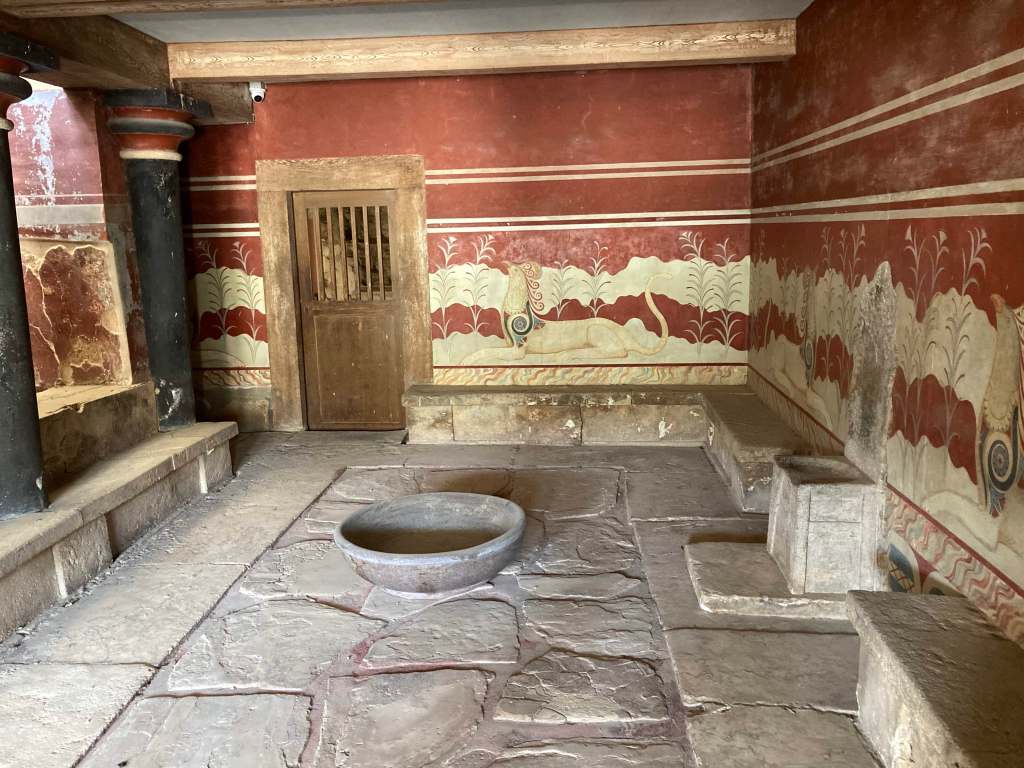
‘Throne Room’, Knossos, Crete. Photo: Laura Shannon
Knossos and other Minoan sacred centres are carefully sited in sacred landscapes, near hills, springs, caves, and cleft or horned mountain peaks representing the body of the Goddess. Earth, sun, moon, and stars thus shape ritual time and space, literally and metaphorically illuminating people’s own place in the sacred cycle of life, death, and regeneration.
The joyous art of this peaceful society shows women in roles of sacred and secular authority, and portrays a Goddess as their central deity, often connected with birds and snakes, often attended by priestesses. Minoan art, in contrast to that of the patriarchal Mycenean and Greek cultures which came later, does not glorify violence or war. Archaeomythologist Marija Gimbutas considered Crete to be the final flowering of the Old European Goddess civilizations, and the very last territory to succumb to the patriarchal Indo-European Kurgan tribes who brought an end to this peaceful world in the the 5th and 4th millennia BCE.
Minoan civilization began to develop when early Neolithic farmers came to Crete from Anatolia around 6300 BCE, bringing knowledge of agriculture, pottery, textiles, and domestication of animals. Over time, these Anatolian farmers (who shared DNA with the people of Çatalhöyük) blended with indigenous Cretans to create the extraordinary society which flourished from 3100-1450 BCE. In this era, people built sacred centres, created beautiful artworks, and produced abundant grain, oil, wine, wood, fruit, honey, textiles, and crafts of all kinds. They exported these with their extensive network of ships through trade routes they established all over the ancient Mediterranean world.
Their ritual centres or ‘palaces’, of which Knossos is the largest, feature multi-story architecture, plumbing and drainage systems, and numerous ceremonial spaces. The absence of defensive fortifications shows that they did not fear attack. Surrounded by fertile fields, these vast complexes served to store surplus produce, to be distributed in times of need. The life-giving grain, combined with their commitment to sharing resources, ensured the success of their civilization.
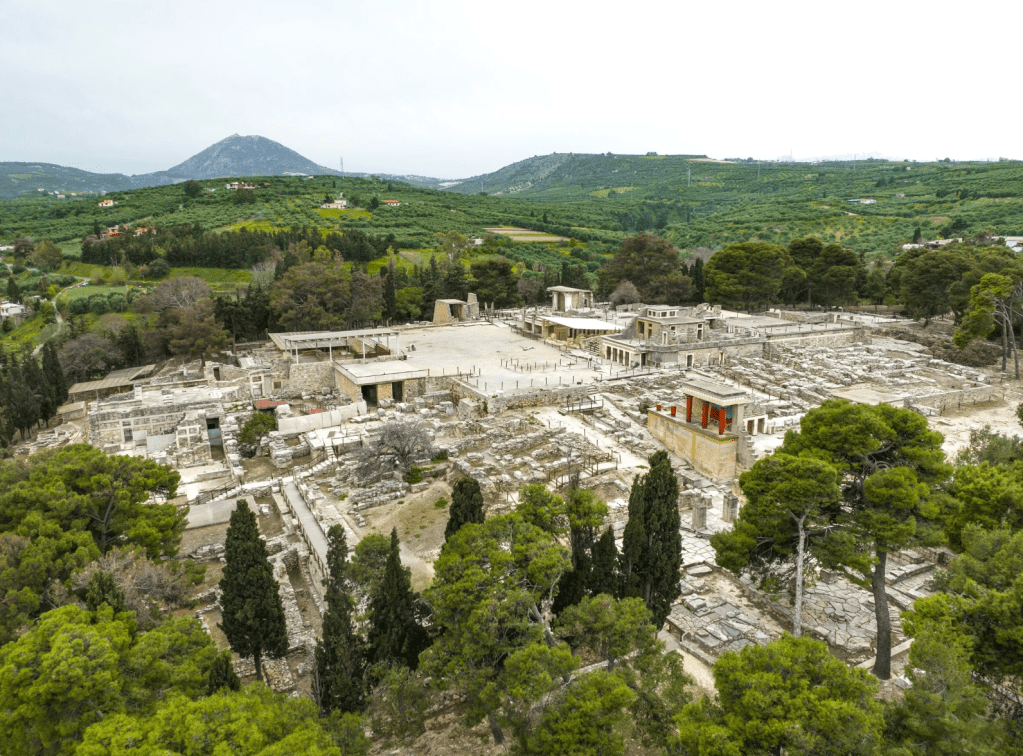
View of Knossos, looking south towards Mt. Juktas. Photo: discovercrete.com
The cooperative values evident in Minoan culture are characteristic of matriarchal and matrifocal societies, as Carol Christ explains, “At early stages of agriculture with land held by the maternal clan, they ensure equal distribution of goods through the practice of gift-giving; they have mechanisms to ensure that everyone’s voice is heard; and they tend to view the earth as a great and giving Mother.” In this way, spiritual and secular structures are deeply intertwined.
Joan Cichon presents compelling evidence for Bronze Age Crete as a matriarchal culture, as defined by Heide Goettner-Abendroth, i.e. not as a hierarchical mirror image of patriarchy, with women oppressing and men oppressed, but as an egalitarian society of peace. In Goettner-Abendroth’s words, “Matriarchies are mother-centered societies, they are based on maternal values: care-taking, nurturing, motherliness, which holds for everybody: for mothers and those who are not mothers, for women and men alike… [I]n matriarchies, mothering – which originates as a biological fact – is transformed into a cultural model.”
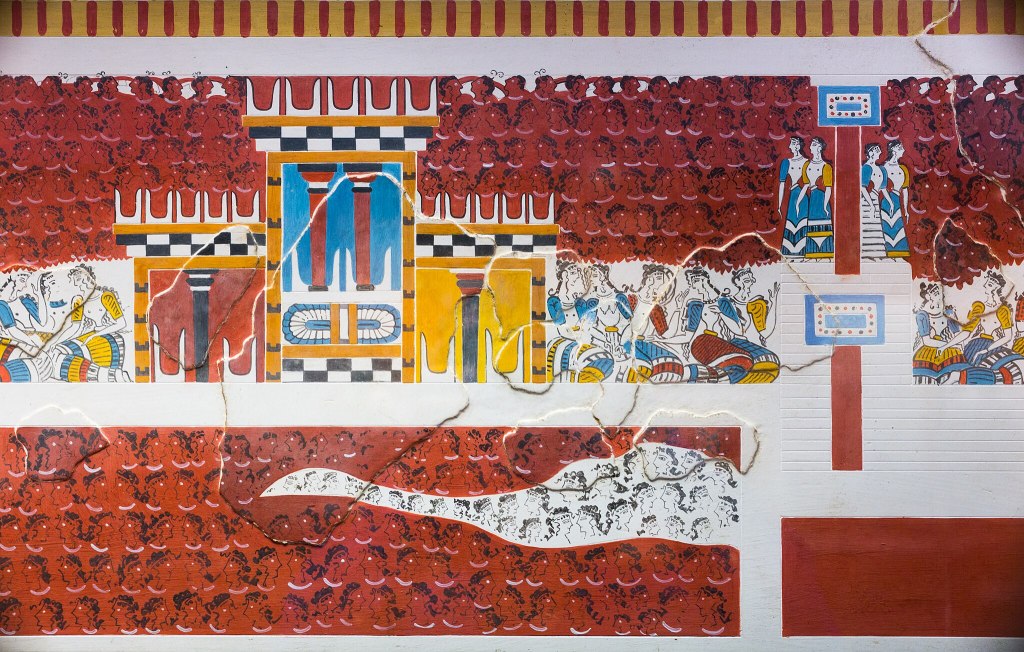
The model of caretaking is expressed in the central storage and communal distribution of resources including grain, and in the large open spaces for ceremonial gatherings and communal dance. The West Procession fresco at Knossos shows people carrying offerings of food and drink to a central female figure, a priestess or Goddess. We can imagine this evocative scene as part of a harvest festival, when the gifts of the earth are at their most abundant, crops have been brought in and those who work the land are free to gather.

West Procession Fresco from Knossos (restoration). Photo: Public domain
Neolithic agriculture was chiefly developed by women, in societies which saw parallels between the fertility of the Earth and that of human and animal mothers. The connection between women and the earth helped to shape people’s image of a female deity, and also to create an egalitarian society based on the mothering principle. Carol Christ explains:
“As discerners and guardians of the mysteries, women created rituals to celebrate the Source of Life and to pass the secrets of agriculture, pottery, and weaving down through the generations. The major rituals of the agricultural cycle involved blessing the seeds before planting, offering the first fruits of the harvest to the Goddess, and sharing the bounty of the harvest in communal feasts. These rituals establish that life is a gift of the Goddess and institute gift-giving as a cultural practice. As women controlled the secrets of agriculture, it makes sense that land was held by maternal clans, that kinship and inheritance passed through the maternal line, and that governance and decision-making for the group were in the hands of the elders of the maternal clan. In this context, the intelligence, love, and generosity of mothers and clan mothers would have been understood to reflect the intelligence, love, and generosity of the Goddess.”
This beautiful (if grainy) image, from an unidentified vintage postcard, shows a grandmother from Crete holding loaves from her oven, made from grain she planted, cultivated, harvested, threshed, stored, ground, and baked herself. Many older women on Crete still practice small-scale agriculture in sustainable ways, following Goddess-given practices which date back to Neolithic times.
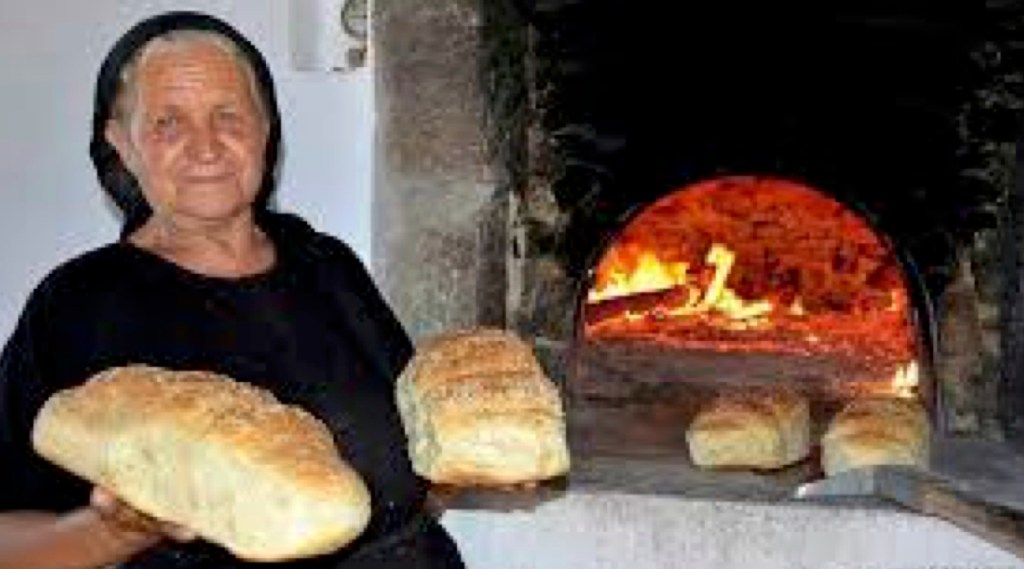
Grandmother from Crete holding fresh-baked loaves. Source: vintage postcard, public domain
Images like this, like the loaves themselves, offer nourishment on every level, and remind us that the earth-reverent wisdom of our indigenous European ancestors is not completely lost.
Indeed, there are many lessons we can glean. The wisdom of ancient Crete invites us to realign with seasonal cycles, to gather together in gratitude for Mother Earth’s many gifts, and to share what we have so there is enough for all. May this year’s harvest bring the blessing of the Goddess, to lead us through these troubled times and back towards a sustainable future.
References:
Helen Benigni (2007). The Goddess and the Bull: A Study in Minoan-Mycenaean Mythology. Chapter Two: The Astronomer Priestesses of the Bronze Age. University Press Of America.
Carol P. Christ (2020) “Women Invented Agriculture, Pottery, and Weaving and Created Neolithic Religion“. Feminism and Religion, 11 May.
Carol P. Christ (2019). “Crete, Religion and Culture” in Encyclopedia of Women in World Religions, Susan de-Gaia, ed. (Santa Barbara, CA: ABC-CLIO LLC).
Joan Cichon (2022). Matriarchy in Bronze Age Crete: A Perspective from Archaeomythology and Modern Matriarchal Studies. Archaeopress Archaeology.
Marija Gimbutas and Miriam Robbins Dexter (1999). “The Minoan Religion in Crete” in The Living Goddesses (131-150). Berkeley: University of California Press.
Marija Gimbutas (1989). The Language of the Goddess. San Francisco: Harper and Row.
Heide Goettner-Abendroth (2012). Matriarchal Societies: Studies on Indigenous Cultures across the Globe. New York: Peter Lang.
Lucy Goodison (2004). “From Tholos Tomb to Throne Room: Some considerations of Dawn Light and Directionality in Minoan Buildings“, in Knossos: Palace, City, State, edited by G. Cadogan, E. Hatzaki and A. Vasilakis, British School at Athens, 339–350.
Vincent Scully (2014). The Earth, the Temple, and the Gods: Greek Sacred Architecture. Trinity University Press.
Laura Shannon (2023). “Crete: Women’s Dance and Culture from the Depths of Time” in Neue Kreise Ziehen Fachzeitschrift für meditativen & sakralen Tanz (3-2023, pp. 25-29).
Discover more from Feminism and Religion
Subscribe to get the latest posts sent to your email.


“May this year’s harvest bring the blessing of the Goddess, to lead us through these troubled times and back towards a sustainable future.” Thank you for this, Laura.
LikeLike
Nice article – great pictures -This Turning is an auspicious one because the sun is on the wane and the Goddess has gone into the Grain that will feed the people…. Indigenous peoples of the Americas continue to celebrate this turning as the Corn Mothers offer their gifts of the first harvest to all…the first of two – the second is at the equinox… As far as I know every culture has a tradition that celebrates this time of Abundance.
LikeLike
I should also add that in the southern hemisphere the opposite occurs… we have a tendency to forget!
LikeLike
Yes. Glenys Livingstone sends out a wonderful newsletter throughout the Wheel of Year, always talking about both southern and northern hemispheres. It’s good to remember that as one pole turns towards the sun, the other pole turns away.
LikeLiked by 1 person
I live and breathe for this ancient civilization! And try to keep it in the forefront of my mind, body and spirit, that things were NOT ALWAYS the way they are now. Thank you to this grand civilization some call Ariadnean, for inspiring us even to this day. Praise the ancestors, centered on the sacredness of women, that are watching over us now.
LikeLike
Very nice Laura!
LikeLike
Thank you for your beautifully written article, Laura. It describes perfectly the civilization that was Bronze Age Crete politically, socially, economically, and spiritually. Your article highlights very clearly “the many lessons we can glean” from this last outpost of Old Europe.
LikeLike
It is a great time of year to honor the inception and innovations of women in horticulture and agriculture. I love the connection you have made Laura; the West Procession Fresco captures this beautifully, showing women and men celebrating in peaceful partnership, sharing gifts of nourishment and music with an honored Priestess or Goddess.
In our women’s circle, we look at Lammas as a sacred time of reflection. It is a moment to look back at how far we have come, gather the wisdom gained from our challenges, and honor the growth we have achieved. Yet, it is also a fragile season of uncertainty, a time when we wonder if all the work we have put in will produce the outcomes we had hoped for. It is a time to pause, breathe, and appreciate the abundant gifts of the Goddess.
LikeLike
Thank you for this thoughtful article, Laura. It stirs in me the contemplation of societies where aggression is not part of the fabric. It makes me wonder what is possible if there is such trust and concern for all that fortifications are not needed. Where honoring the Earth is part of the culture like indigenous ways of being in the world. We have much to learn.
LikeLike
What a beautiful overview of this crucially important knowledge that is so shockingly absent from most of our current cultural discourse! Thank you for sharing this, dear Laura!
LikeLike