The good vs the better by Oxana Poberejnaia

oxanaToday let’s talk about the relationship between the Ultimate and the relative. I do not have the answers to these tricky questions, I would just like to outline the problems. Why, on the Buddhist path, do I often tell myself and others not to rush to get Enlightened immediately? Why do I often keep silent about my friends’ attitudes that I find not so feminist?

There is an old platitude that the theme of the Soviet films about social problems was the “struggle of the good against the better.” This was the case because in the USSR there supposedly was no class struggle and no problems proceeding from the rule of the Communist Party. So in the scripts the conflict was set up between good Soviet people and even better Soviet people, the latter even more dedicated to the Communist ideals.

The fact that I am a feminist and follow a Buddhist path must mean that in principle I am all for “the better” and even, “the best” – that is, a social world where women and men enjoy equal rights and everyone is enlightened.

Continue reading “The good vs the better by Oxana Poberejnaia”

Remember by John Erickson

Remember the loss, because we’re going to need it for the tomorrows to come and for those that need our protection the most: the next generation. Remember, we are Orlando; now, tomorrow, and always.

WEHO CA (June 7, 2015)©2015 Rebecca Dru Photography All Rights Reserved http://www.rebeccadru.com

I want to tell you a short story about the small town of Ripon, WI. On May 19, the local newspaper, The Ripon Commonwealth, which has served as the town’s paper since 1864, published a story regarding the political right’s uproar concerning President Barack Obama’s executive order that all public schools must allow transgender individuals to use the bathroom which matches that of their gender identity. Angry and upset, the paper’s education reporter wrote an article expressing his clear disdain for the President and also expressing a clear lack of empathy, understanding and sheer bigotry towards the transgender community.

Growing up in Ripon, I always read the paper when it came out on Wednesday evenings. Those of you who grew up in a small town can attest to the luxury of seeing friends, family members, and even the smallest ongoings in one’s town in print for the entire town to see and talk about. However, one thing I never saw in the paper was the clear hate I read in Mr. Becker’s article (the author of said piece). Enraged, I immediately asked myself: what can I do? Having connections back in Wisconsin, I immediately turned to friends who owned businesses, a friend who is the Director of a vocal and important group in the town, and community organizations and friends to begin to write letters. Continue reading “Remember by John Erickson”

Goddess Politics and the Cauldron of Memory by Kavita Maya

KavitaMaya‘Someone needs to gather the stories, to keep the cauldron,’ said the late Goddess feminist artist Lydia Ruyle during one of the last times we spoke, at the 2014 Glastonbury Goddess Conference. I had hinted at my concerns around conducting doctoral research in the presence of ongoing conflict within the Glastonbury Goddess community (especially when my broadly-stated site of interest is ‘politics’), and in reply she had stressed the need to ‘hold space’ for the different voices and perspectives in the UK Goddess movement, and that conflict would be inevitable. ‘There needs to be a weaver,’ she said.

The following day I recorded an interview with Lydia and some of her friends at Café Galatea on the High Street, which she had been keen to ensure since the previous summer—with poignant foresight, given her death in March 2016. I’m not sure if she was expecting that I should fully take on the role of this ‘weaver’—there are more stories than one PhD thesis can claim to encompass—but the theme is present in my writing. Her words lead me to reflect on the weaving together of politics with memory and storytelling, and on the need to honour the plural histories of the British Goddess movement. Continue reading “Goddess Politics and the Cauldron of Memory by Kavita Maya”

The Tension of Opposites: Love, Chaos, & the Wild Vortex by Chris Ash

“Perhaps it shouldn’t be surprising that a high tolerance for ambiguity, ambivalence, and a tendency to think in opposites are characteristics researchers have found common among creative people in many different fields. But professional creators… come to understand that in order to be creative, they need to give themselves to sensations of ‘knowing but not knowing,’ inadequacy, uncertainty, awkwardness, awe, joy, horror, being out of control, and appreciating the nonlinear, metamorphosing features of reality and their own thought processes — the many faces of creative chaos.”

– John Briggs and F. David Peat, Seven Life Lessons of Chaos

Christy CroftAs someone whose interfaith, nature-based spirituality regularly draws inspiration from science, I experienced my recent read of the book Seven Life Lessons of Chaos as both an affirmation and a challenge. Throughout the book, one theme emerged over and over, each time in a different context: the creative impulse – that which generates nature and space, planets and stars, love and rage – emerges from within the tension of opposites.

Creation doesn’t burst forth from one opposite overtaking another, but rather as the direct outcome of the unending push-pull swirl of outward and inward, boldness and fear, light and dark. Living in creative authenticity regularly leaves me stewing in a mix of often-contradictory feelings, and while it’s easy for me to revel in my confidence when I’m feeling bold or in my wordy wit when I’m feeling brilliant, it’s far more difficult for me to sit with wonder in times when I feel rejected, unlovable, unaccomplished, insecure, or ugly. My inner dialogue frequently finds me alternating between the opposites that pull at my heart, mind, and way of being in the world.

Really, this is where many of us often find ourselves – be smart but not too intelligent, be beautiful but not vain, be sexy but not sexual. Madonna-whore, virgin-slut – choose a side, but know that once you do you will be judged. We are asked to choose between equally restrictive and caricatured forms that have been pre-fabricated for us by years of cultural control and legal oppression – forms that emphasize who we are in relationship to others, to men, and to our religious laws, rather than honoring who we are to ourselves, to our gods, and in our chaotic brilliance. Continue reading “The Tension of Opposites: Love, Chaos, & the Wild Vortex by Chris Ash”

(((Israel))) by Ivy Helman

me hugging treeThe BBC just ran a story about white supremacist and neo-Nazi groups targeting Jews by signaling each other to their presence on various social media sites through the use of (((this symbol))).  Of course, this is all based on the assumption that a “typically” Jewish last name signifies the bearer is also Jewish.  Through a Google app (since removed) that could recognize patterns such as ((())), these Jewish people began to receive anti-Semitic comments.  There has been a general outcry of disgust among Jews and other minority groups as to the problematic targeting of Jews in this fashion.

The same cannot be said about the BDS movement and people’s willingness to call it out for what it is.  This to me is hypocritical!  According to its website, the BDS movement, or Boycott, Divestment and Sanctions, seeks to end what it understands to be the colonialism, apartheid and oppression of Palestinians in Israel through various financial, commercial and international means.  It accuses Israel of human rights violations, genocide, ethnic cleansing and other war crimes as well as illegal occupation (of the Palestinian lands, not just the occupied territories). Continue reading “(((Israel))) by Ivy Helman”

Garden of Eden Retold by Trelawney Grenfell-Muir

Trelawney bio picture

Today, I came up with a less patriarchal Garden of Eden story:

Endelyn (age 7): “When I think of my soul, in my name “fire-soul,” I think of a powerful wind.”

Me: “That makes sense, since one of the names in the Bible for God/ess is Ruach, which means “breath” or “wind”, but we call it the Holy Spirit. God/ess is also symbolized by the other elements: fire, air, and earth – like when she shaped Eve and Adam out of clay.”

Endelyn, “What? I don’t remember that story.”

Me: “Oh, ok, I’ll tell you.” ……

Here’s the part where I froze momentarily, thinking “how can I tell my children that misogynist failed mentor story? how? how?” <deep breath>
Continue reading “Garden of Eden Retold by Trelawney Grenfell-Muir”

What Traci West Taught Me about Dominant and Excluded Voices by Elise M. Edwards

Elise EdwardsIn my previous post, I mentioned a book I am writing about how theological and ethical considerations in architectural design can define good architecture.  In that post and in ones to follow, I am acknowledging the feminists and womanists and mujeristas who have influenced me while also opening up the dialogue to the feminists in this community who continue to inspire and guide me to do my best work.

But today, instead of talking about creativity or architecture, I want to discuss how I arrived at the conviction that community decisions about how we ought to live—whether those are decisions about laws, institutional policies, religious practices or architectural buildings—need to include the voices of the diverse people they directly and indirectly influence. Continue reading “What Traci West Taught Me about Dominant and Excluded Voices by Elise M. Edwards”

Facing the Moon Alone by Molly Remer

February 2016 030

“When all is said and done I think every Witch should, at some time, face the moon alone, feet planted on the ground, with only his or her voice chanting in the starry night.”

–Laurie Cabot, Power of the Witch

I will never forget the first time I heard someone recite the Charge of the Goddess from memory. Bare-breasted, she strode around the fire in sacred circle at a large goddess festival in Kansas, delivering the words with power, grace, and confident resonance. I thought: I will do that someday.

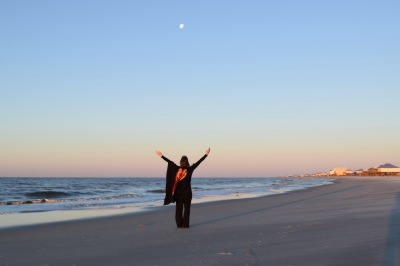
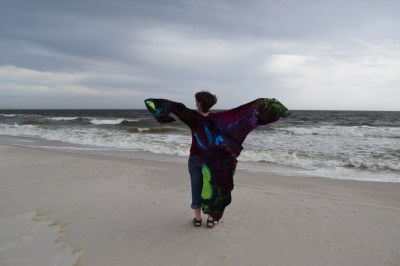
In February of this year, we took a family trip to Dauphin Island. While there, the afternoon of the full moon, I February 2016 148
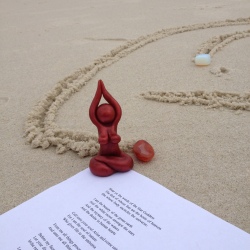
decided that the time had come. I was going to memorize the Charge of the Goddess. First, I thought I would only memorize it a piece at a time. It seemed “too big” to do in a single sitting. I had it printed out on a piece of paper that rapidly became damp with the salty sea air. I drew a labyrinth in the sand with my toes, set one of my goddess sculptures at its entrance, and drew a Womanrunes card.

One stanza at a time, slowly I began to repeat the poem* aloud:

hear ye, the words of the star goddess
the dust of whose feet are the hosts of heaven..
.

Over and over, I said the words, letting them twine around my tongue and in the air, experimenting with cadence and rhythm. After I could reliably repeat one section, I’d move to the next, letting it build in my memory until I could put the two together confidently and then moving to the next.

I am the beauty of the green earth
the white moon amongst the stars..

I stared into the waves, listening to them rise and fall along with my words. My three older children dug in the sand. February 2016 073
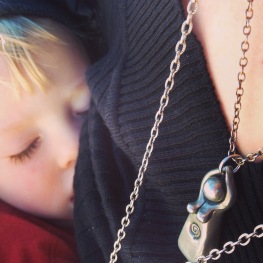
My husband fished. My toddler toddled around and then came to sit on my lap and nursed to sleep for nap time:

before my face
beloved of all…

I whispered into his damp hair. I felt in an altered state of consciousness. The words began to wind their way through me, becoming a part of me, embedded in me. I danced with them as I have never danced with another piece of writing. I felt them merging with me. I sang them aloud. I stated them fast and slow and I built, adding the next line and then the next…

for behold, all acts of love and pleasure
all my rituals.

I turned over hard thealogical questions as the words spun their magic through the air. What does it really mean that “all your learning and seeking shall avail you not, lest your know the mystery.” Do I really feel the goddess within? Do I find her within myself or is she only outside and if she is only outside, does she really exist at all? Tears came to my eyes: do I even like myself?

Two hours passed. My baby awoke and returned to digging in the sand. My husband packed up his fishing gear. The sky began to darken and spit rain. I stood and danced the words into the sand with my feet.

let your divine innermost self
be enfolded
in the rapture
of the infinite

I felt rapturous. I felt triumphant. I had done it. Faster and faster my feet stamped the sand as I called the words into the waves. I spun in circles with my toddler chanting and laughing and offering my devotion before the sea, beneath the moon.

the mystery of the waters
the desire in human hearts…
February 2016 179

*I used Shekhinah Mountainwater’s adaptation of the Charge, originally by Doreen Valiente, as included in the book Ariadne’s ThreadMolly 180

Molly has been “gathering the women” to circle, sing, celebrate, and share since 2008. She plans and facilitates women’s circles, seasonal retreats and rituals, mother-daughter circles, family ceremonies, and red tent circles in rural Missouri and teaches online courses in Red Tent facilitation and Practical Priestessing. She is a priestess who holds MSW and M.Div degrees and recently finished her dissertation about contemporary priestessing in the U.S. Molly and her husband Mark co-create original goddess sculptures, ceremony kits, and jewelry at Brigid’s Grove. Molly is the author of Womanrunes, Earthprayer, and The Red Tent Resource Kit. She writes about thealogy, nature, practical priestessing, and the goddess at her Woodspriestess blog. 

Parenting with the ‘Same Words’ by Sara Frykenberg

Teaching and talking with my daughter, I find myself revisiting the subtle and not so subtle kyriarchial language in my own upbringing in ways that I do not when speaking to other adults with my very intentional and well-trained adult language. Parenting sometimes feels like a trip back in time where I remember and more readily feel my joy of singing particular songs or reading particular stories, simultaneously feeling my inner feminist and adult self cringe at the messages in too many of these stories.

Sara FrykenbergLast month I shared a lesson a student of mine taught me about subjugated knowledge and the colonized mind. This month, I would like to continue in a similar grain and consider how we share the practice of oppression through language, and particularly, as we teach language to our children. Working to counter kyriarchy in my parenting, I often find myself asking, what I am really saying, reading, or singing to my daughter?

I walk with my daughter almost every morning, and as new parents are often encouraged to do, I try to talk to her continuously about a variety of topics. While I do talk to Hazel about meaningful things, like my hopes for her, stories about her family, the joys of reading, etc.; most days my monologues are inspired by whatever we happen to walk by at the moment.

One morning we talked about the differences between fences, gates and walls, their purposes, and the different materials from which they are constructed—I was really reaching on this day. We repeatedly talk about the flora and fauna. I have discovered that there is what feels like an inordinate number of avocado trees in the say, six square blocks surrounding our apartment. How do the people who live here eat all of these avocados? Do they eat them? Do they let them rot on the tree? This seems like a terrible waste of avocados, though there is one home with a bin in the front yard with a sign that says “free avocados,” in which the homeowners leave the fruit for neighbors and passers by like Hazel and myself.

This may seem silly and often, the discussions are silly, but taking to heart what I have learned from liberative feminists, post colonial scholars, and semiotics, I also critically observe how and what I say. One day, trying to make it fun to point out different plants and bushes, I pretended to be an announcer for kind of a nature show. Somewhere in-between introducing the “the deadly oleander,” and “a lovely variety of cacti,” it occurred to me that I was actually engaging in a kind of trope for a travel narrative. It wasn’t that I was saying anything particularly oppressive or colonial; rather, I realized my tone, my ‘how,’ came from the stories of my own youth—it was a kind of cross between stories related to  “Dr. Livingston, I presume,” and Crocodile Dundee. Continue reading “Parenting with the ‘Same Words’ by Sara Frykenberg”

Who’s to Blame for Patriarchy? by Vanessa Rivera de la Fuente

Vanessa Rivera de la FuenteA 16 year old girl was drugged and then gang raped by 33 men in Brazil. The police arrested the boyfriend as a suspect. A 30-second video recording the suffering of the girl was uploaded to social networks, as a display of the “omnipotent” power of patriarchy on women’s bodies; a power that not only destroys wombs or bladders but also unbearably wounds the soul.

A woman was attacked in Chile by her ex-husband. Her name is Nabila. He raped her and then ripped out her eyes, in a jealous rage, because she attended a party. Months after they broke up, she dared to have fun without him.

Each day the body of a murdered woman appears somewhere in Latin America. They appear in the middle of the road, in garbage dumps, wrapped in plastic bags, among the woods or on the shore, cut into pieces, impaled with brooms, burned with acid. And as outrage grows, so violence rages with women.

Who’s to blame for Patriarchy? Continue reading “Who’s to Blame for Patriarchy? by Vanessa Rivera de la Fuente”