

Perhaps we all are standing on the borderlands – left standing in the debris of our consumptive and violent past, walking toward a future we cannot see but can feel in every cell of our bodies as this global fever is creating a world on fire that is reaching each one of us. How do we find our way home? What will it take to change us and, in so doing, change society?
-Terry Tempest Williams
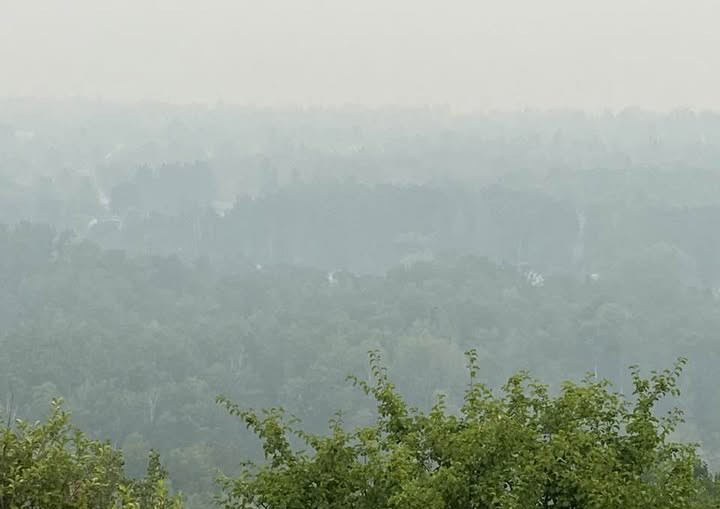
We awoke Wednesday morning to thick, thick smoke. It looked like the more typical fog that often engulfs us in the early morning, but the faint whiff of smoke even inside with windows closed was unmistakable. One step outside and the smoke was overwhelming – like sitting next to a large campfire with the wind blowing the smoke in my direction. As I was starting to cough, I put the baby in his highchair and headed to the basement to get the air purifier. As soon as I plugged it in the indicator light turned red, meaning very dirty air. Fortunately, it quickly cleared the air, but any time we opened a door the light immediately turned purple.
At the moment, in this land of clean water and clear skies, we are experiencing some of the worst air quality anywhere in the world. In the past few days, the Air Quality Index (AQI) on my EPA app has registered over 1100, far higher than the threshold for “Hazardous” air, which is 301. The entire east coast and Midwest have been under air quality alerts from the fires in Canada, but where I live — Duluth, Minnesota — has had the worst air from the fires just a hundred miles to our north. Oddly, the air here is actually worse than in the towns that have been evacuated due to the fires. It’s the worst air ever experienced here. Even inside, the air purifiers are struggling to keep up.

Knowing what the AQI actually measures makes this smoke much scarier. Wildfire smoke is filled with pollutants – carbon monoxide, methane, VOCs, bacteria and fungi – but the main concern is the fine particulate matter. The number on the AQI is of the finest particulate matter from wildfires — smaller than a grain of sand and 30 times smaller in diameter than a human hair (see illustration) – that can infiltrate the lungs and bloodstream, causing inflammation and damage to internal organs. It can cause permanent damage to the lungs, heart attack, and stroke.
According to the Minnesota Pollution Control Agency, with this level of pollution everyone should stay indoors, assuming one’s house is sufficiently sealed to keep out all the smoke. But what of all of those who are unable to go indoors, those who have no shelter, or work outdoors – the park rangers, construction workers, road crews, gardeners and landscapers, farmers and farm stand workers, camp counselors, not to mention fire fighters.
Our poor pups, who after days of temperatures so high they couldn’t get out for a walk, are now even more housebound because the air is not safe for them to breathe, and I can’t give them an N95 mask. And what of all the wild animals? Where are they supposed to go? The smoke is especially hazardous for infants, so what of the baby foxes, deer, and rabbits, the veeries, robins, and sapsuckers? What will happen to their tiny, fragile lungs? They are all the innocent victims of the damage we are doing to the planet, for the forests are burning due to human-caused climate change.
This makes the latest move by Republican Congressmen especially infuriating. Four Republican Congressmen from Michigan have once again written a letter to the Canadian government blaming them for the smoke in Michigan, saying, “American lungs are paying the price for Canadian inaction.” This despite the fact that the real culprit is Republican policies encouraging continued drilling for fossil fuels and rolling back the Biden administration’s investment in renewable energy sources. If anyone is responsible here, it is Republicans and especially the current administration which has done everything in its power to promote climate change.
We can take action to slow its spread, stop it even, reverse it maybe. The contributors to Not Too Late: Changing the Climate Story from Despair to Possibility and What If We Get It Right?: Visions of Climate Futures inspire me with possibility, ways we can get it right, but we do need people who care in political office, corporate offices, the military, to make sweeping policy changes and actions, and the past two years have been increasingly unbearable for that reason. “Where there’s a will, there’s a way,” the saying goes. Well, we have the ways. We just need the will. I applaud the efforts of those communities taking the necessary steps not just to adapt to climate change – for that’s what we’re being told to do – but to do what they can to avert it – New York putting a moratorium on AI data centers, San Franciso that gets 90% of its energy from renewables, the indigenous communities investing in solar energy, the entire country of Iceland that fuels 100% of its energy needs with renewable largely from its vast supply of geothermal energy.
A few years ago, Duluth was being touted as a climate refuge city and a growing number residents from California and Colorado began arriving to escape what had become long annual fire seasons there. A refuge it is no more. We can’t evade climate change by changing geographical locations. For some the crisis manifests in fire, for others it is floods, or massive hurricanes, or tornadoes, rising sea levels, melting glaciers, drought, inescapable heat, or blistering cold. It is planetary. I sometimes think that’s something those who continue to act as if we’re not in an emergency don’t get. We can’t outrun it or buy our way out of it. We are destroying our one precious home and it affects everyone – some more than others to be sure. Wealth and certain locations do provide a bit of a buffer, but fire and flood, wind and wild weather happen everywhere.
When I looked out the window that morning, all I could think of is that we are living in Octavia Butler’s dystopia, Parable of the Sower, with fires and smoke surrounding us. Referring to the myth of the phoenix, Butler wrote, “In order to rise from its own ashes a phoenix first must burn.” Is that what we are now, a phoenix burning? Is this what it will take for us to die to our old consumptive ways and change course? And will we rise from these ashes?
Sources
Butler, Octavia. Parable of the Sower. New York: Grand Central Publishing, 2019.
Johnson, Ayana Elizabeth. What If We Get It Right?: Visions of Climate Futures. New York: One World, Penguin Random House, 2024.
Republicans blast Canada over wildfire smoke, air quality in northern U.S. | CBC News
Solnit, Rebecca & Thelma Young Lutunatabua. Not Too Late: Changing the Climate Story from Despair to Possibility. Chicago: Haymarket Books, 2023.
What Does Air Quality Mean? AQI Levels Explained – ScienceInsights
Williams, Terry Tempest. The Glorians: Visitations from the Holy Ordinary. New York: Grove Press, 2026.
Discover more from Feminism and Religion
Subscribe to get the latest posts sent to your email.


