


The other day my partner, her mother, and I visited one of the family gravesites. We go together all three of us, or just sometimes my partner and I, at least two times a year. My partner’s mother certainly goes more often, especially to the gravesites in Prague. I have noticed that Christians, Jews, Buddhists, Muslims, and the non-religious alike are all often buried in one cemetery, although it is sometimes divided into sections to accommodate some religious beliefs; that seems to be the case in many places throughout the country.
It is typical to visit the cemetery on Dušičky, or All Souls’ Day, and most Czechs, regardless of religious background, participate in the tradition. While this is a common time to visit, it is very typical to see Czechs in cemeteries tending to gravesites throughout the year. This involves cleaning them, washing the gravestones, removing spent flowers and offerings, adding new ones, and lighting candles in remembrance. Cemeteries in the Czech Republic are busy, colorful, peaceful places on account of this. My partner’s family will also offer prayers after finishing the ritual, but I am not sure if this is common as I only ever go with them.
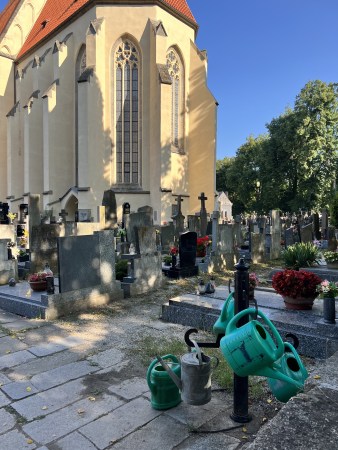
About this gravesite in particular, it is located in Southern Bohemia, and there are three family names associated with it, none of which actually currently belong to us. People in the Czech Republic are often cremated and their ashes deposited in with their other cremated ancestors. No first names are added to the tombstone, although there are places where people have individual graves. The cemetery at Vyšehrad is one of those places, where actors and actresses of the national theater and other notable members of Czech history and society have been buried, although even in the cemetery we visit there are also a number of individual graves.
This visit and participating in the ritual has renewed in me the reflections that I have been having recently about ancestors and traditions. One aspect of my thoughts has Jewish connotations and, I suppose, consequences: the inheritance of Judaism through the maternal line. The other one has to do with luck and gratitude. We will come to that one shortly.
The matrilineal descent of Judaism, while it seems to align with valuing women and mothers, can cause real damage. Even within the same immediate family, a Jewish son could marry a non-Jewish woman and their children would not be consider to be Jewish by some Jews, whereas the Jewish daughter’s children are. If the wife of the son converts with a non-Orthodox rabbi, there are again some Jews who would still not consider these children Jewish. Why is this? We are such a small people. Why are we not more accepting?
This exact situation happens more than one would think. I knew someone, who had Jewish cousins on account of her aunt being Jewish, but according to halakhah, she was not Jewish since her mother was not. She even, at one point, considered being a rabbi (and she would have been a brilliant one), but her lack of status and the lengthy process of conversion alienated her from that choice. I know that some people say conversion for these patrilineal Jews is often relatively simple, but why is it even necessary? It is hard enough being Jewish in this world, why are we, Jews, making it harder on each other?
Being born Jewish is a matter of luck, and some Jews look down on other Jews because of it. This should not be the case if there exists any attachment at all within the individual to their Jewishness, and perhaps even if not. Halakhic Jews can consider themselves cultural Jews and still count as Jewish, why can’t these ‘almost’ Jews also count without having to prove their commitment? We cannot judge their hearts and if the doors stood just a little more open, the Jewish people would only be more rich for it.
This whole discussion of birth and Jewish status has inspired within me reflections on the nature of birth itself. Our lives are the culmination of our ancestors. If even one of them had had a different partner, we, as individuals, would not be alive. Other individuals would be; we have the opportunity now to live the lives that they don’t get to. I am immensely grateful for this and not in the way in which grateful has been thrown around lately. I mean it with all of my heart and all of my soul. How lucky am I that I get to experience this glorious world!
Before you jump to the conclusion to strip away individual’s access to abortions or force parenthood – that is not at all what I mean. What I am suggesting is that if just one of my great-great-great-great grandparents had chosen a different partner, I would not be here. Likewise, if my mother had made a different choice, I would not be here. Think of the sheer number of people involved to bring one individual to life! Think also of the sheer impact to this day of one decision made ages ago.
Yet, before we get too lost in this, it is important to remember that these choices are social and shaped by patriarchy: the farmer needed more children to help at the farm; the slave master did too; a young girl did not feel like she had the power to decline an arranged match; the educated, but poor rabbi wanted a financially well-off spouse; and a girl had a child on account of her father’s horrible decision to rape her. We are the children of all of this. I am not trying to romanticise the process of how we got here. I know that for some people this process has been very painful and the trauma they carry may be generations old or just as likely began with their birth.
What I am trying to say is: I am grateful for the life that I get to live, and that gratefulness, for me, translates into pursuing justice. I can think of two places where I think we should start. As a Jew, we should recognise without added steps the Jewishness of patrilineal Jews (which only some Jewish communities do). As an ecofeminist, we must care for the earth. We owe it to our ancestors to make the world a better place. What would you add?
Discover more from Feminism and Religion
Subscribe to get the latest posts sent to your email.


Thought provoking post…..I am not Jewish but I feel the same way.”What I am trying to say is: I am grateful for the life that I get to live, and that gratefulness, for me, translates into pursuing justice” I would add love to this mix.
LikeLike
Yes, I agree Sara. Thank you for the comment.
LikeLike
I Thanks, Ivy, for this.
I went to visit my husband’s grave in the local Jewish cemetery with an Italian friend a few years ago. She said “I’ll bring the picnic”. That startled me; although I knew the customs of the Day of the Dead, sharing food at a Jewish cemetery had never occurred to me. I have learned since that it is not unusual in some places.
My mother was Jewish and my father was not. My grandparents were completely secular. My husband’s family were Orthodox Jews, so when we decided to get married we went to a local Orthodox rabbi. It was 1970, when long-distance calls were expensive and rare. The rabbi said he had to consult with his colleagues in New York whether I was Jewish enough for him to perform my wedding. I was offended (as I said, my mother was born of Jewish parents), and found a different rabbi for the ceremony.
I vaguely remember a story by a man who attributed his particular collection of genes to the fact that his parents were interrupted when his mother reminded his father to wind the clock. I have not been able to track it down; Google AI wants more details. Does anyone recognize this?
LikeLike
Hi Judith, thanks for the comment. Your story sounds very similar to many I have heard. I’m sorry that you had to experience that. In terms of your question, I am not sure which story you mean. Could it be something by Sholem Aleichem?
LikeLike
Thanks, Ivy. I don’t think it’s a Jewish story. Perhaps late 19th century?
LikeLike
Hi Judith, thanks for the comment. Your story sounds very similar to many I have heard. I’m sorry that you had to experience that. In terms of your question, I am not sure which story you mean. Could it be something by Sholem Aleichem?
LikeLike