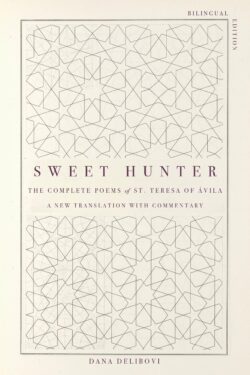
Book Review by Kristen Holt-Browning: Sweet Hunter: The Complete Poems of St. Theresa of Ávila (Bilingual Edition), translated and with commentary by Dana Delibovi

The Catholic mystic women of the medieval and early modern era—such as Hildegard of Bingen, Julian of Norwich, and Theresa of Ávila—can seem unknowable to us now. How did they nurture their fiery love of Christ within the rigid patriarchal (indeed, misogynistic) structure of medieval and early modern European Christianity? How did they find the strength and bravery to write about Jesus as husband, mother, lover? The writing of these mystic women can strike us even now as shocking, given that they often described Christ as their husband, their lover, or even their mother.

In Sweet Hunter: The Complete Poems of St. Theresa of Ávila (Bilingual Edition), poet and professor Dana Delibovi gives us the words of the sixteenth-century proto-feminist in a timbre close enough to our own to help close this gap. As Delibovi notes in her perceptive and illuminating Introduction, she centers Theresa’s balance of the mystical and the practical in her translations. Indeed, Delibovi admits that, “I had to fight the temptation to pretty-up her words and make them seem, well, more saintly.” And yet, it is this precisely this direct language that, paradoxically, heightens the divine fervor behind the writing, as when a shepherd speaks of Mary in “It’s Dawn Already”:

Continue reading “Book Review by Kristen Holt-Browning: Sweet Hunter: The Complete Poems of St. Theresa of Ávila (Bilingual Edition), translated and with commentary by Dana Delibovi”

An Incantation for 2024, USA by Marie Cartier

-please repeat and/or use in ritual, if needed

There was a time (there was a time)

We were waiting for something (we were waiting for something)

We were wanting something (we were wanting something)

We needed it to be different (we needed it to be different)

We were. We are. We are here: this is it.

We want something. We want something. We need something. We need something.

There was a time when we could make something happen.

Continue reading “An Incantation for 2024, USA by Marie Cartier”

REMEMBERING THE MAGIC OF MAMA DONNA HENES: 1945-2024 by Diane Saarinen

For those who don’t know who Donna Henes was, her official bio:

Donna Henes is an internationally renowned urban shaman, spiritual teacher, award-winning author, popular speaker and workshop leader whose joyful celebrations of celestial events have introduced ancient traditional rituals and contemporary ceremonies to millions since 1972. More at her Wikipedia page here.

Donna, known affectionately to many as Mama Donna, was so in tune with the seasons (even putting out a quarterly publication for a time called Always in Season), that when her time came to leave this sparkling, stunning incarnation of hers, she left on Autumn Equinox Eve 2024, just two days after her 79th birthday.

Sad news to those she left behind and sad news to the planet. But as we approach Samhain, Halloween and Day of the Dead, what wonderful memories my friend Donna Henes left me with! And “what is remembered, lives.”  So live on, Mama Donna!

                                                                                      *******

Continue reading “REMEMBERING THE MAGIC OF MAMA DONNA HENES: 1945-2024 by Diane Saarinen”

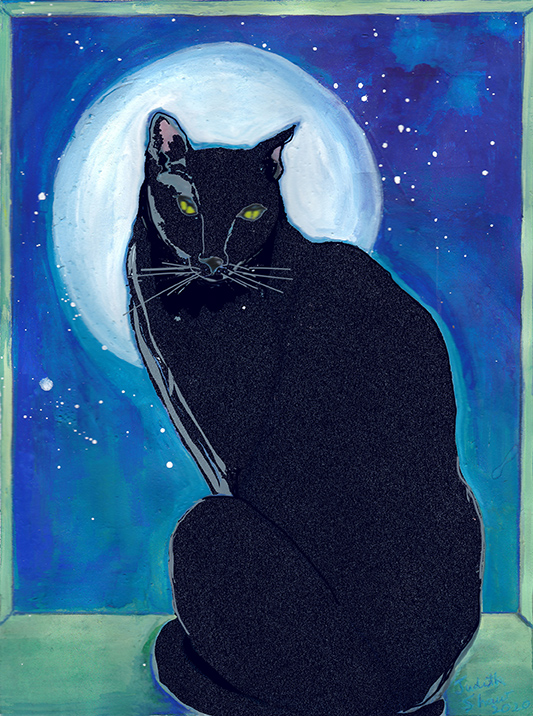
Samhain: The Cailleach, Wolf, and Black Cat  by Judith Shaw


Halloween, with its Celtic pagan roots in the sacred day of Samhain, which later morphed into a Christian holiday, is now mainly a nonreligious celebration in Europe and North America. It’s enjoyed by both young and old with scary outdoor decorations, parties, spooky costumes, haunted houses, carved pumpkins, and candy-giving.

Continue reading “Samhain: The Cailleach, Wolf, and Black Cat  by Judith Shaw”

From the Archives: In Memory of Margot Adler (1946-2014) Priestess, Journalist, Skeptic, Mystic by Elizabeth Cunningham

This was originally posted on October 22, 2014

“Ritual has the power to end our alienation from the earth and from each other. It allows us to enter a world where we are at home with the trees and the stars and other beings, and even with the carefully hidden and protected parts of ourselves that we sometime contact in dreams or in art.” –Margot Adler

Margot Adler died of cancer on July 28, 2014. A Pagan priestess, she asked for memorial events to be held in the season of Samhain, also known as Halloween.  At this time of year, the rituals of many religious traditions remind us that we are all connected, the living, the dead, and those to come, one continuous communion.  In this spirit, I offer a tribute to the late Margot Adler.

Continue reading “From the Archives: In Memory of Margot Adler (1946-2014) Priestess, Journalist, Skeptic, Mystic by Elizabeth Cunningham”

Legacy of Carol P. Christ: Exciting New Research on Matriarchal Societies

This post was originally published on Aug. 5th, 2011

The following is a guest post written by Carol Christ, Ph.D., a pioneer and founding mother of the Goddess, women’s spirituality, and feminist theology movements, and director of the Ariadne Institute.  She is also the author of multiple books including Rebirth of the Goddess.

Although there are some of us who disagree, the “party line” in the fields of Religious Studies and Archaeology—even among feminists– is that there never were any matriarchies and that claims about peaceful, matrifocal, sedentary, agricultural, Goddess-worshipping societies in Old Europe or elsewhere have been manufactured out of utopian longing.

I myself and most other English-speaking scholars defending Marija Gimbutas’s theories about Old Europe have studiously avoided the word “matriarchy” (speaking rather of “matrifocal, matrilineal, and matrilocal” societies) because the very word “matriarchy” conjures up the image of female-dominated societies where women ruled, waged wars, held men as slaves, and raped and abused men and boys. In fact, this fantasy tells us far more about patriarchy than about it does about matriarchy. Continue reading “Legacy of Carol P. Christ: Exciting New Research on Matriarchal Societies”

Ariadne and Me – The .5% by Arianne MacBean

When I travelled to Crete on a Goddess Pilgrimage last year, we were asked to introduce ourselves by our matrilineal lines. I am Arianne, daughter of Bernadette, granddaughter of Helen and a long line of women, known and unknown, stretching back to Africa. Many of the women in the group were able to intone long lists of names in their matrilineal lines. I was not able to go further than my Grandmother, Helen. No one in my mother’s large Polish family could remember my Great Grandmother’s name.

My journey toward Ariadne has been as circuitous as the labyrinth itself. In many ways, I have been searching for her since those first bedtime stories my father used to tell me as a child, when Theseus was the main character and Ariadne, merely a stop on his road. I longed for her, even then, to have her own heroine’s journey. I tried to imagine what that might look like but, without models, could not conjure anything beyond holding the red thread so others could triumph. Later, I began a more conscious search for Ariadne as I became curious about the connections between her choices, feelings, expressions and my own longings, betrayals, and outbursts. Since then, there have been moments when I let myself fantasize about being connected to her in some real way, beyond being named after her, or feeling and acting as she may have. In these fleeting moments when I imagine we are bonded, I am awash in an intense sense of belonging, something I never felt as an only child of divorced parents. But then in a flash, my mind takes a sharp turn, as in a labyrinth, and I negate those feelings with logic. You want to be connected to Her, so you are finding ways to make it true.

Continue reading “Ariadne and Me – The .5% by Arianne MacBean”

NOT POSITIVE MASCULINITY, BUT FULL HUMANITY by Esther Nelson

The following New York Times article titled “We Can Do Better than ‘Positive Masculinity’” by Ruth Whippman was published on October 9, 2024.  Whippman is also the author of the book, REIMAGINING BOYHOOD IN THE AGE OF IMPOSSIBLE MASCULINITIES. Whippman’s New York Times article grabbed my attention.

Decades ago while taking undergraduate courses in the discipline that was then called Women’s Studies (now known as Gender, Sexuality, and Women’s Studies), most of the authors I remember reading insisted that both masculinity and femininity (human ways of being in the world) were cultural constructs, not something innate in humans we refer to as women and men. Throughout the world, societies have shown a lot of variety in ways that women and men express themselves and are expected to behave.

Continue reading “NOT POSITIVE MASCULINITY, BUT FULL HUMANITY by Esther Nelson”

CrossFit, Spirituality, and Trauma: An Introduction by Stephanie Arel with Ashleigh Gibb

We met online. Saram College hosted a theology and trauma workshop that Stephanie taught. Ashleigh asked a question. An immediate connection emerged.

The connection consists of mutual interest and passion around bodies, their strength, their vulnerability; around the spirit, its expressions and its intrinsic materiality; and trauma, what violations to our bodies cause to disrupt and annihilate us. Our interests intersect. Stephanie teaches Scripture and the Human Response to Trauma at Fordham; Ashleigh is a Crossfit Coach and Personal Trainer currently pursuing her PhD. She has nine years of experience working with survivors of trafficking and sexual violence. Together, we recorded a few YouTubes on CrossFit and Spirituality, on Crossfit and Community, and one forthcoming with a topic in the works.

Continue reading “CrossFit, Spirituality, and Trauma: An Introduction by Stephanie Arel with Ashleigh Gibb”

Women’s Bodies As Battlefield by Janet Maika’i Rudolph

Elizabeth Cady Stanton wrote in the introduction to her book The Women’s Bible:

The Bible teaches that woman brought sin and death into the world, that she precipitated the fall of the race, that she was arraigned before the judgement seat of Heaven, tried, convicted and sentenced. Marriage for her was to be a condition of bondage, maternity, a period of suffering and anguish, and in silence and subjection, she was to play the role of a dependent on man’s bounty for all her material wants . .

We are facing the long-term results of these biblical writings. This upcoming election is so unsettling because it is showing patriarchy in all its ugliness. We see how this is being played out, especially regarding abortion, but in all areas of the functioning of women’s bodies. The reason abortion is at the foundation of it all is that the drive to police women’s bodies is the crux which justifies all sorts of cruelties. It is the same with racism. These are issues that span the pantheon of rights; human, economic, healthcare, bodily autonomy. It takes a police state to quell all of these.

Continue reading “Women’s Bodies As Battlefield by Janet Maika’i Rudolph”