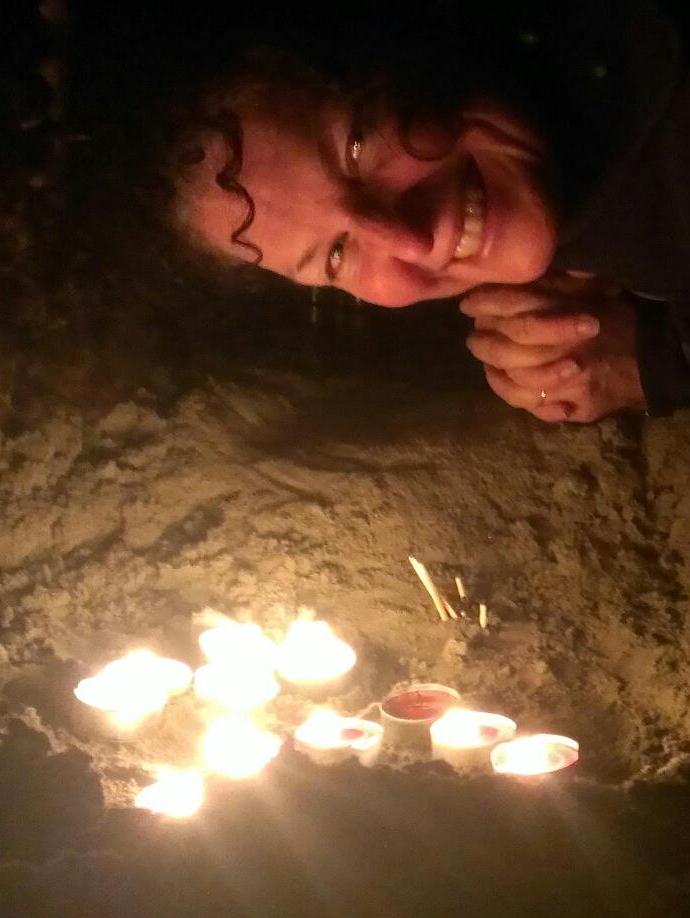
We live in a very small and connected world that at the same time is a very large and disparate one. Sometimes I am overwhelmed by all the news available of the things that occur all over the world, to which I have such quick and easy access online. It makes everything feel so close and connected. At the same time, I also experience a huge disconnect between my very particular and local context and that of others around the globe; women whose reality and life experience I know little about. Even as news about them flash before my eyes, it’s not possible to reduce them to those brief flashes of information or claim to know something substantive about them. In reality, how much am I even able to say about the woman who lives across the street from me, much less women who I only know about online? And yet, my feminism compels me to call them my sisters.
Making Inequality Visible: Mormons Seeking Women’s Ordination are Turned Away from Priesthood Conference by Aimee Hickman
Earlier this month, nearly 150 women were turned away from listening to the leaders of their church. The first weekend of October in the Mormon (LDS) Church is set apart for church members world-wide to hear messages from their leaders. The conference takes place in 5 two hour segments of speakers and music. The Saturday evening segment is called the Priesthood Session–a meeting all priesthood holding men and boys aged 12 and up are expected to attend. This year a new demographic asked to attend the Priesthood Session. Ordain Women, an activist feminist group which is petitioning LDS Church leadership to prayerfully consider the ordination of Mormon women to the priesthood, arrived at the conference doors and respectfully asked for admittance. These women were turned away one by one until the doors were closed and blocked.
On October 5th, I eagerly watched Twitter and Facebook feeds in anticipation of the news of the day: would the many dear friends I had who were petitioning LDS Church leaders for admittance into the Priesthood Session of General Conference be allowed to participate? The first word I got was from Ordain Women organizer Suzette Smith’s simple status update: “They said no.” Continue reading “Making Inequality Visible: Mormons Seeking Women’s Ordination are Turned Away from Priesthood Conference by Aimee Hickman”
WOMEN ARTISTS AND RITUALISTS IN THE GREAT CAVES: THE BEGINNING OF THE END OF INDOLENT ASSUMPTIONS by Carol P. Christ
In an earlier blog, I suggested that women might have blown red ocher around their hands to leave their marks in prehistoric caves.
At the time I thought this was a rather bold suggestion.
Had I been asked why I thought the images were made by women, I might have said that people have understood caves to be the womb of the Great Mother, the Source of All Life, from time immemorial. I might have added that those who performed rituals in the caves cannot have been performing simple “hunting magic,” but must also have been thanking the Source of Life for making life possible for them and for the great beasts they hunted. Still I am not certain that I imagined women as the artists in the Paleolithic caves.
In recent days the news wires have been carrying a story titled “First Cave Artists May Have Been Women, New Study Suggests.” According to retired anthropological archaeologist Dean Snow, the handprints made by Paleolithic ancestors 40,000-20,000 years ago may have been made primarily by women. Snow spent a decade gathering and analyzing photographs of the handprints left in caves. The scientific fact that women’s first and ring fingers are generally of the same length, while men’s ring fingers are generally longer their index fingers, led him to the conclusion that ¾ of the handprints in the caves were made by women! If women were painting their hands on the caves in larger numbers than men, then isn’t likely that they were also painting the images of the great beasts on the walls of the caves? Continue reading “WOMEN ARTISTS AND RITUALISTS IN THE GREAT CAVES: THE BEGINNING OF THE END OF INDOLENT ASSUMPTIONS by Carol P. Christ”
Longing for Hermitage by Elizabeth Cunningham
At least since the days of the Desert Mothers in the 4th and 5th centuries CE, there have been women in the Christian tradition (and doubtless other traditions) who have lived lives in religious solitude, whether by choice or circumstance. In Medieval Europe many churches had anchorholds, small enclosures inhabited by men or women dedicated to a life of solitude and prayer. The word anchorhold implies that the presence of the anchoress or anchorite grounded the church community, but the word derives from the ancient Greek verb (pronounced anachōreō) for to retire or withdraw. Anchoress Julian of Norwich is still revered as the author Revelations of Divine Love, possibly the earliest surviving book written by a woman in the English language. Six centuries after her death, her vision of Jesus our Mother continues to challenge, comfort, and inspire.
I grew up in an Episcopal rectory, daughter of a secretly agnostic mother who loathed being a minister’s wife (living in a fishbowl, she said) and a father who preached and practiced the social gospel as had his father before him. If you weren’t directly feeding, clothing, visiting “the least of these my brethren,” your pieties (as my father dismissed them) were worthless. At every meal we prayed, “make us always mindful of the needs of others.” Selfishness and individualism were synonymous. The pronoun “I” was frowned upon. The only route to salvation was social and/or political activism. My father walked his talk, literally, taking part in the 1965 march from Selma to Montgomery.
Continue reading “Longing for Hermitage by Elizabeth Cunningham”
Peace of mind vs Dogma and Capitalism by Oxana Poberejnaia
When I said in my response to Carol P. Christ’s comment that on one level Goddess spirituality and Buddhism are about the same thing, I am afraid it could have sounded shallow. What I wanted to express is that for a Goddess adherent, the primary goal is not to go through death and be reborn. Neither is the primary goal for a Buddhist to go through death and not be reborn. I believe they both seek the same thing: to be happy in this lifetime, to be comfortable with themselves and the world, to be OK with the reality of their own death. Carol says: “For me, regeneration applies to the community, to nature, to the whole, not to the individual”.
The two faiths just lead to this result by using different theology and practices. One of the ways Buddhism installs this peace of mind is by dissolving the very notion of an “individual” and thus, their impending death becomes less of a problem. From the Goddess side of things, listen to an episode of Karen Tate’s Sex, Religion, Politics podcast Enlightenment for the Rest of Us/Shamanism with Polly Campbell, author of Imperfect Spirituality: Extraordinary Enlightenment for Ordinary People. Karen is a Goddess advocate, and what Polly was teaching could be called secular Buddhism: the same breathing techniques, being in the moment and being grateful.
Continue reading “Peace of mind vs Dogma and Capitalism by Oxana Poberejnaia”
Liberations of Immigrant Women in Western Religious Conversion by Andreea Nica
The prolonged debate around feminist subjectivity and religious participation continues to evoke much compelling discussion in academia, political arenas, and public space. There have been a number of academic studies around the intersection of gender, religion, and migration, specifically on how gender and immigration assimilation is constructed and managed within western religious systems.
I am currently researching the trajectories of immigrant assimilation and conversion, and how gender relations and religious identities are managed within these processes to further develop my proposal for doctoral study. I find this area of research fascinating as it’s so diverse and pertinent to the progression of gender equity amongst religious participants. Continue reading “Liberations of Immigrant Women in Western Religious Conversion by Andreea Nica”
Hajar: of the desert by amina wadud
This week the Islamic pilgrimage or Hajj was completed. For those not gathering on the dusty plains of the desert in Arabia, we have the celebration of the Feast of the Sacrifice, commemorating the exchange of a lamb for the blood of the son of Abraham. This story is coated with patriarchy, and so it is with some fascination that Hajar (biblical Hagar) configures so significantly in the Islamic telling of it.
According to the same patriarchal twist, it is Abraham’s first son that is pivotal to the story’s continuation and the salvation of a people, yet to be born. That his first son, Ishmael, was born of a slave woman—some say of African origins—is not without extreme symbolism for African-American women, mostly Christian. That she is the mother of the tribes of Arabs is also not without some extreme genealogy along with that symbolism. But that she a single female head of household, whose sojourn in the desert still, has a central ritual re-enactment in the Hajj, that I turn to here. Continue reading “Hajar: of the desert by amina wadud”
What Would Malala Do? by Gina Messina-Dysert
October 11th was International Day of the Girl – a movement that empowers girls around the world to see themselves as powerful change agents. This year’s theme is “Innovation for girls’ education.” Certainly, this makes sense given that education is one of our most powerful resources – just ask Malala. During her recent interview on The Daily Show, Malala reminded the world that it is education that can solve global problems – not war.
The youngest person in history to be nominated for a Nobel Peace Prize, Malala is clear in her message; the only way to make change is through peace, dialogue, and education. When asked about her reaction to the threat to her life by the Taliban, Malala responded saying that she thought quite a bit about what she would say if she came face to face with a Talib. “I would tell him how important education is and that I would even want education for your children as well. That’s what I want to tell you, now do what you want.”
Although the Taliban has continued to threatened her life, Malala says striking back is not the right approach. “If you hit a Talib, then there would be no difference between you and the Talib. You must not treat others with cruelty. … You must fight others through peace and through dialogue and through education.” Such words of wisdom from a child. Continue reading “What Would Malala Do? by Gina Messina-Dysert”
The Little Words by Kelly Brown Douglas
As I contemplate the state of our world from the rhetoric of shut-downs to stand your ground, from the self-righteousness of political discourse to the dogma of ecclesiastic pronouncements, and from the justifications for political inequality to the explanations for ecological disregard, I wonder what has happen to all of our little words?
What has happen to our little words of gratitude? These are words like “thank you,” or “I appreciate that,” or “that is kind of you.” Have you ever noticed how in our world today people rush through it without stopping to say thank you? We have become a taken-for-granted people in a taken-for-granted world. We act as if we are entitled to certain things because of who we are or simply because we are. But here is the thing, that which we take for granted we tend to squander, to abuse, and to easily discard—like our natural and human resources. We take for granted our relationships to the earth as well as to one another. We take for granted our life on this planet and our life in community. It is time that we recover our little words. We must learn once again to speak little words of gratitude, for such little words go a long way in changing our world and to transforming a people from being wasteful, excessive and warring to being conserving, non-indulging, and peaceable. Continue reading “The Little Words by Kelly Brown Douglas”
Muslim Ritual Prayer, Social Submission, and Embodied Dissonance by Laury Silvers
Websites run by Muslim scholars typically offer advice columns for those seeking legal rulings and religious guidance on personal concerns. One young Muslim woman wrote to a site about her doubts that wearing hijab was connected to being a good person. The gist of the opinion was that wearing a head scarf, whether she feels right about it or not, will internalize good behavior thus transforming her faith. The acting scholar, Shazia Ahmed writes,
“…performing good deeds, even if one may not be ‘feeling it’, can affect us and change us. The limbs are inroads, and performing good deeds with them can soften a hardened heart, bring enlightenment to a closed mind, and give a person a feeling of rejuvenation and desire to come closer to Allah and do more positive things.”
If she wears a head scarf, her faith, ritual and ethical observance, and peace of mind will increase. This approach is supported by studies undertaken in the field of social and behavioral psychology. It’s been shown that standing or sitting in an open-bodied “power pose” increases testosterone and reduces cortisol, just as forcing a smile increases serotonin. That’s all well and good, and I’ve certainly got nothing against hijab. As we should all be aware by now, hijab has multivalent meanings for Muslim women that do not typically accord with non-Muslim assumptions of its oppressiveness. So hijab is not the point here. My point is that the use of repetitive behaviors and rituals, which are capable of transforming a person’s the inner life, may also act as methods of social control that may not result in the desired peace of mind.
Continue reading “Muslim Ritual Prayer, Social Submission, and Embodied Dissonance by Laury Silvers”