I am a writer, one who sometimes touches on personal issues. But this is the first time I elaborate on why I don’t have children, no doubt, provoked by your “childless cat lady” jibe.
I am childless or childfree; to me, it is a matter of semantics. I have two cats whom I consider my children. In many ways, I am like most Americans; I love my job, I love my students, I love my colleagues.
I have two divorces under my belt. I’m not proud. I made bad choices. I didn’t have the support network nor the mental ability to thrive in the situations. But I had gumption. And I didn’t stay.
So here I am. 54. And starting over.
It can be rather terrifying as motherhood and family has always been my focus.
After my recent second divorce, part of my stability plan was Land. The Blue Ridge mountains in North Carolina called me. The Appalachians. I spent a year looking. I had a list: unrestricted land, at least five acres, a water feature. I had several adventures on my own looking, but I will never forget the day I found it. I was with my son James, and I knew it right away.
Ten acres. A third of it a bog along a creek. Away from it all, but not ‘too away’ as it has a road running through it that leads to a partly developed mountain subdivision.
In my previous post, The Stories We Tell, I drew out the connecting thread that runs through the different books I was reading, the importance of imagination, and the fact that stories capture and shape our imagination, regardless of whether the stories are factually true or not. We inherit them, disparately, and carry them with us as we engage with one another, for better or for worse. And although they are distinct, they also overlap—all our imaginaries overlap and impact one another.
“Rematriation centers Indigenous Women’s leadership for the restoration and regeneration of land and water. By revitalizing Indigenous knowledge, honoring traditions and renewing annual cycles of life, rematriation directly addresses harms caused by patriarchal extraction and violence.” Bioneers
Bioneers, is a FREE online publication that has been around since 1990. in addition to its weekly programs this organization is now introducing the ‘Leading from the Feminine’ newsletter whose intent is to bridge divides and to celebrate connection invoking the feminine as leaders. This newsletter exists to bridge divides and celebrate connections within the rich tapestry of visionary women and men who are evoking/ invoking the feminine to lead with courage, vulnerability, intuition and empathy.
Recently I have been thinking about Neo-Orthodoxy, the leading Protestant theological movement of the twentieth century, as a deification of malepower as power over. In the language of the schoolyard, this translates as “mine is bigger than yours.” Or more precisely: “God’s is bigger than yours.”
Neo-Orthodoxy dominated Protestant theology in Europe and America in the mid-twentieth century and structured my theological education at Yale in the late 1960s and early 1970s. Yale may have been “the bastion” of Neo-Orthodoxy, but Neo-Orthodox perspectives reigned in all the Protestant seminaries and were even celebrated in the media. Neo-Orthodoxy may have some commonalities with fundamentalism but it was by no means an anti-intellectualist approach to theology.
The story of how Cerridwen, the witch goddess, brews a magic potion full of awen (inspiration) which is then accidentally imbibed by the boy Gwion Bach, is well loved across the Western world, especially by neo-Druids. Gwion Bach is then reborn as Taliesin, the greatest bard in Britain. It is a typical heroes tale, with Cerridwen as the muse and initiatrix.
Or is it? This tale has always left a funny taste in my mouth, and when I recently read The Broken Cauldron by Lorna Smithers, I understood why. In the oldest version we have of this tale, Gwion Bach doesn’t accidentally taste the awen. He steals it.
I’ve mentioned before that I’m quite the fan of Jim Rigby, one of the current ministers at St. Andrew’s Presbyterian Church in Austin, Texas. Jim writes a short column four or five times a week and posts them on Facebook. I, along with many others, follow him there; however, I’ve also begun to join the Sunday morning service at St. Andrew’s via Zoom.
As a preface to the Sunday morning services I’ve attended, Jim gives a short explanation of his use of the word “kin-dom” instead of kingdom, fully acknowledging that the word kin-dom was coined by Ada Maria Isasi-Diaz (1943- 2012), a Cuban-American, Mujerista theologian. (Mujer is the Spanish word for woman.)
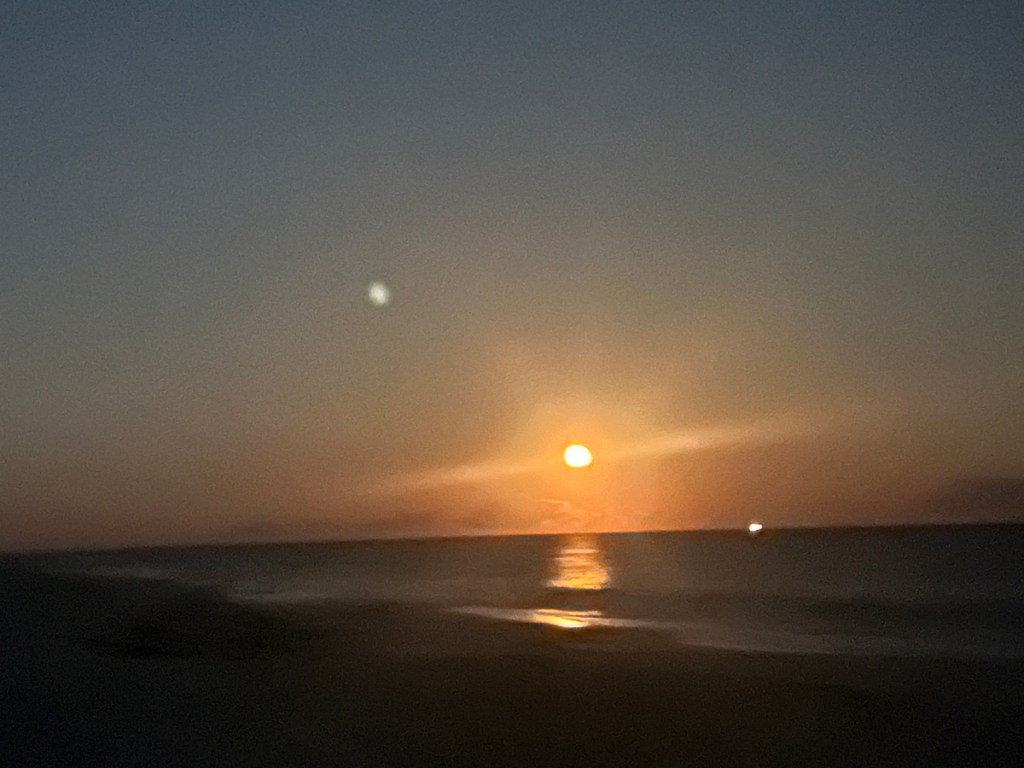
This summer I had the opportunity to travel to Fire Island, New York, which is a long sand bar full of small beach towns with no cars. Fire Island’s been a haven not only for beachgoers but for queer folk for many decades. We stayed in the town of Cherry Grove with friends, and one night we went out to look at the supermoon/blue moon. The moon rose over the horizon, red and a little scary, a sight like none of us had ever seen. Not far from the moon was a star so bright it came out in the photographs. I wondered if that was the morning star. Venus, in our current understanding. Inanna or Ishtar, among some of the ancients. And that made me think of Istehar.
Istehar, in Jewish legend, is a maiden who became one of the Pleiades. Her legend is unusual among Jewish legends because it reads like a Greek myth. It takes place during the time when some angels had descended to earth because they desired human women. One of these angels, Shemhazai, noticed a certain woman named Istehar, and desired her and wanted to be intimate with her. Istehar wished to flee this angel, and so she said: “I won’t accept you as a lover until you give me your wings and teach me the Divine Name that allows you to fly to heaven.” The angel gave her his wings and taught her the Divine Name. Istehar immediately uttered the Name and flew up to the sky, thus escaping the angel. God was impressed by her virtue and decided that she would be placed among the seven stars, in the constellation of the Pleiades, “that humans might never forget her.” (Legends of the Jews I:4:11).
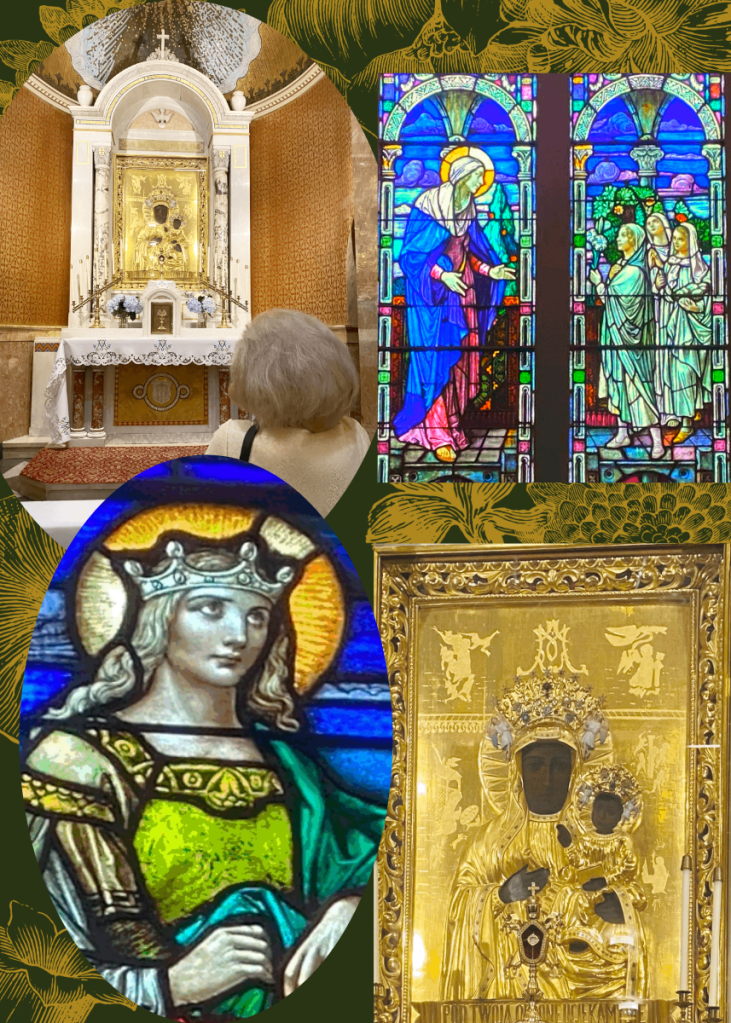
If it weren’t for my mother, I wouldn’t have gone to church on Saturday evening at 5pm. It was a special trip made by me, my daughter and my 89-year-old mother who is visiting here in Connecticut from Ohio. We are met at Holy Name of Jesus Church in Stamford, CT by one of my aunts, some cousins, one of my sisters, a brother-in-law, nieces and nephews – part of our big family.
Holy Name of Jesus Church is in walking distance from the house where my mother grew up: the house where her Polish-immigrant parents raised 8 children. My mother and her siblings attended Holy Name of Jesus Catholic School next to the church from 1st through 9th grade. The school is still there and now houses a daycare and learning center.
Modern science has proven what ancient myth has long told us about our Earth — billions of years ago our world was a water world. It’s not surprising then to find water-based creation stories and goddess mermaids in the myths of our ancient ancestors.



 Feminism and Religion