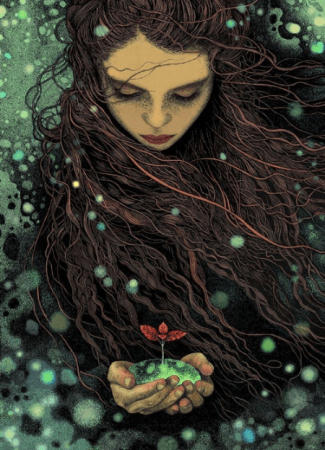
Continue reading “What I Learn from Women in Southern Morocco by Laura Shannon”
Tag: Art
Adoring God in Labor by K Kriesel

The day before the 2019 Nevertheless She Preached conference at First Baptist Church of Austin, TX my own Catholic church’s young adult ministry hosted Eucharistic Adoration. Although I’ve enjoyed Adoration dozens of times, several factors made this evening different. I was preparing for cervical surgery for one. My Hebrew Bible class at Austin Presbyterian Theological Seminary was grappling with Rebekah, Rachel, Leah, and the voiceless Dinah. The call to write the history of 20th century Catholic women theologians had been at my ear all day. The catalyst was when two men at the Adoration began leading a song about God the Father.
Maybe it was just the incense but I swear I saw something. An image of the baby crowning from the womb, God gasping in labor, as the Eucharist wore the gold of the monstrance as a crown before the tabernacle. God was pushing the Body of Christ into creation while I prayed for my own sick body. God was crying out with the voices of these thousands of unheard women. We were all there. I snuck out my phone and took a picture, determined to put the scene to paper.
THREE POEMS OF LIFE by Janet Maika’i Rudolph

As Above So Below
Yes, I believe we are made in god’s image.
If god is the wild, passionate, loud, sexual, sizzling, dancing fires of creation.
And should I ever forget my fiery, heavenly vision, the sun comes out every day to remind me.
And I ask myself, which is more miraculous? Our local star feeding earthly life?
Or me, reflecting the sun, feeling the passion, sizzling in response?
Jacob Dreams and So Do We
(inspired by Genesis 28:12)
As darkness slips into light,
dawn,
with its unique melody,
grows brighter.
As light slips into darkness,
dusk,
with its mysterious possibilities,
settles softly upon the land.
Creation is oneness, but we need duality to experience sex, symphonies, hot fudge sundaes.
Creation is pure love, but it is to the passions of the human heart that we owe our earthwalk
Dawn and dusk hold open the thresholds of mystery inviting our human hearts to experience . . .
The sacred dance where one becomes two becomes three.
The sacred song where three becomes two becomes one.
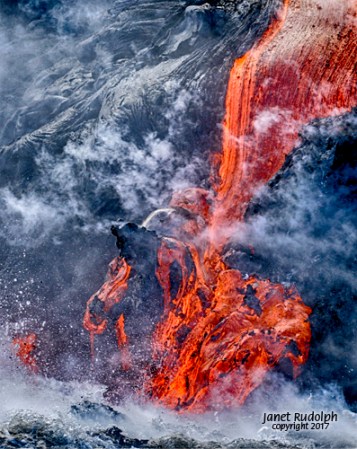
Pele’s Birth Dance
Twinkling stars ignite waves of fire that explode into a tumultuous, joyful noise:
“EH YEH, EH YEH, EH YEH.”
And Mother Earth awakens.
Matter bathed in Pele’s cauldron flares up, erupting into waves of baby earth while roaring:
“EH YEH, I AM, EH YEH.”
As seeds rise from great watery oceans of fire, my heart swells, breathing air into newly forged matter and causing my breath to become song:
“I AM, EH YEH, I AM.”
Fire,
that reflects flame-drenched stars,
that reflects Pele’s dance,
that reflects the passionate seed,
echoes within my belly until I glow with waves of love which burst forth to sing:
“I AM, I AM, I AM.”
And then . . .
Riding a watery wave that gushes forth new life, my newborn erupts from my body, then twinkles, then cries tumultuous joyful noise:
“EH YEH, EH YEH, WAHHHHhhhhhh.”
(Note: “Eh yeh” is God’s name in phonetic Hebrew as given to Moses in Genesis 3:14. “I am” is its traditional translation into English)
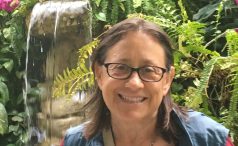
Janet Rudolph has written three books on the subject of ancient Biblical Teachings. One Gods: The Mystic Pagan’s Guide to the Bible, When Eve Was a Goddess: A Shamanic Look at the Bible, and the just recently released book, When Moses Was a Shaman. For more information visit her website at /www.mysticpagan.com/

Birds, Their Song Stills My Heart by Deanne Quarrie
Bluejay

I see you perched on the tree
checking the perimeter for cats lurking.
The feeder below, inviting you down
but you, ever cautious,
make sure that none are about.
Suddenly the sparrows swarm in,
eagerly eating the seed offered.
They flit and flap, and fly about,
scattering seed as they cover the feeder.
Throwing caution to the wind,
down you fly,
eager for your share of the offerings.
You find treats on the ground,
seeds from the tallow above,
a seed so large,
from my window, I see it in your mouth.
I watch you prance, a friend joining you,
Your perky crest and colorful plumage,
your morning dance brings pleasure
as I ponder my coming day.
over my first cup of coffee.
Continue reading “Birds, Their Song Stills My Heart by Deanne Quarrie”
Generosity and Community: the Alternative Worldview of Women’s Ritual Dance, Part 1 by Laura Shannon
My life’s work with traditional women’s circle dances of Eastern Europe and the Near East has been a natural interweaving of feminism, activism and Goddess spirituality. In more than thirty years of experience, my students and I have gained valuable insight into their potential as tools for healing and transformation.
These simple and ancient dances connect us with women’s ritual practices from the past which are rooted in a Goddess-reverent paradigm honouring the earth, the body and the female face of the divine. In the present day, the practice of mindfully dancing traditional circle dances which embody this worldview can help us imagine and create a more equitable society in the future.
Lei by Elisabeth Schilling

Mauro Drudi’s installation of LEI (SHE/HER/YOU – formal) in the Chiesa de San Cristoforo on the Sicilian island of Ortigia where I usually take a bus to daily has become the shrine of women I’ve been searching for. Each time I cry, I am glad I can feel something: those tears are a mixture of communion, comfort, and recognition.
When one enters the church, there are two converging walls. On either side, a woman’s face is painted in shadow and light, gazing off toward the light, is reproduced over and over so that the number of women looks almost countless. They are the same face, a reproduction of Antonello da Messina’s “Annunziata” in the mode of pop art. The difference is not in expression. They all wear the same thoughtful, complicated, neutral countenance, holding deep thoughts and experiences of suffering and wise knowing, both acceptance and maybe resistance; they have lived and might be any age, although I see in our connection my own. The difference is between glossy, unblemished surfaces of wood vs. surfaces weathered, slightly ragged, sometimes scribbled on with ink. The former, found on the right when one enters supposedly represents the “positive” woman, the “western woman [. . . representing someone] happy, gorgeous, well-kept.” On the left, about these representations, Drudi says, “Which artist can paint the skin of a woman who has been abused, beaten, exploited, captivated or disfigured with acid? In my opinion, nobody, and so I let the material speak: the wall of a beach hut destroyed by a storm; woods and materials used and abused [. . .]; exhausted panels deriving from carrying tons of goods, tables, packagings, production wastes.”
Death and Re-birth through a Project by Elisabeth Schilling

For about a year and a half, I have been working on a collection of poetry that I feel is worth something. I have been writing poetry since I scribed pages hidden between my math textbook when I was 9, gone through poetry workshops in graduate school where I produced a creative thesis, and continued to write off-and-on after that. I have an extensive cornucopia of poetry, but it was around last October of 2016, perhaps, that I decided to write my experience.
As a pre-teen, I wrote about what I thought my life could be, fantasizing about being an older woman with mottled relationships, missing opportunities to discuss my fragile relationship with my parents as the only-child-golden-child, my passion and doubts as a religious, my shame at not being more experienced. Even when I was in graduate school for poetry in Ohio, I didn’t think my life was worth excavating. I wrote dreamy, dense poetry that was surreal and symbolic but largely incoherent. I could again have written about my evolving religious beliefs, my curiosities and risks I took living outside of my home state of Oklahoma as a young woman for the first time, my declining relationship with my mother, or my insecurities again, but this time as a lesser-prepared graduate student in comparison with my literary and theory-laden colleagues.
On one hand, some might say the culture I come from is narcissistic and navel-gazing. I would agree, but just like I feel women can sometimes be selfish in a quite necessary and liberating way (as opposed to those around her accusingly saying she is “so selfish” for abandoning them/following her own path/needing a room of her own), I feel the confessional and self-reflective can be the healing and helpful side of the coin. For me, at least in my experience, my “finished” collection feels exactly this way.
Continue reading “Death and Re-birth through a Project by Elisabeth Schilling”
Israel Francisco Haros Lopez by Sara Wright

Borderless Haiku:
We have forgotten the names of each other underneath the shedding skin those names written in our blood that have danced to tonantzin tonatiuh before they knew they were lovers. (IFHL)
Last week I was fortunate to have attended a poetic reading and performance by a remarkably gifted young Mexican man named Israel Francisco Haros Lopez who was born to immigrant parents in Los Angelos. He is both a visual and performance artist, and his work transcends borderlands of all kinds. Israel believes that it is critical to honor and remember the ancestors so that we may once again become one with the winged ones, all those who crawl or walk on this earth, the Four Directions, Earth Air Fire and Water, Tonanztin and Tonatiuh – the Aztec Earth Goddess and the Sun God – Israel’s expression of unity in divinity, and the universe as a whole. His visual motifs are drawn from Pre – Columbian America and his work is an attempt to search for personal truths within the context of today’s world incorporating Mexican/Indigenous stories into the whole.
Continue reading “Israel Francisco Haros Lopez by Sara Wright”
Brigid from The Goddess Project: Made in Her Image by Colette Numajiri

She is the reason BRIDES wear white, swan-like wedding gowns. Brides veil themselves like the Goddess herself, Whom all Bridegrooms honor, until revealing Herself to Her chosen groom. Tiny flowers and shamrocks are said to bloom in Her wake, She brings new life.
BRIDGET BRIGHT by Hedgewytch
She is known as Brigid Bright,
Goddess who shines against the night.
At Cille Dara, at the setting sun,
Her sacred flame is kept by one.
Nineteen times the earth turns round,
As sacred springs come forth the ground.
Twenty times the sun has burned,
And now the Goddess has returned.
Alone she tends her thrice-bright flame,
Born of her heart that bears her name.
The Dagda knows Brigid as Daughter,
Triple Blessed by fire and water.
Poets call her name to inspire.
And healers oft gain from her fire.
Wayland too would know her well
As hammer and anvil ring like a bell.
A sorrowful cry did she give meaning,
When first she brought to Eire keening.
Oh Sacred Fire against darkest night,
Burn for Brigid, for Brigid Bright!
Fire in the head…to quicken us.
Fire in the cauldron…to heal us.
Fire in the forge of the heart…to temper us.
Continue reading “Brigid from The Goddess Project: Made in Her Image by Colette Numajiri”
Sophia from The Goddess Project: Made in Her Image by Colette Numajiri

“Happy are those who find wisdom. . . . She is more precious than jewels, and nothing you desire can compare with her. . . Her ways are ways of pleasantness, and all her paths are peace. She is a tree of life to those who lay hold of her; those who hold her fast are called happy” (Proverbs 3: 13, 15, 17-18).
Sophia is DIVINE WISDOM, Her name comes from the feminine Greek word meaning Holy Wisdom. She is found all over the Bible (Proverbs, Sirach and the Wisdom of Solomon..) and in the Gnostic Gospels (unearthed at Nag Hammadi in 1947.) She has been called the MOTHER OF THE UNIVERSE, Mother of Yahweh and HOLY SPIRIT. The words: “Philosophy, theosophy and sophiology” all come from Sophia. The Bible links her to Christ: “Christ is the Wisdom (Sophia)” (1 Corinthians 1:24, 30). There is some evidence that Mary Magdalene was also called “Mary Sophia.”
Because She did not help advance the patriarchal scheme, Sophia was all but deleted from history. Hidden throughout the Bible and the Dead Sea Scrolls, knowledge of the DIVINE FEMININE all but went up in flames. Even a great cathedral build in Her honor in Constantinopole, Hagia Sophia (Holy Wisdom), was burned to the ground twice. It’s newest rebuild was a mosque and is now a museum. NOTRE DAME (Our Lady) has survived but they eventually claimed it was named after the Virgin Mary. (The famous Notre Dame rose windows are a common symbol of the Divine Feminine!). Some say there are secret societies that still exist to keep knowledge of Her alive.
Continue reading “Sophia from The Goddess Project: Made in Her Image by Colette Numajiri”