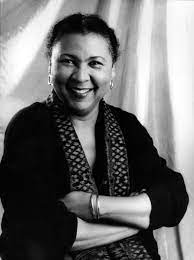
Embodying bell hooks’ theological vision by Liz Cooledge Jenkins

I was recently asked: Who is a theologian you admire? Since I’ve been deeply steeped in the Christian tradition, plenty of Christian theologians could come to mind—Christian theologians, that is, in the sense of humans educated in the Christian theological academy with the theology PhDs to prove it.

 But when I think of theology, these days, I find myself thinking more broadly. Like Kat Armas, who wrote Abuelita Faith as a way of reflecting on and honoring the theological contributions of marginalized women, rather than men who sit in the seats of academic power—and like Sarah Bessey, who writes that theology, at its best, is a field where “everyone gets to play”[1]—I am skeptical of the assumptions Christians often make about who is or isn’t a theologian. And so, when I thought of theologians I look to for wisdom, I thought outside the box. I thought of writer and activist bell hooks.

Continue reading “Embodying bell hooks’ theological vision by Liz Cooledge Jenkins”

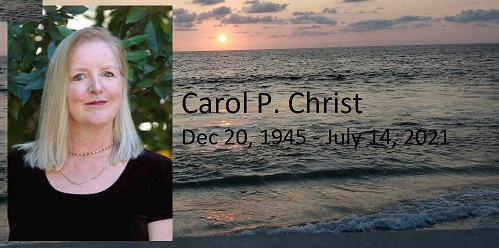
Legacy of Carol P. Christ: Body, Nature, Ancestors

This was originally posted on January 23, 2012

Some years ago, womanist theologian Karen Baker–Fletcher asked about ancestors following a lecture I gave on the body and nature.  I have since come to realize that ancestors are a missing link between the two:  we cannot speak adequately of embodiment and interdependence in the web of life without recognizing the ancestors whose lives made ours possible.  Our mothers quite literally gave us our bodies.  All of our ancestors gave us their genes.  Care and callousness with origins going back longer than conscious memory was imprinted on the psyches of our parents and grandparents and transmitted to us.  All of our ancestors give us connections to place.  While many black people in America can recite oral histories that begin with slavery in the United States, I come from a family where stories of origin for the most part were not valued or told.  Both of my father’s parents lost their fathers when they were very young, and my father, who was raised Catholic at a time when Catholics were discriminated against, preferred to think of our family as “American now.”  Like the hero of the film Lost in America, most members of my family dreamed of “melting right into that pot.” In the process we lost stories we need to help us to understand ourselves and the complex realities that “becoming American” involved.

Continue reading “Legacy of Carol P. Christ: Body, Nature, Ancestors”

RELIGIOUS POLITICS by Esther Nelson

As I mentioned in an earlier post, I am a fan of Jim Rigby, a Presbyterian minister, serving a parish in Austin, Texas. I follow Jim on social media and read his posts regularly. I find his take on modern, American Christianity succinct, on-point, and very similar to my own experience growing up with evangelical, fundamentalist missionary parents.

Jim describes his initiation into religion in the following paragraph:

“As a child I learned an a-political version of Christianity. I…was offended if a preacher brought up social issues in a sermon. Religion for me meant a personal relationship with God so I could sing “Jesus loves the little children” but not feel any need to confront the possibility that my nation might be dropping napalm on them. I was taught to pray for world peace but to remain silent about my nation’s polices that made war inevitable. I could talk about Moses telling Pharaoh to set his people free, but was not permitted to break any chains in my own day.”

Continue reading “RELIGIOUS POLITICS by Esther Nelson”

A Serving of Vegetables with Love: Plastic, Poison, and the Simple Salad Solution

Years ago, I remember looking around one day and realizing that I was surrounded by plastic bottles. Of course I already knew it on some level; I had bought them, after all. But it was one of those epiphanal moments – you know, where you kind of freeze, and time seems to slow down, and everything goes a little out of focus. And I realized – yet again – that I had been hoodwinked. That we all have.

Because I felt like I needed every single one of them. Yet somehow – and not that long ago, either – everyone used to get along fine without all these plastic bottles in their lives. Yes, it probably involved more domestic labor; but it also just stemmed from a local, circular economy based on common sense.

Continue reading “A Serving of Vegetables with Love: Plastic, Poison, and the Simple Salad Solution”

That Old, Old, OLD Story – The Warts and Wisdom of the Ancient

My grandmother Clarine was an incredible human being. I absolutely could not be more proud to be her granddaughter. She started her first teaching position in 1927 at age 17. She met my grandfather in seminary; but despite her clear talent and call, the church apparently felt one minister was enough for the family and refused to ordain her. Undaunted, she famously wrote a one line reply to the bishop: Well, Moses got along fine without it, and Jesus got along fine without it, so I’ll be fine without it, too.

Continue reading “That Old, Old, OLD Story – The Warts and Wisdom of the Ancient”

Solstice Stories : Fire and Ice by Sara Wright

The winter solstice is almost upon us just as the first heavy snow buries the forest and house under 28 inches of snow. I never look forward to this shift into the cold, ice, and snow, although I do wrap myself in peaceful silence, sitting by the fire dreaming as twilight turns to night. My Norfolk Island pine and tipped balsam wreath shimmer with tiny stars. The scent of balsam soothes my senses and purifies the air. This month above all others is my time to honor the trees… I am keenly aware that Bone Woman and Old Man Winter are rising with the moon, whipped up by Northwest winds.

My scientist and naturalist friend, a member of one of the seven Indigenous Sioux tribes agrees with me that winter solstice is a dangerous time, one of the reasons in the old European way that everyone is masked while acting out winter solstice stories. These tales may vary in content but all have the same root. Shadow is on the move. Masks protect the people, the risk of exposure to danger is minimized in this way.

Continue reading “Solstice Stories : Fire and Ice by Sara Wright”

From the Archives: Why Isn’t Easter Marketable? By Anjeanette LeBoeuf

This as originally posted on March 25, 2018.

A few months ago, a friend and I were having one of our many hundreds of random conversations when we started to talk about the differences in the commercialization of the two major Christian holidays: Christmas and Easter. We started really getting invested it this question and what factors lead to Christmas become the juggernaut that it currently is.

Both holidays are given official status. Christmas is a designated federal holiday due to it being permanently celebrated in the Western Christian community on December 25th. Whereas Easter shifts due to seasonal and lunar changes but is always celebrated on a Sunday, meaning it did not need to be given a designated status as Sundays are recognized by the State as a non-work day. Schools across the globe used to call it Christmas and Easter breaks. In the last 10 years, all schools have adopted the politically correct terms of Winter and Spring Breaks. Yet, they still function around the religious observances.

Christmas, it seems comes more and more early in shops. Decorations, candy, gifts, and marketing can be seen as early as September. Christmas music can start to play on radio stations and coffee houses as soon as early November.

Continue reading “From the Archives: Why Isn’t Easter Marketable? By Anjeanette LeBoeuf”

On The Baby and The Bathwater by Liz Cooledge Jenkins

It wasn’t until seminary—and even then, only sporadically—that I learned that many of the foundational figures in Western Christianity held some incredibly sexist attitudes. Somehow, in all my years of attending church, hearing sermons, participating in (and leading) Bible study groups, reading Christian books, and working in ministry, I had missed this historical reality. I just hadn’t thought about it. And the (mostly white male) Christian leaders who shaped my own faith apparently hadn’t thought about it, either. That, or they didn’t think it was important enough to talk about. Or they intentionally tried to keep it on the down low. Or some combination of these things.

In seminary, when influential theologians’ sexist views came up in class, inevitably someone would say—in a wise-sounding tone—“Well, we don’t want to throw out the baby with the bathwater, do we?”

Continue reading “On The Baby and The Bathwater by Liz Cooledge Jenkins”

The Celtic Cross and the Compassing of the Divine Womb, Part 1 by Trelawney Grenfell-Muir

No one knows why Celtic Crosses have a circle. Guesses include pragmatic utilitarianism (to hold the arms up),1 the sun, Greek laurel wreath, Egyptian ankh, circle of creation,2 the Chi-Ro Greek monogram for Christ,3 the divine light that imbues all creation,4 the “Celestial Sphere” found in earlier Eastern Christianity,5 and a range of fanciful inventions based on modern imagination and pseudo-scholarship about Celtic “paganism.” [Leading scholars of pagan history agree that almost nothing is known about pre-Christian beliefs in Britain and Ireland. The few, conflicting descriptions we have, all come from highly tendentious, frequently incorrect foreigners (such as Julius Caesar, who also claimed that German forests were full of unicorns) or from Christian writers of later periods with strong agendas of their own (such as creating a native pagan history and mythology to rival their snobby Greek and Roman “Classical” neighbors).6] The circles on Celtic crosses remain a mystery.

With that in mind, I do not suggest an historical hypothesis here; rather, I offer a theological insight from a modern Feminist Christian perspective. I ask the invitational question: “What happens when modern Christians allow Celtic Crosses to symbolize the Compassing of the Divine Womb?” 

Continue reading “The Celtic Cross and the Compassing of the Divine Womb, Part 1 by Trelawney Grenfell-Muir”

#SharetheMicNow: Social Justice and Christianity by Laurel E. Brown and Anjeanette LeBoeuf

In the midst of recent events and protests, a social media campaign entitled #sharethemicnow has emerged.  The campaign asked white people and people of influence to use their platforms, quiet their voices, and highlight, heighten, and listen to their Black counterparts. I have been honored and privileged to be a monthly contributor here at FAR for 5 years. This month’s post will be in participation with the #sharethemicnow campaign. This campaign seeks to keep the momentum for the realization and implementation of equality and just treatment for all peoples – regardless of race, religion, gender, or sexual orientation. I asked a dear friend of mine, whom I had the pleasure of working with at Whittier College, to write this post. Dr. Laurel Brown, whose discipline is in Social Work, shares with us some thoughts on Christianity and Social Justice in midst of our current issues.


Continue reading “#SharetheMicNow: Social Justice and Christianity by Laurel E. Brown and Anjeanette LeBoeuf”