My daughter Hazel was born on a November afternoon. Just over two weeks old, my own individual role as mother is too young to comment on much here—I am thinking too much and too little about what it means, adjusting to my little one’s schedule, feeling like my boobs are going to fall off from my breastfeeding efforts, and loving in a new way. (It’s amazing how excited one can get about ‘poopy’ after baby has been struggling for days, isn’t it?)
But when I am lying in my bed, sometimes at night, I find myself amazed and grateful for the community it took to bring my daughter into being. I was pregnant but I also had a pregnant community. I labored with community; and what I am learning, is that my motherhood is also a function of community—something, for me, that would not have been possible without the many, many people who supported Hazel and me through the process of new birth. Continue reading “Birth and Community by Sara Frykenberg”
We find our versions of home in these communities and it is within these spaces where our home not only begins to define who we are but we, as a reflection of that space, begin to outwardly redefine the spaces we exist in. If we slowly begin, through our experiences to shape our homes based on privilege and power without self-reflection and acknowledgment of others, then we are no better than those oppressive forces we say we’re against.
This post is a response to a recent blog entry titled “Who is Gender Queer?” on this site from Carol Christ. The post can be read by clicking here.I want to thank my friend, advocate, and upcoming scholar Martha Ovadia for reasons only she knows! Stay brave, speak up, be heard! _________________________________________
It is terrifying to know that something is wrong but not be able to speak truth to power.
It is even more terrifying to know something is wrong, be able to speak to it, and then silence those voices that do not have that same privilege, power, or position.
The struggle that many of us in positions of privilege and power face is not just that of being ostracizing and essentializing forces—it is that we, as allies, members of communities, or even those dedicated to a cause, can ourselves participate in the oppression we are fighting against and can do harm.
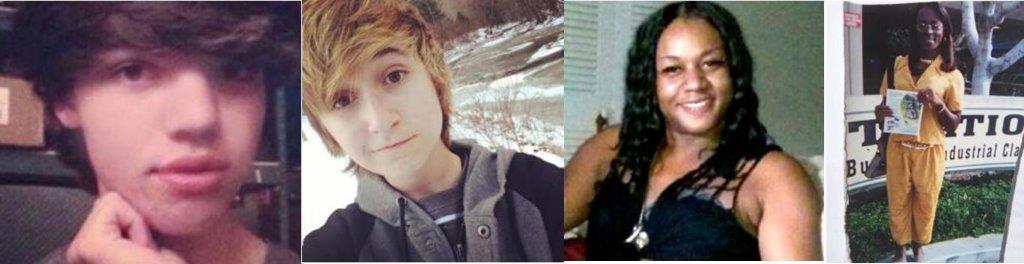
It’s taken me a long time to not only be comfortable with who I identify as, but also how I go about fighting and defining my life based on said identity and experience. However, the one thing that I have the ability to do is choose that identity more freely than others. Unlike Leelah Alcorn, Ash Haffner, Aniya Knee Parker, or Yaz’min Shancez pictured above, I did not have to face the types of oppressions they did, to which they sadly lost their lives, as a result of the fact that we exist in a society that can’t deal with the inability to leave things undefined or to allow people to define who they are on their own terms.
It is vital that although my lived experiences could never meet nor match the same types of oppression that these brave individuals had to face, I, as a white, cisgendered gay male, do not become part of their oppression through my own position and privilege.
As a man who exists in the world of feminism and within various women’s communities, I walk a daily tightrope of privilege and power to insure that I do not silence those that I consider allies, friends, mentors, or colleagues. As a man who exists in the world of the LGBTQ community, I walk an additional tightrope to additionally not take away from or diminish the experiences of those members of our community that do not have the same type of lived experiences as myself. Even within minority communities, there are positions of hierarchy and within these hierarchies of knowledge, identity, or power, comes a responsibility to insure that the oppressed do not become the oppressors.
We find our versions of home in these communities and it is within these spaces where our home not only begins to define who we are but we, as a reflection of that space, begin to outwardly redefine the spaces we exist in. If we slowly begin to shape our homes based on privilege and power without self-reflection and acknowledgment of others, then we are no better than those oppressive forces we say we’re against.
I can’t speak for what identity feels like –I can only speak for what essentializing does, and what it does is reflected in the deaths of Lelah, Ash, and the many others who die nameless. It is our responsibility, as allies, members of communities, and those fighting to end sexist, patriarchal, and, even now, homonormative oppression, to make sure that no more deaths occur on our watch or that truth is spoken to power even when power is masquerading around as truth.
John Erickson is a Ph.D. Candidate in American Religious History at Claremont Graduate University. He holds a MA in Women’s Studies in Religion; an MA in Applied Women’s Studies; and a BA in Women’s Literature and Women’s Studies. He is a Non-Fiction Reviewer for Lambda Literary, the leader in LGBT reviews, author interviews, opinions and news since 1989 and the Co-Chair of the Queer Studies in Religion section of the American Academy of Religion’s Western Region, the only regional section of the American Academy of Religion that is dedicated to the exploration of queer studies in religion and other relevant fields in the nation and the President of the University of Wisconsin Oshkosh’s LGBTQA+ Alumni Association. When he is not working on his dissertation, he can be found at West Hollywood City Hall where he is the Community Events Technician and works on policies and special events relating to women, gender, sexuality, and human rights issues that are sponsored or co-sponsored by the City of West Hollywood. He is the author of the blog From Wisconsin, with Love and can be followed on Twitter @JErickson85
While many Universities last week held massive protests and walkouts on campus, I realized when planning my own protest that if I walked out, I would probably be standing outside on the lawn with very few other protesters. There are plenty of adjunct faculty on my campus—75% to be exact, the national average for all college and university campuses— but I know very few of my adjunct peers and we have no organized voice at the school. Weighing my options (admittedly last minute), I found a great power point presentation on the National Adjunct Walkout Day Facebook page prepared by a Texas adjunct professor, Dr. Jenny Smith, and made available for use by all through Slideshare. Instead of walking out, I taught-in; and I was surprised by how little my students knew about this issue, though I was incredibly heartened by their responses.
Although the specific reasons elude me, I do get nostalgic for “holiday music” during the Christmas season. I’ve written before about growing up in a fundamentalist, Protestant, missionary family. My parents left their homeland (USA), their respective families, and everything familiar to them in order to preach the gospel of Jesus Christ to people (mainly Jews) in Buenos Aires, Argentina, believing Jews had been blinded to the “truth” of Jesus being THE Messiah. My parents’ job (as they saw it) was to be catalytic in removing the scales from blind eyes.
The community they (and I, by default) belonged to and worked with was loosely structured, however, a dour-faced, albeit sincere, Scotsman quietly exerted his will into the day-to-day running of the organization, claiming that his decisions were in fact God’s decisions. Missionaries who disagreed with him could easily find themselves “placed” (all God’s will, of course) several hundred kilometers away to carry on “the Lord’s work” in a remote location–up the Parana River, for example. From the community’s viewpoint (informed by the dour-faced Scotsman), Christmas was a “pagan” (heathen, idolatrous) holiday. We (the church–cult?) did not “esteem one day above another” (see Romans 14:5). Our church community did not celebrate holidays. Continue reading “What’s in a Community? by Esther Nelson”
I was staying with a friend who (luckily for me) owns a home in Puerto Rico. I saw more of Puerto Rico in four days then I believe many might see on a two week vacation! I saw the ocean, swam in the ocean, walked all over Old San Juan with its blue streets, gambled and danced salsa at the famous Hotel San Juan, ate amazing food (especially at my friend’s sister’s restaurant Mom and Dad’s Café) —and of course went to the conference.
And I went to an “old school” lesbian bar. A bar where women loving women gather who were diverse in age—ranging from women in their twenties to women in their fifties and sixties.
My friend said this is the best lesbian bar in Puerto Rico. I brought three friends of mine with me from the conference—wanting to share the wealth of experience that my Puerto Rican friend was allowing me to have with others.
For those who are unaware of my research focus and methodology, I try to use history to reconstruct or reclaim the feminine voice through more of an exegetical lens rather than an eisegetical or ideological lens. When it comes to Thanksgiving, I have yet another opportunity to restore credit to or at least bring visibility back to a woman who fought for Thanksgiving to be recognized as a national holiday on the last Thursday of November. Her works, though plentiful and sometimes known only by title, are largely forgotten to history; Sarah Josepha Buell Hale (1788-1879) is responsible for Thanksgiving becoming a national holiday in the United States.
Certainly, I do not have to go into the disparity that befell women during the 1800’s when it came to education and overall fundamental rights – that is a history with which we are all well familiar. Hale was educated through her brother, Horatio Gates Buell, who shared his education while attending Dartmouth College and “seemed very unwilling that [Hale] should be deprived of all his collegiate advantages,” and through her husband, David Hale, a lawyer who helped her cultivate her writing skills in the evenings. They even established a small literary club with their friends that allowed her to write. Hale was left a widow at a very young age with five children, the oldest age 7. Hale, like so many women during that time period, had to find a way to support herself and her family.
Sarah Josepha Buell Hale
After authoring a book of poems with her sister-in-law, The Genius of Oblivion and Other Original Poems, Hale, in 1827, published her first novel called Northwood – a book published the same year as Uncle Tom’s Cabin that also challenged slavery. From fame gained through this novel, Hale obtained a job as an editor of a women’s magazine, Ladies Book (later Godey’s Ladies Book then American Ladies Magazine), where she worked for about 40 years. She wrote about half of the material contained in the magazines, as a means of helping to educated women. Hale helped to discover and promote such authors as Edger Allen Poe, Nathaniel Hawthorne, Harriet Beecher Stowe, Lydia Maria Child, Catherine Sedgwick, Lucretia Mott, Emma Willard, Susan B. Anthony, Henry David Longfellow, Ralph Waldo Emerson, and Oliver Wendell Holmes.
She is credited for helping to establish Vassar College for women and wrote the familiar child’s poem “Mary had a Little Lamb” in 1830 (Poems for Our Children, republished in Juvenile Miscellany), Traits of American Life, which contained the story of “The Thanksgiving of the Heart:”
Let the creative word romp begin! Our exercise will be simple, yet challenging. I invite you to write one devotional poem per day for the next seven days about whatever moves you spiritually that day in whatever poetic format the words emerge.
Your goal for the next seven days is to let loose a little- step into the creative flow and allow your Bardic Soul to speak. What we will not be going for is perfect, publication-ready material. I know whenever I undertake something like this, I have to remind myself of that. And I have to muzzle that horribly devious little fellow known as my Inner Critic in order for my Courageous Bard to spring free.
Poetry is the creative form which attempts to capture in words and sound the mystery which lies beyond language. We are all capable of writing poetry.
Look for divine poetic inspiration in any and everything around you during next week. Step with intention through your days. Let the whole world sing to you. Dance with language- FEEL it move you! Do not bludgeon yourself with repeated editing. Write, share, and be brave enough to let it be. Continue reading “Devotional Poetry: You’re Invited to a Community Bardic Exercise”
When I think about having returned to the Judaism of my family, I often think about a short phrase that is on almost all of the conversion documents I’ve seen. “Your people shall be my people and your G-d shall be my G-d.” It comes from the Book of Ruth and is a powerful phrase in and of itself. Imagine choosing a journey to a foreign land and being so committed to the person you are traveling with that you are willing to forsake the religion and practices of your people to join hers, even when she extorts you to return to your home. Think about the kind of trust one needs in another to be able to leave everything behind and follow another path. That is ideally what the convert to Judaism has chosen: to leave behind their past, setting out on a new religious path. In fact, it is often frowned upon to ask a convert about their religious past because it is as if it never existed.
Besides these documents, I’ve also encountered the Book of Ruth early in my training as a feminist scholar of religion. I read many commentaries on the story of Ruth, but what I read never spoke to me. Yes, two women were bonded in a deep friendship (perhaps as lovers) struggling to survive and avoid bouts of harassment from men. They also defied patriarchal standards of the day. Sweet and touching, yes. A good example of the importance of friendship between women, definitely! What I didn’t get then that I do now are the values elevated in these two women.
First, what struck me is just how much our pasts are an important part of who we are. In many ways, they help to shape our futures. Ruth’s past built within her the values necessary to make the decision to journey to a foreign land with another woman and without what, could be thought of, as adequate protections.
As I read the blogs posted here, I’m more and more interested in the comments. They show that we and our readers are turning into a real community. For this reason, I’ve decided it might be fun to reconstruct a guided meditation on community from my book Goddess Meditations, which was published in 1999. Goddess Meditations was the first book I wrote after I moved to Long Beach in 1996. I’m rewriting the meditation because I know more now and writer better than I did back then.
Yes, we here at Feminism and Religion are a community, and in my opinion there’s nothing better than community. Individuals come together to form small communities. Small communities come together to form larger communities. And so it goes. Hopefully we’re building up to a world-wide community.
Let’s begin. Sit comfortably, close your eyes, and take several deep, easy breaths. When you feel relaxed, call into your mind the familiar image of a fishing net. See a vast net that stretches up and down as far as you can see, every knot a sparkling star. See yourself in the center of this shining net, but know that each of us stands at his or her own center of the net. The stars revolve around each of us, they shine for each of us. This net has as many centers as it has knots that are shining stars. This net is our community. The Weaver of our net is the Great Goddess. Continue reading “Community: A Guided Meditation by Barbara Ardinger”
As a former lover of Christ and ex-Pentecostalist, I had countless visions and dreams that one day I would be a spiritual leader. While growing up in the charismatic church, it was even prophesied that one day I would become one.
Nearly ten years after leaving the church, I carried a distrust in religion’s relationship with women and its barrier to free thought. My work as a freelance journalist led me to discover a spiritual women’s retreat held in North Bend, Washington. Inspired to experience a non-religious, spiritual gathering, I registered for the retreat held by Center for Spiritual Living (CSL) in Seattle.
“Trans-denominational, inter-generational, not-your-usual church, that was started in 1921. A safe place for ‘the rest of us’ who are looking to connect with God/Higher Power/Universal Presence, but don’t really fit in with any one religion.”



 While attending the recent

 Let the creative word romp begin! Our exercise will be simple, yet challenging. I invite you to write one devotional poem per day for the next seven days about whatever moves you spiritually that day in whatever poetic format the words emerge.

 As I read the blogs posted here, I’m more and more interested in the comments. They show that we and our readers are turning into a real community. For this reason, I’ve decided it might be fun to reconstruct a guided meditation on community from my book
 Feminism and Religion