
Reclaiming My Body by Carol P. Christ

Shortly after writing “Asking for Help,” a blog in which I described losing my physical strength following a series injuries, I finally took a friend’s advice—mainly to stop her from badgering me—and went to the doctor. This is something I don’t usually do, as not only have I almost always had excellent health, but also, I believe that, for the most part, the body can heal itself.  The first doctor sent me to an orthopedist who told me that the persistent bursa on my knee was nearly healed and to go ahead and exercise in order to regain my strength.

A few days later, I found myself walking to the end of my cobblestone street with my little dog and continuing on to the harbor, a walk of about fifty minutes that included a good deal of up and down, as my house is situated above the sea. As I had only planned to walk a short distance, I was amazed that I found the strength to go farther. Soon I found the perfect walk. Leaving home at 4:30 in the afternoon, I follow the road past houses and open fields down to the sea and around the harbor quay out to the lighthouse. The sun sets while I am on the quay and on most days the clear winter sky lights up and the sea turns rose-gold. The return around the harbor takes me past the little church of Agios Nikolaos where I stop to light a candle and say a prayer. Then back up the hill to my house, where I arrive just before dark. Continue reading “Reclaiming My Body by Carol P. Christ”
The Last Time, by Molly Remer

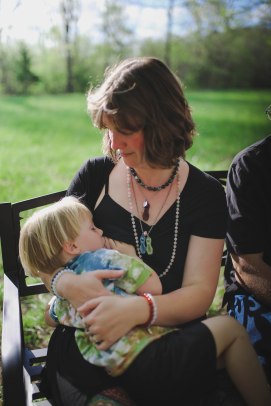
I lie in bed with him, cementing the details in my memory. The way the morning air is heavy and green. The sound of last night’s raindrops continuing to drip from the overfull gutters on the roof. The insistent stab of a single-note bird song in the air. His head nestles in the crook of my arm the way it has done every morning for three years. Blond hair against my nose, breathing in the slightly baby smell of him. “This is the last time,” I whisper softly. “We are all done after this. This is the last time we will have nonnies.”
This is not the first last time for me, but it is the last, last time.  The first baby was born 14 years ago and gathered to my breast with all the tenderness and uncertainty and instinctiveness of a first, first. “Do you want nursies?” I whisper to that new little boy, and we begin the next steps in our bond, nursing for nearly three years, until one day, six weeks away from the birth of the next baby boy, I decide that we truly have to be done. I am a breastfeeding counselor for other nursing mothers and I feel like I should want to tandem nurse my two boys. I fondly envision their hands joining across my body, the easy love and camaraderie between them blossoming through this shared time with their mother. But, I feel an intense irritation with nursing while pregnant, nearly a sense of revulsion and the almost irresistible urge to shove away my sweet little boy as I prepare to greet the life of another. I talk to my midwife about my feelings and she explains that with her own two daughters, the agitated feeling at nursing the older one did not go away with the birth of the second, but instead became dramatically worse. After hearing this, I feel panicky and I decide we do, in fact, have to wean. He is a very verbal and precocious toddler and I am easily able to explain to him that it is time to be finished nursing. One night though, he lies in bed with me crying and begging to nurse. He says he really needs to. I tell him, “remember, we’re all done, but if you really, really need me, if you really, really still need to have nursies, you can.” He doesn’t nurse, but instead falls asleep, reassured that while our nursing relationship might be over, I’m still here.

Continue reading “The Last Time, by Molly Remer”

Embodying Gaia by Christy Sim

Rosemary Radford Ruether wrote a classic text: “Gaia and God: An Ecofeminist Theology of Earth Healing.” Ever since I laid eyes on this amazing book and was convinced of the genius Ruether offered within these pages, I adored images of Gaia.

The great goddess is usually pictured holding the world as her womb, a loving representation of compassionately pulling all the hurt and agony to her abdomen for healing.

Ruether says in “Classical Western cultural traditions” of which “Christianity is a major expression,” we “have justified and sacralized” notions of God and domination (3). Such ideas teach us that domination is “the ‘natural order'” and “the will of God” for the “male monotheistic God” and his followers (3).

But Gaia is so much more and challenges these patriarchical messages in today’s culture. To imagine the divine with this motherly image helps with “ecological healing” (as Ruether says), and, being able to picture a “personified being” in the feminine (4). Gaia is truly special.

Continue reading “Embodying Gaia by Christy Sim”

B’tzelem Elohim and Embodiment by Ivy Helman

studyIt is quite common, I think, for Jewish feminists to gravitate to the first creation story of Genesis/Bereshit as an example of human equality but struggle to claim this same passage as an example of the goodness of embodiment.  Genesis/Bereshit 1:27 reads, “So G-d created humankind in the divine image, in the image of G-d, the Holy One  created them; male and female G-d created them.”  In this passage, we have not only equality between men and women, in direct contrast to the second creation story, but also a description of human nature.

Our Creator made us in the divine image: b’tzelem Elohim.  The most traditional explanations of b’tzelem Elohim describe our divine-likeness to mean: our intelligence, our capacity for goodness, our creativity as well as our inner divine spark.  Most traditional teachings also understand this description as a prescription for action: since every single human being is made in the divine image, we must treat every single human being with respect, dignity, concern and so on.  Continue reading “B’tzelem Elohim and Embodiment by Ivy Helman”

Beginning Conversations about the Body at Ease by Stephanie Arel

A topic that continually perplexes me, both personally and professionally, concerns the connection, or harmonization if you will, between our cognitive capacities and our physical expression and comfort, between thinking and feeling. Yoga, dance, working out, meditating, and other modalities which explicitly bring body and mind together often achieve their goal at the point of practice, and while these disciplines have residual effects, how do they have staying power?


For instance, how do we maintain rootedness in the body when we are caught off guard – for instance, by traumatic affect? When we are faced with information about reality that disturbs us – the truth about a relationship or a physical illness – how do we stay physically present? Or when we (I) spend an inordinate amount of time immersed in activities that are essentially not embodied despite the efforts at theorizing such embodiment – reading, researching and writing – what happens to the body?

Sustaining a mind/body (and spirit) connection is a little tricky. Some psychologists would call this connection a kind of attunement (between a dyad) that fosters a form of affective regulation. This means that subjective experiences, correlating thoughts, physiological responses, and the bodily expressions these provoke come into alignment but not in the manner of repression or suppression, rather as a form of accord or modulation that brings us to our best adult selves and enables decision making that supports our most core self. Capable of achieving this? I think it’s an art. Continue reading “Beginning Conversations about the Body at Ease by Stephanie Arel”

Resisting Shame and Choosing to Live through the Loving Eye by Stephanie N. Arel

This week, I finished reading The Politics of Reality: Essays in Feminist Theory by Marilyn Frye, a text I had not encountered in my studies of feminism (in literary theory, psychology, philosophy, or theology) until now. In some ways, I wish I would have read it sooner. In other ways, I am grateful for this more recent rendezvous. From my current position and perspective – theoretical and personal – I was, I think, more able to hear the core message Frye conveys than I would have been years ago. I have less to protect now, and my ego is less fragile. In the text, she names the mechanisms around which Western – and patriarchal – cultures are founded. Her argument is fluent and cogent, even as it threatens the stability this culture offers. Our lives are embedded in it, even if our personal ethics point to alternative, feminist ways of living. Frye pushes her readers to live alternatively, so that we can recognize the times that we conspire/feed into/comply with patriarchal messages and clean the residue of servitude off of our skin.


For the purposes of this post, I engage two opposing concepts Frye presents in the text: the arrogant eye and the loving eye. Located in the chapter entitled “In and out of Harm’s Way: Arrogance and Love,” Frye investigates how men in phallocentric culture exploit and enslave women. The opposing, contradictory eyes of arrogance and love directly relate to the experience of shame which effectively serves to subjugate women in patriarchal culture.


Shame functions within what I call a logic of exposure. Shame relates intimately to the concept of being seen.  Affectively, shame results from our interest/excitement being partially truncated. For instance, we are drawn to someone (real or imagined); we are interested in their response to us, and somehow something interferes with the desire to connect. Contact is cut off, and interest/excitement partially halted. Shame ensues. We experience that someone (real or imagined) seeing us as other, different, foreign, maligned, wrong, or worthless. We are seen wrongly. This misperception alleviates joy and relates to the gaze of the arrogant eye under which (as the default gaze of phallocentric culture) we often find ourselves seeking approval.

Continue reading “Resisting Shame and Choosing to Live through the Loving Eye by Stephanie N. Arel”

Call Me the Devil, If You’d Like by Natalie Weaver

Call me the devil, if you’d like.

I have just completed the three-hour retreat at the church to prepare my son for his first communion.  It was a long morning, to be sure, but during that time I decide I want to try to bring the family all together.  I host such occasions often, at significant cost and personal effort, but I think it builds up love and community so I do it anyhow.  I go home and begin sending out invitations for the gathering.

At precisely the moment of my welcoming, I learn that I have, once again, been directly charged by so-and-so, because I have worked in a professional capacity and (I am not kidding, dear readers) because I have not had my children in T-ball and Rec Center sports. I am accused of self-aggrandizement because I go to professional conferences (to which I also take my children almost without exception).  I am charged with doing things for my own glory because I teach overloads and offer paid lecture series.

There is no acknowledgement that I work to eat and to earn income to support my children or that I have never had the option not to work outside the home.  I am furious, of course, because I have heard this in varying degrees over the length of my professional life and time as a parent, including once on Mother’s Day. I’m tired of the insult, but when I respond after years of such claims in outrage, I am accused of being too angry.

But, life goes on, and so does the gathering.  It’s a nice time, but after the gathering, I wake up to the boldly voiced disgruntlement of a friend who has been inadvertently insulted by a conversation that occurred at the table.  The insult is derived from the charge that I did not say the right words when I should have. There is a very strong critique and withering suggestion about my core values at stake, since the issue is racial.  I listen and apologize but am left wondering, “don’t you know me by now?”  Have you not dined with me, celebrated with me, felt my love and friendship, outreach and appreciation? I am stymied.  Am I here to be judged?

Continue reading “Call Me the Devil, If You’d Like by Natalie Weaver”

Present in Our Bodies: Sensuality, Movement, Feelings, and Joy by Chris Ash

Christy CroftChristmas morning. I don’t usually have Sundays free and our family holiday celebrations lean nontraditional, so I’d come to a special ecstatic dance celebration and brought my 9-year-old daughter with me. As the music started and people all around us began to flow and move, I reached out to touch her hand. As if she’d been doing it for years, she shifted into a beautiful contact improv flow with me, rolling her arm down and across mine as she beamed love and radiance right into my heart.
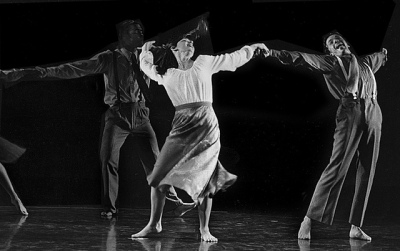
This child brings up so many feelings in me as I watch her grow.

On many occasions at ecstatic dance, I’ve looked around the room and been overwhelmed by the beauty of the dancers and their joyful embodiment. When delight, peace, and ease are conditioned out of many of our bodily relationships through past traumas, body issues, or simply living in a disembodied or misembodied culture, feeling comfortable in our own skins is simultaneously an intentional act of cultural resistance and a profound act of self-care and self-love. Being present in the ecstatic dance space with lovely people moving confidently in fluid, sensual, emphatic, and silly ways fills my heart to overflowing on any given dance day.

Joyful dancers move ecstatically
Photo by Flickr user dannysoar

Being present in that space with my daughter, looking around the room and imagining what it must look like through the eyes of a 9-year-old girl, gave it a whole new hue of meaning. People danced alone or with partners, men danced with men and women with women, all without shame over their bodies or feelings. The occasional dancer who slipped off to sit on the periphery, nursing tears that flow in the way holidays bring for some, was joined, held, hugged, cried with. My little girl danced with joyful abandon surrounded by men and women of all ages and shapes, present in their bodies and feelings, moving in ways that felt good, glowing with presence and the freedom of acceptance. Continue reading “Present in Our Bodies: Sensuality, Movement, Feelings, and Joy by Chris Ash”

Supporting Embodiment: Societal and Jewish Views on Body Modification by Ivy Helman

me-hugging-treeEmbodiment is a feminist principle which has, as its basis, two fundamental criteria.  First, humans require their bodies to live.  We must acknowledge that our existence is tied to our bodies.  This fact grounds us in this world.  Here, and not in some other-worldly place, we live out our lives.  We are dependent on our bodies and what the world provides for our survival.  In other words, humans are inseparable and interconnected to this world.  Humans are not above nature as the Western hierarchical dualist mindset would suggest.
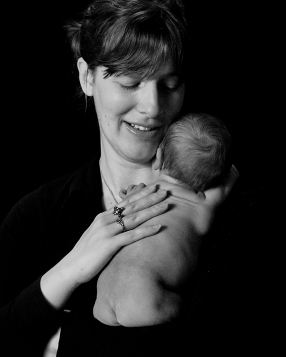
Second, embodiment challenges the hierarchical dualistic notion that the mind and body are separable by connecting the mind to the body.  Humans do not exist because they think, as Descartes once said.  Rather, humans exist because of a complex system of interactions between body and mind. Without the body, the mind fails and vice versa.  The link between the mind and the body has led many feminist theorists to reject any sort of existence beyond this physical life.  That is a topic for another time. Continue reading “Supporting Embodiment: Societal and Jewish Views on Body Modification by Ivy Helman”

Priestess as Shamanic Path – Part 2 by Molly Remer

This is a continuation of Molly’s piece from Wednesday, 10 August 2016. You can read Part 1 here.

After explaining that the homebirth of her second son was her, “first initiation into the Goddess…even though at that time I didn’t consciously know of Her,” Monica Sjoo writing in an anthology of priestess essays called Voices of the 567bGoddess, explains:

The Birthing Woman is the original shaman. She brings the ancestral spirit being into this realm while risking her life doing so. No wonder that the most ancient temples were the sacred birth places and that the priestesses of the Mother were also midwives, healers, astrologers and guides to the souls of the dying. Women bridge the borderline realms between life and death and in the past have therefore always been the oracles, sibyls, mediums and wise women…

…the power of original creation thinking is connected to the power of mothering. Motherhood is ritually powerful and of great spiritual and occult competence because bearing, like bleeding, is a transformative magical act. It is the power of ritual magic, the power of thought or mind, that gives rise to biological organisms as well as to social organizations, cultures and transformations of all kinds… (page unknown).

I have been a childbirth educator since 2006 and I have given birth five times. Each birth brought me the gift of a profound sense of my own inherent worth and value. It was the shamanic journey through the death-birth of my tiny third child, however, that ushered in a new sense of my own spirituality and that involved a profound almost near-death experience for me. After passing through this intense, initiatory crisis, the direction and focus of my life and work changed and deepened. Shortly after the death-birth of my third son, I wrote: Continue reading “Priestess as Shamanic Path – Part 2 by Molly Remer”