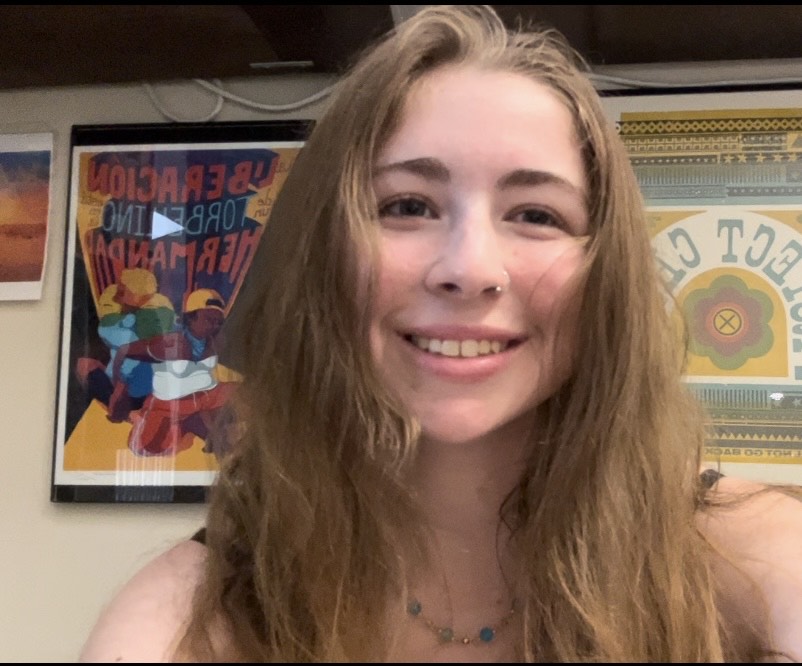
Miriam Is For the Girls by Zoe Carlin

The Book of Exodus is a well-known scripture, and it is one that many Jews, Christians, and even people who are non-religious are very familiar with. Growing up, our family continued to tell this story year after year during Passover. It was one of many classic Torah readings shown to us in our temple. So, one of the key figures in this story is Miriam, Moses’ older sister. Most remember that she helped her mother deliver Moses in secret at the Nile River when he was an infant due to the Pharaoh setting an order to kill every Hebrew son because of concerns of the population growing too much (Exodus 11:5-6). She also assisted in leading the Israelites across the Red Sea when Moses opened it up for the Hebrews to cross (Exodus 14:21-22). An article titled “Miriam: Midrash and Aggadah” shares a deeper analysis of the roles that Miriam upheld as a sister, a daughter, and a woman during this time. It has also informed my understanding of Miriam’s story.

Continue reading “Miriam Is For the Girls by Zoe Carlin”

Legacy of Carol P. Christ: Is the Prophetic Vision of Social and Ecojustice the Fruit of the Poisonous Tree?

This post was originally published on Aug. 26th, 2011

Carol P. Christ earned her BA from Stanford University and her Ph.D. from Yale University.  She is a founding mother in the study of women and religion, feminist theology, women’s spirituality, and the Goddess movement and work has revolutionized the field of feminism and religion.  She has been active in anti-racist, anti-war, feminist, and anti-nuclear causes for many years.  Since 2001 she has been working with Friends of Green Lesbos to save the wetlands of her home island.  She drafted a massive complaint to the European Commission charging failure to protect Natura wetlands in Lesbos.  In 2010 she ran for office in Lesbos and helped to elect the first Green Party representative to the Regional Council of the North Aegean.  She helped to organize Lesbos Go Green, which is working on recycling in Lesbos.

My hope for the new blog on Feminism and Religion is that it can become a place for real discussion with mutual respect of feminist issues in religion and spirituality.

I agree with Rosemary Radford Ruether who argued in a recent blog “The Biblical Vision of Ecojustice” that the prophets viewed the covenant with Israel and Judah as inclusive of nature. Indeed in my senior thesis at Stanford University on “Nature Imagery in Hosea and Second Isaiah,” in which I worked with the Hebrew texts, I argued that too. I also agree that the dualism Rosemary has so accurately diagnosed as one of the main sources of sexism and other forms of domination comes from the Greeks not the Hebrews. I agree that Carolyn Merchant is right that nature was viewed as a living being in Christian thought up until the modern scientific revolution. I agree with Rosemary that it is a good thing for Christians to use sources within tradition to create an ecojustice ethic. I am happy that there are Christians like Rosemary who are working to transform Christianity.  Finally, I am pleased to admit that I have learned a great deal from her.

Continue reading “Legacy of Carol P. Christ: Is the Prophetic Vision of Social and Ecojustice the Fruit of the Poisonous Tree?”

Biblical Poetry: Vibrational Essence by Janet Maika’i Rudolph

Today’s biblical poetry reflects on two passages in Exodus 15:2 and 15:3. Both deal with the vibrational essence that gives rise to the splendors of life.

KJV is the traditional King James Version. MPV is my own Mystic Pagan translation.See notes below for my translations of various words including LORD.

Exodus 15:2

The LORD is my strength and song, and he is become my salvation:
he is my God, and I will prepare him an habitation;
my father’s God, and I will exalt him.
KJV

YaaaHaaaVaaaHaaa, is the source of my vivacity and song
Unveiling pathways of liberation.
Rooted in the potentiality of my ancestors
Resplendent in beauty.
MPV

Continue reading “Biblical Poetry: Vibrational Essence by Janet Maika’i Rudolph”

Beshalach and Liberating Models of G-d by Ivy Helman

29662350_10155723099993089_8391051315166448776_oThe parshah for next week is Beshalach (Exodus 13:17 – 17:16).  There are a lot of very important events happening in just four chapters.  In fact, one could write a blog on any one of the following topics: the Israelite escape from Egypt; the parting of the Red Sea (literally the sea of Reeds); the Israelites being pursued by the Pharaoh and his army; the death of Pharaoh and his army in the sea; the incessant complaints of the Israelites in the desert; and the first descriptions of Shabbat observance.

Yet, this post will not focus on any of those topics.  Rather, I want to examine chapter 15, the Song of the Sea.  It is one of the oldest sections of the Torah and contains some of the most iconic images of the divine.

Yet, the Song of the Sea is a patriarchal text if ever there was one.  G-d is a strong and vengeful (ver. 2) warrior (ver. 3), who has fury or is wrathful (ver. 7), and wields a mighty arm that kills enemies (ver. 6 &12).  This in-your-face power of the deity inspires fear in those who threaten the deity’s chosen people (ver. 14-15), and the Israelites are grateful for it (ver. 11).  Because of the power of this deity, one can rest assured that this warrior deity will rule (be the King) forever (ver. 18). Continue reading “Beshalach and Liberating Models of G-d by Ivy Helman”

Let My People Go! Modern Day Oppression and Exile by Michele Stopera Freyhauf

FreyhaufLet my people go!

Where is the humanity? Why are my sisters and brothers continuously subjected to persecution? Who will help and stop this madness?

I am a member of the human race. Collectively I identify with those who need help and are oppressed. I do not identify with the oppressors, for they are like Pharaoh whose heart was hardened. In identifying with this group, I will provide a label of humanity; for the oppressors do not show care or love but evil and sin towards my people – they cannot be part of this group. As my people flee the boarders from the oppressors, the world has opened their gates to let them in. The world has not turned their back on them. However the oppressors continue to mar their homeland, destroy their culture, and attempt to erase their history, their identity, their footprint on this earth. They are not oppressors but are in fact committing cultural genocide. They are committing genocide against humanity, against anyone who does not follow their ideology, their way of life.

Why should we care? Should we care? For this I say yes. My people need protection and help, but like the Israelites in the story of the Exodus, they yearn for their homeland – a place they were forcibly exiled from. They yearn for food and clean water. They yearn for safety and protection.  While you may think that my people were not forcibly exiled – they were. They fled for their own lives – for their own people, and the community’s hearts became hardened to their pleas for help.

The Syrian crisis is one that we have allowed to repeat over and over again. According to World Vision, nearly 12 million Syrians have been forced from their homes – half of which are children.  At least 7.6 million have been displaced within Syria and more than 4 million have fled the country.  Children affected by this crisis are at risk of becoming ill, malnourished, abused, or exploited.  Save the Children produced a video that shows what happens to a girl after three years of conflict:

Continue reading “Let My People Go! Modern Day Oppression and Exile by Michele Stopera Freyhauf”

Passover and the Exodus: A Feminist Reflection on Action, Hope, and Legacy by Michele Stopera Freyhauf

Freyhauf, Durham, Hahn Loeser, John CarrollLast week, Supreme Court Justice Ruth Bader Ginsburg was in the news again, but not for reasons you would expect.  She, along with Rabbi Lauren Holtzblatt, penned a feminist essay about the Exodus title “The Heroic and Visionary Women of Passover.”  Finding this story was exciting, especially because I am so drawn to the Exodus story (the intrigue and curiosity of which caused me to return to school and study, as one of my main areas of focus, Hebrew Scriptures – along with Archaeology and Ancient Near Eastern History).  Now women’s roles in this story are being elevated thanks to Justice Ruth Bader Ginsburg and Rabbi Holtzblatt.

Before I discuss the message and the importance this message brings, I think it is important to know an important fact about Justice Ginsburg.  Ginsburg is not observant, but does embrace her Jewish identity.  When her mother died, she was excludedRuth_Bader_Ginsburg_official_portrait[1] from the mourner’s minyan because she was a woman; an event in Judaism that is meant to comfort the mourner, brings a sense of community, and is considered obligatory – a means of honoring our mother/father.  This important event left an impression and sent a loud message that inspired and influenced her career path – she did not count – she had no voice – she had no authority to speak.  No wonder her life and career focuses so much on women’s rights and equality.

As many of us know, the story of Exodus is focused on two things 1) Moses and 2) liberation from the bonds of servitude and enslavement; women are rarely discussed.  In the essay co-authored by Ginsberg, women are described as playing a crucial role in defying the orders of Pharaoh and helping to bring light to a world in darkness.  In the Exodus event, God had partners – five brave women are the first among them, according to Ginsburg and Holtzblatt.  These women are: Continue reading “Passover and the Exodus: A Feminist Reflection on Action, Hope, and Legacy by Michele Stopera Freyhauf”

Encountering “the Change” as a Personal Exodus and Liberation by Michele Stopera Freyhauf

Freyhauf, Durham, Gender, John Carroll, Menopause, Celebration, ExodusThe story of Exodus, through a liberation lens, has different meanings depending on the person’s experience in life.  I recently experienced my own kind of liberation, a freedom from decades old enslavement.  Through this realization, I celebrated with many other women with the reminder – you are not alone!

The story of the Exodus is a familiar one. It is a text of oppression, journey, and freedom – a freedom that finds us in new surroundings, a place of revelation and transformation.  Many have written about the Exodus text found in the Hebrew Scriptures from different ideological lenses and social locations.  For me, I propose to apply this to menopause (also known as the “change”).

It is not too far fetched to look at menopause as a transformative event in a woman’s life.  For a woman like me, who struggled with the disease Endometriosis since my teen years, menopause it is not only transformative, but liberative.  The only effective treatment for this disease (for me) was the injections of Lupron Depot that put my body in “medical menopause.” Because of that experience,  I felt like my  body was being liberated from disease – this disease that debilitated me monthly or, at the very least, caused me tremendous pain.

A few weeks ago, I had the experience of attending a musical with a group of friends. I am not in the habit of blogging about my personal life, but I cannot help but wonder if my story and experience might help another.  The problem about “the change” is that we joke about it and usually face it with unbelievable dread.  I propose to look at the “change” as a positive – a new beginning, with a reminder to all women out there – you are not alone!

I received this revelation several months after my surgery at a musical named – you guessed it – Menopause!  What started out as a much needed get together of friends turned into an awakening and celebration. Something that has me celebrating the change – even as I fan myself through the hot flashes (I prefer “personal summers”), tear-up during emotional commercials for no reason (something I haven’t experienced since pregnancy), clinching my teeth due to a quick-igniting temper that causes me to exercise remarkable restrain (and you thought patience was a gift to children and teens), to searching every cabinet for that holy grail of comfort food – chocolate.  As I reflected on that evening, it occurred to me that I was living my own exodus story and the very thing that enslaved me can no longer hurt me – I am now free – renewed and emerged, but still in a strange wilderness that holds different challenges. Continue reading “Encountering “the Change” as a Personal Exodus and Liberation by Michele Stopera Freyhauf”

On the Path of Holiness by Ivy Helman

headshotGrowing up, there was a way in which I always felt excluded from holy things.  There was the holy: blessed water, sacred oil, priestly blessings, consecrated priests, pilgrimage sites, religious buildings and communion to name a few and then there was everything else including me.  Yet, I was a good kid who always (or almost always) did as I was told.  Doing good works is not contrary to a Catholic childhood or education.  In fact, it is an integral part of Catholicism, but there is also a competing notion that good works are in a different ontological category from holiness.  While goodness merits salvation, salvation is not connected to being holy.  Holiness was granted; salvation was earned.  In addition, holiness also seemed more distant because men had more access to holiness than women did.  Only men could be ordained and priests consecrate the Eucharist, celebrate the sacraments and bless people and things.  These are all holy things and the closer one interacts with holiness, the more holiness is bound to transfer onto the person coming into contact with them. Continue reading “On the Path of Holiness by Ivy Helman”

Silencing Miriam: Prophetess, Liberator, and Leader By Michele Stopera Freyhauf

The prophetess Miriam, Aaron’s sister, took a tambourine in her hand, while all the women went out after her with tambourines, dancing; and she led them in the refrain: Sing to the LORD, for he is gloriously triumphant; horse and chariot he has cast into the sea.”(NAB, Exodus 15:20-21)

The Song of Miriam is not a story of death and destruction, but rather liberation.  It is a poetic celebration of God’s liberation of the Israelites from the oppressive Egyptians, which, according to Bernhard W. Anderson in “The Song of Miriam Poetically and Theologically Considered,” marks the beginning of the Israelite tradition (292).  Phyllis Trible in “Bringing Miriam out of the Shadows” states that this act marks the end of the Exodus, which was started by Miriam, not Moses (169, 172).  The act of liberation reveals God’s action in humanity.  Gerald Janzen in Exodus believes this act also moved the Israelites “to fear the LORD and believe in the LORD and in his servant Moses” (109).  The uniqueness of this passage is that the most unlikely person leads – this person is not a man but rather a woman.

This brief passage in the Hebrew Scriptures is revelatory – Miriam is revealed for the first time.  She is a prophetess, Aaron’s sister, and the role of leader of the victory dance to honor the Divine Warrior.

Continue reading “Silencing Miriam: Prophetess, Liberator, and Leader By Michele Stopera Freyhauf”

Is the Prophetic Vision of Social and Ecojustice the Fruit of the Poisonous Tree? By Carol P. Christ

Carol P. Christ earned her BA from Stanford University and her Ph.D. from Yale University.  She is a founding mother in the study of women and religion, feminist theology, women’s spirituality, and the Goddess movement and work has revolutionized the field of feminism and religion.  She has been active in anti-racist, anti-war, feminist, and anti-nuclear causes for many years.  Since 2001 she has been working with Friends of Green Lesbos to save the wetlands of her home island.  She drafted a massive complaint to the European Commission charging failure to protect Natura wetlands in Lesbos.  In 2010 she ran for office in Lesbos and helped to elect the first Green Party representative to the Regional Council of the North Aegean.  She helped to organize Lesbos Go Green, which is working on recycling in Lesbos.

My hope for the new blog on Feminism and Religion is that it can become a place for real discussion with mutual respect of feminist issues in religion and spirituality.

I agree with Rosemary Radford Ruether who argued in a recent blog “The Biblical Vision of Ecojustice” that the prophets viewed the covenant with Israel and Judah as inclusive of nature. Indeed in my senior thesis at Stanford University on “Nature Imagery in Hosea and Second Isaiah,” in which I worked with the Hebrew texts, I argued that too. I also agree that the dualism Rosemary has so accurately diagnosed as one of the main sources of sexism and other forms of domination comes from the Greeks not the Hebrews. I agree that Carolyn Merchant is right that nature was viewed as a living being in Christian thought up until the modern scientific revolution. I agree with Rosemary that it is a good thing for Christians to use sources within tradition to create an ecojustice ethic. I am happy that there are Christians like Rosemary who are working to transform Christianity.  Finally, I am pleased to admit that I have learned a great deal from her.

Continue reading “Is the Prophetic Vision of Social and Ecojustice the Fruit of the Poisonous Tree? By Carol P. Christ”