

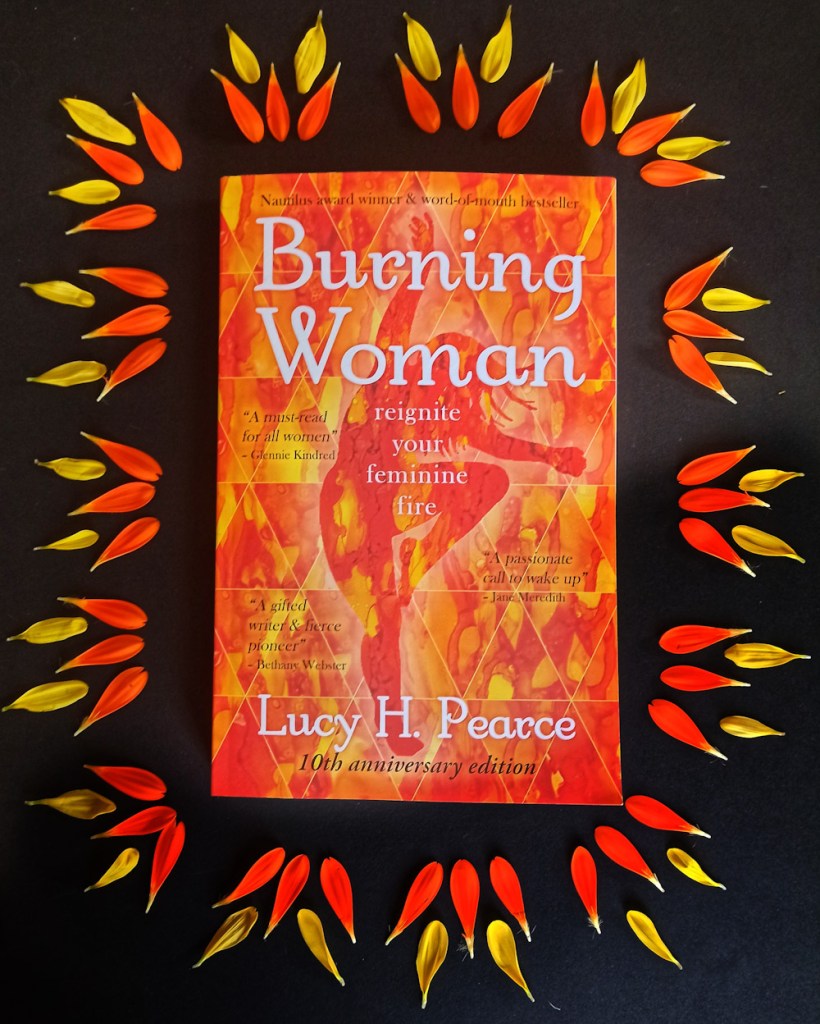
As someone who came into feminism in the late 1970s early 1980s, reading Lucy Pearce’s Burning Woman was re-entering the power and promise of women-centered feminism – the heyday of Adrienne Rich, Audre Lorde, Mary Daly, Clarissa Pinkola Estes, Andrea Dworkin, Charlotte Bunch, China Galland, Riane Eisler, Carol Christ, Gloria Anzaldúa, Susan Griffin, Starhawk, Sara Ruddick.[i] It was the era of reclaiming the Feminine from its patriarchal definitions and women defining themselves outside of patriarchy – celebrating women’s spirituality, art, music, language, bodies, sexuality, birthing, voices, and power – when feminism was about transforming patriarchy rather than fitting into it — when Meg Christian proudly sang Betsy Rose’s “Glad to Be a Woman.”
And then everything changed. Just as women were coming into our own beyond patriarchy, women-centered feminism came to a halt due to pressures both from within feminism and without – with a whole school of deconstructionist feminists[ii] now critiquing women-defined women as “essentialists,” and moving back to minimizing rather than maximizing the differences between the sexes,[iii] with an emphasis on abolishing the gender binary, welcoming trans and non-binary folk, and questioning the whole concept of “women.” Indeed, one of my Women’s Studies, now Gender Studies, students asked me privately if it was okay to call herself a “woman” because the term had become so forbidden among many of the students. At this time, feminist theorist Nancy Hartsock raised the important question, “Why is that just at the moment when so many of us who have been silenced begin to demand the right to name ourselves, to act as subjects rather than objects of history, that just then the concept of subjecthood becomes problematic?”[iv]
So, it is a bold move on the part of Lucy Pearce to reclaim empowered women-centered women, even to use the title Burning Woman,” with the subtitle on the cover of “reignite your feminine flame.” In this 10th anniversary edition she says that she has changed much of the language to make it more inclusive, less binary, and welcoming to all – not wishing to exclude trans and nonbinary women, but also acknowledging that she wrote the book primarily for women-born women, discussing women’s wombs, menstruation, and birthing, recognizing and honoring the “embodied experience of most women.”[v] To this she adds a feminist Jungian perspective[vi], emphasizing the role that archetypal energetic forces play in women’s lives; as well as more recent undertandings of the ways in which both individual and collective and historical traumas affect our nervous systems. Ultimately, in her words, she has written this book “for every woman who has struggled to express herself.”[vii]
Why “burning” woman? As she recognized, “the fear of being burned is oddly female,”[viii] as we remember The Burning Times in our very cells. These burnings were public, she claims, as a warning to all women to stay silent, invisible, ashamed, questioning of our very right to exist. In Burning Woman, Pearce reclaims our burning — our burning with passion, with our power. It is a book that embraces feminine power – not the patriarchal definition of the feminine nor of power as domination, but, just as Audre Lorde had written decades before, “your wild instinctive self, your core longing, your deepest life force.”[ix]
After an initial exploration of the ways that patriarchy has used violence and shaming to silence women’s voices and suppress women’s power and taught us to be “the Good Woman,” Pearce devotes the rest of her book to women’s healing and empowerment — to “dig deep into authentic relationship with our own understanding of spirit, ourselves and our soul people.”[x] She encourages women to reconnect with the sources of our power – “our spirituality, our bodies, the Earth, our lovers, other women . . . our feelings, our hearts, guts, wombs, to our creativity and anger.”[xi] She offers ways to heal our energy blockages and work through the trauma trapped in our bodies. Recognizing the ways in which women’s bodies have been used through fear and shame to prevent our self-expression and empowerment, she argues that “the way into our Feminine power is through our bodies,” and calls on women to “honour your places that feel broken, the physical scars your body bears, the memories your body holds in its cells. Honour these portals to power . . . .”[xii] Thus we must break our silence and dare to speak our truths.
She offers this to each individual woman as a path to her own self-understanding and power, but more than this, she argues that reclaiming Burning Woman is about far more than a personal journey, “it is a shift in the global structure of power and the energy we run on.”[xiii] She challenges each and every one us to ask ourselves, “Do I want to be loyal to my own personal pain and history, or do I want to contribute to collective growth and healing?”[xiv] It is a compelling question and deep invitation to contribute to the transformation of the world, so very needed at this juncture in time.
In addition to being a manifesto and an invitation to women to reclaim our passion, our power, and our voices, Burning Woman is also a how-to, self-help book with what she calls “Burning Questions” and “Firestarters” at the end of every section. I found these to be excellent avenues and exercises for self-exploration. They would also work wonderfully for groups of women in consciousness-raising sessions or in mutual commitment to doing the work to honor their authentic selves. Pearce also devotes an entire chapter to outlining the process of creating a Burning Woman ceremony.
As I said at the beginning, for me, Burning Woman is a wonderful reminder of the empowering depths of women-centered feminism, an important aspect of feminism that has slipped away from the awareness of younger generations of women. I am delighted that Lucy Pearce has reignited this particular flame, making it accessible and inclusive for younger and future generations of women to find their voices and feel empowered to claim the Feminine fire for themselves and the world.
Purchase Burning Woman direct from Womancraft Publishing HERE for a signed copy with exclusive bookmark.
Also now available in paperback, ebook and audiobook from Amazon, online booksellers, or to order into your local bookstore.
Do sign up to the Womancraft Publishing mailing list HERE to find out all about our events for ‘Burning Woman Season’ including a brand new online course
— Writing with Fire – a transformative course for Burning Women with Lucy H. Pearce, author of the Nautilus award winning, Burning Woman.
References
Hartsock, Nancy. “Foucault on Power: A Theory for Women?” in Nicholson, Linda J. ed. Feminism/Postmodernism. NY: Routledge, 1990.
Lorde, Audre. Sister Outsider: Essays and Speeches by Audre Lorde. Trumansburg, NY: Crossing, 1984.
McFadden, Maggie. “Anatomy of Difference: toward a classification of feminist theory.” Women’s International Forum. Vol 7. No. 6.1984: 495-504.
Pearce, Lucy H. Burning Woman. 10th anniversary ed. Womancraft Publishing, 20206.
[i] Indeed, she quotes and references many of these throughout her book – Audre Lorde, Adrienne Rich, Starhawk, Clarissa Pinkola Estés, Andrea Dworkin, Mary Daly, China Galland, Riane Eisler.
[ii] Judith Butler, Monique Wittig, Julia Kristéva, Luce Irigaray among others.
[iii] For an excellent explanation of the many different types of feminisms along a radical to conservative spectrum and a minimizer/maximizer spectrum (those who would minimize the differences between the sexes and those would maximize them), see Maggie McFadden’s “Anatomy of Difference,” Women’s International Forum, 1984.
[iv] Hartsock, “Foucault.”
[v] Pearce, xvii.
[vi] In this she draws on the works of Jungian therapists Clarissa Pinkola Estés, Marion Woodman, and Maureen Murdock.
[vii] Pearce, 4.
[viii]Ibid., 5.
[ix] Ibid., 15. See Audre Lorde’s “Uses of the Erotic: The Erotic as Power,” in her Sister Outsider.
[x] Ibid., 118.
[xi] Ibid., 150.
[xii] Ibid., 168-169.
[xiii]Ibid., 190.
[xiv]Ibid.
Discover more from Feminism and Religion
Subscribe to get the latest posts sent to your email.

 Feminism and Religion
Wonderful review and and important book especially to younger feminists – You know when I entered feminism by the back door as an eco-feminist it never occurred to me to distinguish black from white or red or brown or to allow one’s gender to separate women from other women. I may have been naive but when I saw the woman’s movement disintegrate from the inside I experienced deep dismay KNOWING that women couldn’t afford to allow this to happen but it did…. once ‘feminism was about transforming patriarchy rather than fitting into it’ – this is how far we have fallen – we have come apart from BOTH the inside and the outside. I have reached the point where identity issues bore me and anger me too because of the consequences… we have spent so much time on defining ourselves that we didn’t see what was coming…. Here’s the key: “Do I want to be loyal to my own personal pain and history, or do I want to contribute to collective growth and healing?” HOW ABOUT REPHRASING THIS STATEMENT? CAN WE TELL OUR STORIES AND CONTRIBUTE TO COLLECTIVE GROWTH AND HEALING. The key here is both and – NOT patriarchy’s either or. We can and need to tell our personal stories without separating them from the whole. I taught women’s studies for 15 years and by the end of that time I had to assign books – Rich Daly etc because these women had never HEARD of them…. This sounds like a book that might be very helpful – I sincerely hope so. When a student asks if it’s ok to use the word woman – well we have a problem,
LikeLike
I love your both/and comment Sara, and appreciate all that you said. I always assigned Rich, Daly, Lorde, and the rest. Young feminists would definitely benefit from this book.
LikeLike