“The pictures that line the halls speak volumes about the history of racism and sexism and they shape the future in powerful ways.”–Simon Timm
The author of these words recently posted a short video on Youtube entitled “Mirror Mirror on the Wall: The Legacies of Sexism and White Supremacy at Yale Divinity School.”* The video begins with a catchy little ditty with the words, “God is not a man, God is not a white man.” It tracks paintings and photographs of professors and other luminaries in the field of theology on the walls of the Yale Divinity School. By Timm’s count: 99 white males, 6 women, and 3 blacks. The single black woman is counted in both categories.
This was originally posted on December 18, 2013.This is part of a project to highlight the work of the four women who founded FAR: Xochitl Alivizo, Caroline Kline, Gina Messina, and Cynthia Garrity-Bond
Rosemary Radford Ruether is one of the most brilliant theologians of our time and her newly released autobiography, My Quest for Hope and Meaning, is a gift to those of us who have been so touched by her work. In this intimate and beautiful piece, Ruether shares her personal journey in feminist scholarship and activism. The autobiography opens with a profound forward by Renny Golden (that is also shared here on Feminism and Religion) and continues with an introduction and six chapters where Ruether guides us through an exploration of the influence of the matriarchs in her life, her interactions with Catholicism, her continued exploration of interfaith relations, her family’s struggle with mental illness, and her commitment to ecofeminist responses to the ecological crisis.
Ruether states that “Humans are hope and meaning creators” (xii), and her autobiography details her own quests for hope and meaning. She reflects on the incredible impact made by the female-centered patterns in family and community in her life. According to Ruether, these “matricentric enclaves” grounded and shaped her interest in feminist theory and women’s history. She also describes the spiritually and intellectually serious Catholicism that she received from her mother and articulates her continued frustration with Vatican leadership that has undermined the efforts of Vatican II. For Ruether, her ongoing affiliation with feminist theological circles is crucial as she continues to work toward shaping an ecumenical and interfaith Catholicism.
This was originally posted on April 20, 2015 and was updated by Carol on August 23, 2019
In recent weeks Judith Plaskow and I have been revising the manuscript of our new book Goddess and God in the World in preparation for sending it to the publisher. Yes, we have a publisher. We signed a contract with Fortress Press a short time ago. The book should be out in 2016.
We have been hard—and I mean very hard—at work revising the four chapters in the book that are jointly written. The versions have been going back and forth and forth and back as we revision what we want to say and revise each other’s revisions of the drafts we have. We both want the final manuscript to say things just right and it is very hard not to make one more set of (alleged) improvements.
In the process we have realized that while we often disagree on words and wording, we have come to think alike on a wide variety of issues to the point that it becomes hard to say who had the ideas first. In addition we have both become so familiar with each other’s positions that we can each easily articulate both sides of our dialogue on the issues on which we disagree.
Today is the one year anniversary of the Dobbs decision.
The alarm grows louder. How far will the antiabortion lobby restrict women’s reproductive health care before they are satisfied? If they successfully secure a complete abortion ban, will they stop? Or will they go on to control women’s dress, education, travel, etc.?
Reportedly, Dobbs v Jackson overturned Roe v Wade so the states could set the legal boundaries of abortion through the democratic process. But on November 18, 2022, the US District Court of Northern Texas delivered Alliance for Hippocratic Medicine et al. v US Fodd and Drug Administration et al., a decision that stops medical abortion in all fifty states by ending FDA approval of mifepristone. The Supreme Court has stayed (paused) the Texas order as the appeal works its way to their docket. Mifepristone continues to be available, but for how long? Will the Supreme Court eventually side with the plaintiffs?
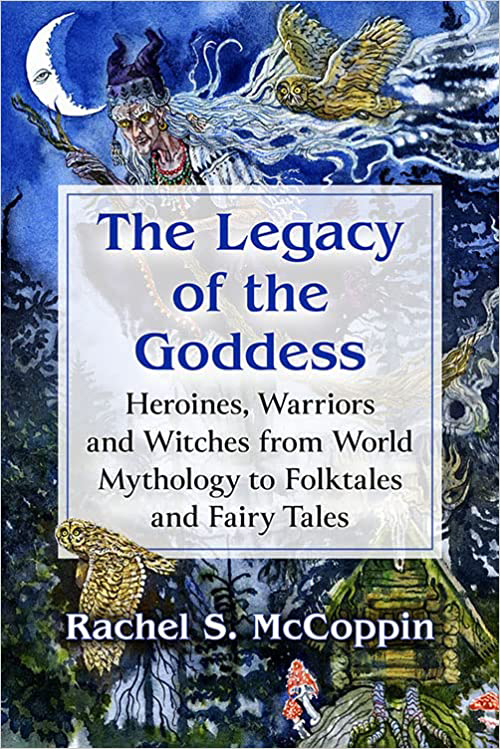
Chapter 4, “Monstrous Females and Ghost Women,” “traces the many female characters within folktales and fairy tales who appear as monstrous, materializing in the forms of giantesses, succubi, mermaids, rusalki, etc. Just as in many ancient myths, even though these monstrous women appear in folktales and fairy tales as hindrances to the quest of the hero, they ultimately serve to educate male heroes about the true meaning of their quest, which again often aligns with concepts associated with mythic goddesses. The many ghost women who appear in folktales and fairy tales around the world are also discussed in this chapter, as they often serve as agents to teach male heroes about how they, particularly as females, have been wronged by males or by patriarchal systems, and thus have been thwarted from completing their own heroic quests” (McCoppin, p. 9).
Though most myths around the world display male heroes partaking on heroic quests, and seldom focus on heroines who participate in their own heroic journeys, this is not at all the case with folktales and fairy tales, as hundreds of folktales and fairy tales portray strong, independent female heroines who indeed partake on their own heroic quests. Therefore, the second half of Legacy of the Goddess focuses on the formidable heroines found in many folktales and fairy tales from around the globe.
This is part 1 of a two part posing. Part 2 will be posted tomorrow.
In this blog post, I would like to take the opportunity to discuss my new book, entitled: The Legacy of the Goddess: Heroines, Warriors and Witches from World Mythology to Folktales and Fairy Tales. This book argues that hundreds of folktales and fairy tales from around the world have preserved elements related to goddess worship from the sacred myths of many ancient civilizations.
Powerful goddesses were worshipped in most global cultures for centuries, until, in many regions, episodes of diffusion, conquest, colonialism, etc. caused the worship of these goddesses to be revised, lessened, or in some cases eliminated. To “preserve at least part of the reverence of goddesses, as well as the memory of the powerful religious and social roles women once held as representatives of goddesses”, hundreds of folktales and fairy tales were created, “told, and retold, most often by women storytellers” to impart goddess ideology (McCoppin, 2023, p. 5). Thus, many folktales and fairy tales portray myriad examples of powerful female characters who portray important messages connected to the goddesses and sacred women of ancient mythology.
Though represented by its detractors as an incursion of paganism into
Christianity, and presented as an integrally and intrinsically Christian phenomenon by its supporters, the truth about the Re-Imagining Conference and movement is that it was a product of a wider feminist awakening. The critique of patriarchal religions that emerged in the academy and in churches and synagogues in the late 1960s and early 1970s was part of the emerging feminist uprising. The feminist movement placed a question mark over all patriarchal texts and traditions, secular and religious, and as such was beholden to none.
In the spring of 1971, Roman Catholic Christian Mary Daly published “After the Death of God the Father” in the liberal Catholic magazine Commonweal. She asserted that the God whose death was touted in the “Death of God” movement was an idol fashioned in the image of male power and authority. She called for “the becoming of new symbols” to express the new becoming of women. In the summer of 1971, a group of nuns from Alverno College convened the first Conference of Women Theologians. Besides sparking dialogue about the role of women in religions, the conference endorsed my call to form a women’s group at the fall meetings of the American Academy of Religion, up until then a gathering of several thousand male scholars of religion, with only a handful of women scholars in attendance. At winter solstice, Z Budapest launched the Susan B. Anthony Coven #1 in Los Angeles publishing a Manifesto calling on women to return to the ancient religion of the Goddess.
Carol Christ at the Conference of Women Theologians
Today I am publishing an early work on female language for God that I wrote with Emma Trout at the first Conference of Women Theologians in 1971. Highly contested at the conference, this essay is a foreshadowing of my subsequent work on the need for female imagery for divinity.
Rereading this essay more than four decades later, I am gratified to see that though we began our essay with the image of God giving birth (which I still view as an important image), Emma and I were aware of the danger that female imagery for God could reinforce “a false sexual polarity.” We insisted then that female imagery for God must not repeat sex role stereotypes, but rather must shatter them.
I am surprised that we also mentioned the need for a new non-static or process metaphysic, a theme I did pursue until I wrote Rebirth of the Goddessand then She Who Changesseveral decades later.
While the references in the essay are dated, the issues it raises are not. Though many mainline Christian and Jewish communities have adopted inclusive language, active experimentation with female language for God is relegated to the fringes of these groups. And while Goddess feminists resist gender stereotypes, some New Age teachers and Neo-Pagan groups perpetuate the idea that the Divine Feminine is receptive, loving, and giving, while the Divine Masculine is active, assertive, and aggressive.
Conference of Women Theologians 1971
ALTERNATIVE IMAGES OF GOD: COMMUNAL THEOLOGY BY CAROL CHRIST AND EMMA TROUT
How much better for theology to conceive of God the Creator as pregnant with the world, giving birth to it and nourishing it, than of God the divine Watchmaker who set the machine ticking millions of years ago. — Penelope Washbourne Chen in “Rediscovering the Feminine in God” The Tower alumni magazine
Even though we know that God Himself is not really a male, we have made use of no other images in talking about Him. As Mary Daly has pointed out, images have a way of perpetuating themselves even though we conceptually know better. (“After the Death of God the Father”) The image of God as a male authority figure serves to legitimize the structures of subordination (oppression) of women to (by) men. The problem is to conceive God in such a way that God’s masculinity does not function as a legitimation system for the oppression of women.
The imaging of God as male has two aspects: 1) the poverty of our language, and 2) the impoverishing of our vision of God by exclusive use of characteristics which our culture has attributed to and limited to the male in conceptualizing and imaging God. In the first of these two aspects we find images of God as Father, King, Lord; our language has no pronoun which is able to embrace and/or transcend both sexes. Our language forces us to think of God as male; we need words like “she-he,” “father-mother,” “daughter-son,” “brother-sister.” Regarding the second aspect: in the Western tradition, particularly the Christian theological tradition our ideas and images have been impoverished by almost exclusive use of “male” characteristics in conceptualizing and imaging God.
For example, initiative, transcendence, authority, primacy, leadership, control and order have all been conceived in static, self-sufficient, abstractly rational terms, in correspondence with masculine stereotypes. An alternative image of God suggested by Penelope Washbourne Chen, imaging God as pregnant, giving birth to, and nurturing the world, presents us with a more dynamic way of conceiving God. Philosophically, this image of God would find expression in the neo-classical metaphysics or process view of reality of Whitehead and Hartshorne, rather than the static ontology of the Greek tradition.
. . .
Let us now turn to the alternatives. Underlying the problem of choosing among the alternative conceptions/images of God is the problem of the evaluation of sexual differences. If, for example, one believes sexual differences are a fundamental polarity in human experience, she will find it appropriate to see this polarity reflected in the deity. If, on the other hand, one does not see sexual differences as a fundamental polarity, she will be wary of correcting a false male image/concept of God by introducing a “female” element which may serve to further legitimize a false sexual polarity.
If one is open to the possibility that sexual differences may not be fundamental, the real question is how to shatter the idol of a male deity without either 1) substituting a reverse idol of a female deity, or 2) legitimizing a false sexual polarity.
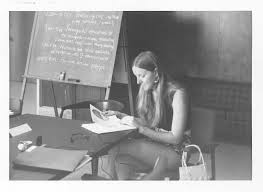
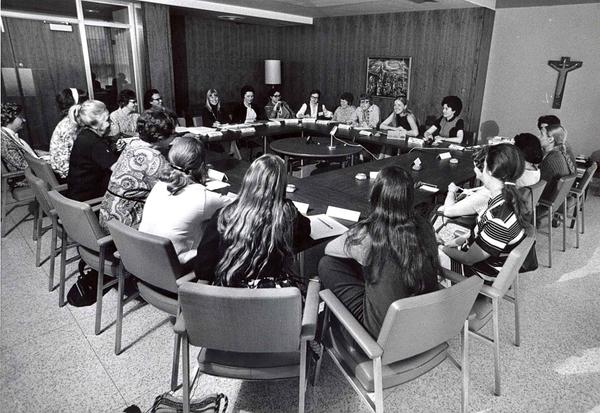
Photos of Carol speaking at the Conference of Women Theologians and of the Conference Participants from the Alverno College archives. Thanks to Sarah Shutkin for providing a copy of the essay from the Alverno College Library Archives.
When I learned about the Navajo Beauty Way, I understood it to be a path in which human beings respect all beings in the web of life and live in harmony with them. But I didn’t understand why this path was called the “Beauty Way.” As a young woman, I knew that my worth was defined by many in terms of my ability to conform to ideals of female beauty promulgated in movies, tv, and advertising. I didn’t believe the Navajos were talking about beauty in that sense, but because of my conditioning, I was not yet able to fully grasp what they might mean by beauty. I would have called the way they were describing a “Way of Harmony” or a “Way of Respect for Life.”
Note: This is the first in a two-part series reflecting on women in the biblical book of Daniel.
I recently had the chance to take a deep dive into the biblical book of Daniel. I think it’s the first time I’ve read the whole book of Daniel since I’ve started intentionally attending to the questions of feminist biblical interpretation: Where are women present? Where are women absent? What are they doing or not doing—perhaps prohibited from doing? How does this passage move its readers toward—or away from—gender equity and women’s empowerment? How does it speak to—or deny—women’s full humanity?
The absence of women in most of the book of Daniel feels glaringly obvious to me.[1] The main characters include the Hebrew exile Daniel, Daniel’s three (male) friends, King Nebuchadnezzar, King Belshazzar, and King Darius. The angels look like men. The divinely appointed eschatological authority figure is described as being like a “son of man.” The particularly oppressive king who desecrates the temple, abolishes the ritual sacrifices, and sets up an “abomination that causes desolation”[2] is definitely male.