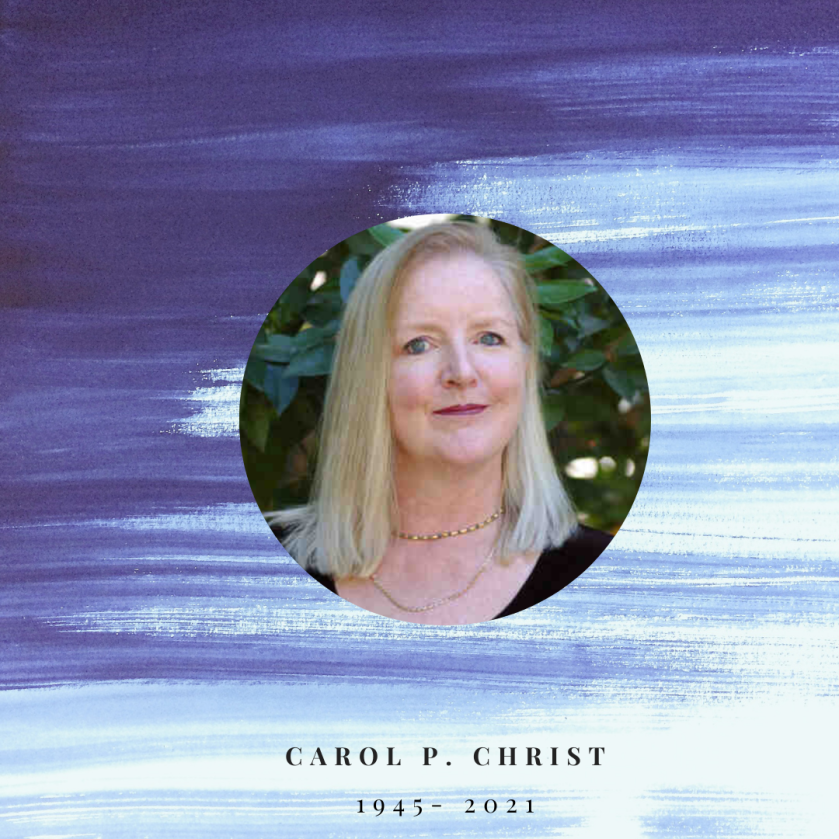
Legacy of Carol P. Christ: The Beauty Way

This was originally posted on January 22, 2018

When I learned about the Navajo Beauty Way, I understood it to be a path in which human beings respect all beings in the web of life and live in harmony with them. But I didn’t understand why this path was called the “Beauty Way.” As a young woman, I knew that my worth was defined by many in terms of my ability to conform to ideals of female beauty promulgated in movies, tv, and advertising. I didn’t believe the Navajos were talking about beauty in that sense, but because of my conditioning, I was not yet able to fully grasp what they might mean by beauty. I would have called the way they were describing a “Way of Harmony” or a “Way of Respect for Life.”

Still, I wondered: why the Beauty Way?

Continue reading “Legacy of Carol P. Christ: The Beauty Way”

The Queen, the Memory-Keeper (Women in the Book of Daniel, part 1) by Liz Cooledge Jenkins

Note: This is the first in a two-part series reflecting on women in the biblical book of Daniel.

I recently had the chance to take a deep dive into the biblical book of Daniel. I think it’s the first time I’ve read the whole book of Daniel since I’ve started intentionally attending to the questions of feminist biblical interpretation: Where are women present? Where are women absent? What are they doing or not doing—perhaps prohibited from doing? How does this passage move its readers toward—or away from—gender equity and women’s empowerment? How does it speak to—or deny—women’s full humanity?

            The absence of women in most of the book of Daniel feels glaringly obvious to me.[1] The main characters include the Hebrew exile Daniel, Daniel’s three (male) friends, King Nebuchadnezzar, King Belshazzar, and King Darius. The angels look like men. The divinely appointed eschatological authority figure is described as being like a “son of man.” The particularly oppressive king who desecrates the temple, abolishes the ritual sacrifices, and sets up an “abomination that causes desolation”[2] is definitely male.

Where are the women?

Continue reading “The Queen, the Memory-Keeper (Women in the Book of Daniel, part 1) by Liz Cooledge Jenkins”

Remember! by Mary Gelfand

“There was a time when you were not a slave, remember that.
You walked alone, full of laughter, you bathed bare-bellied.
You say you have lost all recollection of it, remember! ….
You say there are no words to describe it;
You say it does not exist.
But remember.  Make an effort to remember.
Or, failing that, invent.”

From Les Guerilleres, by Monique Wittig, mid-20th Century French feminist writer

The first time I heard this quote from Wittig was in the mid-1990s when I took ‘Cakes for the Queen of Heaven,’ an introduction to feminist thealogy and the Great Goddess, created by the Women & Religion committee of the Unitarian Universalist Association.  Cakes was my introduction to Carol Christ, feminist thealogy, and the Goddess.  It changed my life forever.  I’ve been teaching this program for close to twenty years now and as my understanding of women’s history and the role of patriarchy in our suppression has deepened, I continue to find new resonances with Wittig’s words.

“There was a time when you were not a slave, remember that.”  This statement is relevant to all oppressed peoples and especially to women.  History tells us that enslavement was a part of European culture long before Africans were kidnapped into slavery on this continent.  Enslavement of the defeated was a common aspect of war, dating back to Biblical times.  Many aspects of the feudal system dominant in western Europe for centuries were little better than slavery. 

Continue reading “Remember! by Mary Gelfand”

The Return of the Goddess to Our Human Consciousness by Caryn MacGrandle

One of the over 700 granodiorite statues made of the Goddess Sekhmet almost 3500 years ago, “the Lady of the Place of the Beginning of Time.” 

Molly Remer of Brigid’s Grove, a fellow contributor here at Feminism and Religion recently wrote on the Mother Well section of the divine feminine app: “I feel like Inanna & Enheduanna are all around in recent months!”

Yes. I do as well.

A year or two ago, I read a book by Lauren Sleeman entitled ‘Behold’.  The premise of the book has remained with me:  a telling of the Goddesses, in particular Lilith, the Great Mother and Crone of the Cosmos, and Hekate, Goddess of the Dark Moon and the Mysteries of Life, who have been silently watching and waiting these past few thousand years to return to our human consciousness. 

Continue reading “The Return of the Goddess to Our Human Consciousness by Caryn MacGrandle”

From the Archives: Recognizing Abuse by Karen Tate

This was originally posted on March 8, 2019

I’ve been thinking a lot about abuse. Of course, most of us know about the domination, exploitation and  need for control meted out by patriarchy, but I wonder if we have actually normalized many abuses? Abuse in the home, in the workplace, in our culture. Perhaps  we accepted it unconsciously because so many of us are conditioned by religions that tell us to make noble sacrifice and tolerate suffering silently. I wonder if we’re calling it out when we see it – often and loudly – or if we’ve become conditioned to quietly accept the abuse with little push back.

My intent is not to offend anyone with this. I want to find common ground and defeat the polarization we find around us, but our President is the poster child for abusive behavior.  Do we recognize his lies and fear-mongering and so many of the ideas he gives credence and license to as abuse?  Not only is he eroding our democratic institutions but he poisons the political, social and cultural arena with negativity, fear and hate, rather than uplifting us and encouraging us to evolve and be the best version of ourselves. I equate him to poison in a well from which we must all drink.

Continue reading “From the Archives: Recognizing Abuse by Karen Tate”

Legacy of Carol P. Christ: The Ninth Touchstone: Repair the Web

This was originally posted on September 3, 2018

As I reflected on the Nine Touchstones again recently, I was pleased to discover that the first and the eighth touchstones are articulations of the central values of egalitarian matriarchal societies. Few of us live today in egalitarian matriarchies, and it would not be possible for all of us to return to cultivating the land. I offer the Nine Touchstones in the hope that they can help us to find a way to express and embody the values of egalitarian matriarchal cultures in the modern world. The touchstones are intended to inform all our relationships, personal, communal, social, and political.

Continue reading “Legacy of Carol P. Christ: The Ninth Touchstone: Repair the Web”

Legacy of Carol P. Christ: Walk in Love and Beauty: A Touchstone for Healing

This was originally posted on July 9, 2018

Nurture life.

Walk in love and beauty.

Trust the knowledge that comes through the body.

Speak the truth about conflict, pain, and suffering.

Take only what you need.

Think about the consequences of your actions for seven generations.

Approach the taking of life with great restraint.

Practice great generosity.

Repair the web

In Rebirth of the Goddess, I offered Nine Touchstones of Goddess Spirituality as an alternative to the Ten Commandments. The Nine Touchstones are intended to inform all our relationships, whether personal, communal, social, or political.

Continue reading “Legacy of Carol P. Christ: Walk in Love and Beauty: A Touchstone for Healing”

Herstory Profiles: Indian Royalty, Suffragette, Women’s Rights Activist by Anjeanette LeBoeuf

April is Sikh Awareness month which is incredibly important this year due to what is currently happening in the Punjab by the Indian Nation State. If you haven’t heard about the government shutdown largely targeting Sikhs, you can read here. To keep the focus on the Sikh Community, this post will be focused on the amazing royal turning fierce activist and suffragette – Sophia Duleep Singh.

Continue reading “Herstory Profiles: Indian Royalty, Suffragette, Women’s Rights Activist by Anjeanette LeBoeuf”

To Stand in the Presence of the Ancients! – Enheduanna, Part 1 by Janet Maika’i Rudolph

Ishtar controlling a lion ca 2334-2154 BCE

To be in the presence of antiquities is powerful. They carry an energy which is palpable.  I found this to be true at the recent exhibit at the Morgan Library in Manhattan that ran from October 14, 2022 through February 19, 2023. 

Enheduanna is a fascinating woman who lived in the lands of Mesopotamia circa the 23rd century BCE. She was a priestess who was also a writer and chronicler of her times. She named herself in her writings making her the first known author of any written works in history. She was so influential that for centuries after her death, scribes learned their craft in scribal schools by reading and copying out her work. Scholars have referred to her as the Sumerian Shakespeare[1]

Her main temple was in Ur, the very city that hundreds of years later gave rise to the biblical priestess Sarah and her husband, Abraham. We can only image how much they had been influenced by her.

Continue reading “To Stand in the Presence of the Ancients! – Enheduanna, Part 1 by Janet Maika’i Rudolph”

The Vows We Make, by Molly Remer

I make a vow of self-sovereignty,
a declaration of wholeness,
a promise to myself that I will keep:
I vow to listen to my heart,
to claim my power and my voice.
I vow to live my own magic,
to step into the center of my own life
and live from there.
I vow to live a life
that includes space for me,
to stand up for what I need,
to listen to my longings,
to honor my inner call,
to do my own work with trust.
I vow to never abandon myself.
I vow to inhabit my own wholeness
in all ways.

In February, I signed up for a Vow of Faithfulness class with WomanSpirit Reclamation. Guided by Patricia Lynn Reilly (of “Imagine a Woman” and A God Who Looks Like Me fame) and Monette Chilson, the class was based on Patricia’s book, I Promise Myself: making a commitment to yourself and your dreams. Structured as a seven week online women’s circle, the class took us on a deep dive into vow-making, culminating in a vow ceremony in which we made a public (to the class that is) declaration of our own vows to ourselves. As the class unfolded, I found myself reviewing past vows as well as sensing new vows bumping up against my consciousness, whispering to be heard.

Continue reading “The Vows We Make, by Molly Remer”