Goddess Lost: How the Downfall of Female Deities Degraded Women’s Status in World Cultures by Rachel McCoppin, Ph.D

In this blog post, I would like to take the opportunity to promote my new book, entitled:  Goddess Lost: How the Downfall of Female Deities Degraded Women’s Status in World Cultures. This book makes the assertion that women must be educated about the history of goddess worship around the world in order to adopt a comprehensive spirituality that fits what it means to be a woman.

Continue reading “Goddess Lost: How the Downfall of Female Deities Degraded Women’s Status in World Cultures by Rachel McCoppin, Ph.D”

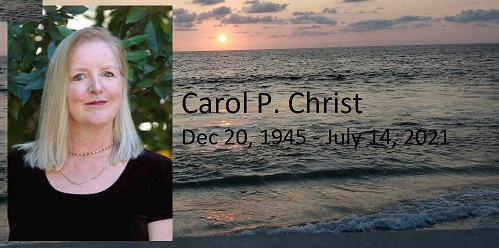
Legacy of Carol P. Christ: Maternal Gift Economy: Webinar Gifts

This was originally posted December 7, 2020

In the 1960s and 1970s, American-born Genevieve Vaughan was living in Rome with her husband, philosopher Ferruccio Rossi-Landi, and their three daughters. When Rossi-Landi, using Marxist models, began to write about language as a form of “exchange,” Vaughan was inspired to articulate her alternative theory based on the idea that language was developed and is learned through the gifts of the mother to the child. From that beginning, Vaughn developed an alternative theory of culture based on what she calls the “gift economy.”

Continue reading “Legacy of Carol P. Christ: Maternal Gift Economy: Webinar Gifts”

Herstory Profiles: Irish Women of Faith, Activism and Politics by Anjeanette LeBoeuf

As it is March, and March is a month for me that is always devoted to celebrating my Irish roots and women, my Herstory Profiles will be on a few exemplary women from Ireland: Brigid (Irish Goddess and Catholic Saint), Margaret O’ Carroll of Éile (Paragon of Leadership, Strength, and Compassion), and Mary Robinson (Historic Leader, Activist, and Humanitarian.)

Continue reading “Herstory Profiles: Irish Women of Faith, Activism and Politics by Anjeanette LeBoeuf”

Legacy of Carol P. Christ: Curiosity About Everything and the Language of the Goddess

The was originally posted on April 14, 2014

mochlos altar stone

My recent discovery of Marija Gimbutas on Youtube rekindled my admiration for her work. In her slide-lecture “The World of the Goddess” Marija Gimbutas allows us to follow the line of reasoning she used to decipher the “language of the Goddess” in Old Europe.

Careful attention to her lecture shows that Gimbutas did not close her eyes, dream, and then attach her own ideas and intuitions to the artifacts she later discussed. Rather, she catalogued groups of images with similar symbolism and used her knowledge of nature (what does a water bird or an owl look like?) and folklore (she collected thousands of songs connected to the agricultural and life cycles in her native Lithuania in the 1930s) to unlock the meaning of ancient symbols.

Continue reading “Legacy of Carol P. Christ: Curiosity About Everything and the Language of the Goddess”

Legacy of Carol P. Christ: GODDESS AND SACRED COW: A RE-EXAMINATION OF THE MYTHOLOGY OF THE SACRED BULL

This was originally posted on August 5, 2013

Most archaeologists and visitors to museums assume that when they see a horned bovine, they are faced with the image of the male God or the image of the bull sacrifice.  In the minds of many, these two are one, as we have been taught that the male God who was the consort or son-lover of the Goddess was sacrificed. Yet horned Goddesses are not infrequent in the history of religions and Hindus still revere the sacred cow.  

Cattle have played an important role in human life from the beginning of agriculture.  Cows provide milk which is also turned into butter, cheese, and yogurt.  Most of the young males and some of the females are killed for meat or leather, while a few males are kept to impregnate the females.  Though the “raging bull” is the lens through which most of us think about mature male bovines, I have been told by a friend who raised cattle that in fact bulls are for the most part gentle and even sweet–though of course they are also potentially dangerous.

Continue reading “Legacy of Carol P. Christ: GODDESS AND SACRED COW: A RE-EXAMINATION OF THE MYTHOLOGY OF THE SACRED BULL”

Legacy of Carol P. Christ: Reading Plato’s Allegory of the Cave as Matricide and Theacide

This was originally posted on October 22, 2012

When I read Plato’s allegory of the cave as an undergraduate, I was told it had something to do with the idea that the “form” of a table is more “real” than the table itself. I must confess that I had no idea what this could possibly mean.

As a graduate student, I struggled with philosophical and theological ideas rooted in Platonism.  Rosemary Radford Ruether named the flawed worldview created by a “classical dualism” that separates mind from body, spirit from the world, rationality from emotion, and male from female.  Her ground-breaking essay “Mother Earth and the Megamachine” clarified the difficulties I was having.

Continue reading “Legacy of Carol P. Christ: Reading Plato’s Allegory of the Cave as Matricide and Theacide”

Upgrade Complete – Reopened!

We are excited to have our new format and hope you enjoy it.

Thanks to Xochitl, we are back up and running in only two days. We needed to upgrade our site because our old theme was no longer being supported. We are hopeful that this will solve the issues people have been having in posting comments.

Change always involves new challenges and we assume this will be no different. If you notice any problems or would like to comment, please let us know by responding to this post or by email /feminismandreligionblog@gmail.com/.

We are excited to have our new format and hope you enjoy it. As always we are so grateful to the FAR community for supporting this important work.

And thank you for your patience.

Janet (with Xochitl) FAR co-weavers

That Old, Old, OLD Story – The Warts and Wisdom of the Ancient

My grandmother Clarine was an incredible human being. I absolutely could not be more proud to be her granddaughter. She started her first teaching position in 1927 at age 17. She met my grandfather in seminary; but despite her clear talent and call, the church apparently felt one minister was enough for the family and refused to ordain her. Undaunted, she famously wrote a one line reply to the bishop: Well, Moses got along fine without it, and Jesus got along fine without it, so I’ll be fine without it, too.

Continue reading “That Old, Old, OLD Story – The Warts and Wisdom of the Ancient”

Herstory Profiles: Activist Preacher Fannie Lou Hamer by Anjeanette LeBoeuf

Throughout the course of this year my monthly posts are going to spotlight extraordinary women; a FAR Herstory Journey. Our first Herstory profile will be Fannie Lou Hamer (1917-1977): a staunch Civil Rights, Voter Rights Singing Activist, Preacher.  

Continue reading “Herstory Profiles: Activist Preacher Fannie Lou Hamer by Anjeanette LeBoeuf”

Return to Mountain Mother[1] by Jeanne F. Neath

Mountain Mother, I hear you calling me.
Mountain Mother, we hear your cry.
Mountain Mother, we have come back to you.
Mountain Mother, we hear your sigh.

Lyrics by Carol P. Christ [2]. Sung to the tune of “Ancient Mother.” (origin unknown)

What do a bunch of feminist women do while riding a tour bus around the Mediterranean island of Crete? If they are on the Goddess Pilgrimage started by Carol Christ and continued by Laura Shannon, they sing songs honoring the Goddess. The song that drew me most from the first time I heard it on the fall 2022 Goddess Pilgrimage was “Mountain Mother.” Not surprising since the rocky, sparsely vegetated, yet hauntingly beautiful mountains of Crete surrounded us much of the time as our trusty bus wound its way up and down and around the island.

Continue reading “Return to Mountain Mother[1] by Jeanne F. Neath”