The Problem of Jehosheba: Reading One Biblical Character in Two Different Feminist Ways by Jill Hammer

Tucked away in II Kings 11 is the story of a mother-daughter feud that is personal, political, and ultimately fatal. Jehu, a charismatic military commander, is anointed by Elisha as the next king of the northern kingdom of Israel. Jehu kills the previous king of Israel, Jehoram, and also Jehoram’s mother Jezebel (yes, that Jezebel—the famous/infamous queen). As part of his violent rise to power, Jehu also kills Ahaziah, king of the southern kingdom of Judah. Ahaziah’s death should mean that Athaliah (Atalya), who is queen mother of Judah as well as the daughter of Jezebel, cedes power to a new king and a new queen mother. Instead, according to the Book of Kings, Athaliah has the rest of the king’s sons and grandsons murdered, and seizes the throne for herself. 

All seems lost for the Judean line, except that Jehosheba (Yehosheva), wife of the high priest Jehoiada and sister of the murdered King Ahaziah, saves one of Ahaziah’s sons, along with the child’s wetnurse, and hides them both in the Temple. Jehosehba keeps the boy, Joash, and his nurse in the Temple until he is six years old. At that time, Jehosheba’s husband, the high priest, anoints Joash king, stages a coup, and executes Athaliah as a usurper. Jehosheba’s action saves the Davidic line. The collection of Jewish legends known as Otzar Midrashim lists Jehosheba as one of the righteous women of the Jewish people.

Continue reading “The Problem of Jehosheba: Reading One Biblical Character in Two Different Feminist Ways by Jill Hammer”

Women, Life, Freedom زن زندگی آزادی : Let’s talk about the protests in Iran by Anjeanette LeBoeuf

Trigger Warning: This post deals with violence towards women, violence towards humans, and egregious abuses of power.

Women, Life, Freedom; Zan, Zendegī, Āzādī;  زن زندگی آزادی has become one of the main slogans for an incredibly important and crucial global protest that is taking place right now. For over 2 months, life and death protests are taking place in Iran. The protests are focusing on the perpetual degradation of human rights with women bearing a large brunt. Many have declared the current state affairs as gender apartheid. We need to be talking more about what is happening with the people of Iran and how best to support them. The protests were started after the brutal murder of a woman due to a portion of her hair being visible outside of her hijab.

Continue reading “Women, Life, Freedom زن زندگی آزادی : Let’s talk about the protests in Iran by Anjeanette LeBoeuf”

Unsung Heroines: Self-Worth takes Time: The Transformation of Angela di Foligno by Elisabeth Schilling

Angela di Foligno was a 13th century Umbrian Franciscan mystic who began her initiation on the spiritual path when she was almost 40. She was officially declared as saint in October of 2013. Her works were dictated to a relative who was scribe and a Franciscan brother in the church, and so we unfortunately do not have access to the complete depth and intimacies of her ecstatic visions and commentary (both she and her scribe discuss how he was writing in such haste and fear from admonishment from his religious brothers that it is a “short and defective version” of her experience). Nevertheless, as readers, there is still so much for us to gain in terms of inspiration and commiseration.

In “The First Twenty Steps of the Blessed Angela in the Way of Penance and Spiritual Perfection,” the Franciscan saint details the arduous journey of mastering both fear and love, a requirement to evolving in our human consciousness to realize our divine spark and transform shame. I want to discuss three aspects of this journey that relate specifically, as I see it, to the challenges set forth by many women: love for the body, love for one’s relational boundaries, and love for one’s time and space. Most cultures fail to honor women in all of their desires and powers, and so we must learn to honor ourselves and each other. Angela, as we shall see, was fiercely willing to honor herself.

Continue reading “Unsung Heroines: Self-Worth takes Time: The Transformation of Angela di Foligno by Elisabeth Schilling”

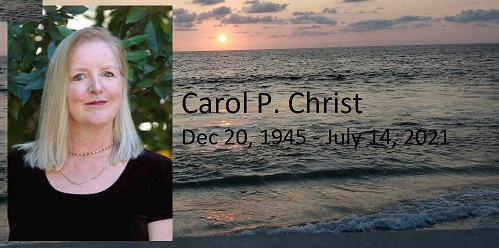
Legacy of Carol P. Christ: Can We Celebrate the Dark? Can We Sleep?

This was originally posted on December 19, 2019

According to Marija Gimbutas, the religion of Old Europe celebrated the Goddess as the power of birth, death, and regeneration in all of life. Agricultural peoples understand that seeds must be kept in a cold dark place during the winter if they are to sprout when planted in the spring. People who work hard during the long days that begin in spring, peak at midsummer, and continue through the fall, are grateful for the dark times of the year when they can rest their weary bones on long winters’ nights. Long winters’ nights are a time for dreams, a time when people gather around the hearth fire to share songs and stories that express their understanding of the meaning of the cycles of life.

The Indo-Europeans were not an agricultural people. Herders, nomads, and horseback riders, they celebrated the shining Gods of the Sky whose power was reflected in their shining bronze armor and shining bronze weapons. When the Indo-European speaking peoples entered into a Europe, they married their Sun and Sky Gods to the Earth Mother Goddesses of the people they conquered. These were unequal marriages in which the Sun was viewed as superior to the Earth. The unhappy marriage of Hera and Zeus reflects this pattern, as do the many rapes of Goddesses and nymphs recorded in Greek and Roman mythology.

Continue reading “Legacy of Carol P. Christ: Can We Celebrate the Dark? Can We Sleep?”

Biblical Poetry – Trees by Janet Maika’i Rudolph

Image from an Egyptian tomb ca. 1314-1200 BCE. Isis is giving nourishment in the form of fruit and drink,

In many cultures of the world, including our own, trees are considered the ancestors of humanity – own our ancestors.

Trees are connected with great goddesses throughout antiquity. We see this in the bible where, as I’ve noted before, the Tree of Life is Eve’s tree for the word Eve means life. It is, in essence, the Tree of Eve. Goddesses in trees feeding humans were common themes in ancient Middle Eastern art. The tree was Hers to give freely of as she wished.  

Anthropologist and religious scholar, Mircea Eliade writes extensively about the associations of trees ancestral connection to humans. He calls them both mystical and mythical.[1] His examples include the Miao groups of Southern China and Southeast Asia who “worship the bamboo as their ancestor.” He also notes Australian tribes who view the mimosa as their progenitor. And there is a tribe from Madagascar, called Antaivandrika which means “people of the tree,” who considered themselves descended from the banana tree.

Continue reading “Biblical Poetry – Trees by Janet Maika’i Rudolph”

Legacy of Carol P. Christ: It’s Time to Thank Stacey Abrams Again

This was originally posted on January 18, 2021

The insurrection in the Capitol on January 6 has dominated the news ever since. Coverage of the Democrats’ victories in the two Senate runoffs in Georgia has been virtually nil. Now that it seems that at least as long as the National Guard is deployed to defend the national and state capitols, the insurrectionists have been stopped, it is time to thank Raphael Warnock and Jon Ossoff–and most of all to Stacey Abrams–for returning control of the Senate to the Democrats.

As is well-known to most readers of FAR, Stacey Abrams narrowly lost the election for Governor of Georgia in 2018 due to voter suppression.

Voter suppression of voters of color and young voters is a scourge our country faces in states across the nation.  Georgia’s 2018 elections shone a bright light on the issue with elections that were rife with mismanagement, irregularities, unbelievably long lines and more, exposing both recent and also decades-long actions and inactions by the state to thwart the right to vote. 

Continue reading “Legacy of Carol P. Christ: It’s Time to Thank Stacey Abrams Again”

Legacy of Carol P. Christ: Practice Great Generosity

This was originally posted on August 20, 2018

Nurture life.

Walk in love and beauty.

Trust the knowledge that comes through the body.

Speak the truth about conflict, pain, and suffering.

Take only what you need.

Think about the consequences of your actions for seven generations.

Approach the taking of life with great restraint.

Practice great generosity.

Repair the web

In Rebirth of the Goddess, I offered Nine Touchstones of Goddess Spirituality as an alternative to the Ten Commandments. The Nine Touchstones are intended to inform all our relationships, whether personal, communal, social, or political.

The eighth touchstone asks us to practice great generosity.

Continue reading “Legacy of Carol P. Christ: Practice Great Generosity”

Legacy of Carol P. Christ: Restored in Beauty

This was originally posted on May 11, 2015

The path leading to the Klapados Waterfall begins at the edge of an open meadow in the pine and oak woodlands of a mountain in the island of Lesbos. After driving several miles on a very rutted dirt track, we parked under an oak tree, crossed the meadow and scrambled down a winding path. After about 20 minutes, it ended at a stream surrounded by plane trees. From there, we climbed over rocks to reach a pool created by the seasonal waterfall.

waterfall at klapados 1

On the day we visited it, the waterfall was only a trickle of cascading drops that moistened its moss-covered path to the pool. The roots of a plane tree growing at the top of cliff followed the path of the water, weaving a web over the rockface all the way down to the pool.

Continue reading “Legacy of Carol P. Christ: Restored in Beauty”

Legacy of Carol P. Christ: Tree-Hugging Is About Trees and So Much More Than Trees

This was originally posted March 11, 2019

Not too long ago I heard someone deride members of a seminar who were building labyrinths in the olive groves of Greece as “a bunch of tree-huggers.”  I bristled! I probably first heard of the Chipko tree-hugging movement which is led by women in the 1970s and 1980s. Because I love nature, I naturally assumed hugging trees is a good thing. Originally, I had no idea that the tree-hugging movement was about much more than saving trees from being felled in the interests of short-term profit.

I did not know that the deeper purpose of the movement is to save a way of life based on forest-culture that is being threatened by the imposition of western ideas and practices promoted by colonialism and its successor, the green revolution. Nor did I know that the traditional forest-culture of India is the provenance of women: more than 4000 years of observing and experimenting created a “women’s knowledge” passed down from mother to daughter.

Continue reading “Legacy of Carol P. Christ: Tree-Hugging Is About Trees and So Much More Than Trees”

Spill that Tea: Catholic Nuns, Meghan Markle, and Theological Feminism by Anjeanette LeBoeuf

I wrote a piece in March 2021 regarding the British Royal Family and their horrendous treatment of the Duke and Duchess of Sussex, Prince Harry and Meghan Markle. On August 23, 2022, Meghan released her first podcast episode for her series titled “Archetypes”. The first episode had guest speaker, famed legendary tennis player Serena Williams. They talked about the misconceptions of ambition and the two-edged sword that women have to endure in society when striving to be their best in a male centric world. And for many of us within Religious and Theological spaces, the disparities that women, queer folk, and non-binary peoples have endured in society are also tied into the misconceptions and harmful archetypes found within religious spaces.

Continue reading “Spill that Tea: Catholic Nuns, Meghan Markle, and Theological Feminism by Anjeanette LeBoeuf”