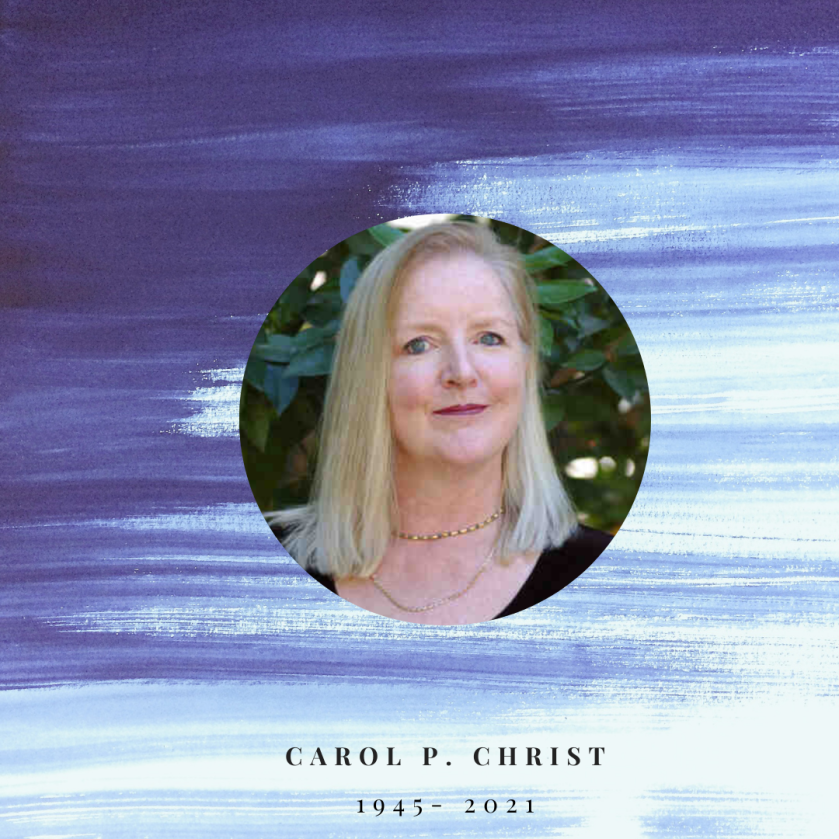
Legacy of Carol P. Christ: Somebody Almost Walked Off With All of My Stuff: And He Didn’t Even Know He Had a Thing of Value on the Open Market*

This was originally posted May 14, 2012

Gina Messina-Dysert’s blog on sexual harassment by a Religious Studies professor brought up memories that have haunted me for years. It has taken me some months to find the courage to post this story.

When I was an undergraduate, I was very naive and barely dating. I was not as prepared for college work as most of the other students, and I devoted myself to my studies.  I had a favorite professor, and I spent a lot of time in his office talking about books and about God.  This professor encouraged me to go on for a Ph.D. in his field at a time when a woman with a Ph.D. was an oddity.  His belief in my intelligence gave me the courage to overcome my parents’ opposition to the idea that I would pursue a doctorate. His recommendations helped me to win Danforth and Woodrow Wilson Fellowships. I naturally assumed that this professor respected me.   

Continue reading “Legacy of Carol P. Christ: Somebody Almost Walked Off With All of My Stuff: And He Didn’t Even Know He Had a Thing of Value on the Open Market*”

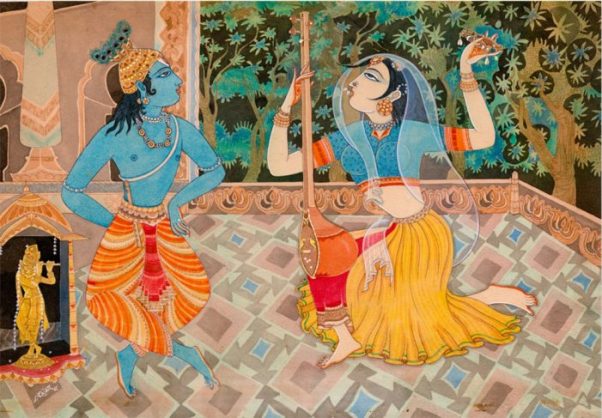
Herstory Profiles: Love, Devotion, and Ecstasy in the life of Indian Poet Mirabai by Anjeanette LeBoeuf

Mira was born in Northwest India in 1498 CE. She is considered a 16th Century Hindu Mystic, Poet, and Wandering Devotee of Krishna. Her relevance and importance is cemented in the moniker given to her of Bai. Bai, is a honorific ending which can also mean elder sister.  Mirabai is quite known throughout India and even across religious traditions. She is a celebrated Bhakti Saint whose devotion to the god Krishna is now lauded and praised.

Mira was born into a Rathore Rajput Royal Family (in modern day Rajasthan). It is said that from the very young age of 5, Mira expressed her devotion to Krishna. Her upper caste status did allow Mira to have access to education and religious practice. But her status also came with forced responsibilities. Mira was forced into a marriage to the crown prince of Mewar and would become a widow five years later. Her father and father-in-law would also later die during the ongoing struggles with Babur, the first Mughal Emperor. As she was still considered part of the Mewari royal family, her remaining in-laws tried to assassinate her on multiple occasions. Some of the attempts included sending her a vial of poison disguised as nectar and a basket of flowers which contained poisonous snakes.

Continue reading “Herstory Profiles: Love, Devotion, and Ecstasy in the life of Indian Poet Mirabai by Anjeanette LeBoeuf”

Legacy of Carol P. Christ: THE CARELESS SPIRIT OF ANNIE CORLISS: TRUMPING DESPAIR IN THE NEW WORLD

This was originally posted on April 2, 2012 and updated on December 30, 2016

Annie Corliss was my great-great-grandmother. The Corliss name, also spelled Corlis, Corless, Corlies, Corlers, and Carlis, is derived from “careless” meaning someone who is “carefree” or “happy-go-lucky.”

Annie Corliss was the daughter of James and Mary Corliss, both born in Ireland. Her parents may have been tenant farmers, but given that their surname could refer to someone who doesn’t settle or own property, they may have been Irish Travellers– itinerant craft persons and traders, sometimes called tinkers because they mended cooking pots and farm implements.  “Irish Travellers are a traditionally nomadic people of ethnic Irish origin, who maintain a separate language and set of traditions. … Irish Travellers have their roots in a Celtic (and possibly pre Celtic) nomadic population in Ireland.”

Continue reading “Legacy of Carol P. Christ: THE CARELESS SPIRIT OF ANNIE CORLISS: TRUMPING DESPAIR IN THE NEW WORLD”

Margins for Magic, by Molly Remer

My ritual today
is to forgive myself
and to begin again
with what I have….

A rite of renewal:
Step out under the sky
whether it holds thunder or sun.
Rest your hands against your heart.
Say: I am here.
I am grateful.
Open your arms to the sky.
Feel air soothe you
and wind bless you.
Say: I am radiant in my wholeness.
I am loved.
Sweep your arms down
to touch the Earth (or the floor.)
Say: I am connected.
I belong.
Settle your hands against your belly.
Say: I am centered.
I am powerful.
I am strong.
Return your hands to your heart.
Wait.
The sacred will meet you here.

We pause today in the middle of the road to listen to a mockingbird perched in a crabapple tree by an abandoned house. In clear and rapid succession, it runs through its impressive repertoire: Phoebe, cardinal, chickadee, titmouse, laser-gun, a few extra trills and beeps and back again. We stand, heads cocked and silent, to experience the performance before walking on with a smile, pausing again to inhale deeply as we pass the wild plum trees so sweet and fleeting. I have been preoccupied with projects, feeling bright, creative energy burgeon inside me as it does around me, so many things tug at the mind and ask for time, leaving my dreams restless, my eyes wild, and my mind awhirl with both pressure and possibility, a persistent urgency that calls me on and away and out of being where I am. On the way back home, we stop again because there are five red winged blackbirds, conversing by the neighbor’s pond and we circle through the grass to examine white flowers in the pear trees and to check for peach blossoms (none). I love spring in Missouri, it restores and nourishes me. It reminds me I am home. I sit with my tea listening to a distant chainsaw and the wild turkeys in their rites of spring, a light rustle of wind, and the clinking of my flattened spoon wind-chimes from years gone by. A lone crow glides in to alight on an oak tree beneath the sun. It tips back and forth briefly, wings a satin shimmer in the sunbeams and then drifts away like a black kite through the spring sunshine. I have joked that the description of my next book could be:  “I sat. I saw these things.” And, this is true, for I did, and this is my news for today.

Continue reading “Margins for Magic, by Molly Remer”

Legacy of Carol P. Christ: 1, 2, 3, 4: FEMINISTS DON’T WANT ANOTHER WAR

This was originally posted on March 19, 2012

War is a feminist issue for many reasons, most importantly because war is always war against women.

Patriarchy, war, rape as the “spoils” of war, and the taking of women and children as slaves in the wake of war arose together.  Recent blogs on Feminism and Religion have addressed the war on women—from the rape culture, to Humane Vitae, to the Catholic Church’s and other church’s  attempts to remove birth control from health care, to the tolerance of sexist hate speech in the culture at large. While the issue of Rush Limbaugh calling Sandra Fluke a slut is being focused on in the press, the drums of war are being sounded again in the Middle East:  the US is considering bombing Iran or supporting Israel if it decides to do so.  Feminists must stand together against war and the harm it does to women, children, and all living things.

Continue reading “Legacy of Carol P. Christ: 1, 2, 3, 4: FEMINISTS DON’T WANT ANOTHER WAR”

Archives from the FAR Founders: We are Worth the Time it Takes to Create a Practice by Xochitl Alvizo

Incarnation, Goddess spirituality, Xochitl Alvizo, god became fleshThis was originally posted on September 10, 2014. It seems relevant to me these days as I continue to develop practices for my groundedness, community, and well-being. 

Recently, in response to the excellent conversation following Nancy Vedder-Shults’ post on the goddess Kali, Carol Christ commented to Nancy, “I too love our conversations, wish there was more in depth talk on our blog [FAR], maybe there will be.” Carol’s comment* struck a deep chord within me. One of the main objectives that the FAR co-founders had in creating Feminism and Religion was that it be a place where we could and would engage with one another across a diversity of feminist issues and the broad range of feminist passions and work – where we could discuss, critique, and build upon on each other’s efforts.

So two things came to mind as I reflected on Carol’s comment. The first was my personal lament that I have not been as actively participating in the discussions that follow the FAR blog posts as I did when we first started Feminism and Religion. FAR has such rich and valuable material – it really does provide a great opportunity for conversation and dialogue – and sadly I have been a passive participant as of late. I read and learn from the discussions, but I have not been joining in. I lament that. FAR is definitely a place where I could engage with others in deep conversations, but how actively am I actually doing this? Continue reading “Archives from the FAR Founders: We are Worth the Time it Takes to Create a Practice by Xochitl Alvizo”

Legacy of Carol P. Christ: EASTER OF THE GODDESS: A VIEW FROM GREECE

This was originally posted on April 16, 2012

On Good Friday, Easter Saturday, Easter Sunday, and Easter Monday the blogs on feminismandreligion.com celebrated mothers and God the Mother.*

 This is my body, given for you.
This is my blood, given for you.

While these words are the center of a Christian liturgy celebrating the sacrifice of Jesus as the Christ, they are more appropriately spoken of our own mothers. Your mother and my mother and all mothers, human and other than human, mammalian, avian, and reptilian, give their bodies and blood so their offspring might have life. True, mothers do not always make conscious choices to get pregnant, but almost all mothers affirm life in their willingness to nurture the young who emerge from their bodies and from their nests. Had mothers—human and other than human–not been giving their bodies and their blood from time immemorial, you and I would not be here.

Continue reading “Legacy of Carol P. Christ: EASTER OF THE GODDESS: A VIEW FROM GREECE”

Legacy of Carol P. Christ: LET’S ASK MITT IF MORMON PATRIARCHAL BELIEFS AFFECT HIS VIEWS ON WOMEN’S EQUALITY

This was originally posted on September 10, 2012. Moderator’s Note: While Mitt Romney is not running for office at this time, there are many politicians, of varying religions, who are and who deserve to be questioned in this manner.

Why has Mitt Romney’s Mormon faith mostly been a non-question in his political life?  John Kennedy was asked if he would obey the Pope or make his own decisions, Jimmy Carter was asked how his Baptist faith would affect his Presidency, and Barack Obama was asked if he agreed with the sermons of his preacher.  Why is the press afraid to ask Mitt Romney if he agrees with the patriarchal teachings of his church and if so, if this affects his views on the rights of women?

Like other patriarchal institutions, the Mormon Church believes that women’s place is in the home.  Every Mormon man is a priest and a patriarch in his own home.  Mormon belief teaches that men are to make the final decisions in the family, that only they can be leaders in the church, and that they are the members of the Mormon community who should speak and act in the public (non-home) dimensions of life.  Traditional Mormons believe that “ [The] LDS [woman is] always [to] accept counsel from her husband, and not as just his opinion, but as God-inspired revelation.” 

Continue reading “Legacy of Carol P. Christ: LET’S ASK MITT IF MORMON PATRIARCHAL BELIEFS AFFECT HIS VIEWS ON WOMEN’S EQUALITY”

Legacy of Carol P. Christ: Why a Goddess Pilgrimage?

This was originally posted on October 1, 2012

What is a Goddess Pilgrimage and why are so many US, Canadian, and Australian women making pilgrimages to ancient holy places in Europe and Asia?  The simple answer is that women are seeking to connect themselves to sources of female spiritual power that they do not find at home.

Traditionally pilgrims leave home in order to journey to a place associated with spiritual power.  “Leaving home” means leaving familiar physical spaces, interrupting the routines of work and daily life, and leaving friends and family behind.  For the pilgrim, “home” is a place that has provided both comfort and a degree of discomfort that provokes the desire to embark on a journey.  The space of pilgrimage is a “liminal” or threshold space in which the supports systems of ordinary life are suspended, as Victor Turner said.  A pilgrim chooses to leave the familiar behind in order to open herself to the unfamiliar—in hopes that she will return with new insight into the meaning of her life. 

Continue reading “Legacy of Carol P. Christ: Why a Goddess Pilgrimage?”

Making Room for Reverence by Kelly Applegate-Nichols

While the Goddess spirituality movement runs alongside the women’s and feminist spirituality movements, I am certain the Goddess herself looks on with wonder and pride at Her creations. I am sure that it pleases Her to see women so devoted to self-sovereignty, and the fierce determination to get out from under the lash of patriarchy, to stand as women together, united in our passion for a better world.

While I know in my heart that we are continually held in the mind of the Goddess, I am called to wonder, how often is She in ours?

Though we make great strides together in our common goal of freedom and peace, some of us seem to be less at peace than ever before; there seems to be an undercurrent of loneliness, of disconnection. Lately, I’ve been thinking, it is at least possible that the thing that keeps us up at night is less about the state of the world, and more about the sometimes tenuous connection with our Mother. We may be so focused on self-empowerment that we have forgotten that there is another power, a “higher power” if you will. And She wants to commune with us.

Continue reading “Making Room for Reverence by Kelly Applegate-Nichols”