Book Review by Mary Sharratt: ESTHER by Rebecca Kanner

esther


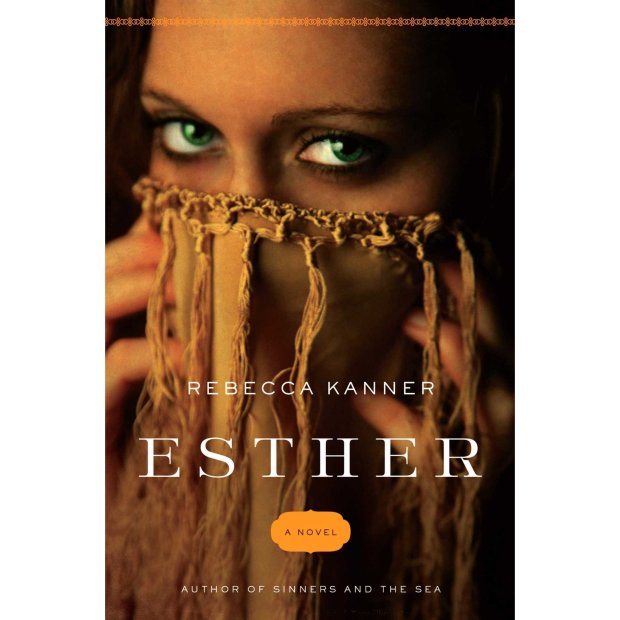
We have been lost to each other for so long. My name means nothing to you. My memory is dust. This is not your fault or mine. The chain connecting mother to daughter was broken and the word passed into the keeping of men, who had no way of knowing. That is why I became a footnote, my story a brief detour between the well-known history of my father and the celebrated chronicle of my brother.

-Anita Diamant, The Red Tent

To a large extent, women have been written out of history. Their lives and deeds have become lost to us. To uncover the buried histories of women, we must act as detectives, studying the clues left from ages lost.

At its best, historical fiction can write women back into history and challenge our misconceptions about women in the past. Anita Diamant’s novel, The Red Tent, became such an iconic classic because she turned our stereotyped image of women in the Old Testament on its head by allowing the biblical Dinah to tell her own story in her own voice. Continue reading “Book Review by Mary Sharratt: ESTHER by Rebecca Kanner”

Painting Herstory: Our Lady of Silver Lake by Angela Yarber

angelaIt has become my new routine during the first phase of my queer little family’s year-long journey. After completing my chores, I run along the trails surrounding Silver Lake and once I’m thoroughly drenched in sweat, I grab a book and push our enormous 15-foot canoe into the frigid waters of the little lake we’re calling home for three months. With a smile that has yet to wipe off my face, I paddle fiercely. I’m typically the only person on the lake.
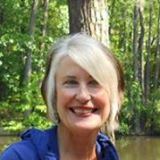
It’s a steep mile hike from the trailhead, and we’re the only ones “living” here for the summer, so my giant green canoe ripples the silvery waters in solitude. Once I find the right spot, I stuff my life vest behind my head and cozy down into the belly of the canoe, book in hand, goofy grin still spread across my flushed face. In the warmth of the sun, I read. In the belly of the canoe, I drift into the history of the lake, the unwritten annals lapping alongside my rocking boat, the portions on record filling the book in my sun-warmed hands.

The author who wrote the history of Silver Lake, William Powers, hiked up with several autographed copies in his rucksack several days after our arrival. He’s a nice man who wrote a nice book. There’s nothing like reading about the history of a place while in the place. Hear me say this clearly: there’s nothing wrong with the nice book this nice man wrote. The stories of Frank Chandler feeling a call from God to build a place for religious camp meetings along Silver Lake’s shores are fascinating, an interesting part of the history of camp meetings that filled the Awakenings throughout the United States. But as I read about Frank Chandler and the various men who the logged roads hikers now hike and built the buildings that haven’t existed for years due to fire, I couldn’t help but notice who was missing. Continue reading “Painting Herstory: Our Lady of Silver Lake by Angela Yarber”

My Tribute to Joy and Vera by Esther Nelson

esther-nelson

My daughter Joy, in so many ways, is like my mother Vera–competent, feisty, determined, smart, no-nonsense, generous, gracious, and loving.  Many of her mannerisms mimic Vera’s as well, yet Joy barely knew my mother.  She died soon after Joy’s fifth birthday.  Unlike both my mother and me, though, Joy came into the world wired with a feminist vision.  Comfortable in her own skin from the “get-go,” she did not shrink from asserting her right (quietly–she’s an introvert) to participate in whatever caught her fancy “out there.”  She always had a strong sense of autonomy and resists, along with other feminists, when men (or to be more accurate–the patriarchal social system that informs us) attempt to shape public policy based on (primarily) men’s experiences and political agendas.

It took some time for me to understand the structured (and toxic) nature of gender inequality within our society, and even more time to learn to “speak that truth to power.”  During Joy’s formative years, I tried my best to instill into her what I had been taught–women were created primarily to be “help-meets” for their husbands and by extension, men.  Joy never bought into that “truth.”  I could tell by the way she lived.  For example, Joy liked to cook.  When she prepared a dish, she balked if (when) family members just helped themselves to the fruits of her labor.  She insisted they first ask to partake of the food she prepared.  She would not be taken for granted. Continue reading “My Tribute to Joy and Vera by Esther Nelson”

The Goddess of Willendorf and Does My Uterus Make Me Look Fat? by Molly

editMollyNov 083

 “Loving, knowing, and respecting our bodies is a powerful and invincible act of rebellion in this society.”
~ Inga Muscio

I do not remember the first time I ever saw her, but I do know that I have loved the Goddess of Willendorf sculpture for many years. When someone uses the phrase, “Great Goddess” or “Great Mother,” she’s the figure I see. To me, she honors the female form. I love her full-figure and the fact that she is not “perfect” or beautiful. I love that she is not pregnant* and what I like best is that she is complete unto herself. She is a complete form, not just a headless pregnant belly. She represents a deep, ancient power to me.

In a past post for FAR, I wrote:

I have a strong emotional connection to ancient Paleolithic and Neolithic goddess sculptures. I do not find that I feel as personally connected to later goddess imagery, but very ancient figures call to something deep and powerful within me. I have a sculpture of the Goddess of Willendorf at a central point on my altar. Sometimes I hold her and wonder and muse about who carved the original. I almost feel a thread that reaches out and continues to connect us to that nearly lost past—all the culture and society and how very much we don’t know about early human history. There is such a solid power to these early figures and to me they speak of the numinous, non-personified, Great Goddess weaving her way throughout time and space.

via Echoes of Mesopotamia by Molly Meade |.

Continue reading “The Goddess of Willendorf and Does My Uterus Make Me Look Fat? by Molly”

Writing: Changing the World and Ourselves. By Ivy Helman

I still remember the first tim20140903_180423e I read Mary Daly’s Gyn/Ecology. It awoke something within me. Her use of language, the power of her writing and the ease with which she created new words taught me so much about the world around me and about the way the language, and subsequently its use in writing, shapes lives, choices, abilities and destinies. She also taught me about myself.

I was hooked, but not just on Mary Daly. Shortly after I finished her book, I moved onto other feminists writing about religion like Katie Cannon, Judith Plaskow, Alice Walker, Carol Christ, Rita Gross, Gloria Anzaldua, Audre Lorde, Adrienne Rich, Margaret Farley and Starhawk to name just a few. All of them, in fact every feminist I’ve ever read, has shown me the way in which words have power and how words speak truth to power. Ever since, I’ve wanted to be the kind of writer whose words carry a power that not only affects people but also inspires a more just, more equal, more compassionate and more humane world. In other words, I wanted to be a writer activist.

Yet, I’ve always carried around with me a sneaky suspicion that people don’t consider writers true activists. If you aren’t holding a sign, screaming or participating in some sort of public demonstration or civil disobedience, then you have no right to call yourself an activist. Is that really true? Continue reading “Writing: Changing the World and Ourselves. By Ivy Helman”

Inner and Outer Darkness in the Skoteino Cave by Coleen Clare

Coleen ClaireLast fall I undertook the Ariadne Goddess Pilgrimage to Crete and saw many wonders. Foremost for me was our descent into the Skoteino Cave, following in the footsteps of ancient Cretans who understood the cave to be the Source of Life, the womb of the Goddess, and a place of transformation. I ventured down tentatively taking very wary steps, protecting my two new hip replacements, determined to join our sacred ritual in the cave with my sisters. My hips called a stop to my descent half-way down. I perched perilously on a small rock ledge and there I confronted inner and outer darkness. It was indeed a profound transformation. Continue reading “Inner and Outer Darkness in the Skoteino Cave by Coleen Clare”

Every Woman has a Story by Gina Messina-Dysert

Gina Messina-Dysert profileRecently, Carol Christ wrote about her experience of being interviewed for the Women’s Living History project at Claremont Graduate University.  It is a project I have co-founded and am continuing to develop; I am grateful that Carol and others have offered their “herstories” to be archived.  While I am not a historian, I do have a strong interest in women’s stories and with important reason…if we do not tell our stories, who will?

I first became interested in oral history during my doctoral program when I took a course with Claudia Bushman focused on women’s autobiography.  It was a difficult time; my mother had passed away unexpectedly and I was consumed with grief.  Because her death was premature – she was only 56 years old – I hadn’t prepared to lose her. I thought I had years to figure out all the things I would want to remember and pass on about my mom.  Yet, she was gone and I could no longer ask her the many things I wanted to know, needed to know about her.  Parts of her story would be lost forever and I did not know how to cope with that.  Continue reading “Every Woman has a Story by Gina Messina-Dysert”

WHEN THE OLYMPICS CELEBRATED THE STRENGTH OF GIRLS AND THE RENEWAL OF LIFE by Carol P. Christ

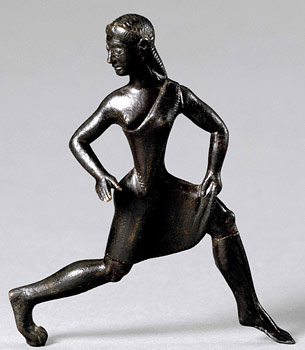
The first “Olympics” were races of girls of various age-groups around a 500 foot stadium in ancient Olympia. The races of girls were held every four years on the new moon of the month of Parthenios (September/October). They were dedicated to Hera Parthenos who renewed her virginity in the river Parthenias. The winners of the races wore olive crowns and feasted on the flesh of Hera’s sacred cow.

These “Olympics” for Hera and for girls came before the more celebrated Olympics for men that were dedicated to Olympian Zeus. The temple of Hera at Olympia is older than the temple for Zeus and the girls’ Olympics were tied to the more ancient lunar calendar.

What did the girls’ Olympics celebrate? Continue reading “WHEN THE OLYMPICS CELEBRATED THE STRENGTH OF GIRLS AND THE RENEWAL OF LIFE by Carol P. Christ”