Ignorance and Invisibility by Ivy Helman

20140903_180423According to the United States Holocaust Memorial Museum, the Jewish population of Czechoslovakia numbered some 357,000 in 1933. By 1950, it was recorded to be 17,000. To be sure, some escaped to Israel or the United States. Yet, within the modern boundaries of the Czech Republic, some 77,000+ perished. You can find the names of the dead inscribed on the walls of Prague’s Pinkas Synagogue. The Jewish community here remains extremely affected by the effects of WWII and the lingering legacy of communism.

How much of that did you know? Did you know that Prague is home to what the Nazis once wanted to call the “Museum of an Extinct Race”? Did you know that most of the synagogues in this entire country are boarded up, torn down or used for something else? Did you know that the entire Jewish Quarter of Prague was almost destroyed until someone stepped in and persuaded others to preserve it? Did you know that Western media is saying that Jewish life in Prague is undergoing a grand rebirth, while at the same time, most tourists leave Prague thinking there are no Jews here anymore? Continue reading “Ignorance and Invisibility by Ivy Helman”

Pesach, Patriachy and the Unfinished Work of Liberation.

headshot2Pesach, or Passover, begins tomorrow at sunset. It has always seemed strange to me that a festival centered on liberation begins with a focus on housework and cleanliness to the point where one is almost a slave to the process of chametz (leavened food) removal.  Not only that, but the spiritual interpretation of what the chametz represents adds to this conundrum.

The Rabbis of the Talmud teach us that chametz represents egotism and arrogance. The divine instruction to eat only unleavened bread for the festival of Pesach is a call to cultivate humility because they believe that our inflated sense of self-worth causes harm to other human beings as we value ourselves and our lives more than them. As we remove the chametz from our homes, we are also supposed to be removing the self-centeredness, arrogance and egotism within ourselves. Cultivating humility redirects our attention to all those parts of our lives that have suffered by being too self-centered, including our relationship with the Holy One. Continue reading “Pesach, Patriachy and the Unfinished Work of Liberation.”

The Politics of Miztvot by Ivy Helman

headshotRecently, Ben of Ben’s Tallit Shop commented on an older post of mine on this website entitled: “How Literal is Too Literal? My Experience with Tallit Katan.   He wrote, “In my opinion, it makes sense to first try the mitzvah of tzitzit in private for a month or two to ensure you are undertaking it for the right reasons.  Making a political statement is not a valid reason (though some people, I imagine, would argue otherwise).  Mitzvahs and politics don’t mix.”

First of all, this comment is both sexist and patronizing!  A man would never suggest to another man to do what he suggested I do and “try the mitzvah… in private… to ensure you are undertaking it for the right reasons.”  I’d dismiss it entirely if I was that kind of person, but I’m not.  Sexism and patronizing aside (as if one could do that really), I would like to engage with his thoughts on the mixing of politics and mitzvot because I think that can lead to great reflection and insight for Jewish feminists.

Not all mitzvot have an inherently political nature, but many do.  In fact, one could even argue something as seemingly apolitical as lighting Shabbat candles could be political.  Lighting candles ushers in Shabbat peace for one’s household and ideally for one’s community even if that peace is only for one day a week.  Since this is at odds with the world’s political environment of fighting, war and violence, it could be interpreted as a political act.  After all, won’t every day in the redeemed world be Shabbat? Continue reading “The Politics of Miztvot by Ivy Helman”

Deciding to Leave or Remain in the Religion of Your Birth – Part II by Judith Plaskow

Photo by Manhattan College

This is a response to Carol P. Christ’s blog of April 29, 2013 on why she decided to leave the Christian tradition. Carol and I discuss these questions further in our forthcoming book Goddess and God in the World: Conversations in Embodied Theology.

You raise the important question of what factors lead feminists to leave or remain within the religion of their birth. Your central challenge to me is how I can commit myself to a tradition in which God is imagined as a violent warrior when these images have harmed and continue to harm women and the world. How can I not recoil from using such images in worship? Why is the power of symbols less important to me than to you?

The first thing I would say is that, like you, I find these images profoundly problematic. One of the projects I have taken on in my retirement is reading the Bible from cover to cover, and I was appalled in going through all the prophets together at the amount of violence in their teachings. When I have spoken on the topic of dealing with difficult texts in the Jewish and Christian traditions—a subject that is dear to my heart—I always talk about God’s violence in addition to texts that demean women. And, yes, I have sometimes asked myself how I can remain part of a tradition in which God is depicted in this way. So I do not disagree with your critique of this imagery, but obviously for me, it is not decisive. Why not? Continue reading “Deciding to Leave or Remain in the Religion of Your Birth – Part II by Judith Plaskow”

Gender in Kabbalah by Judith Laura

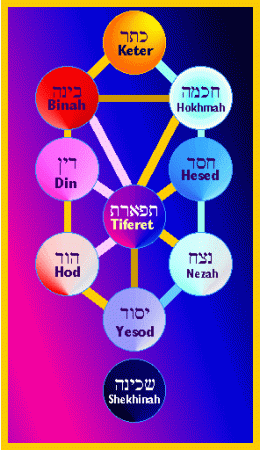
Judith LauraI first started delving into both Jewish Kabbalah and Hermetic Qabalah in the 1990s, after friends told me these forms of mysticism included both female and male representations of divinity and therefore were gender equitable. They were right about the first part: Kabbalah/Qabalah contain both divine masculine and feminine imaging and male and female images.  But as far as gender equity goes, to use today’s slang, not so much!

tree of life kabbalah

Though they are both transliterations of the same Hebrew word, as is common I use “Kabbalah” for the Jewish versions, and “Qabalah” for the Hermetic version, best known through its association with the British Hermetic Order of the Golden Dawn, which began in the 19th Century. The word means “that which is received,” with the understanding that it was “received” from ancient times. Though there is one tradition that says Adam was given Kabbalah in the Garden of Eden, the first written material for Kabbalah, Sefir Yetsirah (Book of Creation), is dated to between 200 and 500 C.E. Kabbalistic concepts changed over the centuries, with writings becoming more significant in the 13th century and even more popular in the 16th and 17th centuries.

Beginning with the Sefir Bahir (Bright Book) in late 12th century France, Kabbalah is represented by the Tree of Life, which has round areas transliterated sefirot (Heb. pl.; sing. sefirah) that I think of as fruit and others call “spheres,” but which in the Bahir, are more accurately translated “sapphires.”*  These “divine emanations,” as they are often called in English, are gendered. How equal is the gender representation? Continue reading “Gender in Kabbalah by Judith Laura”

How literal is too literal? My Experience with Tallit Katan. By Ivy Helman

I tried a new spiritual practice yesterday.  I wore a tallit katan.  It is commonly worn by Orthodox, Hasidic and other Ultra Orthodox men and boys from the age of 3 onward and usually not worn by women within these communities.  Occasionally, one can see Jews (mostly men) from Conservative shuls wearing these garments and rarely from Reform congregations.  They seem to be a marker of a more observant Jewish practice that reads much of the Torah literally.  One is commanded to wear fringes (tzitziyot) when wearing four-cornered garments as reminders of the covenant between G-d and the Jews and more specifically of the 613 commandments.

There are a number of reasons women and men from Orthodox and ultra Orthodox communities give for discouraging women from the wearing of tallit katan and tallit gadol.  First, women are said to be exempt from time-bound mitzvot, or commandments .  Wearing tzitziyot are considered time-bound because the Torah says one should be able to see them which has been interpreted to mean that they be worn during the day.  The reason given that women are not held to time-sensitive mitzvot has to do primarily with their childcare responsibilities.  Children and fulfilling their needs often requires much time and may not allow one to complete a task within a given time frame.  A related ideology says that women are often generally thought to be more spiritually attuned, and therefore do not need such physical reminders to follow the mitzvot. Continue reading “How literal is too literal? My Experience with Tallit Katan. By Ivy Helman”

Reflections on My Spiritual Journey: Claiming Judaism By Ivy Helman

“Is Ivy Helman Jewish?”   This question and knowing that eventually I’d have to respond one way or another to it has caused me many sleepless nights.  At the same time my faith journey has become integral to who I am and I would like to spend some time today sharing it with you.

Why share this and why now?  Well, first, I have not been ready until now.  In addition, external forces which I will talk about in a minute are making my spiritual path an issue.  So I share my story with a measure of concern about its possible effects but also with a great deal of joy about the ways in which my faith journey has challenged me to grow, reflect and change.

Margaret Farley emailed me about two weeks ago asking me how I identified religiously.  Someone had emailed her asking if I was Jewish because this person had read one of my past blogs in which I wrote “my rabbi” on feminismandreligion.com.  This same person is reviewing my book: Women and the Vatican: An Exploration of Official Documents.   Here is how I answered Margaret: “Hi Margaret, I’m Catholic although I do attend services at a Jewish synagogue on occasion since I was raised in essentially a multi-faith home.  On that blog, there really is no Jewish voice, so I try to comment on ideas from that tradition as much as I can.  Ivy.”  I felt unauthentic sending that email.  But, I did.

Still troubled by that answer and rather than put my friends and colleagues in the middle of questions about my faith, I feel that this has now become a public issue that I must address.  It is a question I have known I would have to answer at some point.  Nevertheless, this is not a decision that came easily or quickly.  I’ve literally agonized over it now for months.  During the time, I’ve never questioned my resolve to be Jewish and to continue to follow that spiritual journey in my life; I’ve worried more about how other people will respond and how their responses will affect my career in academia.   If I were allowed to rewrite that email to Margaret, then this is what I would say. Continue reading “Reflections on My Spiritual Journey: Claiming Judaism By Ivy Helman”

RE-SOULING ON SHABBAT BY IVY HELMAN

I attended a service at Congregation Shalom in Chelmsford, MA two Fridays ago.  During the service, Rabbi Shoshana Perry spent a few minutes addressing the last word of a Hebrew prayer found in the Reform siddur, Mishkan T’filah.  It was translated in the siddur as “God rested” but the Hebrew word used was vayinafash, which comes from the word nefesh, or soul.  The prayer emphasizes on the seventh day that God did not rest as much as God took time out to re-soul.  Rabbi Perry believes that our Shabbat should be spent doing things that help us also re-soul.

Initially, I spent quite a long time considering why God would need to re-soul and what exactly God would do to re-soul.  When I realized the futility of trying to sort that out, I moved a little closer to home: what do I do on Shabbat to re-soul?  I was quite overwhelmed trying to answer this question as well.

Traditionally, Shabbat is about study, rest, prayer and family among other things.  In fact, many Jews avoid creative processes like writing, cooking, painting, driving and working because God rested from creative work on the seventh day.  (Incidentally, our creativity is also how we are considered to be made in the image of God).  Part of the reason this idea struck me so deeply is because I often find painting, cooking and writing rejuvenating. Continue reading “RE-SOULING ON SHABBAT BY IVY HELMAN”