Uppity Women Unite by Barbara Ardinger

Barbara ArdingerI have a poster on my wall: UPPITY WOMEN UNITE. In big, red, capital letters. I don’t remember where I got this poster, but I know I’ve had it since the late 70s or early 80s. I’m sure it comes from the raggedy late 60s, when second-wave feminism got up a head of steam and uppity women began getting our attention. That’s when Betty Friedan said being a proper 50s housewife was like having a mental illness. It’s when Gloria Steinem founded Ms. Magazine, which (oh, horrors!) did not give us recipes or home-making tips and did not tell us how to dress to lure our men into bed. It’s when Mary Daly started giving us a whole new, original take on the English language. Ahhh, yes, those were the good ol’ days. And the bad ol’ days, too, when the Equal Rights Amendment was not ratified.

“Uppity” can be a troublesome word. In the olden days, if someone called you uppity, it means you were inferior to them and weren’t staying in what they thought was your proper place. If you were a black person, for example, and if you didn’t step off the sidewalk when white men were coming, you were uppity. If you were a woman who wanted equal pay for doing the same work a man did, you were uppity. Those women in the 1980 movie, 9 to 5, were majorly uppity. And they won the battle.

Uppity women didn’t stay in the kitchen or the bedroom. They used—oh, horrors—the Pill. They marched to Take Back the Night. They got up on stage and played their own drums and guitars and didn’t sing like proper ladies should. They shouted. And they got into politics. Bella Abzug said that a woman’s place is in the House. Shirley Chisolm became the first black female member of congress in 1968 and in 1972 ran for president. (And I voted for her.)

B292_UppityWomenUnite_0

The English teacher in me wants to get in a word or two here. Look at the phrase “uppity women unite.” It might be a front page headline that says strong women who won’t stay on the bottom are getting together. Or maybe it’s a simple declarative sentence. But add punctuation and we get more punch. “Uppity women, unite.” Now the verb is imperative. We must unite. Let’s make it stronger: “Uppity women—unite!” Now it’s a command.

So, uppity sisters, and uppity brothers, too, you know how to multitask. Push the on button in your corpus callosum and let your imagination run while you read this. Let’s consider what the planet might look like if we had equal rights (and rites) in all things. Please understand that I’m not saying women should be the ones on top. I’m not talking about “power over,” but about what Starhawk calls “power with.” That’s shared power, which leads to shared magic.

Points of lightImagine yourself as one of a huge crowd of flying people joined as points of light above the earth. Float peacefully up there for a few minutes. Think about the power of people joined together, the energy of people working together. Now let’s get down to earth. Floaty energy is fun, but it doesn’t get much done. Imagine yourself as a member of a group with a goal. Touch down. Stand on the earth and consider the fact that everything on the planet is alive—not just people and animals and plants, but rocks, too. Even things we constructed have some life force. Embrace panentheism for a little while. Now here’s something to do: Find a church that doesn’t accept uppity women or uppity brothers. You’re united. As united, uppity people, go to that church and stand in a circle around it. Send friendly but firm energy into that church so that, even if a whole denomination or religion won’t change right now, that individual church might change. The next time you go to that church, radiate the same energy when you go inside.

You can also find a church that appreciates uppity folks. Send grateful energy to the church and all the people in it.

UPPITY WOMEN UNITE. If enough of us uppity women and our uppity brothers get together, we will eventually build up to a critical mass. A critical mass can lead to an explosion. I’d prefer to see a spiritual, peaceful explosion. What do you want to see?


Barbara Ardinger, Ph.D. (www.barbaraardinger.com), is a published author and freelance editor. Her newest book is Secret Lives, a novel about grandmothers who do magic.  Her earlier nonfiction books include the daybook Pagan Every Day, Finding New Goddesses (a pun-filled parody of goddess encyclopedias), and Goddess Meditations.  When she can get away from the computer, she goes to the theater as often as possible—she loves musical theater and movies in which people sing and dance. She is also an active CERT (Community Emergency Rescue Team) volunteer and a member (and occasional secretary pro-tem) of a neighborhood organization that focuses on code enforcement and safety for citizens. She has been an AIDS emotional support volunteer and a literacy volunteer. She is an active member of the neopagan community and is well known for the rituals she creates and leads.

The Mosaic Language of God by Andreea Nica

Andreea Nica, pentecostalismThroughout my “bible-thumping, smitten with God” years, I scribbled countless thoughts and prayers in four devotional journals. Recently I came across these journals, wiping away the years of dust accumulated. As I have been detaching from the Pentecostal god, it was a painful, downright mortifying experience to read through my past communication with god. This god seemed so foreign now given my liberated, enlightened, evolved self. I remember writing to and about Him, but I couldn’t help thinking how dysfunctional and convoluted the language I used really was.

I love you Father. Take me…surrender me to your will…your ways. Let me not lean on my own understanding and foolishness.

Mary Daly in Beyond God the Father advocates, “Time to go beyond God the Father. Don’t you see? If God is male, then the male is God. Reclaim the right to name your self, your world, your God. The liberation of language is rooted in the liberation of ourselves. Be a wild woman…God is not A Being. God is Be-ing.”

Many social scientists contend that language is the foundation of our socially constructed realities. We use language as a creative tool and guide to frame our perceptions of the world around us. We also use language to create our own unique creative expressions. That even though we share and appropriate from the accessible pool of creative expressions, each individual designs and discovers their own true form. Continue reading “The Mosaic Language of God by Andreea Nica”

BARBARA LEE SPEAKS FOR ME by Carol P. Christ

carol christWhile I was in Crete on the Goddess Pilgrimage teaching about and experiencing a Society of Peace where violence and domination were neither celebrated nor encouraged, another war broke out in Iraq, breaking my heart, breaking all of our hearts—yet again. When will we ever learn, oh when will we ever learn?

Barbara Lee was the only member of Congress to vote against the US war powers authorized after 9/11 which were used to launch war in Afghanistan; she also voted against authorization for the Iraq war in 2002. Hillary Clinton voted for the Iraq war, despite clear indications that the US administration was lying about weapons of mass destruction—which were never found in Iraq. I voted for Barack Obama because he opposed this war. Then he listened to General Petraeus and expanded the war in Iraq. Barbara Lee speaks for me. Hillary Clinton and Barack Obama do not.

The Iraqi people are once again living in fear of their lives as reports surface that armies and militias are engaging in mass executions of their so-called “rivals.” Is there any cause that could justify this? Continue reading “BARBARA LEE SPEAKS FOR ME by Carol P. Christ”

On Reading, Not Reading, and Disagreeing by Linn Marie Tonstad

Linn Marie TonstadThe theology blogosphere in all its glory has been alive in recent days with furor sparked by a blog post from Janice Rees at Women In Theology, where she discusses not reading Karl Barth, the heavyweight German 20th-century Protestant theologian, as an act of resistance against his dominance in the theological academy and his status as a litmus test for serious scholarship. Reminding myself repeatedly of the great xkcd comic, I’ve resisted my urge to comment on this and a number of other recent debates. (See here for a list of links if you wish to catch up on the discussion, however.) So this is not a post on whether to read Karl Barth.* Rather, the debate made me take a look at some of my own reading practices, and the visions of theological discussion that they encode. It also brought me back to the question of feminist disagreement, which continues to lurk in the back of my mind as I pursue disagreements with some prominent feminist theologians in my current book project.

I’ve written here before about reading authors that I disagree with, and indeed working on theologians I think are wrong about certain issues. On the simplest level, as a feminist and queer theologian, many of the theologians I work on would have questioned or outright resisted my participation in the discipline to begin with – although we cannot always know whether and how they would have done so today (since many of them are dead – yes, the dreaded dead white European males). But I often – not always – find projects that I sincerely disagree with utterly fascinating. From what perspective does the system being developed in such a project make sense? Where would one have to stand to see what that author sees? What do I come to understand about my current context, or the author’s context, from the perspective of the debates and decisions that the author finds pressing? One fairly trivial example: any interest I might once have had in historical Jesus debates was settled forever by reading Albert Schweitzer as an undergraduate. I simply do not find such debates compelling in themselves. (That does not mean I think they are valueless, of course!) But reading theologians who were engaged in such debates teaches me a great deal about how the commonsense assumptions many of us today operate with came to be. And seeing how such debates accompany disagreement over right social relations, over the nature of transmission of Christian traditions, and over what counts as scholarship in theology and religious studies is simply fascinating. Continue reading “On Reading, Not Reading, and Disagreeing by Linn Marie Tonstad”

Feminism and My Existentialist Leanings by Xochitl Alvizo

In light of so much destruction in our world – from the violence inside individual homes to beyond and between national borders – how is it still possible to hope for and to live toward a vision of beauty and peace for the world?

It was at a community college in LA in my Psychology 4 class that I first formally encountered existentialism. When it came to the time of the semester to teach on that topic, our professor, Eric Fiazi, came alive in a new way, energetically teaching us about existentialism and Jean-Paul Sartre. Professor Fiazi dramatically gestured and sketched on the board as he explained the concept of ‘nothingness’ and Sartre’s well-known proposition that “existence precedes essence.”  Teaching psychology was for him a means of teaching what he truly loved, art and existentialism. He believed these subjects helped expand students’ horizons and helped make them happy and productive members of society. And so these class sessions were his favorite to teach – and mine to experience. Immediately, I was hooked.

I remember the moment he hit the chalk to the board – leaving a speck of a mark – telling us that the tiny little mark left on the great wide chalkboard was like our galaxy, tiny  against the great vastness of the universe; the earth, a particle of chalk-dust in comparison, and our individual lives, imperceptible in its midst (it now reminds me of Carl Sagan’s pale blue dot monologue). Engaging the students, he countered each one of their assertions that humans indeed have an essence, a meaning. “Humans are good by nature” – “Humans are inherently selfish beings” – “Humans are created in the image of god” – “We are each created for a purpose”; for each of these he gave a clear and logical retort. I was fascinated! What would it mean to live a life with no inherent meaning – with no essence to determine or guide our existence? How might it be different to live my life stripped of any assumed or inherited sense of meaning or purpose – to instead give these up and start from a presupposition of nothingness? Continue reading “Feminism and My Existentialist Leanings by Xochitl Alvizo”

When Feminists Disagree by Linn Marie Tonstad

Linn Marie TonstadA while back I gave a talk on feminist trinitarian theology to an audience of mostly progressive academics, including feminist and womanist scholars of religion. In the course of analyzing what I called the ‘trinitarian imaginary’ in Christianity and its often-patriarchal and masculinist forms, I suggested that transforming that imaginary might require recognizing the hypothetical character of theological statements until the eschaton, a theme that has been developed in depth by a German theologian named Wolfhart Pannenberg. Now, Pannenberg is decidedly neither a feminist nor a progressive theologian. To name just one example: in his three-volume Systematic Theology, his few explicit references to feminist or female theologians include a brief mention of Mary Daly (volume 1, p. 262) in connection with a critique of feminist theologians for projecting (!) masculinity into God in their readings of divine fatherhood, and a critique of Valerie Saiving and Susan Nelson Dunfee’s positions on the traditional Christian doctrine of sin as pride (volume 2, p. 243). So when I mentioned Pannenberg as a resource in my talk, one of the feminist scholars in the audience audibly gasped and flinched – it became clear in the Q&A that she had significant concerns about whether I could count as a feminist at all. After all, to mine someone like Pannenberg for constructive feminist theological work might imply an endorsement of his other positions, or might entail taking over aspects of his system that would taint my own project in anti-feminist directions – all legitimate concerns.  Continue reading “When Feminists Disagree by Linn Marie Tonstad”

On Pronouns and Liberation in the Classroom by Ivy Helman

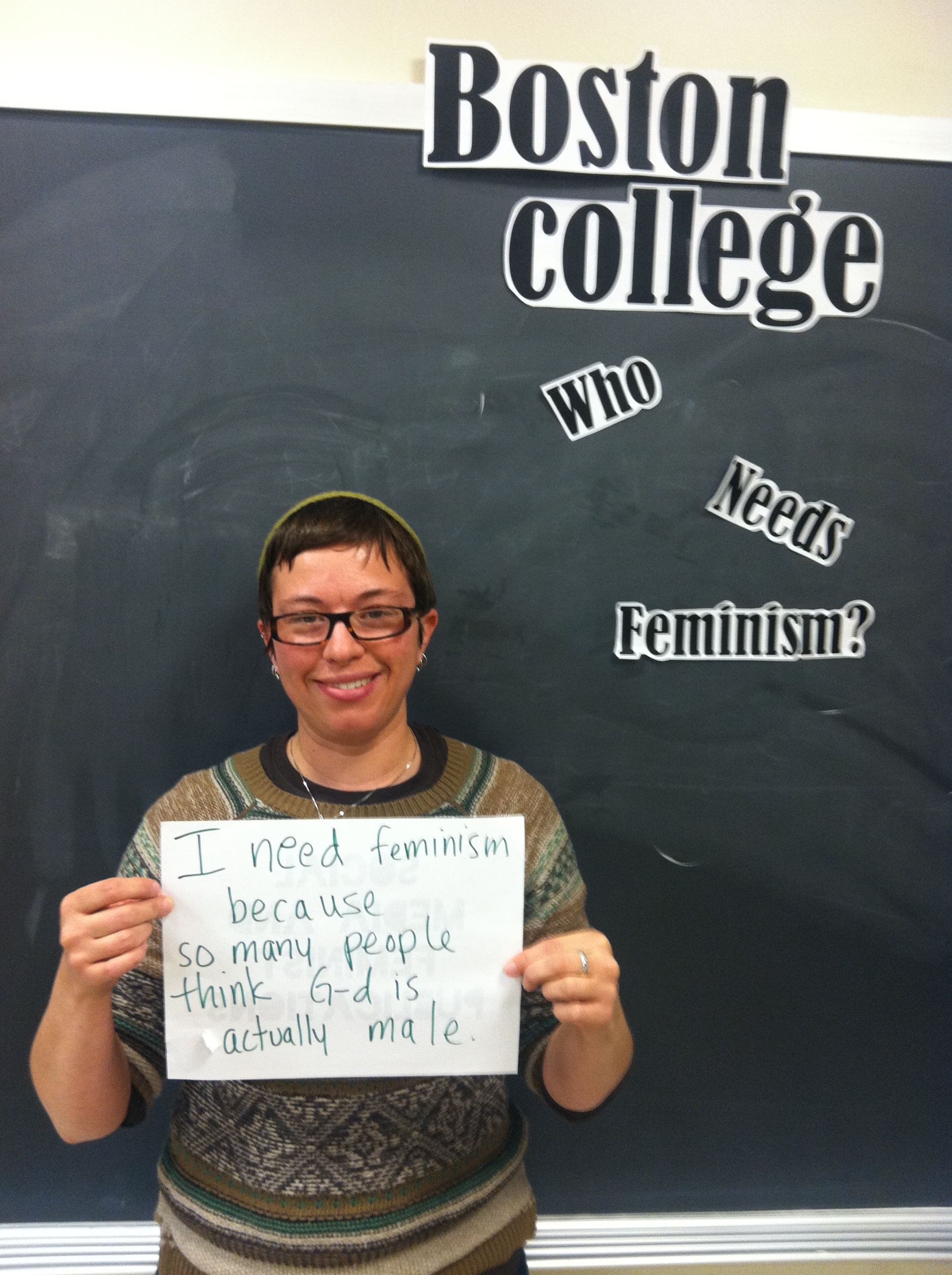
photoIn my introduction to Christianity class, almost every one of my students (who come from diverse religious backgrounds – primarily Roman Catholic, Protestant and Muslim), continues to believe that the best image if not the only appropriate image for G-d is male.  When probed they may speak generically about G-d as genderless, an entity or spiritual presence of some kind, yet conclude by affirming their belief that G-d is male often by adding something along the lines that G-d is best described as Father.  Some go so far in these affirmations that they articulate G-d’s maleness as fact.  It never fails that every semester I struggle with how to address this basic feminist issue within the classroom.

At least as early as 1973, Mary Daly, in Beyond G-d the Father: Towards a Philosophy of Women’s Liberation, articulated the problematic basis of the relationship between gender and divine imagery.  She argues that “If G-d in ‘his’ heaven is a father ruling ‘his’ people, then it is in the ‘nature’ of things and according to divine plan and the order of the universe that society be male-dominated.”  In other words, if maleness is associated with divinity, then the power, domination and running of society by men seems to be divinely ordained. Continue reading “On Pronouns and Liberation in the Classroom by Ivy Helman”

The Wit of the Labrys by Xochitl Alvizo

Always wearing my Labrys

Sometimes I wish I were wittier. Or more precisely, there are moments when I become acutely aware of my underdeveloped wit – and I long to know how to sharpen it!

I have some pretty witty people in my life – my dad, my feminist mentors, my best friends.  They generally fall into two categories, radical lesbian feminists and women-identified men.  The interesting thing about these friends and family members of mine is that they have something very important in common – they all live their lives going against the grain. They are not people content or resigned to the status quo. They are not satisfied with the default ways of the world – the violence, exploitation, hierarchies of valuing various people differently. They understand that all of this is brokenness, and at the same time, they know that all of this is very much part of our reality. I think this is where their wit comes in. For how does one live with a vision for a more beautiful and just world while also daily facing and struggling through the reality of the world as it is? I think their wit is a key factor in sustaining their Wild unstilted spirits. Continue reading “The Wit of the Labrys by Xochitl Alvizo”

A Cross-Cultural Feminist Alchemy: Studying Mago, Pan-East Asian Great Goddess, Using Mary Daly’s Radical Feminism as Springboard by Helen Hye-Sook Hwang

Feminist theology was self-transcending to me. I was unafraid of going beyond the boundary of Christianity and its God. 

Mago is the Great Goddess of East Asia and in particular Korea. Reconstructing Magoism, the cultural and historical context of East Asia that venerated Mago as the supreme divine, is both the means and the end. Magoism demonstrates the derivative nature of East Asian religions such as Daoism, Buddhism, and Confucianism while redefining East Asian Shamanism to be the religious expression of Magoism.

I encountered the topic of Mago during my doctoral studies. The topic of Mago fell out of nowhere at the time I was preparing for qualifying examinations. I had never heard the name, Mago. Only when I was able to collect a large amount of primary sources from Korea, China, and Japan, was I awakened to the cultural memory of Mago. I grew up craving the stories of Halmi (Grandmother/Great Mother), a common referral to Mago among Koreans. I had a childhood experience of being in the fairy land unfolded by my grandmother’s old stories. While “Mago” was unfamiliar to most Koreans, she was taken for granted in her many other names such as Samsin (the Triad Deity) and Nogo (Old Goddess) and place-names such as Nogo-san (Old Goddess Mountain) and Nogo-dang (Old Goddess Shrine). Continue reading “A Cross-Cultural Feminist Alchemy: Studying Mago, Pan-East Asian Great Goddess, Using Mary Daly’s Radical Feminism as Springboard by Helen Hye-Sook Hwang”

Conversation on Leadership Continues…By Xochitl Alvizo

In a recent post on leadership I proposed that facilitating open dialogue is a central aspect of leadership. That if we are to move into new horizons – that is, feminist horizons of mutual communal empowerment and liberation – we must be willing to both risk and dialogue, and a leader is one who helps facilitate those practices.

Dialogue and the practice of making room for one another’s voices and contributions do not come easily to us however. Humans have a tendency to stifle and squelch one another especially if we sense that our privileges and comforts, our truths and our convictions, are being challenged or threatened. And so the breakdown in dialogue can result in the literal prevention of change and possibility – the possibility and actuality of entering into a more divine reality and way of relating. A leader then must be someone who can recognize and be aware of change-stifling powers, be willing to name and resist them, and help facilitate the creation of a literal time/place space for open participation and dialogue. This new open space has the potential and literally becomes the womb from which something new may be birthed…it is a fluid, messy, mysterious place, and not one necessarily easy to exists within, but absolutely necessary if seek to contribute toward a more just and beautiful existence. Open dialogue is a necessary part of helping create this new womb space where differences (of perspective, voices, people) can come together to interact and spark with one another in order to morph and change and thus birth something new together. Continue reading “Conversation on Leadership Continues…By Xochitl Alvizo”