Ancestor Connection Revisited: Anna M. Christ of Little Germany, Brooklyn by Carol P. Christ

carol-christThese days I can’t get my 2x great-grandmother Anna Maria Christ off my mind.  She may be the independent female ancestor I have been looking for all these years.

My father’s father was transferred from New York to San Francisco during the depression. When I moved to New York City, I felt powerfully connected to its diverse immigrant culture, but I never thought of trying to figure out where and when my ancestors lived there.

Recently I found my Scottish and Irish 2x great-grandparents, James Inglis, the seaman, and Annie Corliss, mother of 9, living in the tenements on Cherry Street near the port of New York.  These were my father’s ancestors on his mother’s side.  I felt inspired by a photograph of Annie to take her Irish spirit of triumph over adversity into my soul.

Because it has become fashionable to be interested in things Irish, I began my ancestor research there.  In fact, I am more German (3/8) than I am Irish (3/16).  As I have delved into my German ancestry, I realized that being German became a cause for shame in both the First and Second World Wars.  German language newspapers were banned, Germans were interned, people hated Germans, and many Germans changed their names.

As a child I learned to create mock battles against “krauts,” Continue reading “Ancestor Connection Revisited: Anna M. Christ of Little Germany, Brooklyn by Carol P. Christ”

IS IT ESSENTIALIST TO SPEAK OF EARTH AS OUR MOTHER? by Carol P. Christ

carol-christThe charge of “essentialism” has become equivalent to the “kiss of death” in recent feminist discussions. In this context it is taboo to speak of Mother Earth.  Yet, I would argue there are good reasons for speaking of Mother Earth that do not add up to essentialism. What if the values associated with motherhood are viewed as the highest values? What if the image of Mother Earth encourages all of us to recognize the gift of life and to share the gifts we have been given with others?

For those not familiar with the “essentialism” debate in feminist theory, it might be useful to define “essentialism.”  In philosophy, essentialism is the idea that every “thing” has an “essence” which defines it.  In its pure form, essentialism is a by-product of Platonic “idealism” which states, for example, that the “idea” of table is prior to every actual table and that every actual table is an embodiment of the idea of table.

Aristotle disagreed with the Platonic view “way back then,” arguing that the idea of what a table is can be inferred from actual tables, and so on for every “thing.”  There is no need for an idea to exist prior to the existence of anything. Rather ideas help us to name and categorize existing things.  In the 20th century “existentialism” again challenged “essentialism,” asserting that “existence precedes essence.”  Existentialism argued that free individuals are defined by what they do, not by what they “are” prior to or apart from their actions.

When Whitehead said that all western philosophy can be understood as a footnote to Plato, he was referring in part to disagreements among philosophers about the relationship of ideas to things and existence to essence.

In the context of feminist theory, the charge of “essentialism” is used to criticize theories which speak of woman as opposed to man or feminine as opposed to masculine. Continue reading “IS IT ESSENTIALIST TO SPEAK OF EARTH AS OUR MOTHER? by Carol P. Christ”

Staying In or Leaving the Religious Community of Your Birth: The Dialogue Continues by Carol P. Christ

carol p. christ 2002 colorThis blog is part of an on-going discussion between me and my friend Jewish feminist theologian Judith Plaskow about the differences in our choices to stay in and leave traditional religious communities, which is part of our forthcoming book Goddess and God since Feminism: Body, Nature, and Power.

When you (Judith) discuss the reasons I left Christianity while you stayed Jewish, I think you hit upon a crucial difference between us when you say that I am more “idealistic” than you are.  I agree that this does not mean that I am more ethical than you are.  When you say that I require more “purity of thought” or perhaps more accurately more “purity of ritual symbolism” than you, I think you have hit the nail on the head.  I simply cannot participate in a religious symbol system that I feel has done and continues to do great harm in the world.

I reiterate that for me this “problem” is not limited to the ways in which the maleness of God justifies male domination—including violence against and rape of women.  Equally important to me are the ways that religious symbolisms justify the violence of warfare and conquest.    I simply will not and cannot participate in religious rituals that justify domination and violence in the name of “God.”  If that makes me a “purist” or an “idealist,” I am willing to accept those terms.  Continue reading “Staying In or Leaving the Religious Community of Your Birth: The Dialogue Continues by Carol P. Christ”

Are Buddhist Women Happy? by Oxana Poberejnaia

0The basic question is the same as in a “A Bit of Fry and Laurie” sketch about a sour-faced champion car racer: “Are you happy?” Are we, Buddhist women, happy with Buddhism? Are Buddhist men happy with the position of Buddhist women? Are we happy with the legacy we are leaving for future generations of Buddhist men and women?

This question can be re-phrased as: Are we happy because we should be happy? Because if we are unhappy it is our failure as women? Or as Buddhist practitioners? Are we happy to keep other people happy?

Do these questions sound familiar? – Are these the same questions that women have to deal with anyway, in this patriarchal society we live in? Continue reading “Are Buddhist Women Happy? by Oxana Poberejnaia”

Brigid, Goddess of Healing, Poetry, and Smithcraft by Judith Shaw

judith Shaw photoBrigid, the Celtic Goddess of Healing, Poetry, and Smithcraft, begins her reign on Imbolic, February 2, the midpoint between winter solstice and spring equinox. On this day the ancient Celts held their Fire Festival in honor of Brigid and the growing light. In Scotland, as recently as the mid-twentieth century, houses were cleaned and the hearth fires rekindled on February 2, to welcome in  Brigid.  Remnants of this festival are found in America today on Groundhog Day.

Like the Cailleach, She existed in many places and  was known by many names.  The Irish called her Brighde; she was Bride in Scotland,  Brigantia in Northern Britain, and Brigandu in France.  Some called her Brid, Brig or Brighid.  Later she was transformed by Christianity into Saint Bridget.  Her older name was BREO SAIGHEAD.   Her name has various interpretations, many relating to fire – “Power,” “Renown” “Fiery Arrow of Power ” “Bright Arrow”, “The Bright One”, “The Powerful One”, “The High One” and “The Exalted One”.

Brigid, Celtic Goddess Continue reading “Brigid, Goddess of Healing, Poetry, and Smithcraft by Judith Shaw”

WOMEN FOR PEACE–TAKE TO THE STREETS by Carol P. Christ

Sometimes we are told that domination and violence and war are innate in human nature; therefore, it is futile to protest war.  But this is not true.

I oppose war because I oppose all forms of power-over, domination, and violence.  As a radical feminist and ecofeminist I believe that power can and should always be power-with, the power that nurtures the growth and development of self and others.  The power of Goddess/God is always and everywhere power-with and not ever power-over. 

Are violence and domination innate in human nature?  We have been told that we are the “naked ape” descended from “apes” who, like the chimpanzees with whom we share 98% of our DNA, were male dominant and violent. Do we, then, have any hope not to be violent and dominant?

Franz de Waal’s studies of the other “ape” species that shares 98% of our DNA, the bonobo, debunks this popular myth.  The bonobo live in peaceful matriarchal clans, and their response to conflict is to rub each others’ genitals until the desire to fight goes away.  They are living proof that species very much like us can choose to “make love not war.” De Waal says that the most we can conclude from studies of our ape relatives is that ancestors of human beings, chimpanzees, and bonobos had the capacity to evolve toward dominance enforced by violence, or toward more peaceful ways of resolving conflict.

Continue reading “WOMEN FOR PEACE–TAKE TO THE STREETS by Carol P. Christ”

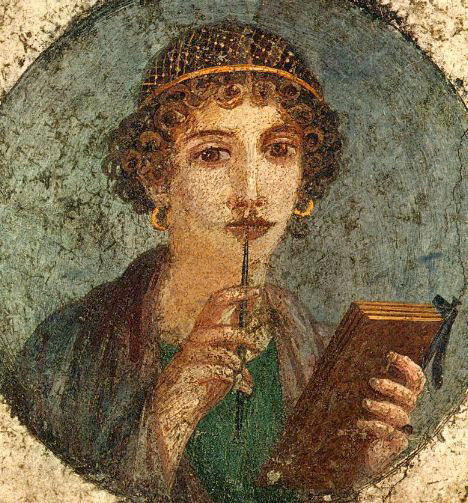
Sappho Chose Love Not War, What Will You Choose? by Carol P. Christ

*

We have been taught to speak of war and the heroes of war in hushed tones. We have been told that evil Helen’s choice was the cause of the Trojan war.  2600 years ago Sappho, known as the greatest lyric poet of ancient Greece, spoke truth to power and unmasked the lies told at the beginning of western tradition.

*

In a poem addressed to Anactoria, Sappho writes:

            Some say a cavalry corps

            some say infantry, some, again,

            will maintain that the swift oars

            of our fleet are the finest

            sight on dark earth …

Here, Sappho invokes the heroic tradition celebrated in the epic poems of Homer that shaped the values of ancient Greek culture and all the cultures that followed it, including our own.  This tradition tells us that to serve in a war and to be remembered as a hero is the highest goal to which a man can aspire.  Sappho does not agree:

             …but I say

             that whatever one loves, is.

Continue reading “Sappho Chose Love Not War, What Will You Choose? by Carol P. Christ”

Goddess as Love: From Experience To Thealogy by Carol P. Christ

If theology is rooted in experience, how do we move from experience to theology? In my life there have been a number of key moments of “revelation” that have shaped my thealogy. One of these was the moment of my mother’s death.

In 1991 my mother was diagnosed with cancer. While she was being treated, I realized that I had never loved anyone as much as I loved her. When I wrote that to her, she responded that “this was the nicest letter” she “had ever received” in her life and she invited me to come home to be with her and my Dad.

My mother died only a few weeks after I arrived, in her own bed as she wished. She was on an oxygen machine, and I heard her call out in the dark of early morning. When my Dad got to the room, he tried to turn up the oxygen, but it didn’t help. Then he called the doctor who reminded him that my mother did not want to go to the hospital under any circumstances.

My Dad then sat by my mother’s bed and held her hand.  As my mother died, I felt that the room was” filled with love.” I sensed that my mother was “going to love.” Continue reading “Goddess as Love: From Experience To Thealogy by Carol P. Christ”

“LOVE PATRIARCHALISM”—ITS UNDERSIDE IS HATE by Carol P. Christ

Where patriarchalism trumps love, when push comes, shove often follows. The underside of love patriarchalism is hatred of the independence of women. 

We are told that it is the duty of a loving father and husband to protect his wife and children.  In exchange, good wives support their husbands and good children obey their fathers.  The bottom line of patriarchy is control.  The fight over abortion is a fight about men’s right to control women.

I have spent much of the past few weeks wondering why so many Republican men hate women.  Why do they want to deny the right to an abortion to a 12 year-old girl raped by her father, to a 21 year-old college student gang raped at a fraternity party, to a 33 year-old woman who submitted to a violent boyfriend she did not know had poked a hole in his condom, or a to a 41 year-old woman who offered a cup of coffee to the man who came to her house to fix the electricity, but who said “no” when he assaulted her.

I have also wondered why Republican men would deny the right to an abortion to 28 year-old married woman who got pregnant while taking the pill, to a 15 year-old girl who got carried away with her boyfriend, or even to a 35 year-old woman who got drunk one night and had sex without protection. We are all human aren’t we?  Birth control sometimes fails and sometimes women make mistakes. Apparently women are to be punished for both! Continue reading ““LOVE PATRIARCHALISM”—ITS UNDERSIDE IS HATE by Carol P. Christ”

SHADOWS OF THE GODDESS IN GREEK ORTHODOX TRADITION: EASTER AND THE DORMITION OF THE VIRGIN by Carol P. Christ

While I would not wish to argue that Greek Orthodoxy is in any way a “feminist” tradition, the shadow of the Goddess falls long over the two great festivals of spring and midsummer.

In Greek Othodox tradition, there are two major spiritual holidays– Easter in the spring and the Dormition/Assumption of the Virgin at midsummer.  The Panagia, She Who is All Holy, also known as Mother of God, Virgin, and Mary, is a central figure in people’s faith–dethroned neither by the Reformation nor by Vatican II.  Indeed when I speak of the need for the “rebirth of the Goddess” in Greece, I am often told, “the Panagia is our Goddess.”  This may not be theological orthodoxy, but it expresses a truth of practice. Continue reading “SHADOWS OF THE GODDESS IN GREEK ORTHODOX TRADITION: EASTER AND THE DORMITION OF THE VIRGIN by Carol P. Christ”