 This is a great day for me as I announce the publication of A Serpentine Path: Mysteries of the Goddess. It is the first —but certainly not the last—book from the new FAR Press, directed by Gina Messina and Xochitl Alvizo, two of the founders of www.feminismandreligion.com. The release of my book is the fruit of friendship and collaboration that has been nourished in the blog community. I hope you will join with us in celebrating our joint venture by ordering the book, telling your friends about it, sharing it Facebook and Twitter (links below), reviewing it on Amazon, and letting Gina and Xochitl know if you can review in a magazine, journal, or blog.
Here is an excerpt from the preface to whet your appetite.
*
A Serpentine Path is a story that begins in despair and ends in rebirth and regeneration. It depicts a turning point in my life, a psychological and spiritual breakthrough that opened me to living the rest of my life in grace and joy. Though I am tempted to say it was a journey from darkness to light, that would be inaccurate, for mine was a journey into the darkness and out again. The path of life is never straight or narrow, and the circle of light and darkness is never-ending.
When I began the journey described in A Serpentine Path, I did not feel loved, I did not want to live, I could not write, and I believed the Goddess had betrayed my faith. As I completed the book, I knew I was loved, I wanted to live, I was writing, and I understood that the Goddess had never abandoned me. Though my life has had its ups and downs since then—as all lives do—I have never forgotten that I am loved, I have wanted to live, I have not stopped writing, and I feel the Goddess ever-present in my body, in my breath, and in my connections with the living and the dead. Though my story is deeply personal, my struggles with love and death, trust and control, are widely shared.
A story of finding the Goddess, A Serpentine Path is part of a growing genre that is developing as women explain to themselves and others why they left the patriarchal religions of their origins for a more nourishing spiritual vision that affirms both women and the earth. A Serpentine Path documents the first of the Goddess Pilgrimages to Crete I have been leading twice a year since then. For the women who have traveled with me, it will evoke many memories. For those who have dreamed of a pilgrimage to the Goddess, it offers an opportunity to imagine the journey. I now know a great deal more about ancient Crete, the folklore and customs of traditional Crete, and the rocks, trees and plants of Crete, than I did when I began. But I learned the mystery on my first pilgrimage. Because we are all deeply connected to each other, I know that the path to the mystery I discovered is not mine alone.
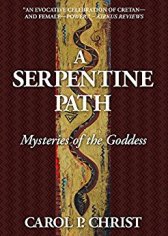 Be among the first to order A Serpentine Path, Carol P. Christ’s moving memoir of transformation. Carol’s other new book written with Judith Plaskow is Goddess and God in the World: Conversations in Embodied Theology. Carol also wrote the first Goddess feminist theology, Rebirth of the Goddess.
Join Carol on a Goddess Pilgrimage to Crete in 2017. Save $200.
Read two of the chapters in the book: Mysteries and Dionysian Rites.
Thanks to Judith Shaw for the cover art “Downward Serpent”


 It is in our hearts –one’s sense of superiority exists within. We are all and each capable of hate and bigotry.
 I caught myself reinforcing the norm. The ever present default
  The pieces of my dissertation are beginning to float to the surface, piece by piece, released into the world as smaller parts of the whole. At some point this all may become a book, but for now, I have enjoyed the opportunity to share some of the learning from my dissertation research in book chapters, articles, and blog posts, which I’d like to share with you all so that you can see some of what I’ve been up to these days.
 A friend of mine once commented that my feminism is evident from the moment you step into my house. In reference to all the female images around my house, she noted that my space reflected a different way of being in the world. I had never thought of it actually, it was not a specifically conscious choice I made to be woman-centered in the books and artwork I displayed, I simply put up what I loved. But once she pointed that out to me, I appreciated the point it raised about what we surround ourselves with and what it reflects about the world we want to live in and help create. What do our spaces evoke for us? for others? Do they help spark the imagination, and if so, what toward?
 I have called it, The Terrible Transition Year, this year of finishing dissertation, uprooting from home, moving cross-country, and starting a new full-time teaching job. Last year at this time I was in LA for a 7-8 week stay, away from home – which at the time was in Boston – writing dissertation nonstop. I spent the holidays apart from my family and shared in none of my traditional holiday celebrations as I intensely pushed forward to complete the dissertation. After (seemingly) endless edits back and forth with my advisor and second reader, I finished the dissertation just in time to successfully defended it in May.
 The earliest memories of myself are as a student. I have distinct memories of myself in my kindergarten classroom. I even remember the location of my seat in the specific cluster of tables I was assigned. I also remember the stick-figure graphics that adorned the pages of the phonics books we used to learn to read. In the second grade, I have my first memory of making a mistake. In a spelling test, I wrote ‘rite’ instead of ‘write’ – and for the life of me, I could not understand how my answer wasn’t the correct one! Yet, despite this incomprehensible error (smile, smile), and the many more since, the classroom has always been the place where my life has been transformed and revolutionized.
 The end of my Ph.D. program is in sight. Originally, in 2004, I came to Boston University School of Theology (BU STH) from Los Angeles for a two-year masters program. Along the way I switched to a three-year masters program, after which I ended up staying for the Ph.D. Now, eleven years later, the end is actually in sight.