

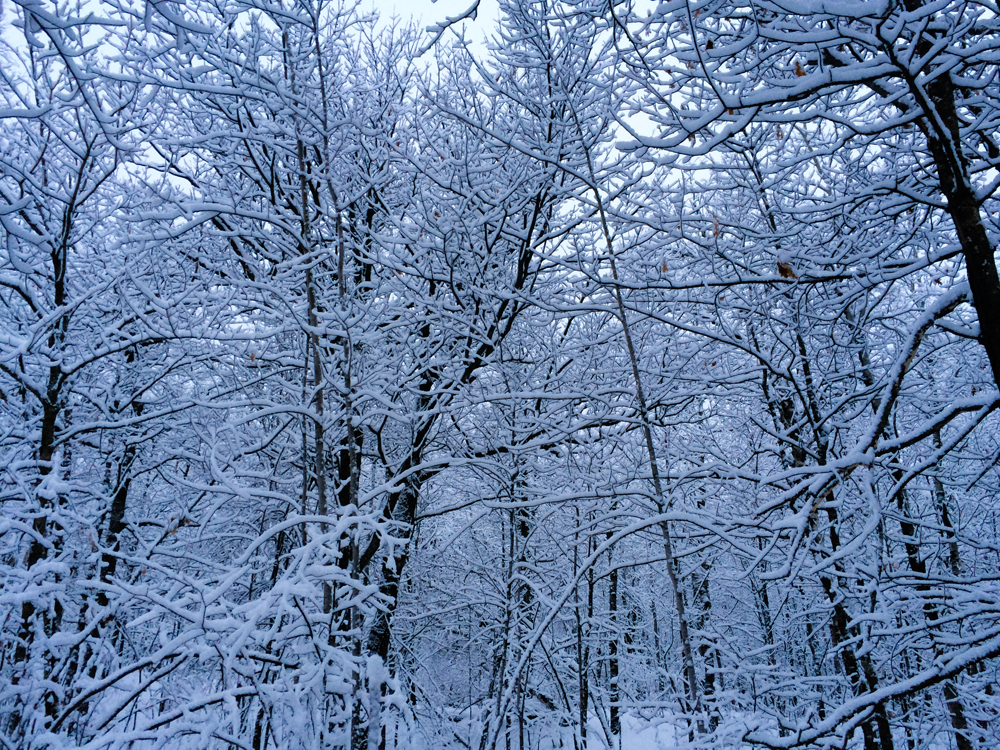
I love the time between the Winter Solstice and New Year’s – a time of suspended animation, a reprieve from the demands of daily life, a respite from the woes of the world, from needing to pay attention to the time of day, days of the week, and tasks that need to be accomplished. A whole week with nothing scheduled on the calendar. Simply presence. It is a liminal time on the threshold between the old year and the new – whether measured by the turning of the planet from dark to light on the Solstice or of the Gregorian calendar year – a time when many of us pause and reflect on the year past and our hopes for the year to come. It is a moment of what the Greeks called Kairos time, as opposed to Chronos time, by which we measure most of our lives — in seconds, minutes, hours, days, and years.
In the years I spent in academia, my life was governed by Chronos time that often forced me to live in the future rather than the present. Course scheduling and book orders needed to happen far in advance. Course syllabi planned students’ readings and assignments for the next several months ahead. Learning was to occur in specific blocks of time, which always struck me as such a bizarre way to teach and learn, when we’d have to break off discussion and deep learning simply because the hour was up.
One of the benefits of retirement is the ability to step off that particular treadmill. Nevertheless, most of the world lives on Chronos time. It is useful, allowing us to make appointments, find mutual times to meet, know when to put the trash out, pay bills, attend events and gatherings. But chronicity of time seems to be increasing. Get-togethers with friends no longer happen spontaneously. Instead, everyone gets out their planners to search for a mutually open spot — often weeks in the future. Even phone calls are scheduled now – texting first to see when someone might be free to talk.
Childhood has also changed that way. Other than school and being home in time for dinner, as children our days simply flowed from one activity to another, especially in the carefree days of summer. Now children’s lives are scheduled with after-school lessons, activities, and summer camps. I remember distinctly the day my son told me that his life was too scheduled and he needed to drop some of his after-school activities. At seven! I’m grateful he knew he needed the time we all need simply to be, to create, to imagine, to play, to rest. about the future.
Chronos time vanishes in the wake of birth and death. The day my mother died, my world stopped while the rest of the world went on. How strange it seemed that other people went about their daily lives as if nothing significant had happened, as if it were just an ordinary day. The same was true on the day my son was born, where my world closed in to only this time, this place, this love, with no cognizance of any life beyond this moment. I’ve been able to create those spaces as well, going on solo retreats where the days flow into each other and for a few days I am removed from the world, beholden to no clock and no one (except my dog). Snow days – those unexpected gifts from the snow goddesses where traffic stops; schools, stores, and workplaces close; events are cancelled — the day is unexpectedly set aside for play – board games, sledding, building snowmen; and for hygge – the coziness and conviviality of gathering under comforters, reading by the fire, and drinking hot cocoa while watching the snowflakes dance outside. It seems wrong that since schools learned how to rely on remote learning during the pandemic snow days have become “remote learning days” instead. We need those unexpected gifts of time and space occasionally to grace our lives. As ecotheologian Mary DeJong has said, “Chronos time is needed to survive. Kairos time is needed to thrive.”
But we don’t need to wait for life and the weather to grant us Kairos time. We can make it a regular practice. We know it as “sabbath.” As practiced in Judaism, the weekly practice of Sabbath — from sundown on Friday to sundown on Saturday — is a time set aside from work, travel, devices, and screens. ”In Sabbath time,” Wayne Muller notes, “we remember to celebrate what is beautiful and sacred; we light candles, sing songs, tell stories, eat, nap, and make love. It is a time to let our work, our lands, our animals lie fallow, to be nourished and refreshed.”[i] Whether a day, a week, or a few moments at the beginning and end of the day, we can commit to setting aside Chronos time and its demands to enter Kairos time, fully present to the present moment.
As I take time away from the news of continued death and destruction of war in Ukraine and Gaza, tensions in the Red Sea, mass shootings, the impending 2024 election — I know my ability to insulate myself from that world for a time is a privilege not granted to those who live its midst. Yet I also know that taking regular sabbath time is an antidote to violence. As Muller writes, “Sabbath time . . . can invite a healing of this violence. . . . When we act from, a place of deep rest, we are more capable of cultivating what the Buddhists would call right understanding, right action, and right effort. . . .Once people feel nourished and refreshed, they cannot help but be kind; just so, the world aches for the generosity of well-rested people.”[ii]
Oh, that we could grant the world a year of snow days, that we all might, in the words of the mystic Rumi, “Come out of the circle of time, and into the circle of love.”
Sources
DeJong, Mary. “Wild Autumn.” Waymarkers.
Muller, Wayne. 1999. Sabbath: Restoring the Sacred Rhythm of Rest. New York: Bantam.
[i] Muller, Wayne. Sabbath, 7.
[ii] Ibid., 5,7, 11.
Discover more from Feminism and Religion
Subscribe to get the latest posts sent to your email.

 Feminism and Religion
Beautiful! I think I have been fortunate in this sense because people tire me out and I have to move into solitary space in order to be filled again… It made no difference when I pursued my career…I had to take the time… mostly in the forest or by the water, always with a dog — I don’t know how to live in the fast lane. It never worked for me… Now on winter mornings I begin my day with a little mediation I have written and by watching birds – Kairos time is built into my life as necessary space.
LikeLiked by 1 person
Yes — In the woods, by the water, and always with a dog. Dogs are such wonderful reminders and caretakers of our Kairos time.
LikeLiked by 1 person
Setting aside to be outside of time each day – what a wonderful idea. It is so easy to have that intention but to let it go as all the little slices of time doing things we think we have to do add up and crowd out that precious Kairos time. I find that taking a walk early in the morning before I start anything else makes the whole day go better – I can orient myself to the day, think about what I need to get done and what maybe doesn’t, I can dream and let my mind wander which is when I do my most creative thinking. It’s been some time since I’ve been able to do that for various reasons – you have inspired me to make sure I do it again starting today.
LikeLiked by 2 people
Morning walks — what a wonderful way to set aside some Kairos time every day. When I’m in Michigan in the summer, a morning kayak paddle does that for me, too. Enjoy your walk!
LikeLike
Halcyon Days … that’s what I call the days before and after Winter Solstice, a period of calm and peace. I didn’t know how my soul and psyche needed these days, or even a daily dedication to this kind of time until COVID and my quarantine in Greece. What a beautiful reminder.
LikeLike
Thank you for this. I just recently named the concept of Kairos time as I was comparing (natural, circular) pagan time to (arbitrary, construct) clock time. I particularly like: As ecotheologian Mary DeJong has said, “Chronos time is needed to survive. Kairos time is needed to thrive.” I have been marking Shabbat for some years; I conceptualize it as a day when I don’t do things that I consider to be work (such as financial calculations) but allow myself to connect with friends (which often involves a screen).
LikeLiked by 1 person
Thank you, Judith. I’m glad this resonated with you. I’m sure in this pandemic era, using screens to connect with people is in the spirit of Shabbot. Taking time for those we love seems to be at the core of it.
LikeLike
Halycon Days! I knew the term, but never knew its particular association with the two weeks at the end of December until now. Thank you for that.
LikeLiked by 1 person