Purim and the Value of Courage by Ivy Helman

Ivy HelmanThe Jewish Festival of Purim and the book of Esther offer us an opportunity to reflect on the value of courage from a feminist perspective. The online Webster’s Dictionary defines courage as, “mental or moral strength to venture, persevere, and withstand danger, fear, or difficulty.” In religious discourse, courage is often categorized as a virtue or a moral principle. Aristotle (384BCE – 322BCE), one of the most famous of the virtue ethicists, believed a virtue like courage should be practiced according to the mean or the right amount. Too much courage leaves one rash, possibly too reactionary and hot-headed while too little makes one cowardly and weak, but just the right amount in a given situation leads to moral behavior. Virtuous living leads to happiness, or perhaps is itself happiness, for Aristotle.  Yet, as a feminist, I understand the worth of courage differently.  To me, the value of courage lies not in individualistic gains nor in personal happiness but in its use toward achieving justice and equality in society.

In the book of Esther, we read about Queen Vashti and Esther both of whom demonstrate courage. (There are many feminist commentaries on the inherent sexism of the book of Esther. While I acknowledge the need for such critique, I am not approaching Esther from this perspective as much as I am approaching it from what we can gain from the actions of the women in the story.) As the book opens, King Achashverosh asks Queen Vashti to parade her beauty at a feast for him and his guests. She refuses to be paraded and thus objectified. Men in the king’s royal court react harshly telling the king that if he lets her get away with such disobedience other women will surely follow suit. This is surely problematic for the kingdom as well as their households. Vashti is replaced as punishment. Continue reading “Purim and the Value of Courage by Ivy Helman”

On Pronouns and Liberation in the Classroom by Ivy Helman

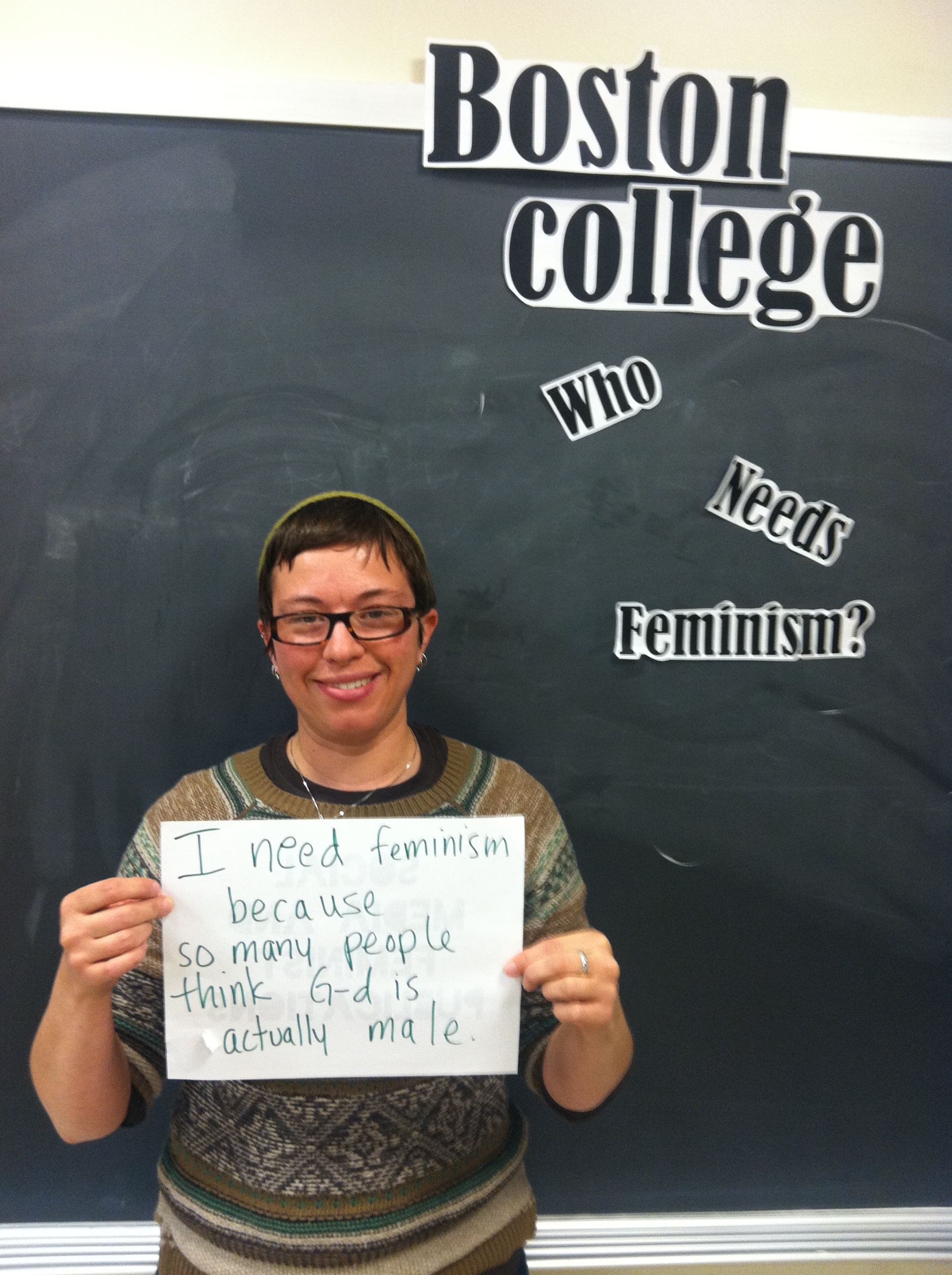
photoIn my introduction to Christianity class, almost every one of my students (who come from diverse religious backgrounds – primarily Roman Catholic, Protestant and Muslim), continues to believe that the best image if not the only appropriate image for G-d is male.  When probed they may speak generically about G-d as genderless, an entity or spiritual presence of some kind, yet conclude by affirming their belief that G-d is male often by adding something along the lines that G-d is best described as Father.  Some go so far in these affirmations that they articulate G-d’s maleness as fact.  It never fails that every semester I struggle with how to address this basic feminist issue within the classroom.

At least as early as 1973, Mary Daly, in Beyond G-d the Father: Towards a Philosophy of Women’s Liberation, articulated the problematic basis of the relationship between gender and divine imagery.  She argues that “If G-d in ‘his’ heaven is a father ruling ‘his’ people, then it is in the ‘nature’ of things and according to divine plan and the order of the universe that society be male-dominated.”  In other words, if maleness is associated with divinity, then the power, domination and running of society by men seems to be divinely ordained. Continue reading “On Pronouns and Liberation in the Classroom by Ivy Helman”

On Love, Theodicy and Domestic Violence by Ivy Helman

ivyandminiLast week, I introduced my students to the theological concept theodicy.  Theodicy is a theological explanation of why suffering and evil occur that usually includes some kind of defense of divine attributes.  For example, if G-d is all-knowing (omniscient), ever-present (omnipresent), all-powerful (omnipotent) and all-loving then how do we explain hurricanes, illness, mass murder, airplane crashes and other forms of evil and suffering?  This is quite difficult because, as my students point out after a few minutes of discussion, most explanations are often unfulfilling or inadequate.  The discussion turns quite quickly to two reactions.  Either, G-d isn’t what we thought G-d was or science does a better job explaining these examples of evil and suffering.  Science explains that hurricanes happen because of various environmental factors or a plane crashes because of mechanical problems. Even the concept of humanity’s freewill as the cause of evil often circles back to G-d’s creation of humanity and leaves students unsettled.  If G-d created within humanity the possibility of evil, how, then G-d can be all-loving?

The love/evil dichotomy is often the real conundrum of theodicies in monotheism.  This has been pointed out by numerous theologians throughout the ages.  How do we account for evil when there is only one divine Being?  How can an all-good, all-loving Being clove-1345952464afLreate or even be responsible for evil?  Which leads to the next question, is evil the absence of love?  These are extremely difficult philosophical and theological questions.

To explore then, we should start where it is often suggested that we learn most about love: family, close friends and intimate relationships.  Take this for example.  Continue reading “On Love, Theodicy and Domestic Violence by Ivy Helman”

The Israel-Palestine Conflict and Ecofeminist Insights for Lasting Peace By Ivy Helman

ivyOn Thursday, November 29, 2012, the United Nations officially recognized the Palestinian Authority as a sovereign state and granted its petition for observer status within the international decision-making body.  Sixty-five years before the United Nations had approved a two-state solution for the region, UN Resolution 181, that officially ended the British occupation of the territory and sanctioned the possibility of two states.  It says:

“The resolution recommends that the United Kingdom (as mandatory power for Palestine) evacuate; armed forces should withdraw no later than August 1, 1948; independent Arab and Jewish States and the Special International Regime for the City of Jerusalem administered by the United Nations should come into existence;  the City of Jerusalem should preserve the interests of Christian, Jewish, and Muslim faiths.united nations

While the Palestinian Arab population disagreed with that solution, when British forces left on August 1, 1948, Israel declared statehood.  The United States recognized its statehood the same day.  Russia was soon to follow suit.

Continue reading “The Israel-Palestine Conflict and Ecofeminist Insights for Lasting Peace By Ivy Helman”

Building a Bridge toward the Future: Will You Meet Me in the Middle? By Ivy Helman

On Tuesday, President Obama’s acceptance speech included the following statement about coming together as a country across differences of opinion.  He said, “We will disagree, sometimes fiercely about how to get [toward the future we hope for]…by itself, the recognition that we have common hopes and dreams won’t end all the gridlock or solve all our problems or substitute for the painstaking work of building consensus and making the difficult compromises needed to move this country forward…”

How do we really do this work?  How do we come together across difference to make change?  How do we foster productive dialogue that produces genuine and real results?  In this dialogue, what principles do we use?  What values do we honor?  What criteria do we use to judge opinions of others?  When is an opinion wrong or when is an opinion just different from our own? Continue reading “Building a Bridge toward the Future: Will You Meet Me in the Middle? By Ivy Helman”

“From Teshuvah to Justice: Jonah’s Call to Change” by Ivy Helman

(I offer here an abridged version of the sermon I gave on Yom Kippur (5773) at Temple Emanuel in Lowell, MA.  The full version will be available on their website soon.  The book of Jonah is always read on Yom Kippur in the afternoon service as the Haftorah.  It is rather traditional that someone (usually the Rabbi) offer an interpretation of it.  Temple Emanuel asked me this year.  I thank the congregation for the honor and I hope my words offered them, and now you, food for thought.)

Scholars believe the Greek philosopher Plato lived between 428 BCE and 348 BCE.  The Allegory of the Cave is one of Plato’s most famous stories.  It illustrates the effects of a change in knowledge, education and experiences on the human being.  Some of you may know it or have read it at some point but for those of you who don’t, let me offer a very brief summary.

There are human beings shackled to a cave in a way that they can only see the wall directly in front of them.  Continue reading ““From Teshuvah to Justice: Jonah’s Call to Change” by Ivy Helman”

Alcohol is a Feminist Issue Too. By Ivy Helman

Sex sells.  The sexual objectification of women is used in advertising to sell anything from auto parts to cologne to alcohol.  Despite the myriads of feminist critiques of women’s sexual objectification to sell products, it still exists.  Open a Vogue Magazine or walk into an Abercrombie and Fitch store.  Women are posed half, to almost totally, nude in sexually suggestive ways trying to entice the generic person in patriarchal society, the “average” male (usually white, middle-class and heterosexual) to buy the product. Sometimes that same sexually suggestive pose is meant to also sell a product to the “average” woman as well with the mistaken notion that she will look as attractive and satisfied as the model if only she own the product too.

One of my part-time jobs is as a clerk at a liquor store where there are a good number of sexually explicit ads for alcohol.  I also have three other part-time jobs teaching in the Women’s and Gender Studies Program at Boston College, in the Religious and Theological Studies Department at Merrimack College and in my shul’s religious school.  My combined income from the four jobs barely covers rent, food and bills and some months when I don’t get paid from teaching I use the little savings I have to make ends meet.

Recently I have noticed how silenced my feminist voice has become in the liquor store because of my precarious financial situation.  I am hesitant to speak up about the sexist ads for fear of losing my job.  This muted feminist voice is a class issue within feminism.  Specifically, classism affects one’s ability to stand up for one’s self when one’s livelihood is on the line.  Often, I find myself thinking about this as I sell customers vodka or beer.

But I also spend a lot of time at the liquor store thinking about religion.  Continue reading “Alcohol is a Feminist Issue Too. By Ivy Helman”

How literal is too literal? My Experience with Tallit Katan. By Ivy Helman

I tried a new spiritual practice yesterday.  I wore a tallit katan.  It is commonly worn by Orthodox, Hasidic and other Ultra Orthodox men and boys from the age of 3 onward and usually not worn by women within these communities.  Occasionally, one can see Jews (mostly men) from Conservative shuls wearing these garments and rarely from Reform congregations.  They seem to be a marker of a more observant Jewish practice that reads much of the Torah literally.  One is commanded to wear fringes (tzitziyot) when wearing four-cornered garments as reminders of the covenant between G-d and the Jews and more specifically of the 613 commandments.

There are a number of reasons women and men from Orthodox and ultra Orthodox communities give for discouraging women from the wearing of tallit katan and tallit gadol.  First, women are said to be exempt from time-bound mitzvot, or commandments .  Wearing tzitziyot are considered time-bound because the Torah says one should be able to see them which has been interpreted to mean that they be worn during the day.  The reason given that women are not held to time-sensitive mitzvot has to do primarily with their childcare responsibilities.  Children and fulfilling their needs often requires much time and may not allow one to complete a task within a given time frame.  A related ideology says that women are often generally thought to be more spiritually attuned, and therefore do not need such physical reminders to follow the mitzvot. Continue reading “How literal is too literal? My Experience with Tallit Katan. By Ivy Helman”

Why a Kippah Reminds Me that Rationality Should Not Be Our Only Imago Dei By Ivy Helman

Neil Gilman in his book Sacred Fragments writes, “Since our faculty of reason is G-d-given, since it is the quality that distinguishes us from the rest of creation, and since all human beings share that same innate faculty, what better way to establish the veracity of a religious tradition than by demonstrating its inherent rationality?”  To be fair, Gilman is not the only and definitely not the first to support this position.  Many theologians, especially those influenced by various Greek philosophers like Socrates, Plato and Aristotle, have said the same thing.  In the Roman Catholic tradition, Thomas Aquinas is adamant that rationality is humanity’s imago dei, how we are made in the image of God – what the beginning of Bereshit (Genesis) suggests.  Descartes argues, “I think therefore I am.

Patriarchy emphasizes rationality as divinely given over and above other attributes that humans share with non-human life – like instinct, growth and maturity, life and death, memory, caring, empathy, dependence, interconnectedness, relationality, and communication (in all its forms, not just speech).  Continue reading “Why a Kippah Reminds Me that Rationality Should Not Be Our Only Imago Dei By Ivy Helman”

The Transformative Power of Daily Practices by Ivy Helman

My simple daily rituals and spiritual practices are what keep me mindful of G-d and G-d’s presence in my life.  They also remind me of G-d’s call to justice, care, compassion and love. 

“I find by experience, not by reasoning,

but by my own discovery that G-d is near me,

and I can be near G-d at all times.

I cannot explain it but I am as sure of my experience

as I am of the fact that I live and love,

but I know I do.

In the same way, I know I am in contact with G-d.”

This poem by Lily Montagu speaks to me.  I read it most mornings as I say my morning prayers, and it is one of those mantras I try to live by.  I have found that contrary to popular belief, sustained religious practices can be just as transformative as instantaneous conversion experiences.  This is why I have developed certain spiritual and specifically Jewish practices (For more about my joinery to Judaism, see one of my previous blogs “Reflections on my Spiritual Journey: Claiming Judaism”).  I find that they help me develop and cultivate a strong relationship with G-d.  For example, I keep a kosher home; wear a kippah daily; try to pray at least twice a day and before snacks and meals; practice the principles of Mussar; attend regularly Shabbat services Friday evenings at my Reform Congregation in Lowell and Saturday morning services at a Conservative congregation in Nashua, NH; light Shabbat candles; try not cook or create on Shabbat; make Havadalah to mark the end of Shabbat; give tzedakah as much as I can and study Torah with my friends.  This list is not all encompassing and there are quite a few areas of my practice I wish were more disciplined as well.

Continue reading “The Transformative Power of Daily Practices by Ivy Helman”