Hitting the Trifecta in Women’s Issues by Michele Stopera Freyhauf

One did not have to watch the debate between Barack Obama and Mitt Romney this past Tuesday to know that Romney hit the trifecta in the area of women’s issues.  It was all over social media within minutes of statements being made that marginalized or treated women as “less than.”

The issue of contraception and rape is still a topic of debate.  Church’s post signs to “Vote for Religious Freedom” and hand out voting guides that help you gauge the moral candidate.  Bulletin boards stating that “Obama believes in abortion and gay marriage – do you? vote Republican” appear by the highway.  This issue will not be settled during the election.

If people in power set an example of bullying and/or oppressive behavior, this behavior becomes acceptable.  If women are treated “less than,” then their dignity as well as their humanity is compromised.

An extreme example of this de-humanizing treatment of women in American society appeared October 13th in Cincinnati.com.  A story was published about a flyer found in the men’s restroom of a co-ed freshmen dorm at Miami University.  The title of this flyer – “Top Ten Ways to Get Away With Rape:” Continue reading “Hitting the Trifecta in Women’s Issues by Michele Stopera Freyhauf”

Validating the Gospel of “Jesus’ Wife” is not Necessary to Prove Female Discipleship by Michele Stopera Freyhauf

The Gospel of “Jesus’ Wife” is certainly at the center of a battle that was last seen when questions of authenticity were raised about the James (Jesus’ brother) ossuary.  In a New York Times article, September 30th, Judith Levitt states that this document adds weight to theological and historical flaws surrounding the issue of the ordination of women.  The Vatican believes that their theology is still sound, calling the document a forgery.

The Gospel of “Jesus’ Wife.” [www.boston.com]
Frankly we do not need this document to validate the existence of female deacons and disciples – we have the biblical text and writings of the early church to validate this position.

Nor do we need this document to show that the standing from the Vatican’s point of view of ordaining women is theologically and historically flawed.

“In 1976, experts of the Pontifical Biblical Commission determined that there were no scriptural reasons preventing women’s ordination. The Congregation for the Doctrine of Faith overturned the commission’s judgment and instead wrote its own statement (Inter Insigniores, 1976) stating that women do not image Jesus who was a man; and therefore only male priests can adequately represent Christ.” – Women’s Ordination Conference

John Ortberg, in the Huffington Post, addressed a bigger issue surrounding female leadership in the Church brilliantly:

“perhaps what matters most in this discussion is the impact Jesus had — not on one woman — but on the status of women as a whole.”

Continue reading “Validating the Gospel of “Jesus’ Wife” is not Necessary to Prove Female Discipleship by Michele Stopera Freyhauf”

Lucy Burns, A Look at a Catholic American Suffragette by Michele Stopera Freyhauf

As we approach the election period infused with controversy, saturated by television commercials, as well as endless advertisements on the radio, Internet, and yes, even Facebook, we must remember the sacrifices made by our foremothers during the suffrage movement, which gave women the right to vote.  While all elections are important, this one has targeted issues involving women in a way that could negatively impact our rights – to the point of rewinding the clock on progress made in women’s equality during the last 40+ years.  This election needs the voice of all informed voters.  However,  it is imperative for all women to make their voices heard this year by casting a vote.  To turn a blind eye to these issues diminishes the sacrifices our foremothers made for us. To not cast a vote takes away your voice, makes you a silent bystander – something that was tried by the government and patriarchal system during the suffrage movement.

To illustrate this, I would like to highlight Lucy Burns and the Night of Terror endured at the Occoquan Workhouse by her and many of her friends.   Of all Suffragettes, Lucy Burns spent more time in jail then any other protesters.  Born 1879 in Brooklyn, Lucy was raised in the Roman Catholic tradition by a father who believed that his sons and daughters should be educated equally.  Burns gradated from Vassar College in 1902, then attended Yale Graduate School studying linguistics.  She eventually went to Oxford University in England to resume her studies.  It was at Oxford that she became involved with activism and the suffrage movement. Continue reading “Lucy Burns, A Look at a Catholic American Suffragette by Michele Stopera Freyhauf”

Is the Republican Party Platform Truly Pro-Life? by Michele Stopera Freyhauf

As many feminists invest their life fighting for women’s rights to be the center of attention – no one could predict the occurrences of this election year.  In my previous post “Rape is Not a Political Platform – Rape is a Violent Crime!” Carol P. Christ made a comment about women’s issues and politics:

 “I have been waiting all my life for women’s issues to become central in an election campaign, but I guess I should have been more specific in my wish: this is not the format I imagined…”

Christ’s reaction is like so many others in the election; no one could have imagined such a bizarre and backwards slide being lobbied against women’s rights.   Issues being bantered around continue to be rooted in a purported pro-life stance.  This ranges from trans-vaginal ultrasounds, definitions of “legitimate” rape, and now using an Ob/Gyn’s “best guess” to define the gestational age of a baby from the time of a woman’s last period.  This is not a game – this is semantics, this is politics, this rhetoric, and frankly, this needs to stop. Continue reading “Is the Republican Party Platform Truly Pro-Life? by Michele Stopera Freyhauf”

Rape is Not a Political Platform – Rape is a Violent Crime! By Michele Stopera Freyhauf

Just when you think you have heard it all, here we go again – another politician with “open mouth-insert foot” syndrome.  Discussing his zero-tolerance policy for abortion, Missouri Representative Todd Akin made the following statement last Sunday about pregnancies that result from rape:

“from what I understand from doctors, that’s really rare.  If it’s a legitimate rape, the female body has ways to try to shut that whole thing down.  But let’s assume that maybe that didn’t work or something.  I think there should be some punishment, but the punishment ought to be on the rapist and not attacking the child.”

In an inadequate attempt to apologize and clarify his words, Akin stated that he meant to say “forcible rape.” This clarification fares no better nor does the fact that he later acknowledges that women “do become pregnant” during a “forcible rape.”  It is interesting to note what Akin considers to be “rare.”  According to the Washington Post, approximately 5% of rape victims become pregnant.  Akin reduced this to a statistic – 1 out of 32,000 women.  This, for Akin, is a rare occurrence.

Stating that a woman’s body is capable of preventing pregnancy in the case of “legitimate rape” demonstrates how out of touch politicians are and further (re)affirms the bigotry that exists within our political system.  The same politicians who have waived a “war against women” this year, try to promote policies that exercise control over what a woman can and cannot do with her body; policies that are  based on ill-advised misinformation.  Decisions politicians make for a woman – what she can and cannot do with her body – are rooted in personal faith beliefs, party-line agendas, and supporters (campaign financing dollars and lobbyists).  This year, a woman’s body has become a platform for votes.

Inasmuch as I would like to think Akin’s statement is an isolated event, Garance Franke-Ruta points out that this is not the first time a politician made a statement about rape victims and pregnancies: Continue reading “Rape is Not a Political Platform – Rape is a Violent Crime! By Michele Stopera Freyhauf”

Discrimination, the Catholic Bishops, and Chick-fil-A by Michele Stopera Freyhauf

You may be tired of the controversy about Chick-fil-A, but the events of the last few weeks revealed a big issue in the organization – that of discrimination and the illusion of religious freedom.  However discrimination exists beyond the LGBTIQ community, it applies to Catholics and those “outside” their strict fundamentalist belief system.  However, the hierarchy in the Catholic Church seems to be embracing many of the beliefs put forth by Evangelical Fundamentalists in the political arena.

When it was time for my eldest daughter to get her first job, she applied and was hired to work at Chick-fil-A.  Knowing they were a  Christian organization, I felt that she would be well treated and we could still have family time on Sundays.  Everything started out o.k. but the longer she worked there, problems developed.  First, when I stopped through the drive-thru to show my support as her mother, I received apocalyptic material in my bag talking about the end times, where my soul would go, and inviting me to their church.  I found the material offensive and never returned. Despite the organization’s community support and “Christian” values, I was still fairly naive about their discriminatory practices that many experience on a daily basis.

Continue reading “Discrimination, the Catholic Bishops, and Chick-fil-A by Michele Stopera Freyhauf”

Silencing Miriam: Prophetess, Liberator, and Leader By Michele Stopera Freyhauf

The prophetess Miriam, Aaron’s sister, took a tambourine in her hand, while all the women went out after her with tambourines, dancing; and she led them in the refrain: Sing to the LORD, for he is gloriously triumphant; horse and chariot he has cast into the sea.”(NAB, Exodus 15:20-21)

The Song of Miriam is not a story of death and destruction, but rather liberation.  It is a poetic celebration of God’s liberation of the Israelites from the oppressive Egyptians, which, according to Bernhard W. Anderson in “The Song of Miriam Poetically and Theologically Considered,” marks the beginning of the Israelite tradition (292).  Phyllis Trible in “Bringing Miriam out of the Shadows” states that this act marks the end of the Exodus, which was started by Miriam, not Moses (169, 172).  The act of liberation reveals God’s action in humanity.  Gerald Janzen in Exodus believes this act also moved the Israelites “to fear the LORD and believe in the LORD and in his servant Moses” (109).  The uniqueness of this passage is that the most unlikely person leads – this person is not a man but rather a woman.

This brief passage in the Hebrew Scriptures is revelatory – Miriam is revealed for the first time.  She is a prophetess, Aaron’s sister, and the role of leader of the victory dance to honor the Divine Warrior.

Continue reading “Silencing Miriam: Prophetess, Liberator, and Leader By Michele Stopera Freyhauf”

Abuse of Power in the Catholic Church Part II – WE are the Church! By Michele Stopera Freyhauf

Spiritual Power is arguably the most dangerous power of all.  In the wrong hands, it gives the power to make judgments even about the eternal fate of another person.  It needs a sign on it at all times saying, ‘Handle with extreme care.’  The greater the power a person exercises, the more need there is for checks and balances before it is used and accountability after it is used.” – – Bishop Geoffrey Robinson

 May 6th, I addressed the issue of abuse of power in the Catholic Church and how we seem to be unraveling any kind of progress made since Vatican II.  Since writing that article, the Leadership of the LCWR met with Vatican Officials and expressed their concerns openly.  A dialogue occurred and left no resolution, just information that the leadership will discuss with the community at their August meeting.  That meeting will reveal their next step in this controversy – concede and follow the conditions and rules sets forth by the CDF or disband and form a new religious community or maybe there will be another option revealed.

I have to ask though – Was this a meaningful meeting or was it meant to pacify the Sisters and their supporters? Will the Vatican change its stance? Certainly, the U. S. Catholic Sisters have not been

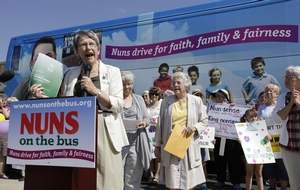
reposted from http://www.nunsonthebuss.com/bus

pacified, nor have their supporters.  For example, there is a “Nuns on the Bus” tour traveling around the United States,  prayer services for the Sisters, #nunjustice and #whatthesistersmeantome campaigns on Twitter.  Even the Women’s Ordination Conference delivered a petition containing over 57,000 signatures to the Vatican in support of the Sisters.  Certainly, the support for the sisters and their mission is not dwindling, but growing stronger every day.

As for the Vatican, a change in their position is doubtful, but we can continue to pray.  I am, however, very discouraged by a statement attributed to Pope Benedict that indicates a desire to have a smaller more faithful Church of Catholics then a large Church of people who do not adhere to Church Teaching – seeking out a small, strong, holy community.

Obviously, it is my hope that this statement was taken out of context, but I have to be honest and say

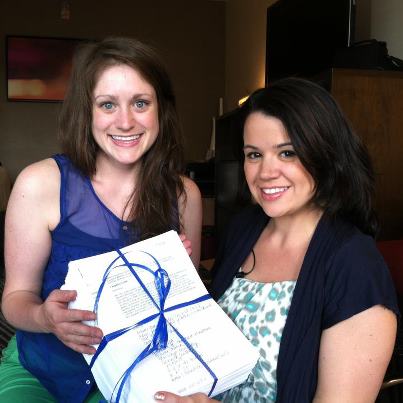
Women’s Ordination Conference delivering Petition
Picture reprinted from WOC’s page on Facebook

that my hope is filled with doubt.  This is not the first time I have heard clergy make this statement. Priests have made this statement in my presence – wanting a more faithful flock and dismissing those that do not adhere to their interpretation of Church teaching. This stance does not bear fruit, but is rather a power play – a play that can be called many things – misogynist, arrogant, non-pastoral, cold-hearted, and frankly un-Christian.  It also plays with a person’s spiritual fate and in many cases their soul.   The psychological impact of something like this is dangerous for some. Some ordained will go so far as to withhold sacraments or even compromise the person’s  status in the Church, including their role in ministry, for the sole purpose of  inducing compliance – a tactic that dates to the medieval period.

Continue reading “Abuse of Power in the Catholic Church Part II – WE are the Church! By Michele Stopera Freyhauf”

Remembering My Grandmother: Not as a Suffering Servant but as a Devoted and Loving Mother By Michele Stopera Freyhauf

The last week-and-a-half has been probably the most heart wrenching time I remember having in my life.  You see, my grandmother passed from this life June 19th and the void in my heart is huge.  I have to admit that I am lucky that my grandmother was a huge part of my life and the last family funeral I attended was in 1983.  Certainly one expects grandparents to pass away, even when they live a healthy long life.  Nothing prepares you for the time that you must say good-bye.  You yearn for one more conversation, one more hug, one more kiss – the thoughts churn and churn robbing you of sleep or peace.  At some point, a level of acceptance or at least the ability to cope will occur – when is a mystery, but for now I just try to be strong – for my mom, my sister, and my children.

Driving home from vacation, I received the news from my sister, Lisa:

Lisa:    Nanny has lymphoma, which they found in her stomach and invaded her spine, paralyzing her from the hips down.  It is fast moving.

Me:     How long?

Lisa:    2-4 weeks. Hospice was called and is making her comfortable.

The news was jolting, but I did not realize that the initial expectation 3 days earlier was 6-8 weeks.  She had tests for a bleeding ulcer, so this diagnosis was jolting.  Over the last year, we dealt with dementia and health issues.  These either were false alarms or cured thanks to the love of her family, care from the people at the nursing home, and her nurse practitioner and physician.  I wished that this was also a false alarm – but it was not, this time it was real and the end was eminent.

Seeing my mother at Father’s Day celebration, the news was even more grim – Nanny is no longer alert, can no longer open her eyes – they are making her comfortable.  The last time her eyes opened was after her priest gave her last rites.  He turned to leave, she opened her eyes, said “Hi Father,” and went back to sleep.  This was the last time her eyes would open.  My mother tells me that she is not expected to live through the week.

I took my children over to say good-bye.  I know I should be grateful that my girls have a close relationship with their great-grandmother, one that spanned 19 years.  I know I should be grateful that I had her in every facet of my life.  It is no secret that family was important to my grandmother, and she adored all of her children, grandchildren, and great-grandchildren.  This is a trait handed to my mother, my sister, and me.  Something I strive to instill in my children.

The good-byes were difficult as she was essentially unconscious and her breathing was noisy.

My sister called, how is she?

Me:     Breathing is labored and gaps between breaths are getting longer.

Lisa:    Will she be o.k. tomorrow?

Me:     I have no idea.  You may want to visit tonight just in case.

My sister and her husband appeared about 10 minutes later.  Wanting to give her time, I left with my family.  Going home was hard.  I was afraid she may not make it through the night.  I hoped with all my heart that this was not the end.

The next morning I returned to work.  She made it through the night.  I was in my office for a few hours before when I received a call from my dad.

Dad:    I am just calling to tell you Nanny is declining pretty fast.  They are saying minutes to hours – we are all here.  No need for you to come, I just wanted to let you know.
Me:     I am on my way.

Depending on traffic, I had a 40 – 60 minute drive.  I had to be with the woman that helped care for me and loved me.  The person that I took trips with, would talk hours on the phone with, cook with.  My grandmother was at every event, every family function, every holiday, and every birthday.  She was a huge part of my life and very important to me.  I needed to get there before she took her last breath – thankfully, I did.

The goodbyes continued.  Staff and residents alike came down to say goodbye. She was loved my so many.  Tears flowed for this petite woman with beautiful blue eyes, a contagious smile, and a heart of gold.  Her three children, my father, my sister, a few friends, and I kept vigil by her bedside.  I held her hand, sponged her neck and forehead to help with the fever, and kissed her forehead.  This went on all day and all night.

It was now midnight.  Everyone left the room to have a snack.  It was a long day and we forgot to eat dinner.  The staff was nice enough to provide us with muffins, water, pop, and coffee but this was no longer enough.  Every time someone would leave to use the restroom, you did not know if she would still be there when you came back.  Even running to a fast-food restaurant to grab a few sandwiches was done with angst and concern. Continue reading “Remembering My Grandmother: Not as a Suffering Servant but as a Devoted and Loving Mother By Michele Stopera Freyhauf”

Hagar – Demoted Servant or Egyptian Princess? By Michele Stopera Freyhauf

A socio-political examination of Genesis 16 explores how ancient myth can influence the story of Hagar and Sarai. Socio-political events could have occurred between the Egyptians and King Solomon that influenced the writing of this text.  According to John Currid in Ancient Egypt and the Old Testament, the Egyptians and Hebrews borrowed many things from each other and because of that, an inter-relatedness exists between the languages as well as cultural and religious practices of both kingdoms (26).  It is this inter-relatedness that I wish to explore and ask the question -was Hagar an Egyptian Princess demoted to a lower position of servitude in order to make a political statement of superiority of the Israelites over the Egyptians?  Or is this a story of conflict between two of Solomon’s wives?  Finally, could this story tell us about events that occurred after Solomon’s death since the Biblical texts from the pre-exilic period began to take shape during the reign of David and Solomon?  This is a very brief exploration of these theories.

In Genesis 16, Hagar and Sarai connect Egypt and Israel in a familial relationship, one rooted in strife.  These two women, an Israelite and an Egyptian, are brought together because of Sarai’s barrenness and need to fulfill the covenantal promise. Because of this, Hagar becomes Abram’s secondary wife.  This is not the only time that marriage between an Israelite and Egyptian occurs in the Old Testament.  Joseph marries and an Egyptian, the daughter of a priest of On (Genesis 41:45).  Solomon also has an Egyptian wife who seems to have some importance because she is mentioned six times in the Old Testament (1 Kings 3:1; 7:8, 9:24; 11:1-2; 2 Chronicles 8:11).

Important is the fact that this passage could be rooted in the writings that emerged in that period that portray family strife.  Savina J. Teubal in Ancient Sisterhood: The Lost Traditions of Hagar and Sarah, states these “andocentric writing and editing” of the biblical narratives portray conflicts between women who “vie for the attention of their husbands or sons” (19).  In this case the story really could be a tale of family strife inspired by two of the wives of Solomon, one of which was Egyptian.

Continue reading “Hagar – Demoted Servant or Egyptian Princess? By Michele Stopera Freyhauf”