To Bless One Another, by Molly Remer

May you allow yourself to
taste your longings
and to bravely honor them.
May you make wise sacrifices.
May you trust in abundance.
May you savor the many flavors
of this sweet life before your eyes,
beneath your feet,
below your skin,
within your soul,
around your heart.

I had imagined making beautiful loaves of herbed and flowered breads, but instead we hold scraps of plain white biscuits in our hands. Homemade, yes, but not as seasonally resplendent as I envisioned. It is Lammas, the festival of First Fruits, a celebration of sacrifice, gratitude, abundance, and renewal. I remind my four children of these themes as we stand in our small family circle on our back deck at sunset. There has been rain and the air is cool and beautiful, unseasonably delightful for August. The mulberry trees are broad leaved and heavy, leaning over the rails of the deck, where the last of the blackberries also hang, black and red beneath rusted red, gold, and green leaves, spotted with last month’s heat, brambles twined through the railings in a way that delights me—the wild’s insistence on creeping steadily closer and closer to enfold our home.

I have made four extra little biscuits, round and a bit lumpy, an offering for each of the four directions. I extend my hand into the center of our circle, cupping one small round biscuit at a time. My children and my husband extend their hands over and under mine and we offer our gratitude into each morsel in turn, one for each direction and each element. For North, we speak of stability and strength, the health of our bodies, the safety and security of our foundation, the earth on which we live. For East, we speak of air, our mental states, how we will be mindful of how we speak and think and focus our energy and time. For the South, we speak of fire, of tending the flames of our inspiration, nourishing our passions, and watching for burnout. In the West, we speak of water, of being emotionally stable and loving. In the last seventeen years of parenting, if there is one thing I have learned is that rituals with children need to always involve action. The kids are eager to toss the biscuits into the air, in the directions we are honoring.  In past years we have tossed pinches of cornmeal, at other times of the year grains of corn or flower seeds or dried herbs or petals, at the Winter Solstice we toss pieces of our annual golden “sun bread.” This bread, washed with egg and laden with butter is one we make together on solstice morning, shaping the smooth dough into a large sun face with a spiraled corona of rays. After it has baked, we offer scraps to the sun at noon, tossing them high into the air as we shout “Thank you! Thank you!” again and again into the crisp winter air. Last year, my garnet bracelet, a symbol of the path I walk with the goddess Persephone, flies off as I toss my sun bread and disappears into the waving stalks of wild grasses. We are never able to find it and the unexpected symbolism of Persephone becoming joined anew with the amber waves of Demeter’s grains delights me.
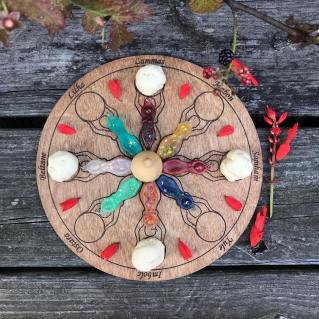
On the summer solstice this year, I made a cake in the shape of a honeycomb, decorating the hexagons with wild blackberries and rose petals. And, now on Lammas, there are these small white biscuits in our hands. My oldest son is almost seventeen. He is nearly as tall as his father, six feet. He has the biscuit for the south, which from where we stand on the deck is our house. He winds up his arm and lets the biscuit fly up, up and over the roof.
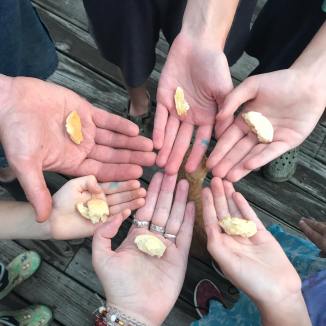
We offer our own small personal pieces of biscuit next, pinched as the first bite from each of our servings at dinner, as representative of a sacrifice we will make this season. And then, we cup our open hands close to our hearts and one by one we speak of what we are grateful for and what abundance we are welcoming, what we are making space to harvest in our open hands.

We join hands and sing, our six year old son requesting “We Are a Circle,” and following his lead, we sway from side to side as we sing, eventually all kicking our legs back and forth into the center of the circle and laughing. We say our closing prayer next, as we do each time we celebrate together: may goddess bless and keep us, may wisdom dwell within us, may we create peace* and then I extend my arms and gather them to me, for a large family hug. There is a sense of connection and renewal around us as we laugh and smile and I tell them thank you for participating.

This ritual was largely spontaneous, all I knew when I stepped outside was that we wanted to offer our gratitude symbolized by our four tiny loaves of biscuit-bread and that we wanted to acknowledge this next turn on the wheel of the year.

Several years ago, when I was still teaching at a local college, one of my students objected to the fact that material on working with LGBTQ clients was part of my class outline. She went through my personal Facebook page and those of my family members, where she noticed photos of the wedding ceremony I performed for my brother and his wife. A message arrived in my email: “by whose authority do you think you have the right to perform marriages?” she inquired. By my own authority, I thought, though in my reply I also cited that I am a legally ordained priestess and as such am recognized by the state of Missouri as capable of solemnizing legal marriages. Not much later, she dropped my class explaining in writing that to continue taking it would be to turn her back on Jesus Christ.

At mother blessing ceremonies, we often sing a song called “Call Down a Blessing.”** After one ceremony, I was asked, “but WHOSE doing the blessing?” and my answer was simple: We are. We are blessing one another.

These are radical acts. These are feminist acts. This is feminism and religion. To express gratitude for the earth, to name the elements as holy, to honor the cycles of the seasons and our lives, to design our own ceremonies, to hold our own circles, to be our own authorities, to bless one another and the spaces between us.

I have two teenage sons now, one seventeen and one fourteen. We have lifted our arms to the rising moon, tossed scraps of bread to the noontide solstice sun, and dabbed sweet spring water on one another’s faces in blessing since they were born. This is what they know.

And, even though they are now teenage boys, each night without fail they come to me and to their dad in turn to be kissed on the forehead in our nightly ritual, a benediction of love. Good night, sleep good, I love you, we each say. My seventeen year old usually drops his return kiss on the top of my head in my hair, speaking the familiar words back to me, good night, sleep good, I love you. Sometimes as I’m getting ready for bed, brushing my teeth in the bathroom, I look up to see him standing in the doorway, “mom,” he says, “did I forget to kiss you?” and I proffer my forehead, just in case we’ve forgotten. The boys each kiss their dad goodnight too and he them—on the forehead, a kiss, and the words, spoken and returned, good night, sleep good, I love you. Sometimes I think this is most potently feminist act of all, these two boys rapidly becoming men beneath our roof, going to bed each night with a kiss and the affirmation that they are loved.

Molly Remer’s newest book of poems, Sunlight on Cedar, was published in March. Molly has been gathering the women to circle, sing, celebrate, and share since 2008. She plans and facilitates women’s circles, seasonal retreats and rituals, mother-daughter circles, family ceremonies, and red tent circles in rural Missouri. She is a priestess who holds MSW, M.Div, and D.Min degrees and wrote her dissertation about contemporary priestessing in the U.S. Molly and her husband Mark co-create Story Goddesses, original goddess sculptures, ceremony kits, mini goddesses, and more at Brigid’s Grove. Molly is the author of WomanrunesEarthprayerthe Goddess DevotionalShe Lives Her Poems, and The Red Tent Resource Kit and she writes about thealogy, nature, practical priestessing, and the goddess at Patreon, Brigid’s Grove, Feminism and Religion, and Sage Woman Magazine.

*Thanks, Carol Christ! We’ve used this family blessing to close our ceremonies for about ten years.

**Originally by Cathy Barton and Dave Para.
Nourishing Wholeness in a Fractured World, by Molly Remer

List for today:

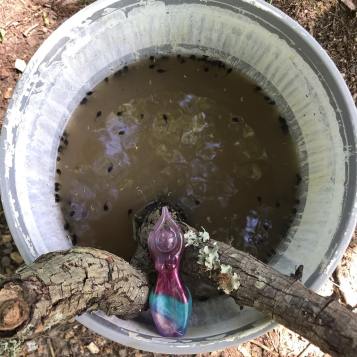
Rescue tadpoles from the evaporating puddle
in the driveway.
Look for pink roses in the field.
Look for wild strawberries
along the road.
Listen to the crows in
the compost pile
and try to identify them
by their different voices.
Plant basil and calendula
and a few more rows of lettuce.
Examine the buds beginning
on the elderberries
and check blackberry canes
to see if the berries have set.
Watch the yellow swallowtail butterflies dance.
Wonder about action and apathy
and what bridges gaps.
Refuse to surrender belief in joy.
Listen for faint echoes of hope.
Feel the tender beat of humanity
pulsing in the world.
Feel the sun on your face
and water seeping
into your jeans.
Remember that even if you have to
move one tadpole at a time,
change is always possible.

It is easy to become exhausted and overwhelmed by the volume of things there are to say, the things there are to think about, to care about, to put energy into, to love, to be outraged about. I want to invite you, at the moment of this reading, to breathe it out, to let yourself come into your body right where you are this second, and put one hand on your heart and one hand on your belly. Remind yourself that you’re whole right here, right now. There is suffering and there is fear and there is pain and there is joy and there is beauty and there is life, and we can hold it all. Let yourself settle and feel, present in this moment, in this unfolding. And, with whatever you feel, whether you feel hopeless or joyful or angry or happy or thrilled or enthusiastic or creative or drained, whatever it is, with your hand on your heart, accept those feelings as okay right now: how you feel, is how you feel; where you are, is where you are; who you are, is who you are. Continue reading “Nourishing Wholeness in a Fractured World, by Molly Remer”

Persistent Beauty by Molly Remer

I knelt beside a sprinkling
of deer fur
dotted with delicate snowflakes.
Don’t take a picture of that,
my husband said,
people will think it is gross.
I don’t find it gross.
I find it curious.
I find it surprising.
I find a story.
Sometimes I feel like
I have to battle a horde
of demonic trolls
before I can take care of myself,
I tell him,
and yet somehow,
I say,
always,
always,
I find my life is still a poem,
in the quietude,
in the battling,
on my knees in brown gravel
to better see this spray of fur
and how the frost
glows like white stars.


I sit on a stone in the pines and let the winds come, sweeping my hair back and lifting my lamentations from my forehead, where they have settled like a black cloud.

I let the air soften my shoulders and my sorrows, sunshine bright on thick brown pine needles, slickly strewn across the steep hill. Continue reading “Persistent Beauty by Molly Remer”

A Lonely Mystic by Molly Remer

I want to be a lonely mystic
dwelling in devotion,82419444_2537557396456467_4177258129500667904_o
constantly dialoging with divinity,
drenched in wonder,
and doused with delight
in knowing my place
in the family of things.
I want to weave spells
from wind and wildness,
soak in solitude,
and excavate  the depths
of my own soul.
I want great expanses of time
to be and to listen,
to feel and know,
each step a prayer,
ceaselessly walking with the goddess.
I crave the clarity of insight
dropping with a flash
into my open hands,
the clear space of listening
with no other voices in my head.
I want to pray with my eyes wide open83673511_2550947128450827_73123862618832896_o
from sunrise until sunset,
never missing an opportunity
to commune with the sacred,
to feel myself enrobed,
ensconced,
ensorcelled,
enspelled
with divine wonder, curiosity,
awareness, and understanding.
I want to light candles
and speak spells,
weave magic from the ordinary
and listen,
always listen,
to the whispers of my heart.
I want a chamber of quietude
with only crows and owls
for companions,
the soft eyes of deer
in a wooded glade
my witnesses,
steam rising from my broths and brews,
weeds and roses twining together
into the medicine of my spirit.
I want to be quiet and contemplative,
waiting in the shadows to spot the magic,
to feel the power,
to see through to the threads of things.
I want to feel still and holy
grateful and graceful,
to be an enspirited beacon
embodying my prayers.

Instead,
I am a mama mystic
I nestle children against my shoulder,
my nose resting in blonde hair and needs,
mediate disputes,
knead bread dough,
make dinner,
fold laundry,
read books,
find filaments of magic
wound around the smallest things,
claw solitude from scraps,
and weave small spells
and bits of enchantment
from moments of magic
that wander by my full hands and head.
I gently coax quiet poems
from full spaces,
let prayers wind up over days,
nosing patiently into the cracks
between my deeds.
And, with my hands in the dough,
or my nose in the hair,
or the hand in mine,
I am drenched in devotion,
dialoging with divinity,
each step a prayer,
and knowing my place
in the family of things.
This is where the goddess dwells
right through the middle of everything,
in the temple of the ordinary.
Here, she says,
this too,
is holy,
sacred,
true,
and it needs you,
not that bloodless,
imaginary,
perfect priestess,
of silent
secret praise.
This is the real work of living
and it shows you who
you
are.


*“Family of things” phrasing from Mary Oliver.

Molly Remer has been gathering the women to circle, sing, celebrate, 65317956_10219451397545616_5062860057855655936_nand share since 2008. She plans and facilitates women’s circles, seasonal retreats and rituals, mother-daughter circles, family ceremonies, and red tent circles in rural Missouri. She is a priestess who holds MSW, M.Div, and D.Min degrees and wrote her dissertation about contemporary priestessing in the U.S. Molly and her husband Mark co-create Story Goddesses, original goddess sculptures, ceremony kits, mini goddesses, and jewelry at Brigid’s Grove. Molly is the author of WomanrunesEarthprayer, the Goddess Devotional, She Lives Her Poems, and The Red Tent Resource Kit and she writes about thealogy, nature, practical priestessing, and the goddess at Patreon, Brigid’s Grove, and Sage Woman Magazine.
Mess and Magic, by Molly Remer

Maybe beautiful things 77381912_2495811250631082_8017831208572420096_o
don’t only grow from peace,
maybe they grow from the
soil of living,
which holds both
blood and tears
muck and magic.

Last week I tried to work on my book while the household debris whirled around me. We are supposed to be leaving for homeschool co-op in just a few minutes, I still need to take a shower, there are orders to fulfill and I really, really want to format this title page, add two attributions, and re-upload the digital file.

The toilet has a ring of water around it, or is it pee, the children come to report.

There’s a weird smell in the kitchen.

I can’t create like this, I yell.

I want to be inspiring, not so messy, not like this.

I gesture frantically, almost crying, my hair wild, my eyes frenzied.

I only have nine minutes before it is time to leave and I still need to take a shower and I haven’t finished my formatting. I stare at the screen and shout:

I only want to make things
from a place of beauty and peace.

But, then I say:

maybe beautiful things don’t only grow from peace,
maybe they need this too, this mess, in order to flourish.

I abandon my book file, left open on my screen, photo half placed and words askew and I take my shower with my heart beating too fast, my mind spinning with to-dos, and agitation thrumming through my veins.

I hastily dry my hair and we pack the car. We will be late, I know. As fly down the road there is a big buck in the road.  It is hunting season and I stop the car on the hill to watch him. Our eyes meet for a moment, he is still, his antlers are wide and beautiful, some of the nicest I’ve ever seen. His shoulders are broad and brown in the early morning sun.

Run free, big guy, I say, run free. If you go up the hill, you will be at our house and it is always a safe place.

This feels both true and beautiful.

A week passes and it is still hunting season, rifle now instead of bow, so my husband and I put on our orange vests before we go out for our morning walks, so that no one will shoot us. I have lived in a state where hunting is an established part of the culture for my entire life, so deer season is “normal” to me and I understand the purposes of it, though I cringe every November to hear the gunshots in the early morning, the wild eyes and swiveling ears of the deer whose home has been invaded with fear and risk after a summer of grazing on wild grasses and berries.

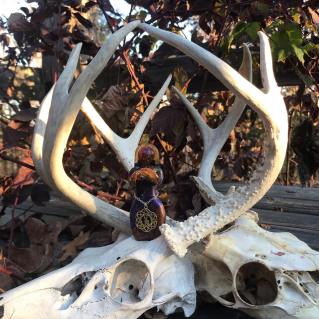
Today, as we walk, we reach the crossroads and something tugs at my attention. I turn back and look into the woods where my eyes catch on the body of the beautiful buck, lying motionless at the base of an oak tree. He has been murdered and then left behind, his large body still and silent, his beautiful antlers against the leaves, the sun glinting on a stripe of white along his belly. His legs are folded against his body, relaxed, this is not a very old kill.

My thoughts of my work and my doing and all the everything that needs my attention fall away and I am struck with grief at this senseless death. I think about his antlers and how I’ve always wanted to find some and I know that someone will come back and cut off his head to remove them. I think for a moment that it could be me who does this, but I don’t have the heart or stomach for it. I imagine taking rosemary and lavender petals to scatter over his body, I imagine laying my hands across his fur and thanking him for being here. I think perhaps that after the vultures and coyotes have done their work I will creep back through the woods and look for him, for his bones, and perhaps I will collect the antlers then, if they have not been chewed by rats or carried off by dogs. I hate that this has happened. It tortures me to walk back by and leave him there, disrespected and alone.

I leave a message for our closest neighbor asking if perhaps he shot a deer that got away and later died in our woods. I message another neighbor and ask if he thinks there is anyway the meat could still be used. The first neighbor calls me back a half hour later, I am surprised to hear his voice on the phone, as we don’t talk often. He is agitated and yelling, not at me, but about the men he found in the road yesterday who killed this animal. He heard the gunshot while cleaning his own deer from the morning and flew down the road to confront them, where he found them standing in the road, truck parked at the crossroads, the deer dead beneath the tree. This is illegal and it disgusts him, his voice shakes as he recounts the story. He tells them that he will always know what they did and they are the ones who have to live with themselves and their actions. They deny it, claim someone else must have done it and drive away, leaving the body behind. He expects they will sneak back in the night to take it, but they have not, and there he lies in the dappled morning sun.

Our employees have arrived to work and the house is full of voices and questions and people waiting for me to do things. I take a shower anyway. Showers are one of those things I occasionally withhold from myself as I desperately try to keep up with everything people need and want from me in a given day, but I take the shower and try to let the adrenaline, the anger, the sense of waste and loss wash away from me. I keep thinking about the deer, his life, my mind turning it over and over, my body filled with sorrow.

As I am putting on my lotion and simultaneously also answering calls from our bank 73292554_2486141391598068_5135782722731507712_oabout a new account, feeling rushed and out of breath, there is a knock on the front door. I quickly dress and go out to the living room, my hair still wet and ragged, and find our other neighbor standing there. He is holding two white skulls in his hands, long antlers curving between his fingers. We talk about the buck, about the waste of his life, about the disrespect and senselessness of this action. He is a hunter too and he says he has been watching this deer for more than a year and that you get to know them when you live here, that you see the same ones, sometimes every day, that there are only so many in a given range, and you get to be a part of their lives. We ask him if he knows Limpy, the doe with the broken leg that healed crookedly, but that we see almost every day, sometimes twice a day, in the field across the road.

She raised twin fawns this year, he says.

We look at each other quietly for a moment. I feel a wave of gratitude that I live somewhere where the neighbors, too, know Limpy and her babies.

I hurt my ankle in June of this year and when I could finally walk on the road again, taking my first real walk in six weeks, I saw Limpy and her twins at the end of our driveway. She looked at me for a long time and I felt a sense of kinship with her, two mothers with injured legs, trying our best to keep going.

My neighbor holds the antlered skulls out to me and says he will call the buck in to the conservation department as you are supposed to do. He says this deer has sentimental value to him and he will make a mount with his head and he is offering me these skulls in trade. I take them with gratitude, though it isn’t the same as finding my own. The antlers are whitened and smooth. One has small chew marks along two of its spikes, the others has knobby ridges along the base. They are beautiful. I hold one skull in each hand, antlers curving along my arms. They feel like precious treasures to me, something given, something received, a moment of genuine respect for a needlessly slain creature of these woods we all love.

When Mark and I walk the next morning, the buck’s body has been moved deeper into the woods, out of sight, and there is only a heavy flattened place stained dark red in the carpet of oak leaves across the forest floor and the thick smell of blood in the air to indicate that he was ever there. We know though, we shared this home ground, and I leave rosemary, lavender, and thyme scattered across the blood-soaked leaves.

Molly Remer has been gathering the women to circle, sing, celebrate, 65317956_10219451397545616_5062860057855655936_nand share since 2008. She plans and facilitates women’s circles, seasonal retreats and rituals, mother-daughter circles, family ceremonies, and red tent circles in rural Missouri. She is a priestess who holds MSW, M.Div, and D.Min degrees and wrote her dissertation about contemporary priestessing in the U.S. Molly and her husband Mark co-create Story Goddesses, original goddess sculptures, ceremony kits, mini goddesses, and jewelry at Brigid’s Grove. Molly is the author of WomanrunesEarthprayer, the Goddess Devotional, She Lives Her Poems, and The Red Tent Resource Kit and she writes about thealogy, nature, practical priestessing, and the goddess at Patreon, Brigid’s Grove, and Sage Woman Magazine.
 

To Light a Flaming Pumpkin: The Inexact Art of Family Ritual, by Molly Remer

Our bounty is inIMG_7695
creativity
friendship
community
the myriad small adventures
of everyday.
We tell of magic
and moonrise
and listening to the pulse
of the earth beneath our feet.

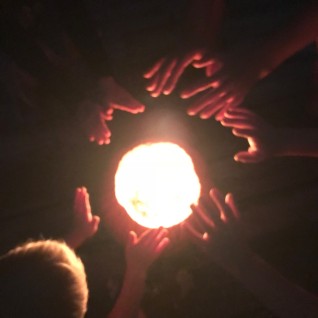
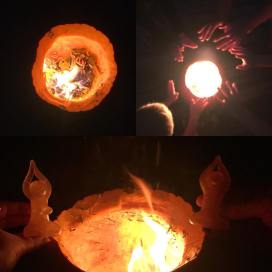
Ah, October. Fall has settled into the trees and air. Last year on Samhain (Halloween), as the sun was setting and the full moon was rising, my family stood together in the dim light on our back deck, lit a fire in a hollowed out pumpkin and offered handfuls of herbs into the flames as we celebrated our blessings, our harvests, and our bounty, as a family and as individuals. As we spoke aloud our blessings and our bounty, our words got deeper, broader, and more authentic. My twelve year old son stepped forward to say how thankful he is that he gets to live with his best friend, his fifteen year old brother, and they embraced over the flaming pumpkin. My fifteen year old son offered his thanks for a family that has “cool IMG_7387rituals like this” and my four year son offered his blessings for the “energy we feel together.” My seven year old daughter offered her gratitude for pandas and for toys.

The next week, we returned the seeds to the pumpkin and released it to the outdoors to grow next year.

Seventeen years ago, I held my first Winter Solstice ritual. I wrote my wish for a baby onto a small piece of paper and rolled it up into a “seed” of my dreams that I planted within a special wooden box. On the autumn equinox the following year, I gave birth to my first child, a son who now stands inches above me, but who joins hands with his family each month to sing “Dance in the Circle of Moonlight” together on the back deck under the full moon.

After having this first baby, it became increasingly important to me that we celebrate holidays and traditions that reflect our spiritual values and worldview rather than the packaged version of the holidays offered by society, or the religious observances of dominant faiths that do not match our own. While we have celebrated the wheel of the year together in a variety of ways in what has now been sixteen years of parenting and twenty-one years of marriage, it wasn’t really until last year that I felt I finally, truly hit my stride in planning fulfilling, nourishing family rituals. Perhaps it is because I am no longer trying to juggle nursing a baby or changing a diaper while simultaneously also guiding a ceremony. Perhaps it is because I’ve loosened up and accepted the myriad imperfections possible within a multi-age celebration. Perhaps it is because when one of the children wanders off during circle or interrupts me while I’m talking, I accept it as part of the flow, and continue our work without breaking my stride. Perhaps it is because I now laugh too when someone makes a joke during my careful ritual, and continue to roll with it, instead of feeling like it is disrespectful. Perhaps it is because I consider a 15-20 minutes family ritual perfectly sufficient instead of trying to plan for a full-fledged, retreat-style “program” of activities. Perhaps it is because we’ve joined hands in family circle in so many ways and for so many years that we all now trust that I’m not giving up on doing this together.

In the course of the year we’ve anointed one another’s foreheads with fragrant oils while standing in the freezing water of a freshwater stream. We’ve felt the raindrops kiss our faces and the rays of the sun peek in and out of the clouds as we celebrated the summer solstice by releasing wildflowers into the river. We’ve howled at the moon together, built a green man face from leaves, stones, and sticks in the field, created flower mandalas, thrown pinches of cornmeal into the woods as a symbolic sacrifice, soaked our feet in warm water laced with rose petals and then massaged one another’s feet with lotion, walked through a spiral of candlelight, and offered handfuls of herbs into a flaming pumpkin.

As we notice the changing seasons and honor the call of nature within our lives through ceremony, celebration, and song, we make visible the interconnected dance of life. We reaffirm our commitment, our relatedness, to each other and to the natural environment around us. We communicate with and are in relationship to that larger force of life and spirit that we call Goddess. And, we bring our spiritual beliefs into our bodies, hands, minds, and hearts in an ever-spinning Wheel of celebration, attention, observation, enjoyment, communion, and love.

 “We can think of ritual as the container we weave in which we can be carried away by magic and ecstasy.”

—Starhawk and Valentine, The Twelve Wild Swans

For your own flaming pumpkin ritual, choose a large, round pumpkin, cut off the top 42311806_2188101348068742_1038582461505732608_oand hollow it out. Keep the seeds to plant with the remnants of your fire later. You may start the fire with paper and a lighter and then keep adding herbs to keep it burning, or you may stoke it by putting some alcohol in the bottom of the pumpkin to begin with. Alcohol burns cool and can create a longer lasting, less smoky flaming pumpkin. Offer your autumn bounty into the pumpkin with herbs sprinkles/handfuls—these can be spontaneous spoken aloud declarations of your harvest, your celebrations, your gratitude, etc. What are you thankful for?

  • Optional: offer any sacrifices/releasing on slips of paper into the flames
  • Optional: Sing “Hallowed Evening” chant (by my kids and me)

Hallowed evening
Hallowed night
We dance in the shadows
We offer our light.

Additional Articles:

Pain and Pausing, by Molly Remer

“I pin my hopes to quiet processes and small circles, in which vital and transforming events take place.”

—Rufus Jones

Last year in August, I wrote here at FAR about my own pattern of getting sick each July and 67552265_2390846147794260_5776927048312291328_othe steps I have been taking over the last three years to change that pattern for myself. This year in a surprisingly literal twist, I fell and hurt my ankle in June, and now, eight weeks later, am still recovering from that fall, thus inadvertently continuing my pattern of spending July of every year “out of commission.”

There is no dramatic story associated with my fall, I was quite literally just standing still on the front porch, waiting for my kids to open the front door after getting home from a Girl Scout meeting, when my foot slipped off the short front step and I came down hard on my ankle, twisting it beneath me at a 90 degree angle inward, as if I stepped down onto the end of my leg bone instead of my foot. I knew immediately that this was not a “normal” misstep or simple twist of the ankle, my leg hurt in a different and deeper way than I’ve ever experienced before, the swelling instantaneous and visible through my sock before I could even crawl inside. My husband Mark came running to help me and all I could say was, I think I’ve really, really hurt myself. Continue reading “Pain and Pausing, by Molly Remer”

Nourishing Your Caring, by Molly Remer

Take time 60107979_2326071390938403_2921363486892097536_o
to nourish
your caring.
It is needed.

Last month it was raining heavily on a Saturday morning and I spent time coloring letters to fairies with my younger children and baking a cake. Before I knew it, the day had slipped away into the rain and I didn’t get to make my daily visit to the woods behind my house as I like to do in the morning. While the things I did instead were fun and loving, I found myself telling my husband, once again, that I am feeling burned out in my life in general and like I’ve lost my caring. I sometimes worry that I don’t care anymore, that I’ve used up my care, my inspiration, my passion, that I’ve fueled magic for others for so long, that my own has evaporated and I’m finished, extinguished. I listed off the things I need to refuel my soul and restore my care so that I can be there for others, for our work. My list was simple and short and my husband pointed out that I get the things on it almost every day:

  1. Go to the woods.
  2. Write and journal.
  3. Walk and discover things.
  4. Create/draw/take pictures.
  5. Read.

I need to nourish my care, I tell him, because I can’t stop caring.

Caring is what holds life together.

What do you need to nourish your caring?

This year, I have found myself struggling with recurrent episodes of feeling like I don’t care. I feel careworn, care-overloaded, care-burned out, care used-up. Sometimes I even feel like I actually can’t care anymore, like all my care is used up, spent, extinguished, exhausted. I have also found myself feeling a little sad and wistful remembering how much I used to care, about everything, but at times I also feel liberated by owning the “don’t care” sensation. Sometimes it sets me free. The world is stained, strained, and brittle from so much lack of care from so many people. We must keep caring, we must care, even when it is a strain. I suppose the secret may be not to care too much about things that don’t require our care, not to overload ourselves with cares that are not our own, or that don’t actually require our attention and are, frankly, quite fine without us and our meddling.

After the month’s Pink Tent ritual with my local circle, a friend tells me that she has been 58639012_2319362924942583_1704575264542949376_o(1)going to yoga class and every time she lies on the floor at the end of class, she thinks of me. I consider this a compliment. If I could be known as a lay-down revolutionary, that would please me. At least two years ago, I put on my list of “100 Things to Do this Year,” to lie on the floor for at least three minutes every day. I have kept this up more or less every day since then, even setting my phone timer for three minutes at the end of my personal yoga practice each morning, so I know I’m actually giving this to myself. I wonder what might change for many of us if we allowed ourselves three minutes a day to lie on the floor? Ten minutes? Fifteen minutes? One hour? Another friend tells me she needs a time out to refill herself until she is overflowing, instead of just refilling her cup a tiny bit and then draining it over and over again. I feel this too. I have the sensation that I been coasting on my reserve tank for at least a year and my reserves are now becoming depleted too. It takes more than three minutes to fill the tank, so that it carries sustained and lasting energy to fuel my soul.

In the woods the next day, I sit with my eyes closed in the sunshine, basking in the warmth. I hear the sound of birds from each side of me, ping-ponging off of one another into the sparkling green air. I listen to them until my mind softens and I am no longer tormenting myself with questions of how to be better, be more, fix it all. I am very still on the rock and when I open my eyes, I see a vulture coasting towards me. It swoops very low, skimming the treetops, possibly checking to see if I am actually breathing there on the stone, it circles once, twice, three times, above my head, at each pass coming very low, low enough that I can see its red head turn from side to side, looking at me.

Hey, buddy, I say. Yes, I’m still breathing!

My floor-lying friend has spent the night at my parents lodge and I go to visit her and to paint with my mom, my daughter, and my friend and her family. My head is throbbing with the headache I often get following an intense ritual and I don’t feel very present, but we paint anyway, the colors swirling and mixing and the freeform nature of the pour painting meaning there are no mistakes, only magic. When we finish, I help her load a weaving loom into her car and we speak briefly about group dynamics and ritual etiquette, and priestessing energetics. As we speak, I look up to see nine vultures this time, circling in the wide sky above the large open field surrounding the lodge building. They dance in the air and they whisper, It is okay to let go. It is okay to soar. It is okay to be free. It is okay to clean things out and away. That is how you can keep caring.

Recipe for Rebuilding a Soul:

1 weary heart61445954_2342336385978570_2975037873578835968_o(1)
2 open arms
1 large flat rock
As many tall pine trees
as you can find
1 empty book
Many pens
Lots of water
2 scoops of sunlight
An infinity of starshine.

Mix together patiently and wait in the shadows. Let rise in the sun. Let rise with the moon. Check for delight. If still soggy and deflated, expose on a hillside or soak in the ocean. Sprinkle with laughter.

Submerge beneath a stream of inspiration.
Drizzle with dreams and a generous helping of time.
Steep with incredible slowness.
Dust with flowers and need well.
Let become exquisitely tender and soft.

When fully risen, warmed throughout, and glowing with strength and satisfaction, enjoy with a tall glass of moonlight, a side of magic, and a handful of enchantment.

Create regularly for best results.

Additional audio poem: Careworn Soul

This essay is excerpted from my book in progress, The Magic of Place: Rebuilding the Soul Where and How You Are.

Molly Remer has been gathering the women to circle, sing, celebrate, and 61538890_2344169199128622_8199673458095816704_oshare since 2008. She plans and facilitates women’s circles, seasonal retreats and rituals, mother-daughter circles, family ceremonies, and red tent circles in rural Missouri. She is a priestess who holds MSW, M.Div, and D.Min degrees and wrote her dissertation about contemporary priestessing in the U.S. Molly and her husband Mark co-create Story Goddesses, original goddess sculptures, ceremony kits, mini goddesses, and jewelry at Brigid’s Grove. Molly is the author of WomanrunesEarthprayerShe Lives Her Poems, and The Red Tent Resource Kit and she writes about thealogy, nature, practical priestessing, and the goddess at Patreon and at Brigid’s Grove.
The Sanctuary of One Another by Molly Remer

53850207_2292227257656150_5800641319395131392_o“Please prepare me
to be a sanctuary.
Pure and holy
tried and true.
With thanksgiving
I’ll be a living
sanctuary
for you.”*

Beautiful Chorus (Hymns of Spirit)

In March, my husband drove our daughter into town to work at her Girl Scout cookie booth and released me to prepare for an all-day Red Tent retreat for my local women’s circle. After I packed my supplies for ritual, I set off on a walk in the deepening, rain-dark twilight. As I walked, I sang a song of sanctuary over and over, until I felt transported into a different type of consciousness, my feet steady on muddy gravel, the leafless branches stark against grey sky, moss and stones gleaming with sharp color against the roadside. A fallen tree absolutely carpeted with enchanting mushrooms caught my eye and invited me off the road and into its arms. As I stood there, feeling as if I had stepped out of ordinary reality and into a “backyard journey,” the spring peepers in the ephemeral pool in our field began their evening chorus. It has been so cold out with below freezing temperatures, snow, and ice for days since first hearing them in early March that I actually wondered if they would survive to continue their song.

Mercifully, though, it is not a silent spring. Continue reading “The Sanctuary of One Another by Molly Remer”

Devotion by Molly Remer

There are things that ask
50237778_2257311164481093_3090053013251817472_oto be remembered
or, is it that I ask to remember?
The everyday enchantments
of our living
words forming slices of
memory.
A white squirrel watching
from a sycamore tree
the sounds of black
crows calling
from within the secret
passages
between oak tree
and neighborhood
footprints of a shy orange
coastal fox in the sand.
Rays of sunlight
forming individual white rainbows
stretching from cloud
to water.
I no longer feel like I have anything
to teach
I just want to tell you about the
shell I found today
the sandy pink color
of its wave-shaped spiral
the way the pine needles
form a canopy under
which orange monarchs dance
the surprising softness and bright
green hue of thin fingers of grass
the pretty purple pollen cones
of a longleaf pine.
The colors of a morning woven
into a tapestry of devotion.
That is the word for this feeling
in my chest.
Devotion
to noticing.

Devotion is not a word that I have previously felt particularly inspired by or connected to. Perhaps it is too heavy, too responsible, or even “too religious”—carrying connotations of dogma or roteness. However, in the last month or so, something has opened up for me to consider the word, and the process, in a different way. Continue reading “Devotion by Molly Remer”