Realize by Natalie Weaver

Natalie Weaver editedAutumn of 1977.  The faculty wives have come together in the modest University Heights home of a physics professor.  Their Aquanet hair is sprayed to the heavens and at significant risk of igniting from lipstick-stained cigarettes that are resting precariously in the cradle a heavy crystal ashtray.  Their business is serious.  They are putting together a cookbook.  The Faculty Wives Cookbook of 1977, to be precise.  It is a noble task.  They will cook from it for their young families, for their husbands, that is, the faculty.  Even more, they will use each other’s recipes.  Martha will cook Mary’s chili; Margaret will lose weight on Donna’s diet cabbage stew. It is an achievement that will be smugly displayed on bookshelves for decades.   It will yellow, and the black plastic spiral binding will wear and crack.  The Kinko’s heavy card stock cover will be ringed with coffee marks.  And, one day, daughters-in-law will decide whether to keep it or to pitch it out.

I think I must have one of the last remaining copies of this rare book.  Almost 40 years old, I stumbled on it while cleaning the other day, seeing at last with my own eyes a thing of legend.   At the dinner table, I oft heard of the making of this collection of recipes – what a job it was to oversee and how much pride the wives felt in its completion.  Holding it now, I was struck poignantly by the absence of its authors from the scene.  No longer card bearing faculty wives, they are widows or caregivers to aged retirees or elderly divorcees or simply deceased. Continue reading “Realize by Natalie Weaver”
Have You Seen These Muslim Women? by Vanessa Rivera de la Fuente

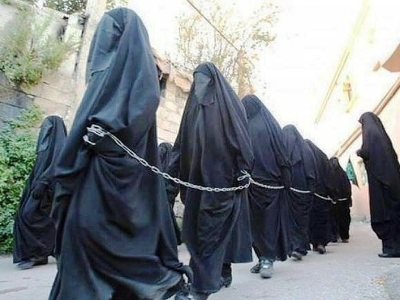
Shia Women AshuraThe photo that accompanies this article, or others similar, have been posted, shared and commented through social networks as expression of the inherent misogyny of Islam, with descriptions such as “DAESH taking women to sell in the concubine’s market” or “Muslim women being carried to forced marriages”. I’ve also seen this picture being used by some feminists in academic conferences to illustrate their presentations on the “Status of Women in Islam.”

This photo has been misused. This image is taken from a religious event which is celebrated for Shiite Muslims to describe the terrible events that took place in Karbala 1,200 years ago. This act recalls the occasion when the family of the Prophet Muhammad, formed mostly by women, was taken prisoner, including children and forced to walk chained. History records and praises the courage of women who bear this painful pilgrimage instead of submit themselves to their captors.

 “Muslim Women” is a Hoax Continue reading “Have You Seen These Muslim Women? by Vanessa Rivera de la Fuente”

I’m Failing by John Erickson

“How is your dissertation going?”

WEHO CA (June 7, 2015)©2015 Rebecca Dru Photography All Rights Reserved www.rebeccadru.com

“How is your dissertation going?”

Never before has a simple question packed such a punch. Five little words strike fear into my heart as I remember I have a countless number of things to do before I get that title after my name: Ph.D.

There are so many reasons I feel like I’m failing at my dissertation and school, which I used to love. The first reason is I never have any time to write. Continue reading “I’m Failing by John Erickson”

(((Israel))) by Ivy Helman

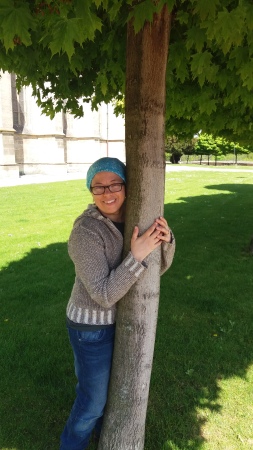
me hugging treeThe BBC just ran a story about white supremacist and neo-Nazi groups targeting Jews by signaling each other to their presence on various social media sites through the use of (((this symbol))).  Of course, this is all based on the assumption that a “typically” Jewish last name signifies the bearer is also Jewish.  Through a Google app (since removed) that could recognize patterns such as ((())), these Jewish people began to receive anti-Semitic comments.  There has been a general outcry of disgust among Jews and other minority groups as to the problematic targeting of Jews in this fashion.

The same cannot be said about the BDS movement and people’s willingness to call it out for what it is.  This to me is hypocritical!  According to its website, the BDS movement, or Boycott, Divestment and Sanctions, seeks to end what it understands to be the colonialism, apartheid and oppression of Palestinians in Israel through various financial, commercial and international means.  It accuses Israel of human rights violations, genocide, ethnic cleansing and other war crimes as well as illegal occupation (of the Palestinian lands, not just the occupied territories). Continue reading “(((Israel))) by Ivy Helman”

Tipping Points in Academe By Grace Yia-Hei Kao

I’ve been thinking a lot about tipping points of late.

According to Malcolm Gladwell’s debut book, The Tipping Point: How Little Things Can Make a Big Difference (2000), a tipping point is “the moment of critical mass, the threshold, the boiling point” when an “idea, trend, or social behavior crosses a threshold, tips, and spreads like wildfire.”

Continue reading “Tipping Points in Academe By Grace Yia-Hei Kao”

A Short Lesson in Subjugated Knowledges

“We” can give many answers for how to colonize someone; but for many of us, it often takes special training, years of education, reconstructive projects, task forces, books upon book of reading, listening through the loud and ever present static of dominant culture, constant vigilance, one’s own liberation, the liberation of others, etc. to learn how to think otherwise.

Sara FrykenbergIn her Presidential Address at the national meeting of the American Academy of Religion in 2011, Dr. Kwok Pui-lan outlined a history of Religious Studies and its relationship to colonial projects, challenging the membership to apply post-colonial theory and analysis to our scholarship and teaching, think with and relate to our global colleagues, and start asking questions about what studying religion does for us, “rethink[ing], reimagin[ing] and recreat[ing] our discipline.”[1] Responding to this call, I have been slowly working to include postcolonial discourse in each of my classes, lower division, upper division, graduate and undergraduate.

Continue reading “A Short Lesson in Subjugated Knowledges”

STEM and Sexism: Pedagogical Responses to “Chilly Climates” by Sara Frykenberg

Another way to put this: there is nothing inherently competitive about the study of mathematics. The classroom is competitive in order to create a particular kind of graduate—one who engages in a particular [dominant] culture. Liberative pedagogy challenges the ways that classrooms are run in order to challenge the dominant culture.

Sara FrykenbergRecently, a friend of mine sent me a journal article entitled, “Are STEM Syllabi Gendered? A Feminist Critical Discourse Analysis,” and a response to the research from a rather conservative publication, the National Review: “Female Researcher: We Must Make STEM Courses ‘Less Competitive’ to be more ‘Inclusive’ of Women.” Not a feminist or feminist scholar himself, his question to me was whether or not the author of the original research article, Laura Parson, was sexist and/or racist for suggesting that course syllabi needed to be, or rather sound, less “difficult,” less competitive, etc.

For those of you who don’t know, STEM educations refers to education in Science, Technology, Engineering and Mathematics; and within the United States, women are significantly underrepresented within these fields. I share these articles and my friend’s question in this blog because I believe there is a common misconception that feminist and other liberative educators are arguing that we need to make courses “easier” or “less intimidating” in order to create inclusion. The implication here, that somehow women and/or people of color need an easier course, can be understood as a sexist and racist assertion of inferiority. However, this common critique misses its own investment in kyriarchal codes. Conflating masculinist pedagogical practices with academic rigor, this circular logic redirects the responsibility for inclusion onto the oppressed themselves as though the supposedly “intimidated minority,” is deficient, not the exclusivist language and practices that reinscribe power for particular people and particular ways of being. Continue reading “STEM and Sexism: Pedagogical Responses to “Chilly Climates” by Sara Frykenberg”

Social Transformation in the Urban Context (a.k.a. PANAAWTM 2016) By Grace Yia-Hei Kao

In a few days I’ll be heading to Chicago to attend another conference—PANAAWTM to be exact. PANAAAWTM stands for “Pacific, Asian, and North American Asian Women in Theology and Ministry.”  As I’ve explained in a previous blog, PANAAWTM’s deepest roots can be traced back to two groups of women: Continue reading “Social Transformation in the Urban Context (a.k.a. PANAAWTM 2016) By Grace Yia-Hei Kao”

I Am a High School Drop-Out by Karen Leslie Hernandez

karen hernandezIn 1985, four months before I was supposed to graduate from high school, I awoke one morning, made a hasty decision to escape my harsh reality, and by the end of the day, I was a high school drop-out.

Even now, with a BA from Wellesley College and two theological master’s degrees, I have a difficult time admitting I dropped out of high school. It’s not necessarily because I am embarrassed, but more, it is because it reminds me of that very painful time in my life.

My journey is, I am aware, different, to say the least. However, as I rummage through my past, I am always reminded that I didn’t get here alone. No, indeed, there were many beautiful souls that helped me get to where I am today.

In all the work and conversations I have had with women around the world – women in the Slums of Mumbai, domestic violence survivors, rape victims, women that have experienced war and trauma, incest survivors – I am always reminded of one thing – women are all born with strength, beauty, hope, and a future. Somewhere along the way, for many of us, things change, and the sad reality is that things change because of where we are born, or our educational opportunities, or our social class, or our race, or our religion, or our place in the family, or mental illness, or abuse, and so on. I think a lot of times things change for women, simply because we are women. Continue reading “I Am a High School Drop-Out by Karen Leslie Hernandez”

What Happens when Wonder Woman “Leans In” and Winds up in Traction? by Michele Stopera Freyhauf

FreyhaufThey always say in writing – use a title and the first few sentences to grab attention and the reader will want to see what you have to say. By my title, you have probably ascertained that I have made reference to a couple things:  Wonder Woman, Sheryl Sandberg’s “Lean In,” and traction.  While lately, I have suffered from writer’s block and lack of time to work on my writing, I have also found myself in another place of suffering that has me in traction at least thrice weekly.

It is in that spirit that I reflect on my former status as the infallible wonder woman – the mom of 4, who works full time, teaches, writes, supports her family, is in the middle of writing a dissertation and who started this new year as my year to “Lean In” and really excel in my career  – to the current status of fallible woman, mom of 4 trying to stay afloat in all of her obligations, dealing with difficult sibling and teenage bantering as well as (thanks to a begging daughter spouting promises of responsibility) a Siberian Husky puppy and a resident 10 year-old Boston Terrier who now demonstrates the IMG_3984epitome of love-hate relationships, to prioritizing projects in order to keep everyone happy while I try to heal, attend physical therapy, and manage newfound pain and limitations.

In this post,  I offer my [brief] thoughts about aging and struggles when a body, probably abused through pushing too hard, but also enduring the normal wear and tear of aging, begins to betray you while trying to come to terms with to a new normal of limitation within your own being  –  “adapting” if you will – a skill that I believe women have come to master well.

Throughout life, we all face our shares of limitations and encounters with mortality.  Lately, it seems like I have encountered one thing after another.  However, as these events arise, life must inevitably move on – but, moving on does not mean ignoring what just occurred.  Rather, time needs to be taken to understand and appreciate each of these things – even if things do not go our way. Continue reading “What Happens when Wonder Woman “Leans In” and Winds up in Traction? by Michele Stopera Freyhauf”