In a recent post Xochitl Alvizo cited Beverly Harrison’s much-loved essay “Anger as a Work of Love.” Harrison captured feelings that were in the air at the time of its writing several decades ago. Women were laying claim to the right to be angry at the silencing of our voices, the double standard, the media portrayal of women, income inequality, lack of access to good jobs, failure to prosecute rape and domestic violence, and a host of other injustices.
Most of all we were protesting the cultural stereotype that the “good woman” (understood to be white, Christian, and married or hoping to be) would not protest loudly or at all, would turn the other cheek, and would think about others rather than herself. (Jewish women and black women had to strive doubly hard to “live up” to this standard, as it was assumed that Jewish women were “overly assertive” and that black women were “too strong” and often “angry.”)
In this context Harrison’s essay and Mary Daly’s epithet “rage is not a stage” gave women—especially white women–permission to get in touch with our feelings of anger and to express them. We understood that “good women” had been hiding and repressing their feelings for centuries if not millennia with the result that the structures of injustice remained intact. Continue reading “Anger is Not a Panacea: The “Next Stage” after Rage by Carol P. Christ”
Oppression is systemic. Injustice is systemic. It pervades the whole – it seeps into everyday actions and becomes habits and patterns that function as default. As a result, the actions that fall within these patterns hardly need justifying. If anything, the questioning of them is what is put on the defensive. And those who stand against injustice must usually do so in the face of militarized policing, before vast forces that serve to preserve the status quo.
I can’t help but see the similarities between the everyday existence of young black men, of boys in this country, and that of women. The lack of safety in public places; the need to always be aware of one’s surroundings; the lack of trust in the intentions of another; living with the knowledge that people like you experience violence at much higher rates than others. It is a racist, violent, patriarchal world we live in. And, yes, it is also other things, good and beautiful things, but sometimes the hard reality of everyday life blocks out that light. Continue reading “Systemic Violence and the Killing of Michael Brown by Xochitl Alvizo”
I have a poster on my wall: UPPITY WOMEN UNITE. In big, red, capital letters. I don’t remember where I got this poster, but I know I’ve had it since the late 70s or early 80s. I’m sure it comes from the raggedy late 60s, when second-wave feminism got up a head of steam and uppity women began getting our attention. That’s when Betty Friedan said being a proper 50s housewife was like having a mental illness. It’s when Gloria Steinem founded Ms. Magazine, which (oh, horrors!) did not give us recipes or home-making tips and did not tell us how to dress to lure our men into bed. It’s when Mary Daly started giving us a whole new, original take on the English language. Ahhh, yes, those were the good ol’ days. And the bad ol’ days, too, when the Equal Rights Amendment was not ratified.
“Uppity” can be a troublesome word. In the olden days, if someone called you uppity, it means you were inferior to them and weren’t staying in what they thought was your proper place. If you were a black person, for example, and if you didn’t step off the sidewalk when white men were coming, you were uppity. If you were a woman who wanted equal pay for doing the same work a man did, you were uppity. Those women in the 1980 movie, 9 to 5, were majorly uppity. And they won the battle.
Uppity women didn’t stay in the kitchen or the bedroom. They used—oh, horrors—the Pill. They marched to Take Back the Night. They got up on stage and played their own drums and guitars and didn’t sing like proper ladies should. They shouted. And they got into politics. Bella Abzug said that a woman’s place is in the House. Shirley Chisolm became the first black female member of congress in 1968 and in 1972 ran for president. (And I voted for her.)
The English teacher in me wants to get in a word or two here. Look at the phrase “uppity women unite.” It might be a front page headline that says strong women who won’t stay on the bottom are getting together. Or maybe it’s a simple declarative sentence. But add punctuation and we get more punch. “Uppity women, unite.” Now the verb is imperative. We must unite. Let’s make it stronger: “Uppity women—unite!” Now it’s a command.
So, uppity sisters, and uppity brothers, too, you know how to multitask. Push the on button in your corpus callosum and let your imagination run while you read this. Let’s consider what the planet might look like if we had equal rights (and rites) in all things. Please understand that I’m not saying women should be the ones on top. I’m not talking about “power over,” but about what Starhawk calls “power with.” That’s shared power, which leads to shared magic.
Imagine yourself as one of a huge crowd of flying people joined as points of light above the earth. Float peacefully up there for a few minutes. Think about the power of people joined together, the energy of people working together. Now let’s get down to earth. Floaty energy is fun, but it doesn’t get much done. Imagine yourself as a member of a group with a goal. Touch down. Stand on the earth and consider the fact that everything on the planet is alive—not just people and animals and plants, but rocks, too. Even things we constructed have some life force. Embrace panentheism for a little while. Now here’s something to do: Find a church that doesn’t accept uppity women or uppity brothers. You’re united. As united, uppity people, go to that church and stand in a circle around it. Send friendly but firm energy into that church so that, even if a whole denomination or religion won’t change right now, that individual church might change. The next time you go to that church, radiate the same energy when you go inside.
You can also find a church that appreciates uppity folks. Send grateful energy to the church and all the people in it.
UPPITY WOMEN UNITE. If enough of us uppity women and our uppity brothers get together, we will eventually build up to a critical mass. A critical mass can lead to an explosion. I’d prefer to see a spiritual, peaceful explosion. What do you want to see?
Barbara Ardinger, Ph.D. (www.barbaraardinger.com), is a published author and freelance editor. Her newest book is Secret Lives, a novel about grandmothers who do magic. Her earlier nonfiction books include the daybook Pagan Every Day, Finding New Goddesses (a pun-filled parody of goddess encyclopedias), and Goddess Meditations. When she can get away from the computer, she goes to the theater as often as possible—she loves musical theater and movies in which people sing and dance. She is also an active CERT (Community Emergency Rescue Team) volunteer and a member (and occasional secretary pro-tem) of a neighborhood organization that focuses on code enforcement and safety for citizens. She has been an AIDS emotional support volunteer and a literacy volunteer. She is an active member of the neopagan community and is well known for the rituals she creates and leads.
These past three months I have learned the wonderful, important word “survivorship.” At the cancer center where I receive care, “survivorship” means life’s physical, emotional, mental, spiritual, economic, social, and political aspects affecting the quality and quantity of life after treatment.
“Survivorship” also perfectly describes what I have seen over and over working with older women, especially those who have made their lives masterpieces of this art. The deaths of loved ones, the loss of home and country, devastating illness and lifelong disability, violence from family and discrimination and hate from strangers – through it all they have found a strength and power that they have used to make their lives and that of others more meaningful and impactful. In fact, almost all older, and many younger, women I know have been transformed by their own kind of survivorship into someone beyond who she imagined she would ever be.
Survivorship also describes the courage, persistence, strength, wits, guts, intelligence, and wisdom of the global community of women necessary to overcome the trauma, violence, violation and repression of at least the past several thousand years. It is what has brought women through to where we are now. Women’s spirituality as a force and a movement is also a heroine of survivorship. Through millennia of being repressed and dressed up in the garments of patriarchal practices to suit their needs, the traditions and spirit of the Female Divine have survived and we now see Her reclaiming Her place in our spiritual lives, theology, and world history.
In February 2014, headlines incorrectly stated that Gloria Steinem said religion is the biggest problem facing women today. Wrong.
In her interview by Jennifer Aniston at the first Makers Conference, Steinem said that not talking about religion is one of the biggest problems facing feminism today. That’s a big difference. At first she said the biggest problems are “anti-feminism” and “pay inequality,” but those issues are already on the table. She believes the feminist establishment isn’t talking about religion enough.
I agree and have agreed for a long time. Like many in this community, I have spent many years talking about feminism and religion, and it’s about time the Big Names noticed it is an important conversation. I hope they realize quickly that it’s already been going on for over a century!
A few days ago I had the pleasure of giving a talk at the Secular Student Alliance Conference on how non-believing persons can work with Churches. Amidst the chaos of conferences–managing your time, deciding which talks to attend, and making sure you have enough water (it was a Burning Ring of Fire outside in Tempe, AZ)–I got to meet some pretty incredible secular women.
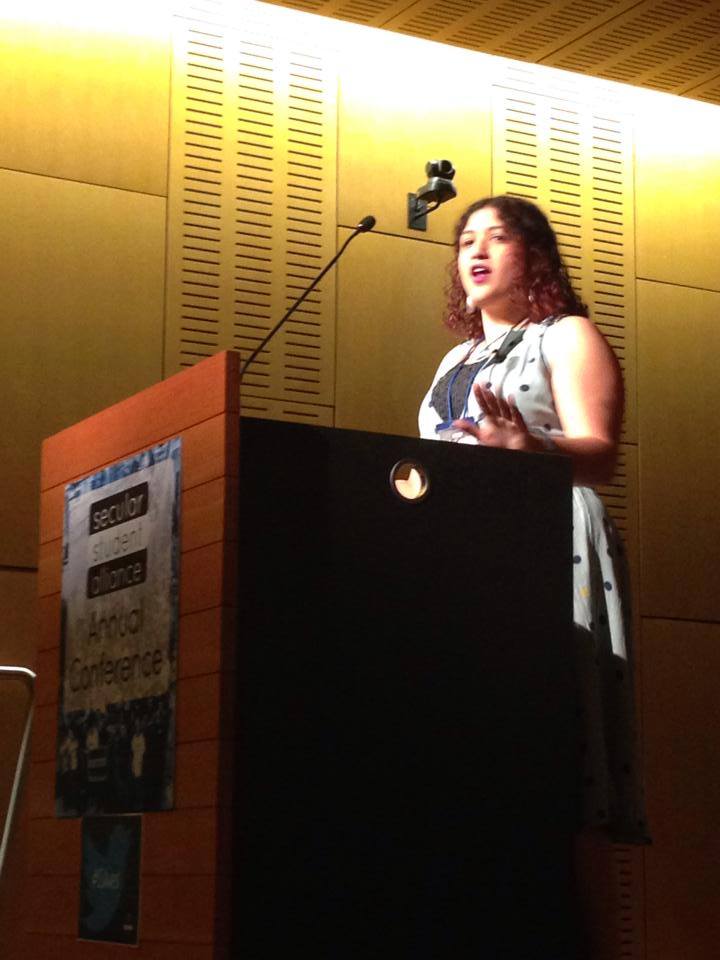
One of them was Heina Dadabhoy.
Heina speaking at SSA.
Former Muslim, blogger at Freethought Blogs, and overall bad-ass, Heina spoke about ways in which secular groups can create a more welcoming environment for ex-Muslims and Muslims beginning to doubt. Her talk, “Of Murtids and Muslims,” (a “murtid” is a public apostate) was not only about her experiences coming out as a secular humanist, but considered some of the absurd questions people ask her (and other ex-Muslims) about leaving Islam. “So did your parents try to honor kill you?” “Have you gone through FGM?” It was disturbingly humorous.
What I considered to be Heina’s main point, was that we should respect each others’ individual differences and not generalize and caricature all Muslims with the depictions of some. “Just because you read Ayaan Hirsi Ali’s book,” Heina notes, “does not make you an expert on Islam.” Heina made sure to emphasize the radical diversity that exists in Islam. She also spoke of the some of the issues that people go through when they leave Islam: How do I create a new identity when my old one was intricately tied up in my Muslim community, family, and culture? How do I navigate popular culture when I have missed a bunch of it? How do I find myself in this new secular world? Heina’s answers were refreshingly honest and insightful.
P.S. Aisha (one of Muhammed’s wives) should not simply be reduced to the young person Muhammed married; she was also a war leader, influential Muslim thinker, and someone who contributed greatly to early Islam. This is, of course, Heina’s insight.
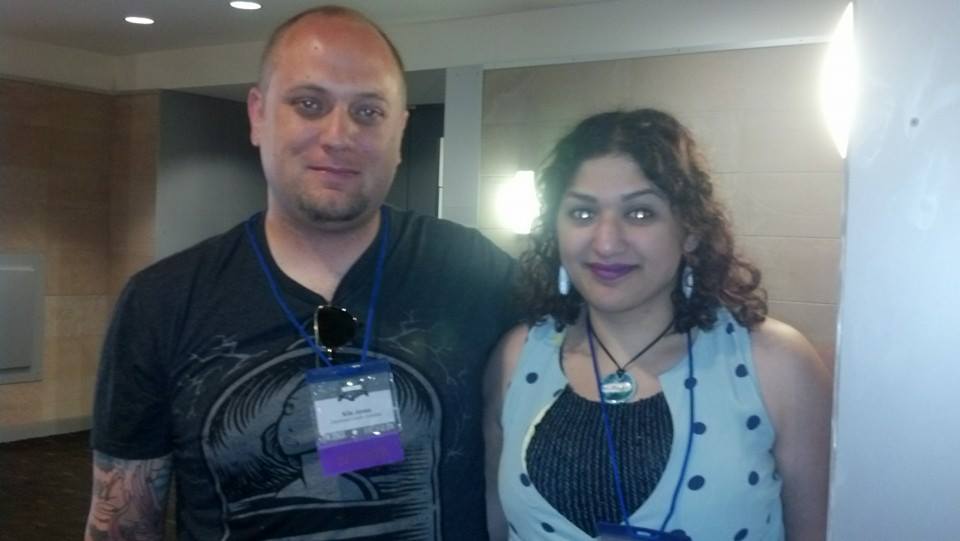
Me and Heina at SSA
Another awesome secular woman I met, was Sarah Morehead.
Sarah. Photo from Apostacon.
Sarah is a former evangelical Southern Baptist, Executive Director of the “Recovering From Religion” project, and another overall bad-ass. She spoke on how to start up a Recovering From Religion group on your campus. Here is a blurb about Recovering From Religion,
“If you are one of the many people who have determined that religion no longer has a place in their life, but are still dealing with the after-effects in some way or another, Recovering From Religion (RR) may be just the right spot for you. Many people come to a point that they no longer accept the supernatural explanations for the world around them, or they realize just how much conflict religious belief creates. It can be difficult to leave religion because family and culture put so much pressure on us to stay and pretend to believe the unbelievable. If this is you, we want to help you find your way out. Don’t let people convince you that you just didn’t have ‘enough’ faith, or that you just haven’t found the “right” religion.”
Sarah and I chatted (and often laughed) about our old experiences as conservative Christians. We discussed some of the funny language (Christian-eze) we used to use, the various levels of guilt and shame that were cast upon us, and how science helps explain some of the interesting displays of piety often seen at Pentecostal services. Sarah’s jovial and welcoming demeanor was calming, and as an Executive Director for a project aimed at helping people “recover” from religion, I cannot think of a better person for the job.
Lyz. Photo by SSA.
The last woman I have in mind is Lyz Liddell.
Lyz is the Director of Campus Organizing for the Secular Student Alliance. I have an interview I did with her a while back, on this very blog! Besides running around with her headset on, standing on chairs for announcements, and generally keeping the world of SSA from not crumbling into oblivion, Lyz is a great motivation and example. If you are ever interested in starting a SSA group on your campus, talk to her.
To all those who attended this years SSA West, or who are involved with helping secular students: Unite!
Kile Jones holds a Bachelors of Theology (B.Th.) from Faith Seminary, a Masters of Theological Studies (M.T.S.) and a Masters of Sacred Theology (S.T.M.) from Boston University, and is a current Ph.D. in Religion student at Claremont Lincoln University. He also holds a Certificate in Science and Religion from the Boston Theological Institute. Mr. Jones has been published in Zygon: Journal of Religion and Science, Philosophy Now, Free Inquiry, World Futures, Human Affairs, and the Secular Web. He is the Founder/Editor-in-Chief of Claremont Journal of Religion (www.claremontjournal.com), and is the Founder/Director of Interview an Atheist at Church Day (interviewatheists.wordpress.com).
Supreme Court Justice Ruth Bader Ginsburg said it best when she quoted Planned Parenthood of Southeastern Pennsylvania vs. Casey court case expressing her dissent on the Hobby Lobby decision made on Monday, June 30, 2014.
“The ability of women to participate equally in the economic and social life of the nation has been facilitated by their ability to control their reproductive lives.”
The Supreme Court ruled 5-4 in Burwell v. Hobby Lobby that closely held companies with religious objections can opt out of providing contraception coverage under the Affordable Care Act. The Supreme Court’s majority also rejected the Obama administration’s argument that for-profit companies cannot assert religious rights under Religious Freedom Restoration Act. As the RFRA only refers to persons, closely held companies are designating themselves as persons in the case. Closely held companies such as Hobby Lobby are owned by one person or are family owned business and are not a publicly traded company. Justice Sonia Sotomayor agreed with Justice Ruth Ginsburg’s dissent that companies do not have such rights – publicly traded on not.
The Burwell v. Hobby Lobby was about asserting patriarchal power and retaining profit–not about religious freedom. The Obama administration argued that the contraception requirement was not a mandate because companies could have dropped their insurance coverage and offered their employees another insurance option. The truth to Hobby Lobby is they wanted to have the privileged advantage of tax breaks offered under the Affordable Care Act while securing more money by skirting the contraception requirement under the cloth of religious freedom. Continue reading “Hobby Lobby, Not Invited at the Spiritual Negotiating Table by Qumyka Rasheeda Howell”
When I was a little girl, I used to be afraid. I was afraid of the dark. I was afraid of thunderstorms. I remember once cowering on the floor in the back seat of the car waiting for my dad to come take us home. My dad, who was a Methodist Minister, was too busy talking about God to really notice my reaction to being there in the back seat of the car during that terrible storm. Instead, he just kept busy, talking about God to other grown ups—talking in a way I did not understand, or found incredibly boring and long winded, sometimes even just a little frightening.
But Thunderstorms filled in a gap I did not know I had. A gap between my tiny self and the awesome Reality I have since come to know in a very different way. So when I would hear thunder, I thought of it as coming from God. I would begin this conversation with the Awesomeness of It asking moral questions: you know about good and bad. The thunder would seem to provide direct answers. Was that the voice of God?
Isn’t that how so many people think of God: an awesome and overwhelming omnipotent presence—with a voice that roars?
One dark night, during another storm, maybe my father heard me crying. He sat me on his lap and told me, in his quiet voice, how God had promised He would never again destroy the world by water. The sign of this promise, he said to me, was the Rainbow… the place where water, light and power combine to show color and beauty. That was my first experience of transcendence. From that time forward I would seek that loving nurturing experience of the Ultimate. Continue reading ““Papa Don’t Preach”: TED-like Talks at Malmo Nordic Women’s Forum May 2014″
It is World Pride in Toronto this year. The city is filled with people from everywhere celebrating the gorgeous spectrum of humanity and the right of all human beings to live with dignity. In honor of World Pride and happy coincidence of the beginning of Ramadan, I would like to share one of the earliest sermons I gave at Toronto Unity Mosque reflecting on the struggles of our LGBTQ refugee congregants. I share this to honor those refugees, as well as our other congregants whose journey is no less significant, and also to honor my friends and co-founders of the Toronto Unity Mosque, El-Farouk Khaki and Troy Jackson, as well as Adnan Hussein who was with us from the early days.


 In a recent post Xochitl Alvizo cited Beverly Harrison’s much-loved essay “Anger as a Work of Love.” Harrison captured feelings that were in the air at the time of its writing several decades ago. Women were laying claim to the right to be angry at the silencing of our voices, the double standard, the media portrayal of women, income inequality, lack of access to good jobs, failure to prosecute rape and domestic violence, and a host of other injustices.







 Feminism and Religion