Six Degrees of Separation, Hungarian Royalty Chefs, & A Trip to Lens Crafters by Natalie Weaver

Natalie Weaver editedWe were playing six-degrees of separation, I think.  I don’t know if there are rules to follow.  It was after dinner, and we were talking about people we had encountered and their linkages to others.   Surprisingly quickly, we found ourselves connected to Dwight D. Eisenhower, Elvis, Winston Churchill, and the Queen of England, herself.   My mom had autographs from Jerry Lee Lewis, Duke Ellington, the Globe Trotters, and a gaggle of NFL players and professional golfers.  She once chatted up Tori Spelling in a bathroom in Canton, Ohio at a Football Hall of Fame Induction ceremony.  My husband worked in film in Los Angeles and Cleveland, meeting a crowd of stars and politicians over the years.  One time he had a chance, face-to-face encounter with Prince (the artist himself!) as one rode up and the other rode down an escalator at a Borders in Chicago.   As the distance between them closed, my husband quietly acknowledged him, saying, “Bravo!”  Prince, whose head was angled away so as to avoid having to say anything, apparently, after a moment of consideration, looked back over his shoulder as they passed and silently mouthed, “Thank you.”  I still give my husband kudos here… I mean, what else do you say to Prince?  This connection, moreover, gave us our links to Morris Day, Jerome, Apollonia, and Shelia E., so we were all excited at his impressive list.  I had a far less remarkable cast of characters to contribute, but I could offer a Vatican insider acquaintance, providing thereby a papal connection, which gave us our links to several world leaders.  I felt I had contributed my part, even without autographs and celebrities.

With the exception of a Robert Redford encounter while volunteering on a political campaign, the couple that was with us had fewer serendipitous meetings to report.  But, we did learn that there was a grandfather in their mix who had served as a royal cook in Hungary.  The game now shifted to linkages in history.  Who were our notable ancestors?  Who were our ancestors, period?  Continue reading “Six Degrees of Separation, Hungarian Royalty Chefs, & A Trip to Lens Crafters by Natalie Weaver”

Strong Female Role Models among Swedish Immigrant Ancestors in Kansas City by Carol P. Christ

carol p. christ photo michael bakasWhen I decided to become a career woman, I thought I had no role models in my family. My parents (who sometimes considered me the black sheep) would have agreed. Imagine my surprise to find a matriarchal family and three generations of businesswomen women among my Swedish family in Kansas City!

My great-aunt Edith who was a stenographer, secretary, and notary public was a fixture at family gatherings. When I knew her, she was living in California with her two brothers who also were not married. Until their father died, they had lived their whole lives in the family home in Kansas City. I sensed that though my family respected my uncles, they felt sorry for Aunt Edith. It certainly was never suggested to me that instead of getting married and being supported by a husband, I could become a self-supporting working woman like my aunt. Continue reading “Strong Female Role Models among Swedish Immigrant Ancestors in Kansas City by Carol P. Christ”

The Spirit of Capitalism vs. the Spirit of Traditional Rural Life by Carol P. Christ

marika's rakiIn this picture, Marika from Skoteino Crete toasts our group and downs a glass of her homemade raki. Marika, who is best friends with Christina who makes lunch for us, has just returned from her home next door with her gift of a glass of raki for each of us.

Marika, who has little, is eager to give to us. Hers is but one of many gifts from the heart we receive on the Goddess Pilgrimage to Crete. Why is it that we who have so much do not give as spontaneously?

One answer is that capitalist individualism has taught us to count our worth by how much we have and to fear for the day when we will have nothing.

These words may be a cliché, but they hold a profound truth nonetheless.

Heide Goettner-Abendroth tells us that in matriarchal societies with small-scale sustainable agricultural economies, people did not hoard or save for a rainy day. With the labors of their bodies and minds, they took only what they needed from the land. When there was a surplus, they gave parties, sharing what they had with others. Even with the coming of patriarchy, ancient matriarchal customs of generosity survived among rural farmers. Continue reading “The Spirit of Capitalism vs. the Spirit of Traditional Rural Life by Carol P. Christ”

A Message from the Ancestors by Carol P. Christ

carol at green party 2014 croppedIn recent weeks and even months I have not been my usual cheerful self. After returning from sharing companionship and spiritual vision with a group of wonderful women on the Goddess Pilgrimage to Crete, I have been feeling lonely. This feeling came to a head on December 7 when it was cold and grey here in Lesbos, as had it been for weeks.

Feeling particularly sad that morning, I realized that December 7 was my mother’s Yahrzeit, the twenty-third anniversary of her death. The fact that I must use a Yiddish word to speak of this important day reflects the fact that we do not have a word (let alone a ritual) in the English language, in our versions of the Christian tradition, or in Goddess feminism to recognize the day a loved one died. As we Americans all know, we are supposed to get on with it and not dwell on death and dying.

A friend called that day to let me know that she was planning to visit me for few days during the holiday season, adding that she was looking forward to enjoying my tree and holiday decorations. “Oh,” I said, “my (live) Christmas tree is so heavy and hard to get into the house, I was thinking of not even bringing it in this year.”

That afternoon, I girded my loins and knocked on a neighbor’s door to ask for help. Of course one of the reasons that I was feeling sad is that as I live alone, I have no one to help me move a heavy tree. The neighbor’s shy son was more than willing to help, and we were lucky that we got the tree in a day before the pounding rains that would have doubled the weight of the soil in its pot.

001dec 2014 232As I decorated my tree over the next two days, memories of my mother flooded into my mind. How I miss my mommy. “Do you still think of your mother?” I asked an older friend shortly after my mother died. “Yes,” she replied, “Every day.” Me too, I thought, as I unwrapped the Christmas tree skirt, one of the last gifts Mom had given to me, and the dolls and pink doggie she had saved for me.

The ritual of decorating my tree for Christmas is my memorial to my mother’s love. How much fun we had choosing what was usually a scrawny tree—the largest we could afford, but not the smaller prettier one my mother would have preferred. How I remember baking and decorating cookie cutter cookies—eating the raw dough, licking the sugar icing from our fingers, and always putting what Mom said were too many red hots and silver dots onto the cookies.

My mother’s memories of Christmas were not all happy. But my Mom tried her best not to dwell on sadness. Shortly before she died, I found my mother baking cookies for a man who also had cancer. “I was feeling sorry for myself,” she said, “so I decided to do something for someone else.” I could hear my mother’s mother speaking through her in that moment.

My grandmother’s attitude, which was Midwestern, Christian, and deeply female, was nearly lost to me, for I come from the generation that discovered therapy. In the process of dealing with our feelings, we criticized our ancestors for not doing the same. As Christmas approaches this year, I wonder: were my Mom and my Grammy right? Is there a profound truth in their knowledge, transmitted through the generations, that the best way to deal with one’s own sorrows is to do something for others?

***

011If so, then I guess it is time to plan my winter solstice birthday party (which I was also thinking of cancelling this year)–pick up the phone and start inviting friends over to enjoy my home, my tree, and my food, the gift of life shared with others.

Happy Winter Solstice to all and to all a good night!

***

Carol leads the life-transforming Goddess Pilgrimage to Crete (facebook and twitter) spring and fall–early bird discount available now on the 2015 tours.  Carol can be heard in interviews on Voices of the Sacred Feminine, Goddess Alive Radio, and Voices of Women.  Her books include She Who Changes and Rebirth of the Goddess and with Judith Plaskow, the widely-used anthologies Womanspirit Rising and Weaving the Visions and the forthcoming Turning to the World: Goddess and God in Our Time. Photo of Carol by Michael Bakas.

Reclaiming the Feminist Beginnings of America’s Thanksgiving by Michele Stopera Freyhauf

Freyhauf, Feminism, Religion, Durham, Old Testament, Blogger, Bible, Gender, Violence, Ursuline, John CarrollFor those who are unaware of my research focus and methodology, I try to use history to reconstruct or reclaim the feminine voice through more of an exegetical lens rather than an eisegetical or ideological lens. When it comes to Thanksgiving, I have yet another opportunity to restore credit to or at least bring visibility back to a woman who fought for Thanksgiving to be recognized as a national holiday on the last Thursday of November. Her works, though plentiful and sometimes known only by title, are largely forgotten to history; Sarah Josepha Buell Hale (1788-1879) is responsible for Thanksgiving becoming a national holiday in the United States.

Certainly, I do not have to go into the disparity that befell women during the 1800’s when it came to education and overall fundamental rights – that is a history with which we are all well familiar. Hale was educated through her brother, Horatio Gates Buell, who shared his education while attending Dartmouth College and “seemed very unwilling that [Hale] should be deprived of all his collegiate advantages,” and through her husband, David Hale, a lawyer who helped her cultivate her writing skills in the evenings. They even established a small literary club with their friends that allowed her to write. Hale was left a widow at a very young age with five children, the oldest age 7. Hale, like so many women during that time period, had to find a way to support herself and her family.

Sarah Josepha Buell Hale

After authoring a book of poems with her sister-in-law, The Genius of Oblivion and Other Original Poems, Hale, in 1827, published her first novel called Northwood – a book published the same year as Uncle Tom’s Cabin that also challenged slavery. From fame gained through this novel, Hale obtained a job as an editor of a women’s magazine, Ladies Book (later Godey’s Ladies Book then American Ladies Magazine), where she worked for about 40 years. She wrote about half of the material contained in the magazines, as a means of helping to educated women. Hale helped to discover and promote such authors as Edger Allen Poe, Nathaniel Hawthorne, Harriet Beecher Stowe, Lydia Maria Child, Catherine Sedgwick, Lucretia Mott, Emma Willard, Susan B. Anthony, Henry David Longfellow, Ralph Waldo Emerson, and Oliver Wendell Holmes.

She is credited for helping to establish Vassar College for women and wrote the familiar child’s poem “Mary had a Little Lamb” in 1830 (Poems for Our Children, republished in Juvenile Miscellany), Traits of American Life, which contained the story of “The Thanksgiving of the Heart:”

Continue reading “Reclaiming the Feminist Beginnings of America’s Thanksgiving by Michele Stopera Freyhauf”

Belonging to the Land by Carol P. Christ

Carol Christ in LesbosI believe that we can restore our hope in a world that transcends race by building communities where self-esteem comes from not feeling superior to any group, but from one’s relationship to the land, to the people, to the place, wherever that may be.—bell hooks

In these words from her poignant memoir-reflection-analysis Belonging, bell hooks suggests that rather than creating identity by comparing ourselves to others, whether in the academy, in communities, or in the larger society, we would do better to root our identity in the land.

Hooks “left home” in rural Appalachia in order to pursue “higher” (why do we call it that?) education including a Ph.D. which enabled her to teach at prestigious universities in the urban north. Despite her considerable success as an academic and a black feminist, hooks suffered persistent depression in the cities where she taught. Eventually she diagnosed her dis-ease as a longing for the home she had left behind, specifically as a need to connect with the traditions of her ancestors, the mountains, and the land that had sustained them since the end of slavery. Continue reading “Belonging to the Land by Carol P. Christ”

Death with Dignity by Carol P. Christ

Carol Christ in LesbosIn the summer of 1960 when I was 14 years old my much loved grandmother Mae Inglis Christ died of a cancer that affected her brain. The last time I saw my Nannie was shortly after her diagnosis in the early spring. While we were visiting, the cancer affected her back, and she took to her bed. In those days children were not allowed in hospitals. I never saw my grandmother alive again, but my mother told us that our grandmother was hooked up to tubes much longer than she should have been. Mother vowed, “This will never happen to me.” I was driven to the funeral in a limousine with my grandmother’s girlfriends. They spoke about my grandmother’s last days, describing how (because her mind was affected by cancer) my little grandmother had screamed and screamed at them for not visiting–even though they were with her every day. They found my grandmother’s outbursts so traumatic that they said they were relieved to see her looking so peaceful in her coffin. Continue reading “Death with Dignity by Carol P. Christ”

The Ancestors Live in Us by Carol P. Christ

Carol Christ in LesbosOn the recent Goddess Pilgrimage to Crete women had the option of riding up a winding road on a mountainside in the back of a farm truck singing “She’ll Be Comin’ ‘Round the Mountain” or could choose to go with the guard in his closed automobile.

That evening one of the older women who had chosen to ride in the car said, “I saw how much fun you were all having, but I have done that before. This time I was happy to let the rest of you do it.”

“That’s exactly how I feel about death,” I responded. “Some people want to live on after death, but I don’t. I am happy to let others do it. The only thing that would upset me would be if life did not go on after me.” Continue reading “The Ancestors Live in Us by Carol P. Christ”

Honoring Our Mothers, Honoring Our Selves by Safa Plenty


moon

“The moon has always been the primary symbol for female energy; its cycle around the earth takes approximately twenty-nine days, the same amount of time as the average woman’s menstrual cycle. It is often felt that as the pull of the moon affects the waters of the world, so does its motion affect the body of woman.” —Women’s Medicine Ways’ Cross-Cultural Rites of Passage by Marcia Starck 

Her full moon arose today,
sprinkling liquid stardust
onto her bathroom floor,
decorating her mattress
with vibrant hues of deep red,
staining her pajama pants
with artistic, circular symmetry.

For days, she had waited
for the completion of her moon,
while the sun shun
its luminous rays upon her,
the fall equinox bringing that
massive star into greater centrality.

And on a night, her moon had not set,
she sang to the four directions,
shattering myths of tainted womanhood,
tales of storks placing fragile care packages,
under willow trees.

Sang to Grandmother Moon,
Honoring the feminine Divine,
Celebrating her Sacred Waters,
Occupying her sanctified space
for the rejuvenation of Mother Earth,
honoring our Mothers,
honoring our selves.

wpid-wp-1409462860041.jpeg

Safa N. Plenty is currently pursing her Ph.D at Claremont Lincoln School of Theology in the area of Practical Theology, Spiritual Formation and Education. She holds a Masters of Social Work from Columbia University and an undergraduate degree in interdisciplinary studies with a minor in Africana Studies. For the past three years, she has worked as a K-12 education contractor and assistant counselor at a community college. Her research interests include Sufism, Attachment to God, indigenous cosmology, particularly Native American and Australian spirituality and somatic psychology. She is also interested in religious mysticism, mindfulness practice in Buddhism and the role of feminism and religion in cultivating a peacemaking capacity among young Muslim women. She is currently working to develop a faith based healthy relationships program for Mothers and Daughters. She enjoys writing poetry, research, and contemplative practice and tuning in with nature.

Casa Coatlicue by Erica Granados De La Rosa

Erica GDLR 2On a corner adjacent to a cantina, across the street from a home full of barefoot children running through open doorways, and a few houses down from a paleteria y fruteria in San Antonio, Texas, sits a bright white house dressed up in orange trimmings – Casa Coatlicue[1]. Before you walk through the gate you notice a raised bed of herbs, a garden, a large collection of potted succulents, and a metate[2] on the ground. Walking inside you can’t help but smell the sage, copal, and other herbs and incense that have left their smoky traces on the walls of the living room, the kitchen, and then the bedroom. As the house begins to introduce itself, you notice altars in corners and crevices of each room. Your curiosity begins to churn as you notice pictures and canvasses on the walls of ancient and present day cultural symbols, including one poster that reads “This land was Mexican once, and indigenous always,” and a large picture of Selena Quintanilla that captures her warm smile and beautiful black hair. As soon as you begin to take in the colors and ancient smells, the house is introduced to you by name, Casa Coatlicue, the home of four queer young healers, dreamers, lovers, artists, scholars, and spiritual activists who are reclaiming the life-giving traditions of their ancestors.
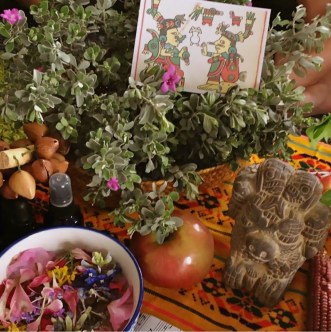
Community altar from  workshop
Community altar from workshop

Earlier this year, I was invited to a curanderismo workshop hosted at Casa Coatlicue. The word curanderismo had an air of secrecy, power, and nostalgia of home for me. I understood curanderismo as the medicine and magic of our grandmothers, and increasingly the forgotten inheritance of our communities. As I spoke with the residents of Casa Coatlicue, we began to identify the chronic erasure and appropriation of brown folks’ spiritual traditions, food, art, and customs by predominantly white, new age culture. Saddened by the loss and the historical disconnect of our people, we collectively affirmed the urgency and importance of relearning and reclaiming our own spiritual traditions not only to tap back into our cultural identity as native and mestizo people but also to tap into a powerful tool for the transformation of our current realities. In the midst of historic and present day manifestations of systemic violence against us – young brown bodies being gunned down in our streets, whole communities being persecuted, incarcerated, and displaced, as well as forced sterilization and assimilation- there is a critical need to tap into radical and sustainable ways to not only resist but to heal. Continue reading “Casa Coatlicue by Erica Granados De La Rosa”