Women’s History Month: Painting and Empowering Adolescent Girls by Angela Yarber

In celebration of Women’s History Month, the Holy Women Icons Project is excited to launch Revolutionary Girls, a new program seeking to empower marginalized adolescent girls by telling the stories of revolutionary women through art, writing, and discussion. Partnering with local schools and other non-profit organizations in the Puna District of Hawai’i County, we are creating a curriculum that features often overlooked historical and mythological women whose lives, legends, and legacies embody empowerment, resilience, and emotional intelligence that can embolden adolescent girls to become socially aware revolutionary leaders.

Research shows that girls’ self-esteem plummets in early adolescence, due in part to unrealistic body images in media and casual (or even overt) sexism from parents, teachers, and peers. Our Revolutionary Girls project aims to counter these negative influences by offering girls aged 11-15 a space of empowerment. Prior to adolescence, many girls believe they are as smart, strong, and capable of leadership as boys. At the onset of puberty, girls are often taught that their only value is in their appearance, and that they are not as capable or valuable as men and boys. Simultaneously, girls are exposed primarily to the histories and myths of men in power while in the classroom, the revolutionary lives, legends, and legacies of countless revolutionary women altogether absent from their textbooks and lessons. Continue reading “Women’s History Month: Painting and Empowering Adolescent Girls by Angela Yarber”

“Womenspiration” for International Women’s Day by Elise M. Edwards

elise-edwardsHappy International Women’s Day!  I hope it is a happy day for you as we recognize women’s achievements throughout the world.  Our FAR community is not only for or about women, but as feminists in some form or another, collectively we support women, their growth, their health, and their contributions to the world.  On a day like today, we should take note of what still needs to be done and recommit ourselves to our work.  But let’s not rush past an opportunity for joy and celebration. Many generations of women have fought for equal rights and participation in all sectors of society, and we have made progress. To commemorate that legacy today, I am highlighting just a few of the women who inspire me with their lives and with their work. They are my “womenspiration.”  My hope is that you join me in recognizing them and that as you read about them, you reflect on the women who inspire you.

Continue reading ““Womenspiration” for International Women’s Day by Elise M. Edwards”

A Dream Home by Joyce Zonana

Forty years ago, I abandoned my own inner quest to establish myself as a writer/translator, discouraged by the voices of publishers who told me the book was unmarketable, worried about making a living and reassuring my family (whom I had broken from when I was seventeen) that I was “okay.” I chose the relatively safer path of becoming an English professor, and I worked for more than thirty years helping others to find their voices. I do not regret taking that path. It has led me here.

jz-headshotI wake up each morning in a simple bedroom lit by the rising sun: a wardrobe, a bookshelf, a small wooden table, and a chair, arranged on painted plank floors. Just outside the window behind my head are the tallest trees I have ever seen, their grey-brown trunks growing straight up into a sky I cannot quite make out from my warm bed, with its white cotton sheets, white coverlet, and cozy down comforter. The room’s soft yellow walls reflect and amplify the winter light. Part of me wants to luxuriate, to lie here for hours, feeling the sun on my face as I gaze up at the trees and allow my consciousness slowly to return from dreams.

IMG_7594

Yet I am here not simply to luxuriate but to work . . . in the next room is a desk, two desks actually, piled with books, folders, dictionaries, my HP Laser Jet printer, and my tiny laptop. From this room too, I can look out on woods and fields on three sides. Best of all, from the desk where I work, I can watch the sun set in the late afternoon.

Sunrise and sunset. And in between, a day entirely to myself, a day when I can work and dream at leisure, but during which I also feel impelled to stay on task, to complete the project that brought me here. Continue reading “A Dream Home by Joyce Zonana”

Toil and Trouble (Part 1) by Barbara Ardinger

…and Ella can’t remember the last real meal she had. After supper with the refugees in the witch’s house, she and the witch put their heads together to begin making significant plans. She’s also been meeting all the refugees who now live on the witch’s farm. She knows first-hand why these people fled the capital and the other cities. “Oh, lordy, yes,” she says. “I used to know all the important people. My dear sisters and I went to all the big events, ate the finest cuisine—” suddenly remembering where she is, she looks down at the table “—oh, dear, but I don’t mean to criticize your cuisine.”
The ravens, all perched on the backs of chairs look straight at her. “Good food, this,” says Kahlil, “except these girls don’t serve eyeballs.” “Stop that,” Domina whispers (if ravens can be said to whisper). “Don’t be so picky. Everybody here gets enough to eat.”

Ella, who is more used to cats and dogs and the occasional parakeet than to ravens, blinks and continues. “I wish I knew where my sisters are now. Thanks to our ‘relationships’ with the princes, we were High Society and—”

Continue reading “Toil and Trouble (Part 1) by Barbara Ardinger”

A Feminist Retelling of Cain and Abel by Trelawney Grenfell-Muir

Eve and Adam had many children. Two of them, the sisters Cain and Abel, were best friends. When they grew up, Cain became a farmer, and Abel became a shepherd. In their community, people shared what they had with each other. They shared this way in order to help the community be strong, and to practice gratitude. They shared with each other in sacred, holy ceremonies, in which they put their communal offerings onto an altar for Sister God/ess, to be blessed. One day, both Cain and Abel brought an offering to their community. Cain brought some food she had grown, and Abel brought a sheep. The community gathered for the ceremony. They prayed prayers of gratitude and blessing, and thanked the Earth for its abundance. They each laid hands on the sheep and thanked her for her life, blessed her spirit that it might journey peacefully and joyfully to reunite with Sister God/ess, and praised her for giving her body to feed the community.  Then they killed the sheep, as quickly and carefully as they could, and set the meat in the sacred fire to cook. Abel was glad that she could help her community be fed and healthy with the sheep she had given.

Continue reading “A Feminist Retelling of Cain and Abel by Trelawney Grenfell-Muir”

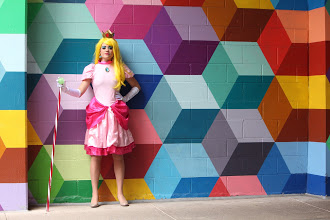
Princess Peach from The Goddess Project: Made in Her Image by Colette Numajiri

Toy stores and department store aisles are decked with pink and purple princess paraphernalia. Disney has provided an array of princesses for little girls to choose their birthday party or bedroom decor from. But as we all know, there’s a deeper secret hidden in the FAIRY TALES that high powered media execs have made their fortunes on: THE GODDESS.

Every hero’s tale, be it in video games or romantic movies sets out to do one thing: SAVE THE PRINCESS.  When I was a child I saved Her myself on my little Nintendo system never knowing why She was in trouble in the first place. And was I the only one who ever wondered why NONE of the PRINCESSES HAD MOTHERS!?

In the early Centuries during the Christianization of Europe, Pagans (which means “people of the land”) hid truths right under the nose of the newly forming Christian Church in their folklore, games and children’s rhymes to avoid being burnt at the stake. These simple people tried to covertly keep the Wisdom of the Sacred Feminine that they’d been honoring since the beginning of time, ALIVE.

Continue reading “Princess Peach from The Goddess Project: Made in Her Image by Colette Numajiri”

In Light of Women by Mary Jane Miller

Why are so few women mentioned in the great feast days like Pentecost, the Last Supper, the Baptism of Christ, etc.? God made no commandment that they not be included.
Inquisitive women like myself have always been around Christ listening to His message. There they were, cooking and cleaning at the Last Supper, at the wedding at Canon and when He fed the five thousand. When Christ invited the children to come to him, you can be sure the mothers were there, too.
Beginning as early as the fourth century the dominant Christian leaders, all men, twisted and distorted Holy Scriptures to thwart the ascendant positions for women within the religious hierarchy and in christian societies in general. Yet, the underlying teachings of Jesus Christ, the Apostle Paul, Moses and the prophets, – all call for the proper and equitable treatment of God’s children. Without a doubt, God and Christ love all of humankind with no gender bias. When women listen to scripture we naturally fill in the gap, or adjust the gap knowing in our hearts and souls, we are not inferior to men.

Continue reading “In Light of Women by Mary Jane Miller”

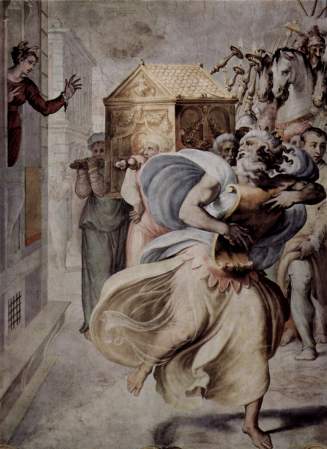
Michal the Priestess: Midrash, Multiplicity, and the Tales of King David by Jill Hammer

When I was in my late teens, I discovered midrash: the Jewish exegetical process by which commentators weave creative and additive interpretations into the sacred text.  Midrash comes from the word “to ask,” “to seek,” or “to divine.” For example, the tale in which a well follows the prophetess Miriam through the wilderness is an ancient midrash. The story in which God stops the angels from singing as the Egyptians drown in the Sea of Reeds is a midrash. Each of these stories derives from a particular close reading of text, whether a Torah text or a verse elsewhere in the Bible.  Each of them allows a new generation to add its own perspectives to the tradition.

Contemporary feminists, and many other contemporary artists, writers, and exegetes, have used a modern form of midrash to add liberatory perspectives to Jewish tradition and to biblical lore.  From Miriam to Vashti, female biblical characters shine in the creative interpretations of feminist midrashists.  Judith Plaskow’s “The Coming of Lilith” made a huge impact on the reading of the story of Eve and the legend of Lilith. Anita Diamant’s The Red Tent changed the conversation on Dinah forever. Alicia Ostriker, Norma Rosen, Veronica Golos, and many others have joined in this creative play which highlights marginalized voices within the text.  Wilda Gafney has made contributions to a Christian and womanist form of midrash.  Voices like Andrew Ramer and Joy Ladin have invited us to see queer and trans themes in the text. And of course many others, from poet Yehuda Amichai to bibliodramatist Peter Pitzele, have added to this rich tapestry.

Continue reading “Michal the Priestess: Midrash, Multiplicity, and the Tales of King David by Jill Hammer”

Leia Should Get Her Movie by Trelawney Grenfell-Muir and Tallessyn Grenfell-Lee

This post is written jointly by sisters, Trelawney and Tallessyn, who have been thinking and discussing together about this. 

Contains Spoilers from the movie Star Wars VIII: The Last Jedi (TLJ).

I was born in 1974. Star Wars IV: A New Hope was perhaps the first movie I saw in a movie theater. Back then, I was too young to understand much more than that there were good guys, bad guys, and, yay – the good guys won. Except, for once, there was also a good gal. There was Leia. In a world of Spidermans, Supermans, Batmans, Lukes, Hans, Obi-Wans, and a deluge of male heroes of every kind…. There was Leia. 

It’s hard to overstate how much my sisters and I loved Leia. She was so much cooler than Luke or Han. Luke was whiny and immature. Han was irresponsible and selfish. But Leia – Leia had been fighting for justice long before either Luke or Han entered the picture, and Leia had the smarts, the skills, and the grit to get shit done.  Continue reading “Leia Should Get Her Movie by Trelawney Grenfell-Muir and Tallessyn Grenfell-Lee”

Goddesses of Mindfulness for a New Year Feminism and Religion by Angela Yarber

I’ll be honest. For me, 2017 royally sucked. Though “feminism” was dubbed the “word of the year” by Merriam-Webster’s—as evidenced by the Women’s March, the Handmaid’s Tale, Wonder Woman, and the Me Too Movement—the reason feminists thrust our fed-up fists into the air in protest so frequently was because of the way women are routinely unjustly treated.

In the midst of this global, political, national fury, I experienced personal struggles in 2017 with the death of my brother and my mother’s cancer diagnosis. There was beauty and goodness that filled the year, to be sure, but you can believe me when I say that I am welcoming 2018 with open arms. As I entered into conversation with myriad feminists across the gender spectrum around the world, it seems that many echo these sentiments. We could not wait to bid 2017 farewell. Yet, I knew that I did not want to enter the year filled only with bitterness and resentment. Rather, I wanted to mindfully move forward with radical gratitude, hope, and intentions set on creating a more beautiful 2018. Enter the goddess. Continue reading “Goddesses of Mindfulness for a New Year Feminism and Religion by Angela Yarber”