

 Since 1985, I have been researching Balkan folk dances and teaching them in women’s circles all over the world. Common symbols in dance patterns, textile motifs and archaeological artifacts from southeastern Europe have remained the same from ancient times to the present, which leads me to suggest that the dances may be descended from ritual practices dating back to Neolithic times. In my view, these patterns serve as a symbolic language, expressing reverence for the cycle of life. Emphasizing connectedness and continuity, homecoming and support, women’s ritual dances can rekindle ancient values of sustainability, empathy and equality, and provide an antidote to the alienation of self which is epidemic in the western world. In nearly thirty years of teaching, I have found that women all over the world respond to these dances as valuable tools for healing and self-discovery. Continue reading “Women’s Ritual Dances and My Journey to Healing by Laura Shannon”
Category: Art
Painting Jephthah’s Daughter by Angela Yarber
 And Jephthah made a vow to the Lord, and said, “If you will give the Ammonites into my hand, then whoever comes out of the doors of my house to meet me, when I return victorious, shall be the Lord’s, to be offered up by me as a burnt offering…Then Jephthah came to his home at Mizpah; and there was his daughter coming out to meet him with hand drums and with dancing…he did to her according to the vow he had made…” (Judges 11:30, 34, 39)
When I was a little girl I used to make up routines to perform for my family. From Tina Turner’s “What’s Love Got to Do With It” to Michael Jackson’s “Beat It” I can remember making up creative choreography and performing in front of the affirming audience that was my family. Often times, my routines were accompanied by props, such as a hula hoop, roller skates, or an unwilling younger brother. Whether I had props or not, there was always a big smile on my face as I twirled and leapt to the tunes on my family’s 8-track, record, or cassette player. Half the fun was making up the routine and practicing until it was performance perfect. The other half of the fun was the response on my family’s faces as I forced them to “watch me, watch me!” once again. Despite the cheesiness of my routines and my silly props, they watched with delight, clapped, and encouraged me to dance all the more. Such is the experience for many fortunate children: choreographing routines, drawing pictures, making up skits and plays, and practicing to make their parents proud. Continue reading “Painting Jephthah’s Daughter by Angela Yarber”
Of Birds, Angels, and Tidings of Great Joy by Carol P. Christ
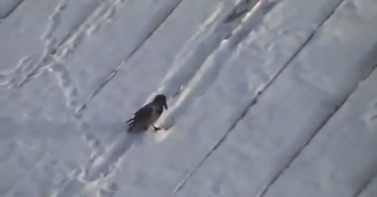
 A link to a video of a European Hooded Crow sliding down a snow-covered rooftop on a mayonnaise-lid sled appeared on my Facebook timeline a few days ago. For me this crow expresses the “spirit of the season” as aptly as anything I can think of. She brings a smile to my face on a grey and cold morning. She makes me want to climb up on the rooftop and slide down with her. She reminds me that we humans are not alone–we share the world with a vast multitude of other intelligent creatures. She tells me that there is nothing more sacred than the joy of life.
The ancient Cretans believed that the capacity to enjoy life was not limited to human beings–they believed that animals enjoy life as much as we do, and they expressed this sensibility in their art. They also celebrated birds because their arrival in spring announces the beginning of the growing season. This early pot in the shape of a bird or duck opening its mouth to–as we kids used to say–“drink the rain” cannot help but evoke a smile. Continue reading “Of Birds, Angels, and Tidings of Great Joy by Carol P. Christ”
Painting Sappho by Angela Yarber
“Someone, I say, will remember us in the future,” she once wrote. To my knowledge, she was never dubbed a prophet. A muse, yes. A romantic, perhaps. But never a prophet, rarely holy, and nary an icon. Until now. Hailed as one of the best Greek lyric poets, many have tried to forget her, or at least the more provocative elements of her life. The passionate poet Sappho was born on the island of Lesbos around 620 BCE (sometime between 630-612 BCE). The word lesbian stems from the place of her birth and her name is the origin of the word sapphic, though most scholars assert that little is known of her actual life and that the majority of her poetry is not autobiographical. Yet her lyric poetry speaks of love for both sexes and myriad people.
What is more, the idea of homo and heterosexuality are not transhistorical essences, but instead are relatively recent socio-historical constructs. To say that there were strict sexual binaries in the ancient world in which Sappho lived would be an anachronism. Sexuality was much more fluid. Not surprisingly, many scholars have tried to name and claim male lovers for Sappho, a heteronormative attempt to erase her fluid sexuality, her hope to be remembered in the future dashed, demeaned, forgotten. In fact, during the Victorian Era, many asserted that Sappho was the headmistress of a girls’ school, another attempt to straighten out her memory, her poetry, her love. Continue reading “Painting Sappho by Angela Yarber”
Seeing Death and Resurrection by Linn Marie Tonstad
 Yesterday, I visited the Capuchin catacombs in Palermo, Sicily. In a grotto about a mile or so from the center of the modern city are found the preserved remains of about 2,000 people who paid the monks to preserve their bodies after death, dress them in their finest clothing, and put them on display. Each of them is placed in its own niche along the wall, held up by iron bands, and has a tag around its neck with its name and date of death. The bodies are not displayed in random order: they are sorted (to some extent) by sex, profession, and familial status. In one large recess, a number of children’s skeletons are on display, many of them in heartbreakingly tiny coffins. In another corridor, friar after friar hangs in his robes, some with cords around their necks signifying their adherence to a Franciscan order. Almost indistinguishable from the cords are the braids still hanging from the heads of some of the women’s bodies. Some families are arranged together; in another corridor doctors and lawyers are segregated and in yet another female virgins are gathered together. The oldest body I saw dated from 1599 – high on a wall hangs the body of a monk whose name was almost illegible but who hailed from the Umbrian hill town of Gubbio.
Some of the skeletons presented death’s heads; others had skin dried to a leathery tightness over remaining bony protuberances. Some of their outfits are well preserved; others have disintegrated under the relentless assault of the years. The practice became illegal around 1880, but until then, people chose – or perhaps their relatives chose for them – to be preserved in this seemingly macabre manner. Continue reading “Seeing Death and Resurrection by Linn Marie Tonstad”
Painting Dorothy Day by Angela Yarber
Radical Revolutionary. One with the workers. Daily works of mercy. One who challenged the status quo. She never wanted to be called a saint, though the Claretian Missionaries proposed that she be canonized in 1983. The Catholic Church calls her a “Servant of God.” I call her a Holy Woman Icon. She joins the myriad other Holy Woman Icons with a folk feminist twist that I feature each month: Virginia Woolf , the Shulamite, Mary Daly, Baby Suggs, Pachamama and Gaia, Frida Kahlo, Salome, Guadalupe and Mary, Fatima, Sojourner Truth, Saraswati, Jarena Lee, Isadora Duncan, Miriam, Lilith, Georgia O’Keeffe, Guanyin.
Born on November 8, 1897 Dorothy Day’s radical spirit, her development of the Catholic Worker Movement, and her solidarity with the poor have taught countless women what it means to be a revolutionary. This American anarchist and activist converted to Catholicism as an adult after living what many describe as a bohemian lifestyle. She advocated the Catholic economic theory of distributism, daily works of mercy, pacifism, and solidarity with the poor. Continue reading “Painting Dorothy Day by Angela Yarber”
Ode to Mum – Source of My Being by Jassy Watson
 Lately I have been contemplating my ‘source of being’. I had always assumed it was my connection to the earth. It is this of course, but my revelation came when I realised it was the connection to my mother, and my connection to her mother – me as mother, and not just my birth mother, but all mothers. The earth as mother, the universal mother, cosmic mother. All of them, my source of being.
My memories of growing up start from a very young age. In fact, so young, I have vivid memories of being born. I remember being breastfed and the smell of my Mum’s skin which was such a source of comfort. Thinking about my source and having these early memories re-surface has come at quite a pertinent time of the year, considering that it is Beltane in the Southern Hemisphere, and Samhain in the North. At Beltane we celebrate the coming summer with fire and blessings of fertility, life and abundance. While at Samhain we are remembering our ancestors, those who have passed and loved ones who are still with us. Yesterday, the 31st, I flew from Australia to the USA and I have been able to experience both transitions. This following poem and accompanying artwork represents these polar opposites; birth and death. More importantly, it is an ode to Mum.
Continue reading “Ode to Mum – Source of My Being by Jassy Watson”
Three Poems by Janine Canan
The Visit
I came here
in order to lie in the sand
on a sunny day
and feel the warmth
the way it lifted me
weightlessly
we were one
the Earth and I
seamless
she pressed her face
to mine, I ran
my hands through her
and we streamed
with timeless
happiness
I came to lie in the sand
and feel
her living warmth.
Continue reading “Three Poems by Janine Canan”
WOMEN ARTISTS AND RITUALISTS IN THE GREAT CAVES: THE BEGINNING OF THE END OF INDOLENT ASSUMPTIONS by Carol P. Christ
 In an earlier blog, I suggested that women might have blown red ocher around their hands to leave their marks in prehistoric caves.
At the time I thought this was a rather bold suggestion.
Had I been asked why I thought the images were made by women, I might have said that people have understood caves to be the womb of the Great Mother, the Source of All Life, from time immemorial. I might have added that those who performed rituals in the caves cannot have been performing simple “hunting magic,” but must also have been thanking the Source of Life for making life possible for them and for the great beasts they hunted. Still I am not certain that I imagined women as the artists in the Paleolithic caves.

In recent days the news wires have been carrying a story titled “First Cave Artists May Have Been Women, New Study Suggests.” According to retired anthropological archaeologist Dean Snow, the handprints made by Paleolithic ancestors 40,000-20,000 years ago may have been made primarily by women. Snow spent a decade gathering and analyzing photographs of the handprints left in caves. The scientific fact that women’s first and ring fingers are generally of the same length, while men’s ring fingers are generally longer their index fingers, led him to the conclusion that ¾ of the handprints in the caves were made by women! If women were painting their hands on the caves in larger numbers than men, then isn’t likely that they were also painting the images of the great beasts on the walls of the caves? Continue reading “WOMEN ARTISTS AND RITUALISTS IN THE GREAT CAVES: THE BEGINNING OF THE END OF INDOLENT ASSUMPTIONS by Carol P. Christ”
Longing for Hermitage by Elizabeth Cunningham
 At least since the days of the Desert Mothers in the 4th and 5th centuries CE, there have been women in the Christian tradition (and doubtless other traditions) who have lived lives in religious solitude, whether by choice or circumstance. In Medieval Europe many churches had anchorholds, small enclosures inhabited by men or women dedicated to a life of solitude and prayer. The word anchorhold implies that the presence of the anchoress or anchorite grounded the church community, but the word derives from the ancient Greek verb (pronounced anachōreō) for to retire or withdraw. Anchoress Julian of Norwich is still revered as the author Revelations of Divine Love, possibly the earliest surviving book written by a woman in the English language. Six centuries after her death, her vision of Jesus our Mother continues to challenge, comfort, and inspire.
I grew up in an Episcopal rectory, daughter of a secretly agnostic mother who loathed being a minister’s wife (living in a fishbowl, she said) and a father who preached and practiced the social gospel as had his father before him. If you weren’t directly feeding, clothing, visiting “the least of these my brethren,” your pieties (as my father dismissed them) were worthless. At every meal we prayed, “make us always mindful of the needs of others.” Selfishness and individualism were synonymous. The pronoun “I” was frowned upon. The only route to salvation was social and/or political activism. My father walked his talk, literally, taking part in the 1965 march from Selma to Montgomery.
Continue reading “Longing for Hermitage by Elizabeth Cunningham”
 Feminism and Religion