Moving through the Midlife Threshold

Goddess Qi Gong as a New Compass

There is a deep and insidious taboo around ageing that leaves so many of our experiences as women unspoken, as if the physical, emotional, hormonal and mental shifts of growing older should be suffered alone and hidden behind doors.

What if we can turn midlife into a positive initiation that we share together? Would it be possible to learn to read our body and psyche differently? Might practising conscious movement literally help us move through this phase? And what would happen if we re-orient ourselves towards the many faces of the Goddess?

Continue reading “Moving through the Midlife Threshold”

The Second Skin: Lipstick, Lies and Lead part 2 by Sabahat Fida

part 1 appeared yesterday

It is mind-boggling to consider how standards for women’s bodies have been normalized over time. Centuries ago, practices like binding women’s feet in ancient China or forcing the use of corsets to narrow the waist which are now universally condemned as cruel and uncivilized. Throughout history, women have been subjected to extreme and often harmful beauty standards.  Foot binding created tiny “lotus feet,” causing lifelong pain and disability, while in Europe, tightly laced corsets compressed ribs and displaced organs to produce an exaggerated hourglass figure. In parts of Southeast Asia, neck rings elongated the neck but weakened muscles over time, and in Africa, South America, and Asia, lip and ear stretching permanently altered tissue as a marker of beauty or status. Pale skin was prized in ancient Egypt, Asia, and Europe, often achieved through toxic powders containing lead or arsenic, while teeth were filed, blackened, or inlaid to meet local ideals. Women were also expected to meticulously shape or remove hair and conform to strict weight norms, whether forced thinness or fattening, depending on the era. Across centuries, these practices reveal a clear pattern: women’s bodies were controlled, altered, and harmed in the name of beauty ,  a coercion that, in many ways, continues today through cosmetic interventions and socially enforced aesthetic standards.

Continue reading “The Second Skin: Lipstick, Lies and Lead part 2 by Sabahat Fida”

The Second Skin: Lipstick, Lies and Lead part 1 by Sabahat Fida

A woman’s body has become a site of commodification to such extreme that even her most basic necessities are not spared. Products meant for hygiene or comfort ; razors, deodorants, tampons, shampoos  are packaged, scented, and coloured in ways that signal femininity, pushing them into a hyper-aesthetic zone of the departmental store. This creates a glaring economic contradiction: men’s products, often identical in function, are sold cheaper, while women pay a premium simply for their gender. But the exploitation is not merely financial. By demanding that her essentials adhere to socially approved standards of beauty, the market sends an unambiguous message: a woman’s needs, her very body, are only legitimate when they are commodified, beautified, and consumed in accordance with society’s expectations. The Pink Tax is thus not just a matter of inflated prices, it is a subtle enforcement of control, conditioning women to invest continuously in an ideal that is neither natural nor negotiable.

But this exploitation extends far beyond commercialized markets and seeps into the routines of everyday life. A tailor may charge different rates for the same shirt depending on the gender it is intended for, while a simple haircut at a salon can cost women far more than men, despite the identical service. Men’s consumption remains largely practical, functional, and unembellished, whereas women are expected to pay for aesthetic compliance at every turn. This raises the question: is the female market driven merely by trends or gullibility, or is it a reflection of deeper societal pressures — an unspoken demand that a woman’s body and appearance must conform to rigid standards of femininity in order to be socially acceptable?  Is the answer  in the very language and design of advertising  Taglines like “You’re worth it” or “Strong is beautiful” which  carry a psychological imperative, subtly instructing women to compare, conform, and continually invest in their appearance as a measure of worth ? These subliminal marketing strategies are deeply rooted in social comparison theory, objectification and fear appeal/protection motivation theories.

Continue reading “The Second Skin: Lipstick, Lies and Lead part 1 by Sabahat Fida”

A Taoist View of Intention (Yi)

Choosing How We Show Up with The Inner Compass of Mind, Eye and Heart

What does it mean, to set an intention? In this piece, I explore the Taoist concept of Yi, the integration of mind, eye and heart as a practice of coming into alignment with life.

This essay invites a nuanced relationship with intention, away from the modern hype around manifestation, and instead rooted in choice, care and conscious participation in life.

Klara Kulikova, Unsplash

A common concern around the word ‘intention’, especially in spiritual or self-help contexts, is its suggestion that thinking the right thoughts or holding the right mindset, will miraculously give you what you want.*) When it doesn’t, the implied message is that you somehow fell short: you weren’t positive enough, not aligned, or evolved enough for it to work. In short, the burden of failing is placed on you, without recognising the complexity of life. Rest assured, that’s not the kind of intention I’m writing about here.

Continue reading “A Taoist View of Intention (Yi)”

Let’s Have The Talk – What Does “The Birds and The Bees” Actually Mean: By Zoe Carlin

Recently, I have thought about a common idiom that has been used to refer to sexual reproduction, the birds and the bees. I became curious why animals that appear in most gardens were used as an example to explain where babies come from, until I did some research. It turns out that since the birds lay eggs, that is their representation of the female body and the bees represent the sperm due to pollination. It is a very subtle, overlooked message that can be disguised as being more age-appropriate to young children. However, I decided to dig a bit deeper. Ed Finegan, a USC professor of linguistics and law, has stated that this phrase has existed a lot longer than one might think. There is evidence of it being used in a somewhat sexual context going back to at least two authors, Samuel Coleridge Taylor (1825) and an entry from John Evelyn’s The Evelyn Diary (1644). 

In Work Without Hope, Samuel Coleridge Taylor quotes, “All nature seems at work . . . The bees are stirring, birds are on the wing . . . and I the while, the sole unbusy thing, not honey make, nor pair, nor build, nor sing.” This separation of the birds and bees is indicating the loneliness and sadness of missing out on a potential romantic connection. When going even further back in time to 1644, it was noticed in the Evelyn Diary that there was an entry discussing the interior design of St. Peter’s in Rome: “That stupendous canopy of Corinthian brasse; it consists of 4 wreath’d columns, incircl’d with vines, on which hang little putti [cherubs], birds and bees.” This description is illustrating that there is a possible sensual or sexual meaning of the architecture in St. Peters.

Continue reading “Let’s Have The Talk – What Does “The Birds and The Bees” Actually Mean: By Zoe Carlin”

Time Travel with Your Moving Body as Antenna by Eline Kieft

Explore how your body is always positioned in time and space, connected to the world around you, and even to the times that came before and the ones still to unfold. Use movement as a way to travel through time…

I’m passionate about movement as a way of knowing, and how we can calibrate our body* to perceive information from our interior world, and from the living, breathing world around us. Read how movement can become a conscious act of locating yourself in various conditions and unfolding layers of being.

Eline Kieft, 2025 by Andy Murray.

Continue reading “Time Travel with Your Moving Body as Antenna by Eline Kieft”

Healing Soul Loss Through Movement

We tend to imagine soul loss as something rare and dramatic, or reserved for those with deep trauma. But in shamanic paradigms across cultures, soul loss is a normal part of being human. The concept refers to moments when a vital piece of our essence disconnects, often as a survival mechanism. In psychology this is called dissociation. This can happen through shock, illness, relational rupture or subtle decisions we make to fit in, stay safe or succeed. A piece of us leaves in order to preserve the rest.

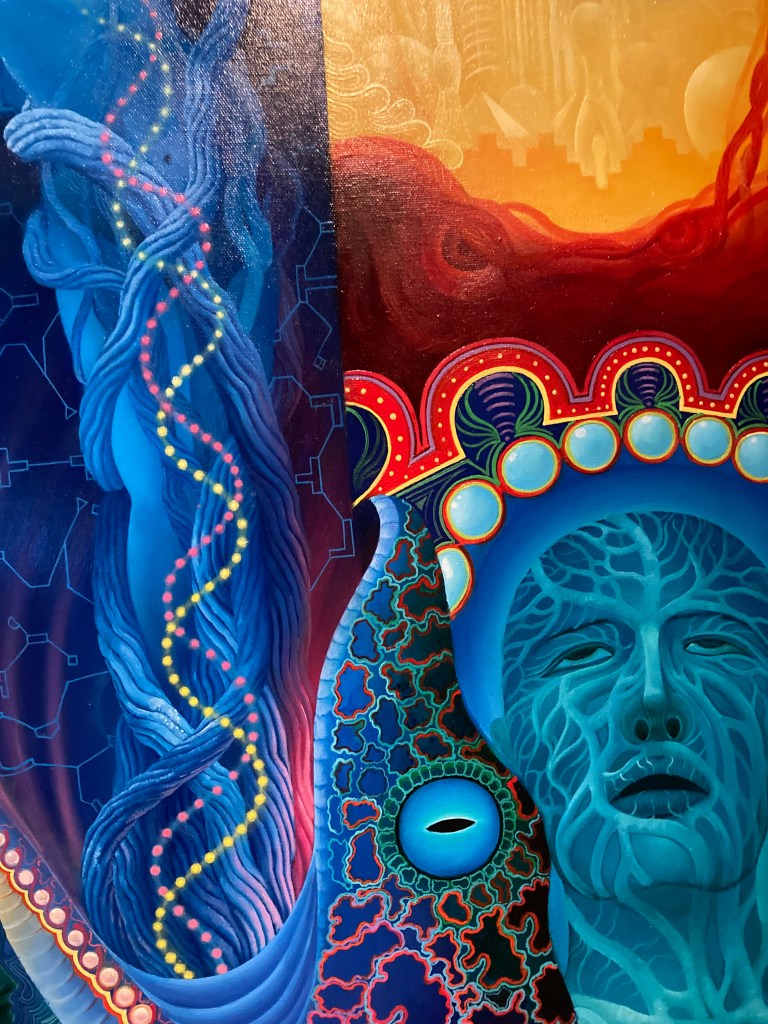
[Image credits: Detail from Anderson Debernardi’s painting “Iniciacion Shamanica”, seen at Exhibition Visions Chamaniques. Arts de l’Ayahuasca en Amazonie Péruvienne, ‎⁨Musée du Quai Branly, 2024. Photo by Eline Kieft.]

Continue reading “Healing Soul Loss Through Movement”

Dancing the Stories That Heal

After a near-death experience in 2019, I found myself immersed in myth and movement—sitting with Clarissa Pinkola Estés, dancing archetypes through Movement Medicine, and weaving stories like the Handless Maiden and the Red Shoes into my everyday life. This post shares some of the journey of how myths became embodied allies and an invitation for you too, to remember what lives in your bones.

Tapestry: Le Grand Charniers (1959) by Jean Lurçat, Musée Jean-Lurçat, Angers, photographed in 2024. Image © Eline Kieft.
Continue reading “Dancing the Stories That Heal”

Do You Hear Seal-Woman Calling?

It was beautiful to read Carol P. Christ recent ‘from the archives’ post “Mermaid, Goddess Of The Sea,” especially because I’m in the middle of organising my first live Story-Dance workshop since several years, to move through one of my favourite stories of the Selkie-Seal Woman!

Stories of seal-women drift across the sea from the windswept coasts of Scotland to the icy shores of the Arctic. In the Scottish and Irish Highlands, Seal-women are known as selkies—shapeshifters who live as seals in the ocean, and who, when they shed their skins, walk as women on land. These selkie women dance beneath the moonlight, their laughter echoing across the waves as they rejoin their sisters in joyful reunion with the earth.

Continue reading “Do You Hear Seal-Woman Calling?”

Yoga for Witches: Should You Try This at Home?

In this post, I review Yoga for Witches by Sarah Robinson, a practical book that weaves together two ancient practices with surprising similarities, yoga from the East, and witchcraft as practiced in Northwestern Europe.

I start with what I loved, and how Robinson describes the similarities and differences between those two traditions. That weaves into some personal and deeper reflections on the theoretical background and yoga sequences. At the end you’ll find a specific recommendation so you’ll know if this is the book for you!

Continue reading “Yoga for Witches: Should You Try This at Home?”