

The month of May finds those within the Christian tradition solidly within Easter season, reveling in the promise of resurrection, while simultaneously celebrating Mother’s Day. To be honest, I’d never seen much of a correlation between these two events in the past. But since my brother’s death in March, I’m viewing everything through the lens of grief, likely a new perspective that will color the way I see the world forever. Namely, until this year, I’d never really given much thought to what Jesus’ mother, Mary, was feeling in a post-resurrection world. Of course, the suffering, sorrow, and sadness of a mother who watched her child die is something that most Christian churches highlight during Holy Week, on Good Friday, or even on Easter Sunday. But then our liturgy shifts, as though Mary transitioned from weeping at the gruesome death of her child one day and then suddenly celebrates the reality of resurrection the next. At the risk of extreme blasphemy—a place where I consistently reside—when I place myself in Mary’s shoes as a mother, resurrection kinda sucks. Continue reading “Painting Our Lady of Sorrows: Mother’s Day and Resurrection by Angela Yarber”
Category: Christianity
Moonlight Reflections by Elise M. Edwards
As I post this, May 10, a full moon, known as the “Bright Moon” or “Flower Moon” is in the sky. This full moon occurs during a season of transition when living thing things renew and bloom. For those of us in the Northern Hemisphere, it’s spring, but another transition is already underway. For many of us, spring is nearing close to summer in temperatures; in plant, animal, and insect life; and in our schedules. I am concluding a long, demanding spring semester and yearning for summer. Even though I welcome the transition, I know that like all change, it holds both opportunity and challenge. The full moon prompts me to look at the upcoming summer with clear, examining eyes
 As I post this, May 10, a full moon, known as the “Bright Moon” or “Flower Moon” is in the sky. This full moon occurs during a season of transition when living thing things renew and bloom. For those of us in the Northern Hemisphere, it’s spring, but another transition is already underway. For many of us, spring is nearing close to summer in temperatures; in plant, animal, and insect life; and in our schedules. I am concluding a long, demanding spring semester and yearning for summer. Even though I welcome the transition, I know that like all change, it holds both opportunity and challenge. The full moon prompts me to look at the upcoming summer with clear, examining eyes.
It’s strange–perhaps downright heretical–for a Christian to talk about the power of the moon. Continue reading “Moonlight Reflections by Elise M. Edwards”
When a Methodist Turns Baptist by Katey Zeh
Nearly a year ago, almost to the day, I entered the sanctuary of an historic church in downtown Raleigh for the first time. Visiting a new faith community is nearly always at least a slightly uncomfortable social experience. In my case I’d grown quite accustomed to feeling like an outsider in these spaces as a significant portion of my work included traveling to congregations around the country. This particular Sunday, however, had me a more on edge than usual.
The church, as it turns out, was Baptist. I was Methodist. Sitting down in a Baptist Church for worship felt something akin to rooting for a rival sports team. It was simply not done.
I recall on several occasion the pastor of my hometown Methodist church, a soft-spoken and generally mild mannered man, would poke fun at Baptist preachers from the pulpit. If a worship service ran long as it often did on the Sundays we celebrated communion, my mother and I would half-jokingly lament that our favorite lunch spot would be filled with Baptists by the time we got there. One could argue it was all in good fun like any hometown rivalry. But even well-meaning jokes, if they are repeated enough, have a poisoning effect over time.
As I fidgeted in the pew that first Sunday waiting for the service to begin, a woman sporting black cat-eye glasses and fiery red lipstick leaned across the pew to greet my husband and me. “Is this your first time at Pullen?” she asked. I nodded my head and confessed quietly that I was struggling a bit with being in a Baptist church. “I’m Methodist,” I whispered to her. Without skipping a beat, she responded with a hint of a smile, “Well honey, I’m Jewish.”
Needless to say this Baptist Church was unlike the ones we’d joked about in my small town Georgia church. Pullen Memorial Baptist Church has been on the forefront of social justice movement for decades, much to the chagrin of certain other Baptist-identifying bodies. From affirming women and the LGBTQ community to standing against racism and Islamophobia, Pullen is committed to the work of dismantling oppressive systems.
Prior to my first Sunday at Pullen I’d tried desperately to find community in several local Methodist churches, but I could not in good conscience align myself with their theological values. Pullen, on the other hand, affirmed my spiritual sensibilities and challenged me to examine them critically. In the end I had to make a decision: what was more important to me, the ministry of the congregation or its label (and the stereotypes that came with it)? As you might guess, the choice was easy.
Last month my husband and I along with our two-year-old daughter stood before the congregation and pledged our commitment as official members of Pullen Memorial Baptist Church. Some have asked me if leaving the Methodist faith was terribly painful for me. In truth this decision felt very little like a departure at all; rather it felt grounded in the deep joy and affirmation of having found a community to make my spiritual home. No change is without some sense of loss, but what I mostly feel is an overwhelming sense of joy.
Joining a Baptist congregation has opened my heart to the possibility of unexpected becoming. We are never as sure of things as we might like to believe. I’m grateful for that.
 Katey Zeh, M.Div is a strategist, writer, and educator who inspires communities to create a more just, compassionate world. She has written for outlets including Huffington Post, Sojourners, Religion Dispatches, Response magazine, the Good Mother Project, the Journal for Feminist Studies in Religion, and the United Methodist News Service. Her book Women Rise Up will be published by the FAR Press in March of 2018. Find her on Twitter at @kateyzeh or on her website kateyzeh.com.
Remembering Sor Juana Inés de la Cruz’s Life and Legacy: Champion of Universal, and Non-Human Rights November 12, 1648/51 – April 17, 1695 by Theresa A. Yugar
She studies, and disputes, and teaches,
and thus she serves her Faith;
for how could God, who gave her reason, want her ignorant?—Sor Juana Inés de la Cruz, Villancico, or, “Carol”, in celebration of St. Catherine of Alexandria (1692)
 The reason for this blog, and for writing it on this day, is to celebrate and remember the life and legacy of Sor Juana Inés de la Cruz.
In 1994, I was exposed, by chance, to the life and writings of 17th century Novohispana feminist Sor Juana Inés de la Cruz. I am the product of twelve years of Catholic education, eight years of which were in an all-women setting. Again, by chance, I learned about Sor Juana in a liberation theology class while studying feminist theology at Harvard Divinity School. In this class, I learned about Sor Juana’s bold advocacy of the right of women to be educated. This spurred me to learn more about this Catholic Latina theologian whom I would later discover was the last great author of El Siglo de Oro (Spain’s Golden Age), recognized in her era as an esteemed poet, mathematician, astronomer, and more. This was the beginning of my life-long passion to reclaim the legacy of Sor Juana and her-story within the Christian, non-Christian Western tradition, and in Spanish and Mexican history. Continue reading “Remembering Sor Juana Inés de la Cruz’s Life and Legacy: Champion of Universal, and Non-Human Rights November 12, 1648/51 – April 17, 1695 by Theresa A. Yugar”
Standing Rock: What Does Easter Look Like? by Elizabeth Cunningham
 As I write, Bakken crude oil is moving through the Dakota Access Pipeline under the Missouri River at Lake Oahe Reservoir, crossing treaty lands and waters that the Sioux Nation never ceded to the United States Government.
This, after the Standing Rock Sioux Tribe has opposed the Dakota Access Pipeline since it was proposed in 2014, with hundreds of other tribes making formal declarations in support of the tribe’s opposition. This, despite ongoing lawsuits. This, after a prayer camp begun by a small group of indigenous youth in April, 2016 grew to several camps with a total population at one point of close to 20,000. This, after 4,000 United States military veterans came to stand with the water protectors in December, 2016. This, after the United States Army Corps of Engineers under the Obama administration denied the easement to cross the river and legally bound themselves to conducting an environmental impact study that the Trump administration aborted. This, after countless unarmed water protectors faced attack dogs, mace, rubber bullets, water hoses turned on them in sub-freezing weather, and noise cannons. This, after the arrest of over seven hundred people (some charged with felonies and still awaiting trial) many of whom were strip-searched and held in kennels in an unheated parking garage. This, after hundreds of people camped all winter, surviving blizzards and bitter cold. This, after people remained standing in prayer until they were forcibly removed from the prayer camps on February 22nd, 2017. Continue reading “Standing Rock: What Does Easter Look Like? by Elizabeth Cunningham”
The Nature of Communal Pondering by Elise M. Edwards
Last week, I listened to an episode of Krista Tippett’s series On Being that featured an interview with poet Marilyn Nelson. I am not very knowledgeable about the world of modern poetry, but I am familiar with Nelson’s work. A couple years ago, I wrote about Fortune’s Bones: The Manumission Requiem, Nelson’s poetic composition about Fortune, an enslaved man whose owner rendered his body into a skeleton for medical training. Fortune’s identity and history had been erased across centuries as his remains were displayed. Community concerns eventually led to a multi-disciplinary academic, artistic, and community effort to honor the man and, in 2013, put his bones to rest. Isaye M. Barnwell, a musician formerly of Sweet Honey in the Rock, developed a cantata and choral work for Fortune’s Bones. These developed into a series of artistic performances and community events that demonstrate the power of art to speak through and for those who are marginalized—even in death. Disparate communities joined together to ponder Fortune’s life, and it was powerful.
In the On Being interview, Nelson spoke about “communal pondering,” and I’ve been repeating this phrase to myself since then. It identifies a form of creative activity and a spiritual way of being that I am deeply committed to, and have not been able to name. Communal pondering occurs when a group of people are listening together and are opening up new paths for discourse and action by the engaged reflection that takes place within that listening.
Continue reading “The Nature of Communal Pondering by Elise M. Edwards”
Should I Stay or Should I Go? by Esther Nelson
 On March 13, 2017, Carol Christ wrote on this “Feminism and Religion” blog:
I agree with Carol. This is an important subject to ponder as we think and write about the choices we make regarding the faith traditions we either inherited or belonged to at one point or another during our lives.
I just finished re-reading Joanna Brooks’ memoir, THE BOOK OF MORMON GIRL. Raised Mormon in an insular family in a “tract house on the edge of the orange groves” near San Diego, California, Joanna learned, and felt, early on that salvation meant “belonging,” tied to people who believed as her family and their Mormon ancestors did, “safe where no one would say your books of scripture are all made up.”
The stories that shaped Joanna early on in her life all “arrived at the same conclusions: the wayfarer restored, the sick healed, the lost keys found, a singular truth confirmed.” She wants to tell “orthodox Mormon stories,” yet “these are not the kinds of stories life has given me.” Continue reading “Should I Stay or Should I Go? by Esther Nelson”
Coexist or Contradict? How about Resist Instead by Katey Zeh
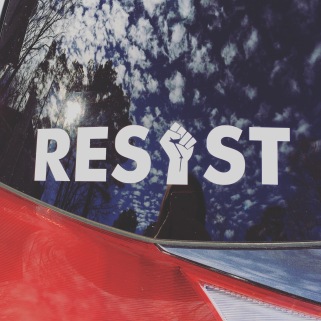
While stopped at a red light on my way home one day I noticed that the two cars immediately in front of me had the same “Coexist” bumper sticker. You’ve probably seen one like it. Each of the letters of is a symbol representing a major religious or spiritual ideology. For example, the “C” is a crescent moon symbolizing Islam, and the “X” is a Star of David symbolizing Judaism.
This was a particularly long traffic light, which gave me time to realize that I was mistaken. In actuality the bumper sticker on the car just ahead of me did not read “Coexist” but “Contradict.” Underneath that it read, “They can’t all be true-John 14:6.” Despite my early days of earnest scripture memorization I couldn’t recall this particular passage, but I had a hunch it was the verse in which Jesus said, “I am the way, the truth, and the life.” I was right.
I’ll admit my eyes rolled back in my head over this display of Christian moral superiority. Continue reading “Coexist or Contradict? How about Resist Instead by Katey Zeh”
The Social Structures of Religious Identity and the Decision to Leave or Stay by Carol P. Christ
 Reflecting on our different choices to “stay or leave” the religions of our upbringings while writing Goddess and God in the World with Judith Plaskow, I was prompted to think again about the social and ethnic structures of denominationalism. One of the things Judith has been saying to me since we began discussing this question years ago, is that for her being Jewish is an identity that deeply affects her choice to stay within her religion.
Here on FAR both Gina Messina and Mary Hunt have stated that for them being Catholic is so closely tied to their Italian and Irish identities that they cannot think of themselves anything other than Catholic. For Gina, this recognition led to a renewed commitment Catholicism as a religion. She considers herself “faithfully feminist” and expresses her hope that Pope Francis will transform the church. Mary, on the other hand, feels strongly disaffected from the Church hierarchy and traditional Catholic teachings and does not think Francis will change the Church in significant ways. At the same time, she does not disavow her Catholic identity.
Black feminist theologians, especially those who are Protestant, often speak about black Christianity as inseparable from their identity. White Protestant feminist theologians may feel similarly tied, but they are less likely to say so publicly. Continue reading “The Social Structures of Religious Identity and the Decision to Leave or Stay by Carol P. Christ”
Doctrine and Fidelity by Elise M. Edwards
This past week, I was listening to Krista Tippett’s podcast On Being as she spoke with Pádraig Ó Tuama. He is a poet, theologian, and leader in the Corrymeela community of Northern Ireland. As he spoke about several things related to the challenges of belonging, reconciliation, and fractured communities, he said, ”The measure of Christian fidelity is more than the positions we take.”
I agree. I interpreted his statement as a condemnation of the ways Christian doctrines and moral positions too often take priority over other matters of faith.
Continue reading “Doctrine and Fidelity by Elise M. Edwards”
 Feminism and Religion