From the Archives: Thanksgiving and Service by Sara Frykenberg

This was originally posted on December 3, 2103

Growing up in an evangelical Christian church, I was taught that human beings should serve one another and put others before themselves.  These two different teachings, paired with patriarchal misogyny, have sometimes been very problematic for me.  I tend(ed) to give too much.  Too many demands with which I complied were self-negating (which after all, helped me to make other people more important than myself).  It took me a long time to learn how to appropriately prioritize my own needs, to stop mistaking self-esteem for the”‘sin of pride,” and how to say no when I needed to… Actually, I am still learning some of these lessons.

Conversely, my ritualized service to the church was sometimes confusing, awkward or embarrassing.  I clearly remember having the opportunity to serve as something like an usher during Thanksgiving at our family’s church as a child.  This involved wearing a pilgrim costume, which for me meant finding a Puritan style costume in the church’s closet that fit my overweight childhood frame.  This was not an easy task and left me feeling ashamed.  Later as an adolescent, my youth group asked us to wash one another’s feet as Jesus did for his disciples.  Now, don’t misunderstand me here— I do believe that this ritual has the potential to be very powerful and meaningful for those involved.  However, my teenage self could not identify with the symbolic gesture beyond realizing that:

1)    I thought touching other people’s feet was gross, as was having my dirty feet touched and,
2)    I knew I ‘should’ get something out of the ritual but did not, so I felt spiritually guilty or inadequate.

Overall, I often associated Christian service with guilt, inadequacy, my role as a daughter or woman or my sacrificial duty.

Despite these issues, I usually genuinely enjoy serving others and giving to other people.  I love to host people and care for them.  I like to help.  I even prefer to help.  Serving one another we can express and allow others to express love.  But this past week, one day before Thanksgiving, a dear friend of mine gently challenged me to allow myself to be served or, as she put it, “to give someone else the gift of giving to me.”  Specifically, she was referring to a pending holiday meal for which I expressed my anxiety and frustration with not being allowed to help—which somehow makes me feel like a child.  Even writing this phrase, “makes me feel like a child,” I know that I have touched deeper feelings of helplessness or vulnerability that at some point, I learned to battle with competence and over-achievement.  I do often feel like a child or guilty when other people do for me what I think I could or should do for myself; and my friend’s brief words encouraged me to explore this relationship to being served.

“Service” can sometimes feel uncomfortable for the reasons I mention above, but more so, for its connection to the coercive “servitude” required by existent hierarchies within andro-kyriarchal oppressive systems.  I have been subject to this coercive servitude, and also, its beneficiary.  As a white, middle class, Western woman I have far too much privilege that is contingent upon the forced labor and oppression of other people.  This kind of forced servitude is very wrong; and I am still learning how and where to choose other than to be complicit in this abuse.  But, there have also been many distinctive instances in my life where I have felt reciprocally and undeniably “served” by people around me, without abuse and without manipulation.

Driving to Colorado one summer to see the friend I mentioned above, my two companions and I served one another.  The individual in the back seat was responsible for cutting bagels and spreading cream cheese on them for the driver and navigator, while the navigator held the drink, food or whatever other item that the driver could not.  This may sound like a small thing, but it wasn’t.  I felt taken care of and loved in this small and traveling community.  We also had a safe word that meant, “leave me alone, I’m grumpy” on our long trip.  We made agreements to account for one another’s  discomfort and effort.  We respected one another and cared for each other.

Beginning my work as an adjunct professor, I encountered a great deal of stress and often long and awkward work hours.  Many times I felt like I needed help, but there was nothing I could ask for help with when it came to my job: I needed to grade my own papers, plan my own lectures, and yes, write my own blogs.  My husband has responded by taking care of me in other ways.  He makes me dinner, goes to the store and makes sure I take breaks.  We take turns taking care of one another, and I am grateful for him.

This past week after talking to my friend, I noticed how willing people were to touch me to soothe aching muscles.  I’m not sure how to describe what I felt, but it was like something invisible in certain spaces was suddenly visible.  I also realized that it had been a very long time since I had freely and openly received this touch.  Later during the weekend, a friend came to my house  and she made me dinner!  My husband rubbed my chest after a long night of coughing yesterday because I still haven’t completely rid myself of the smoldering in my lungs.  I was defensive for so long.  Shedding my defender allows me to rediscover all those things for which I am thankful.

Gratefulness is an action.  It can be found in those expressions that return, receive and allow for mutual loving.  I am learning new rituals that help me to remember that this kind of mutual serving and being served is sacred.  In a summer ritual, my friend and I washed one another’s hair instead of our feet.  I am still learning to ask for assistance from the goddess after freeing myself from an abusive omnipotent god, but I am starting to ask.

I am starting to pray again.

BIO: Sara Frykenberg, Ph.D.: Graduate of the women studies in religion program at Claremont Graduate University, Sara’s research considers the way in which process feminist theo/alogies reveal a kind transitory violence present in the liminal space between abusive paradigms and new non-abusive creations: a counter-necessary violence.  In addition to her feminist, theo/alogical and pedagogical pursuits, Sara is also an avid fan of science fiction and fantasy literature, and a level one Kundalini yoga teacher.

The People Who Have Always Had Questions by Liz Cooledge Jenkins

A few weeks back, author and historian Jemar Tisby tweeted that an acquaintance of his “described their general experience with white evangelicals as ‘people who don’t have any questions.’ I immediately knew what they meant.” The tweet gained some traction, with 62.1k “likes” at the time I’m writing this. The next week, Tisby followed up with a thoughtful reflection piece, expanding on his own experience with white evangelicals needing to have answers to every question, from “How old is the earth?” to “How should Christians vote?” Tisby unpacks the dangers of this kind of arrogant certainty, inviting Christians instead to embrace mystery, curiosity, and learning.

I resonate with many of Tisby’s observations and reflections. From my experience (including thirteen years in evangelical churches and a Master of Divinity degree from an evangelical seminary), I wouldn’t say these things are true of every single white evangelical—but they’re definitely true enough of the movement as a whole that they are very much worth naming, engaging, and challenging. I appreciate Tisby’s work.

Continue reading “The People Who Have Always Had Questions by Liz Cooledge Jenkins”

SpiritualiTEA with Chasity Podcast, Episode 3 by Chasity Jones

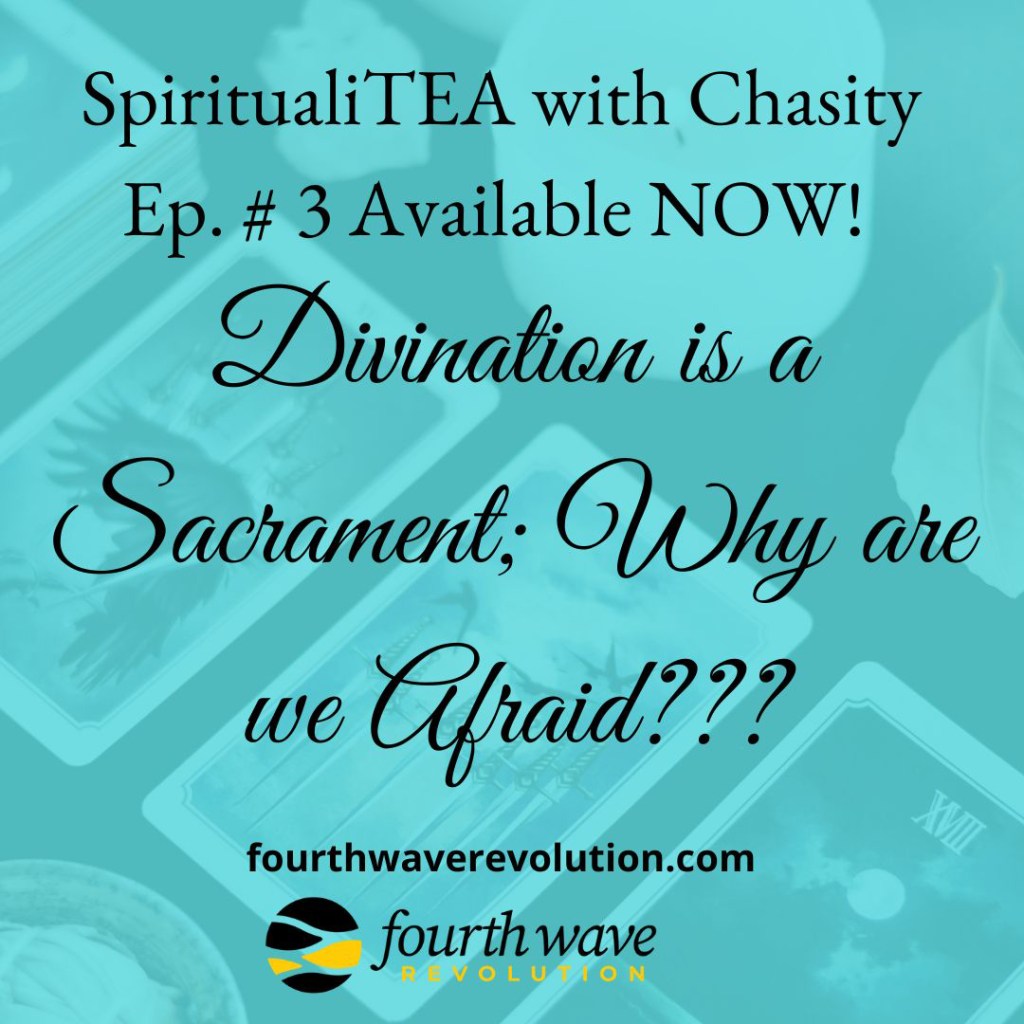
An excerpt from SpiritualiTEA with Chasity Podcast Episode 3: Why are we afraid of Divination??? What is divination?

Divination is from Latin divinare “to foresee, to be inspired by a god”. (Goleman, David. The Varieties of the Meditative Experience. London: Rider, 1975.)

“DIVINATION IS A SACRAMENT!!” – Chastity S. Jones

This is beautiful to me because it reminds me of how when the prophets would begin to prophesy in the bible or even the explosive forward movement of the spread of the gospel- driven by the Holy Spirit, as well as those who documented the gospel are all described as being inspired by God. 

The most popular form of divination right now is tarot cards but we will discuss how there are many other forms- including forms that are acceptable in the church RIGHT NOW.

There are many bible verses cursing those who divine but I want to reiterate that one bible verse cannot be a comprehensive ethic or set of ethics, especially when there are other verses that contradict that verse.

Continue reading “SpiritualiTEA with Chasity Podcast, Episode 3 by Chasity Jones”

Can I get an “Amen” up in here? by Laura Montoya 

I am a great evangelist. I used to evangelize in Pentecostal settings until I was 22. Then, I left my church to evangelize about feminist issues to every woman that crossed my path. Rhetoric is a gift I received when I was a kid and that I inherited from my grandpa and my dad. But during the COVID lockdowns, it was hard to socialize, and my evangelization skills turned toward making my friends and family join the privileged fan base of Ru Paul’s Drag Race. One by one, I convinced my sister, cousins, neighbors, and best friends to watch the reality show, and they did with astonishing devotion. Every week, two or three of us gather in someone’s living room wearing masks to watch episode after episode after episode. Our debates about the queens in the show could last all night long. Who had the best performance? Did you like their lip-synching? “That elimination was so fair/unfair!” 

Continue reading “Can I get an “Amen” up in here? by Laura Montoya “

From the Archives: Politicians Make Dangerous Theologians by Katey Zeh

This was originally posted November 21, 2017

ben-white-181034

Accounts and allegations of sexual harassment, assault, and abuse perpetrated by mostly straight white men in power have flooded the U.S. news cycle for months. Each new revelation confirms that sexual violence is an epidemic fueled by systems of unchecked power and authority, including patriarchy, white supremacy, and Christian supremacy.

After The Washington Post published the story of Leigh Corfman who recounted the sexual abuse she suffered as a teenager at the hands of Roy Moore, Alabama State Auditor Jim Zeigler came to his defense and argued that this would have no political impact since Moore “never had sexual intercourse with any of these girls.”

We all ought know by now that such allegations of sexual abuse, even when the perpetrator admits to them, bear little weight on the electability of white male politicians (see: November 8, 2016). Even so, I was stunned by a poll that revealed that 29% of Alabama voters answered that they are now more likely to vote for Roy Moore since allegations were made against him.  

Continue reading “From the Archives: Politicians Make Dangerous Theologians by Katey Zeh”

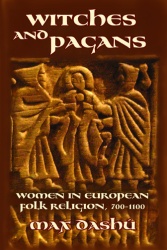
The Legacy of Carol P. Christ: Weaving and Spinning Women: Witches and Pagans by Max Dashu A Review

Moderator’s Note: This was originally posted on September 19, 2016

Max Dashu’s  Witches and Pagans: Women in European Folk Religion 700-1000 challenges the assumption that Europe was fully Christianized within a few short centuries as traditional historians tell us. Most of us were taught not only that Europe became Christian very rapidly, but also that Europeans were more than willing to adopt a new religion that was “superior” to “paganism” in every way. Careful readers of Dashu’s important new work will be challenged to revise their views. When the full 15 volumes of the projected series are in print, historians may be forced to hang their heads in shame. This of course assumes that scholars will read Dashu’s work. More likely they will ignore or dismiss it, but sooner or later–I dare to hope–the truth will out.

witches-and-pagans-cover

History has been written by the victors—in the case of Europe by elite Christian men. These men may have wanted to believe that their views were widely held, but Dashu suggests that they were not. Combing artistic and archaeological records, Dashu finds (to give one example) that images of Mother Earth nursing a snake are far from uncommon and can even be found as illustrations in Christian documents and on Christian monuments. Clerics rage against people—particularly women–who continue to visit holy wells and sacred trees and to practice divination and healing rituals invoking pagan powers. To paraphrase Shakespeare: “Methinks the cleric doth protest too much.” Were these things not happening and happening often, there would have been no need to condemn them.  Using these clues, Dashu provides intriguing new readings of the Poetic Edda and Norse sagas.

Continue reading “The Legacy of Carol P. Christ: Weaving and Spinning Women: Witches and Pagans by Max Dashu A Review”

I’m Not “Fit” to Judge Another Woman’s “Fit”ness by Liz Cooledge Jenkins

In recent conversations around abortion rights—spurred by a leaked draft of a Supreme Court decision that would overturn Roe v. Wade—everyone has opinions. The financially comfortable, often-white, often-evangelical women in my circles have opinions. And these opinions often involve the lives and choices of materially poor women and women of color.

            In her recent book The Trouble with White Women: A Counterhistory of Feminism, Rutgers University professor Kyla Schuller profiles seven pairs of feminist activists over the last two hundred years. Each pair includes one woman who operated from a framework of white feminism—a framework that, according to Schuller, “consistently…wins more rights and opportunities for white women through further dispossessing the most marginalized.” And each pair includes a woman who embodied intersectional feminism—a feminism that “expose[s] sexism to be a powerful structure of systemic inequality and attempt[s] to untangle its deep threads with other forms of domination, while also building new practices of care, coalition, faith, and solidarity.”[1] This is not just history but a live tension in the present day.

Continue reading “I’m Not “Fit” to Judge Another Woman’s “Fit”ness by Liz Cooledge Jenkins”

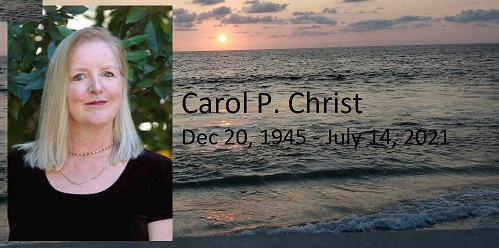
Carol P. Christ’s Legacy: Love Divine, All Loves Excelling

This was originally posted on Sept. 9, 2011

In my last blog I wrote that the image of God as a dominating other who enforces his will through violence–found in the Bible and in the Christian tradition up to the present day–is one of the reasons I do not choose to work within the Christian tradition.  To be fair, there is another image of God in Christian tradition that I continue to embrace.  “Love divine, all loves excelling” is the opening line of a well-known hymn by Charles WesleyCharles Hartshorne invoked these words and by implication the melody with which they are sung as expressing the feelings at the heart of the understanding of God that he wrote about in The Divine Relativity.

Love divine, all loves excelling also expresses my understanding of Goddess or as I sometimes write Goddess/God.  Though I am no longer a Christian, but rather an earth-based Goddess feminist, I freely admit that I learned about the love of God while singing in Christian churches.  Hartshorne wrote that he knew the love of God best through the love of his own mother, and I can say that this is true for me as well.  My mother was not perfect, and she did not understand why I wanted to go to graduate school, my feminism, or my adult political views, but I never doubted her love or my grandmothers’ love for me.  (I count myself lucky.  I know others did not have this experience.)  Like Hartshorne, I also learned about the love of God through the world that I always understood to be God’s body.  Running in fields and hills, swimming in the sea, standing under redwood trees, and encountering peacocks in my grandmother’s garden, I felt connected to a power greater than myself.


Continue reading “Carol P. Christ’s Legacy: Love Divine, All Loves Excelling”

From the Archives: Frozen 2: Can the Christian Church Hear its Gospel Song? by Trelawney Grenfell-Muir

This was originally posted on March 5, 2020

The first time I saw Frozen 2, I was impressed by the ecofeminism and the efforts to respect the Sami culture. The second time, I thoroughly enjoyed the superb music and the character development. The third time… was a religious experience.

Other contrubutors have written wonderful reviews of Frozen 2, and I agree wholeheartedly that its animation reinforces the sexist idea that females should be tiny compared to males, except for our eyes, which should be larger than our wrists. These disempowering representations saturate today’s media, and I regularly spend a whole lot of time deconstructing them with my daughters.

However, there is a lot to love about Frozen 2, and as a Christian, I found myself resonating with several of the symbolic truths the film offers. I spent some time looking into the Sami religion, to see how much of it was incorporated into portrayals of the Northumbra. I knew that Disney had consulted with Sami representatives to portray their culture with respectful accuracy. The Sami history is an all too familiar tale of violent imperial conquest allied with Fundamentalist Christian Dominionism. The wounds of Sami history certainly give me terrible grief as a white American and a Christian, and I hope that the anti-colonialist messages of the film spread awareness of such violence in my country. 

Continue reading “From the Archives: Frozen 2: Can the Christian Church Hear its Gospel Song? by Trelawney Grenfell-Muir”

Carol P. Christ’s Legacy: Kassiani: Placing a Woman at the Center of the Easter Drama

This blog was originally posted on April 13, 2015. You can read the original comments here.

For many years I been told of the beautiful Hymn of Kassiani, sung only on Easter Tuesday night, but I had never heard it until this week. For many this song is the high point of Easter week.

Kassiani, also known as St. Kassia, was a Greek woman born into a wealthy family in Constantinople (now Istanbul) about 805 to 810 AD. According to three historians of the time, she was intelligent and beautiful and selected as a potential bride for the Emperor Theophilos. The chroniclers state that the Theophilos approached her and said: “Through woman, the worst,” referring to the sin of Eve. Clever Kassiani responded, “Through woman, the best,” referring to the birth of the Savior through Mary.

Apparently unable to accept being put in his place by a woman, Theophilos chose another bride. Kassiani founded a monastery in Constantinople becoming its first abbess. She was an outspoken theological advocate of icons during the iconoclastic crisis (for which she was flogged). One of only two women to publish under her own name during the Byzantine Middle Ages, Kassiani wrote both poetry and hymns. Up to 50 of her hymns are known today, with 23 of them being part of the Greek Orthodox liturgy

.

Continue reading “Carol P. Christ’s Legacy: Kassiani: Placing a Woman at the Center of the Easter Drama”