

Modern science has proven what ancient myth has long told us about our Earth — billions of years ago our world was a water world. It’s not surprising then to find water-based creation stories and goddess mermaids in the myths of our ancient ancestors.
Continue reading “Atargatis, the Mermaid Goddess by Judith Shaw”Category: Divine Feminine
Rhiannon as Midlife Queen Mother by Kelle BanDea
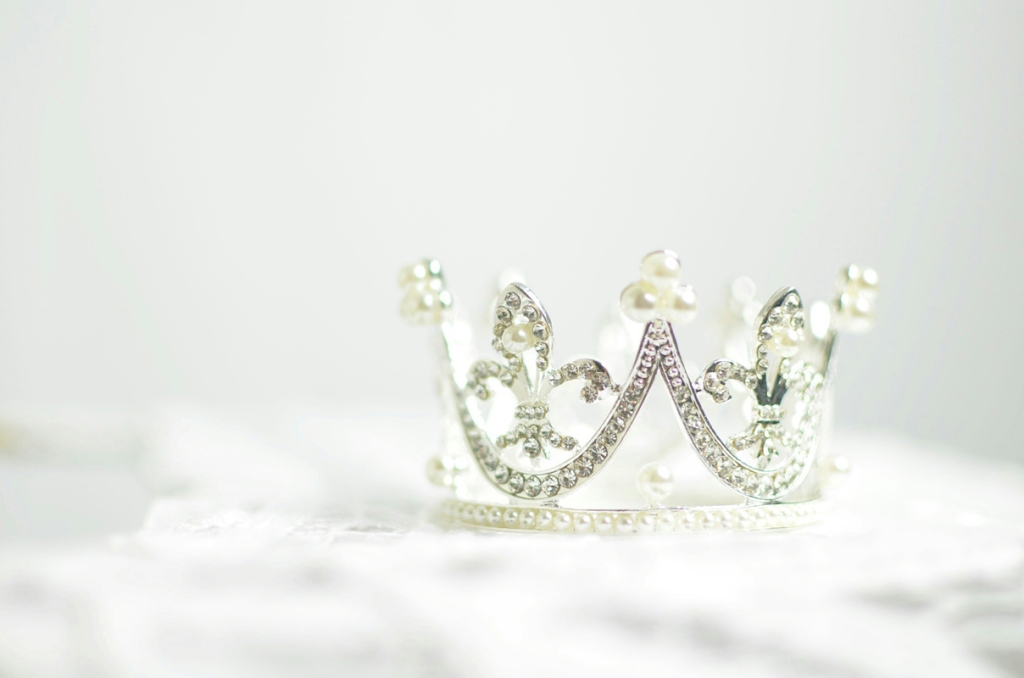
We tend to think of Rhiannon as the fairy maiden on the white horse who entices Pwyll, the King and her future husband, into the Otherworld. Or she is the young mother who is unfairly blamed for the death of her own child until he is restored to her. This is Rhiannon’s story as it is most well-known, and she has become a beloved figure due to it. The image of the beautiful fairy woman on the white horse has become equated, to modern neopagan folks and Goddess-women, with the ancient Celtic and Indo-European horse goddesses. Of all the women in the medieval Welsh lore that we know as the four story ‘branches’ of the Mabinogi, Rhiannon is perhaps the most beloved.
But this is only half of the story.
Continue reading “Rhiannon as Midlife Queen Mother by Kelle BanDea”On the changing role of the Goddess
Goddess Prominence & Nature Participation through time
Today I reflect on the presence or absence of the goddess in religion and society, and how we view humanity and participate in nature as a result.
This post is inspired by “The Myth of the Goddess. Evolution of an Image” by Anne Baring and Jules Cashford, and especially by its final chapter “The Sacred Marriage of Goddess and God: the Reunion of Nature and Spirit.” This dance of integration of apparent opposites is essential to my work.
Continue reading “On the changing role of the Goddess”Crete as the cradle of a culture of peace – Part Two by Laura Shannon
Part One of this article spoke of our collective yearning for peace, and the difficulty of imagining a peaceful world when we are taught to believe that “patriarchy and with it war and domination are universal and inevitable.” (Carol Christ, 2015)
But this is a myth. The peaceful civilisation of Bronze Age Crete lasted two thousand years with no sign of violence, slavery, or war. Most likely matriarchal, matrifocal, and matrilineal, ancient Crete embodied the final flowering of Old Europe. Art and archaeology reveal a life-loving people who honoured the earth, the Goddess, and nature, particularly mountains, caves, and trees. Key values and symbols of this culture of peace survive today in Cretan women’s dances and folk arts including pottery, textiles, baskets, and bread.
Continue reading “Crete as the cradle of a culture of peace – Part Two by Laura Shannon”She Cannot Win Within this System … Marianne Williamson by Caryn MacGrandle
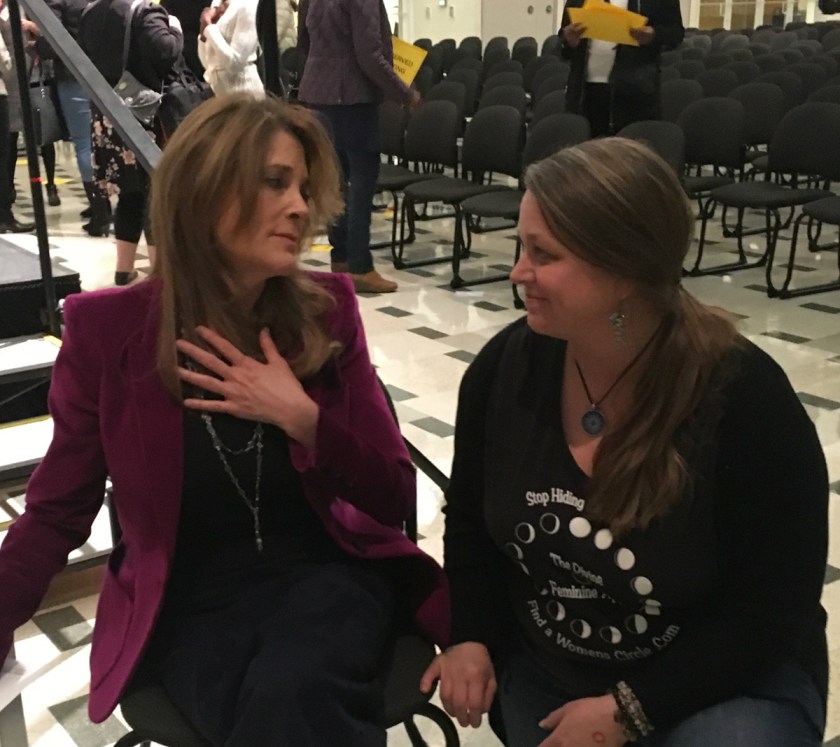
From my conmadres: “Well, yes, I agree with everything she says, but she can’t win.”
Meaning, “I’m not going to support her, send her money, talk about her campaign.”
I press on asking ‘why’. And the answer I invariably get is that she will not make it as she is outside the system.
First off, let’s backup, if you are outside the United States, you may not be aware of Marianne Williamson. If you are inside the United States, you may not be aware of Marianne Williamson as she has been blackballed by media (Dean Phillips got into the race and two days later, he was already on Meet the Press and NBC News.) Marianne has had to pay for all her media even though her polling numbers within the Democratic party are at 11%!
Continue reading “She Cannot Win Within this System … Marianne Williamson by Caryn MacGrandle”Embracing the Dark Goddess – Empowering Paradigm Shifts, Part 1 by Judith Shaw
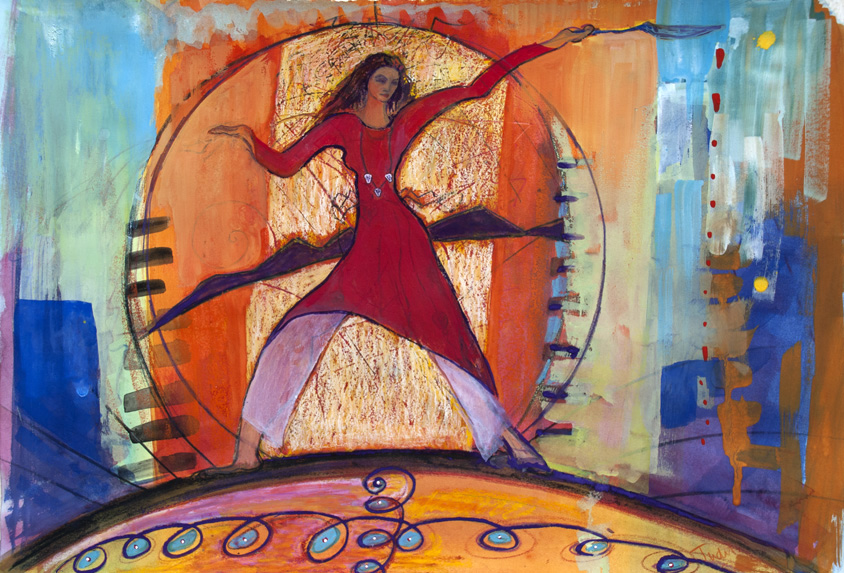
I always approach the Dark Goddesses with trepidation, preferring to focus on the bright, life affirming aspects of the Goddess. Yet now I find that the difficult break-downs and violent conditions of these days are calling me to explore the terrifying aspects of the ones called “Dark Goddesses.”
But who are the Dark Goddesses and why are they called dark? That question is one of controversy within the Goddess community. Carol Christ has written that the Dark Goddess only exists as a projection of patriarchal values onto the Goddess, turning the Goddess into a force of war and terror, in particular the War Goddesses found in various cultures. Christ views war as an abnormal desire for the Goddess. Whereas others view the Dark Goddess as a part of the one Great Goddess, who encompasses all.
Legacy of Carol P. Christ: Sophia, Goddess, and Feminist Spirituality: Imagining the Future
This was originally posted on September 17, 2018

Though represented by its detractors as an incursion of paganism into
Christianity, and presented as an integrally and intrinsically Christian phenomenon by its supporters, the truth about the Re-Imagining Conference and movement is that it was a product of a wider feminist awakening. The critique of patriarchal religions that emerged in the academy and in churches and synagogues in the late 1960s and early 1970s was part of the emerging feminist uprising. The feminist movement placed a question mark over all patriarchal texts and traditions, secular and religious, and as such was beholden to none.
In the spring of 1971, Roman Catholic Christian Mary Daly published “After the Death of God the Father” in the liberal Catholic magazine Commonweal. She asserted that the God whose death was touted in the “Death of God” movement was an idol fashioned in the image of male power and authority. She called for “the becoming of new symbols” to express the new becoming of women. In the summer of 1971, a group of nuns from Alverno College convened the first Conference of Women Theologians. Besides sparking dialogue about the role of women in religions, the conference endorsed my call to form a women’s group at the fall meetings of the American Academy of Religion, up until then a gathering of several thousand male scholars of religion, with only a handful of women scholars in attendance. At winter solstice, Z Budapest launched the Susan B. Anthony Coven #1 in Los Angeles publishing a Manifesto calling on women to return to the ancient religion of the Goddess.
Continue reading “Legacy of Carol P. Christ: Sophia, Goddess, and Feminist Spirituality: Imagining the Future”Legacy of Carol P. Christ: ALTERNATIVE IMAGES OF GOD with Emma Trout
This was originally posted on August 3, 2105
Today I am publishing an early work on female language for God that I wrote with Emma Trout at the first Conference of Women Theologians in 1971. Highly contested at the conference, this essay is a foreshadowing of my subsequent work on the need for female imagery for divinity.
Rereading this essay more than four decades later, I am gratified to see that though we began our essay with the image of God giving birth (which I still view as an important image), Emma and I were aware of the danger that female imagery for God could reinforce “a false sexual polarity.” We insisted then that female imagery for God must not repeat sex role stereotypes, but rather must shatter them.
I am surprised that we also mentioned the need for a new non-static or process metaphysic, a theme I did pursue until I wrote Rebirth of the Goddess and then She Who Changes several decades later.
While the references in the essay are dated, the issues it raises are not. Though many mainline Christian and Jewish communities have adopted inclusive language, active experimentation with female language for God is relegated to the fringes of these groups. And while Goddess feminists resist gender stereotypes, some New Age teachers and Neo-Pagan groups perpetuate the idea that the Divine Feminine is receptive, loving, and giving, while the Divine Masculine is active, assertive, and aggressive.
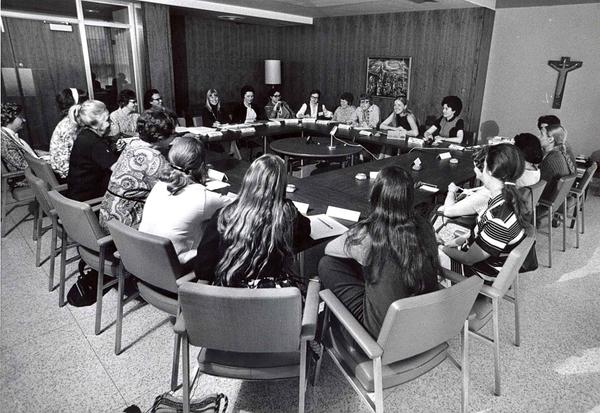
ALTERNATIVE IMAGES OF GOD: COMMUNAL THEOLOGY BY CAROL CHRIST AND EMMA TROUT
How much better for theology to conceive of God the Creator as pregnant with the world, giving birth to it and nourishing it, than of God the divine Watchmaker who set the machine ticking millions of years ago. — Penelope Washbourne Chen in “Rediscovering the Feminine in God” The Tower alumni magazine
Even though we know that God Himself is not really a male, we have made use of no other images in talking about Him. As Mary Daly has pointed out, images have a way of perpetuating themselves even though we conceptually know better. (“After the Death of God the Father”) The image of God as a male authority figure serves to legitimize the structures of subordination (oppression) of women to (by) men. The problem is to conceive God in such a way that God’s masculinity does not function as a legitimation system for the oppression of women.
The imaging of God as male has two aspects: 1) the poverty of our language, and 2) the impoverishing of our vision of God by exclusive use of characteristics which our culture has attributed to and limited to the male in conceptualizing and imaging God. In the first of these two aspects we find images of God as Father, King, Lord; our language has no pronoun which is able to embrace and/or transcend both sexes. Our language forces us to think of God as male; we need words like “she-he,” “father-mother,” “daughter-son,” “brother-sister.” Regarding the second aspect: in the Western tradition, particularly the Christian theological tradition our ideas and images have been impoverished by almost exclusive use of “male” characteristics in conceptualizing and imaging God.
For example, initiative, transcendence, authority, primacy, leadership, control and order have all been conceived in static, self-sufficient, abstractly rational terms, in correspondence with masculine stereotypes. An alternative image of God suggested by Penelope Washbourne Chen, imaging God as pregnant, giving birth to, and nurturing the world, presents us with a more dynamic way of conceiving God. Philosophically, this image of God would find expression in the neo-classical metaphysics or process view of reality of Whitehead and Hartshorne, rather than the static ontology of the Greek tradition.
. . .
Let us now turn to the alternatives. Underlying the problem of choosing among the alternative conceptions/images of God is the problem of the evaluation of sexual differences. If, for example, one believes sexual differences are a fundamental polarity in human experience, she will find it appropriate to see this polarity reflected in the deity. If, on the other hand, one does not see sexual differences as a fundamental polarity, she will be wary of correcting a false male image/concept of God by introducing a “female” element which may serve to further legitimize a false sexual polarity.
If one is open to the possibility that sexual differences may not be fundamental, the real question is how to shatter the idol of a male deity without either 1) substituting a reverse idol of a female deity, or 2) legitimizing a false sexual polarity.
Read the entire essay Alternative Images of God-Carol P. Christ & Emma Trout (1971).
Photos of Carol speaking at the Conference of Women Theologians and of the Conference Participants from the Alverno College archives. Thanks to Sarah Shutkin for providing a copy of the essay from the Alverno College Library Archives.
Legacy of Carol P. Christ: Can You Kill the Spirit? What Happened to Female Imagery for God in Christian Worship?
This was originally posted March 16, 2015
When I first began to think about female language and images for God I imagined that changing God-He to God-She and speaking of God as Mother some of the time would be a widespread practice in churches and synagogues by now. I was more worried about whether or not images of God as a dominating Other would remain intact. Would God-She be imaged as a Queen or a Woman of War who at Her whim or will could wreak havoc on Her own people?
Forty years later, very little progress has been made on the question of female imagery for God. I suspect that most people in the pews today have never even had to confront prayers to Sophia, God the Mother, or God-She. Most people consider the issue of female language in the churches to have been resolved with inclusive language liturgies and translations of the Bible that use gender neutral rather than female inclusive language.
Continue reading “Legacy of Carol P. Christ: Can You Kill the Spirit? What Happened to Female Imagery for God in Christian Worship?”Legacy of Carol P. Christ: Maternal Gift Economy: Webinar Gifts
This was originally posted December 7, 2020
In the 1960s and 1970s, American-born Genevieve Vaughan was living in Rome with her husband, philosopher Ferruccio Rossi-Landi, and their three daughters. When Rossi-Landi, using Marxist models, began to write about language as a form of “exchange,” Vaughan was inspired to articulate her alternative theory based on the idea that language was developed and is learned through the gifts of the mother to the child. From that beginning, Vaughn developed an alternative theory of culture based on what she calls the “gift economy.”
Continue reading “Legacy of Carol P. Christ: Maternal Gift Economy: Webinar Gifts” Feminism and Religion