Three Poems by Annelinde Metzner

  To spend time in nature and deeply connect with Her is to allow enough time for Her surprising wisdom and dreamlike insights to open up for me.  I call this “Plein Air Poetry.”  It’s a joy to wait in nature and see who connects with me on any given day.

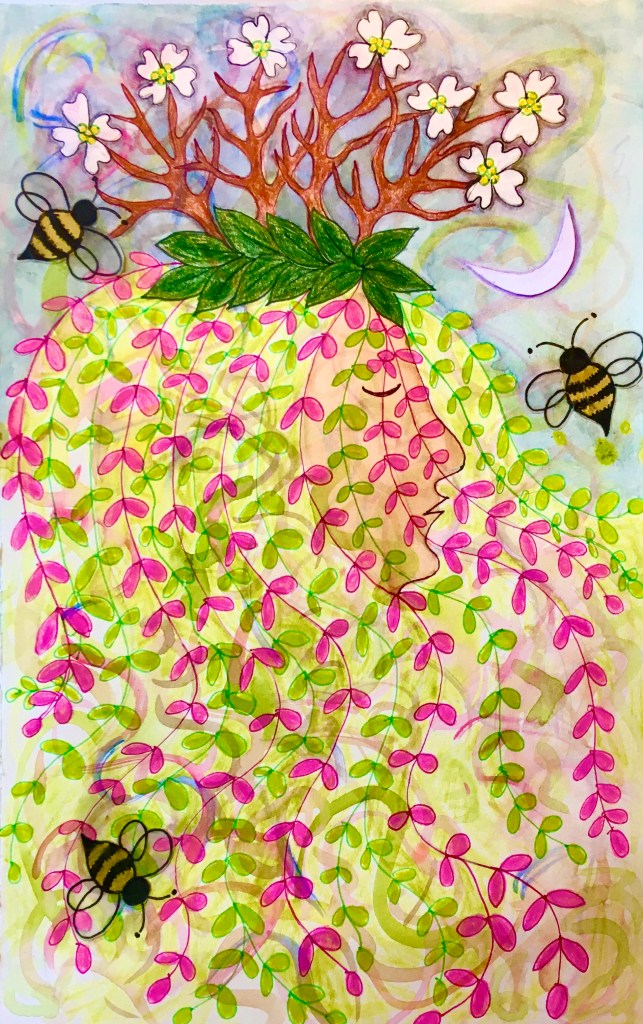
     These poems come with the gratitude of very early Spring when Her first shoots and flowers, such as the weeping cherry which birds have planted all over my yard, begin to appear like mysterious veils over winter’s greyness.

Deb Pollard Greening

Greening              April 6, 2022

Suddenly I awaken, early April,
and a diaphanous green veil
has draped over the weeping cherries,
the first to bloom with delicate, drooping grace.

Continue reading “Three Poems by Annelinde Metzner”

The Magic of the Labyrinth by Janet Maika’i Rudolph

Labyrinths are magical. I’ve always been drawn to them. About two years ago, a local Episcopalian Church rebuilt their beautiful outdoor labyrinth and opened it to the public. In concert with them, I have been delighted and honored to offer guided walks there. Doing these walks, both in leading them and in walking myself, have given me the opportunity to reflect deeply on what they mean from many perspectives: historical, personal, spiritual, philosophical, experiential.

When I walk a labyrinth, it feels like I am mirroring the universe while expanding my internal journey. Teresa of Avila agrees with me (or, more accurately, I with her). She wrote, “If we learn to love the earth, we will find labyrinths, gardens, fountains and precious jewels! A whole new world will open itself to us. We will discover what it means to be truly alive.”     


Continue reading “The Magic of the Labyrinth by Janet Maika’i Rudolph”

The Bang Bang Boys by Sara Wright

Mad wolf boys bay
a waxing solstice moon 
to Bloom

PTSD 
Violence
is the Gateway
Nowhere to hide

Bang Bang

Warblers sing on


Fright
fragments
innocence
Nerves strung too tight
contract
Guns batter
Forest Peace

Bang Bang

Continue reading “The Bang Bang Boys by Sara Wright”

From the Archives: Answering the Call by Joyce Zonana

This was originally posted on April 30, 2020

Very early in Henri Bosco’s 1948 novel Malicroix, a young man, Martial de Mégremut, living placidly amid fruitful orchards in a tame Provençal village, receives a letter informing him he has inherited “some marshland, a few livestock, a ramshackle house” from a reclusive great-uncle, Cornélius de Malicroix. Against his family’s strenuous objections–with alarm they speak of “marshes, mosquitoes, miasmas”–Mégremut resolves to travel alone to the remote Camargue to claim his “wild” Malicroix inheritance. The house is on an island, and to reach it Mégremut must cross a rough river, at night, in a frail wooden boat piloted by a taciturn old man who meets him at dusk in the middle of a vast plain.

So begins a deeply internal quest narrative, an initiatory journey that forces Mégremut to come to terms with himself and with the elements–earth, water, wind, and fire–that are ever-present, sometimes terrifyingly so, on the island. For once he arrives, he learns that he must remain there alone for a full three months if he wishes to obtain the inheritance. Torn about whether to stay or leave, he finds that the decision to stay is made of its “own accord,” unconsciously.

Continue reading “From the Archives: Answering the Call by Joyce Zonana”

Rites of May, by Molly Remer

It is important that we share these rituals of celebration and affirmation with our sons as well as our daughters. Men, too, should know the power of joined hands in a circle, voices lifted in song, and sweet words of connection surrounding one another on a bright spring day…

I rose early seeking Beltane dewdrops
with which to anoint my brow.
the cupped violet stems and clover
were dry
and I found no dewdrops
in the chickweed stars.
Instead, I put out oranges
for the orioles,
ran my fingers through the dandelions,
and pressed my nose into the lilacs.
I spotted green flowers
on the mulberry trees,
found the first wild pink geraniums
and tender bells of columbine
and came face to face
with the quiet black eyes
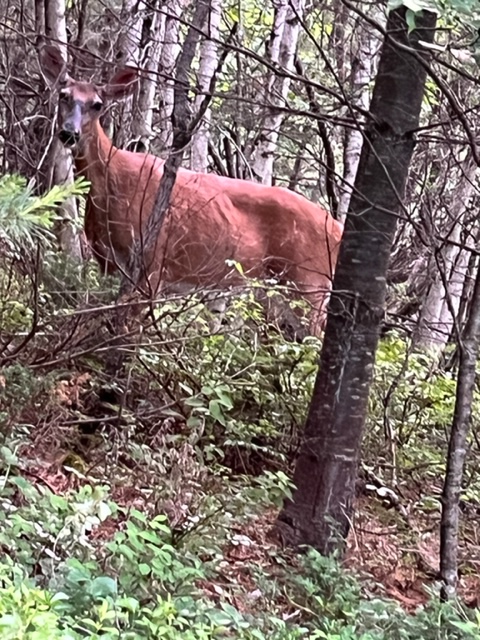
of solemn deer in the raspberry bushes.
These things
their own kind of anointing,
their own small and significant
rites of May Magic.

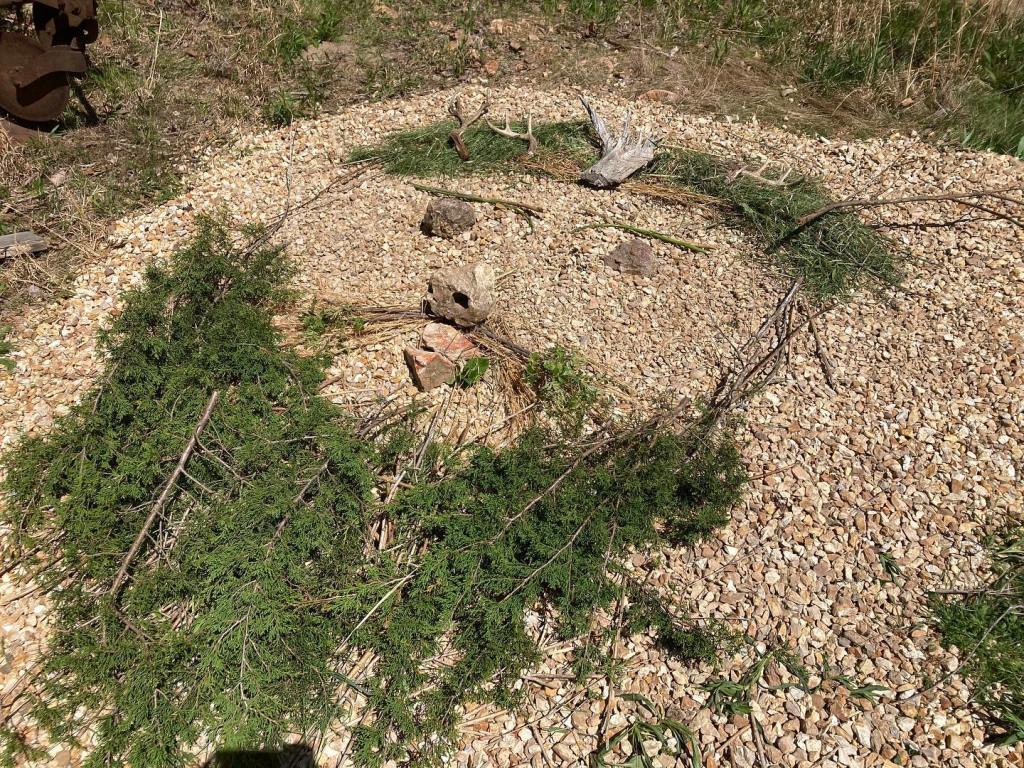
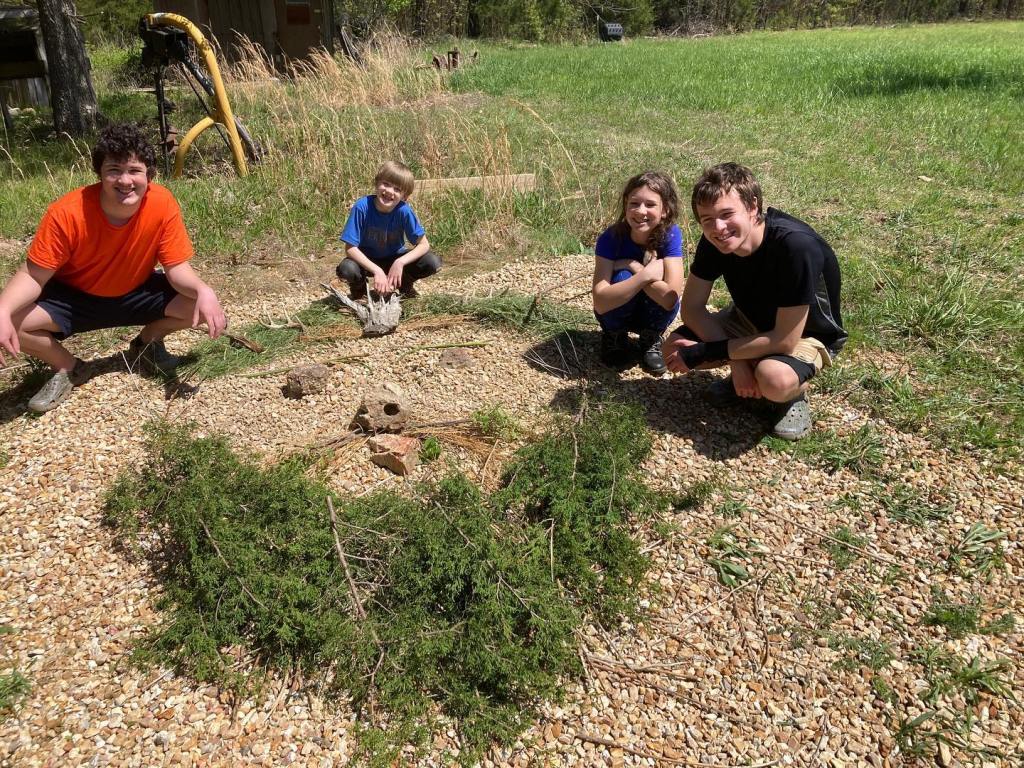
As a family, we traditionally celebrate the May by making a Green Man face in our field, using natural items that we find that day. As a goddess-focused person who walks an almost exclusively goddess-centered/nature-based path, this is one of our few family rituals that centers around more masculine sacred imagery. It is a favorite for my kids—rituals involving multi-age groups should always be as highly participatory as possible. I have written several times for FAR about how my hearth-priestessing has evolved over the years, letting go of more and more control, doing less and less planning, and being more freeform, spontaneous, flexible, and playful. My four children now range in age from 7-18. We have celebrating the turning of the Wheel of the Year for their entire lives. I love how our memories of past rituals inform the present—for example this year’s Green Man had the same rock for a nose that we used for last year’s Green Man.

This year, May Day was bright and sunny with a wild wind. We circled near the driveway, building our Man on the gravel, where his features would stand out against the brown rocks. We gave him antlers formed from cedar branch and white-tailed deer and a crown of a split stump of gray oak. My oldest son trimmed off cedar branches for his beard, my husband pruned the hydrangeas of last year’s dead growth to frame his face, my sixteen year old gathered golden stalks of dry bluestem grass for a mustache, and my 11 and 7 year olds gathered pieces of grass and cinquefoil to trim his hair and beard.

We stood around him in admiration for a few minutes and then I spoke of the bounty, growth, and renewal of this time of year. We stood hand in hand and read the following blessing together (me calling a line and then all repeating it):

A sweet blessing
of the singing sky
to us.

A slow blessing
of the shining flame
to us.

 A strong blessing
 of the crashing wave
to us.

 A soft blessing
of the pulsing earth
to us.

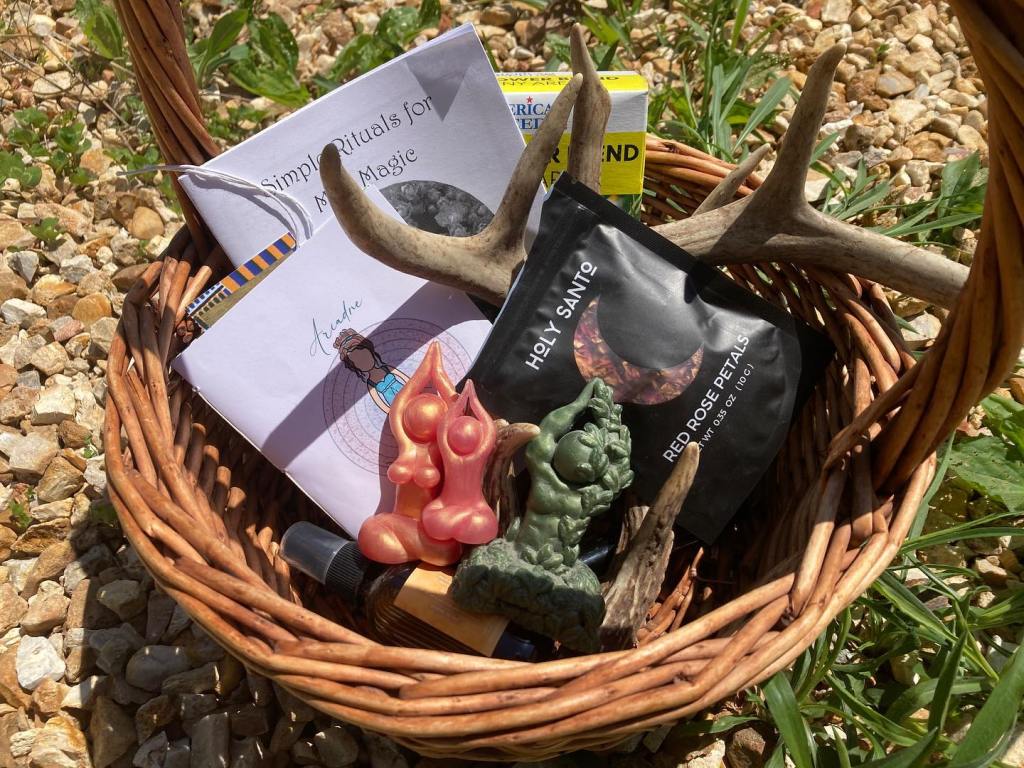
We then offered a wish to one another in turn with a spritz of “Valiant Heart” spray (from Honey and Sage Co). For example, I spritzed my daughter (11) and wished her curiosity and creativity and then she turned to her father and spritzed him wishing him health and prosperity.

I gave everyone four rose petals (whole flowers would have worked well, but I was working on the fly!) and invited everyone to kiss each petal in turn and then offer it to the Green Man (the wind whirled most of our petals away as we released them, which was pleasant as well—our wishes, accepted), based on this past poem:

Find four flowers
and bring them to your lips
one at a time.
One for wonder.
One for joy.
One for love.
One for magic.
Make your promise
invite them in,
one by one
the spell is done.

We sang a few lines together, laughing, from one of Tom Bombadil’s ditties in The Fellowship of the Ring and shouted out, “Happy May!”  after finishing our raucous rendition:

Now let the song begin! Let us sing together!
Of sun, stars, moon and mist, rain and cloudy weather,
Light on the budding leaf, dew on the feather,
Wind on the open hill, bells on the heather,
Reeds by the shady pool, lilies on the water…

We then each took a handful of wildflower seeds and sang “Call Down a Blessing” over them, each of us plugging in a blessing word in our turn.

Call down a blessing
Call down
__________before you
__________behind you
__________within you
and around you.

This song is based on Cathy Parton and Dave Para’s song, but is sung collaboratively with each person choosing a blessing to sing together in the blank space. (A recording of our women’s circle singing this together during a ritual is available here.) We then scattered to plant our handfuls of seeds in whichever place we wished to do so.

This whole ceremony took less than thirty minutes and we closed our largely spontaneous ritual by joining hands and offering our family’s usual closing prayer (learned from our own dear Carol Christ): May Goddess bless and keep us, may wisdom dwell within us, may we create peace.

It is important that we share these rituals of celebration and affirmation with our sons as well as our daughters. Men, too, should know the power of joined hands in a circle, voices lifted in song, and sweet words of connection surrounding one another on a bright spring day.

My oldest son is graduating from high school this month and this week I took him to register for his first college classes. At this threshold moment in parenting, I feel the odd psychological sensation of overlapping generational “timelines,” sometimes feeling like I, myself, have become my parents, while at the same time, feeling like I am a college student myself. But, for now, at this moment, we stand here together under a Beltane sun, laughing together around a Green Man in the stones.

Molly Remer, MSW, D.Min, is a priestess, teacher, and poet facilitating sacred circles, seasonal rituals, and family ceremonies in central Missouri. Molly and her husband Mark co-create Story Goddesses at Brigid’s Grove (brigidsgrove.etsy.com). Molly is the author of nine books, including Walking with Persephone, Whole and Holy, Womanrunes, and the Goddess Devotional. She is the creator of the devotional experience #30DaysofGoddess and she loves savoring small magic and everyday enchantment.

Legacy of Carol P. Christ: What Does Mother’s Day Mean in a Patriarchal and Matricidal Culture?

This was originally posted on May 9, 2016

When we seek immortality or spiritual “rebirth,” are we not saying that there is something wrong with the “birth” that was given to us through the body of our mothers? In She Who Changes and in “Reading Plato’s Allegory of the Cave as Matricide and Theacide,” I asserted that our culture is “matricidal” because it is based on the assumption that life in the body in this world “just isn’t good enough.”

What is so wrong with the life that our mothers gave us that we must reject it in the name of a “higher” spiritual life? The answer of course death.

Can we love life without accepting death?

Can we love our mothers if we do not accept a life that ends in death?

Jesus was said to have encouraged his disciples to leave their wives and families in order to follow him.  When he was told that his mother and brothers were outside and waiting to speak to him, he is said to have said:

“Who is my mother, and who are my brothers?” And stretching out his hand toward his disciples, he said, “Here are my mother and my brothers!  For whoever does the will of my Father in heaven is my brother, and sister, and mother. (Matt. 12:48-50)

Continue reading “Legacy of Carol P. Christ: What Does Mother’s Day Mean in a Patriarchal and Matricidal Culture?”

From the Archives: Frozen 2: Can the Christian Church Hear its Gospel Song? by Trelawney Grenfell-Muir

This was originally posted on March 5, 2020

The first time I saw Frozen 2, I was impressed by the ecofeminism and the efforts to respect the Sami culture. The second time, I thoroughly enjoyed the superb music and the character development. The third time… was a religious experience.

Other contrubutors have written wonderful reviews of Frozen 2, and I agree wholeheartedly that its animation reinforces the sexist idea that females should be tiny compared to males, except for our eyes, which should be larger than our wrists. These disempowering representations saturate today’s media, and I regularly spend a whole lot of time deconstructing them with my daughters.

However, there is a lot to love about Frozen 2, and as a Christian, I found myself resonating with several of the symbolic truths the film offers. I spent some time looking into the Sami religion, to see how much of it was incorporated into portrayals of the Northumbra. I knew that Disney had consulted with Sami representatives to portray their culture with respectful accuracy. The Sami history is an all too familiar tale of violent imperial conquest allied with Fundamentalist Christian Dominionism. The wounds of Sami history certainly give me terrible grief as a white American and a Christian, and I hope that the anti-colonialist messages of the film spread awareness of such violence in my country. 

Continue reading “From the Archives: Frozen 2: Can the Christian Church Hear its Gospel Song? by Trelawney Grenfell-Muir”

Whispers of the Ancient Ones by Judith Shaw

Moving from town to town – by train, bus and ferry – I have walked and walked the ancient land of the Scottish Highlands. From Paleolithic to Mesolithic to Neolithic and on to Picts, Celts, Scots, Romans, French and English – many different people have walked these same paths.

Standing Stones, Cupmarked Stones and Pictish Stones along with medieval castles, monuments, graveyards to soldiers lost in centuries of battles and sheep, always sheep – pepper the landscape everywhere.

The Callanish Stones – circa 3500 BC – Isle of Lewis, Outer Hebrides, Scotland
Cupmarked Stone, Aberfledy, Perthsire
Pastures of Fortingall – a very small village in Perthshire, Scotland
Graveyard to soldiers lost to war, Fort William, Scotland

This land was formed millennia ago when Mother Earth first birthed herself from the waters of our beginnings. Through epochs of volcanic spewings, earthquakes, continents splitting, the ice advancing and retreating – change, always change, remains the one constant. Here in this high land, one is reminded of the smallness of our individuality.

Isle of Skye, East side of island formed by tectonic plate movement
Niest, most westerly point on Isle of Skye

Tales of goddesses, gods, faeries, giants, monsters and countless heroines and heroes inhabit the land.

After the ice receded – the Faery Glen, Isle of Skye
The Faery Glen – another view

All along this way the Ancient Ones have whispered to me – whispered through the rushing streams and babbling creeks, joyous bird song, waves murmuring, waves crashing against the shore, and wind howling through the air.

A beach on the Isle of Lewis

It has rained and rained and yet one day the sun emerged, revealing the vibrant green, green, green – everywhere green – temporarily lifting the blue grey mists and the brown, brackish swaths of horizon.

Every moment has been a joyous exaltation of our beautiful Mother Earth. And of course, along the way I was drawing. Here are a few sketches or dream remembrances.

Sheep, Birds and Trees
On the Banks of the River Tay
Seaweed and Rocks
Loch Dreams

And one day there was snow!

I’ll leave you with just a few more photos – big vistas, trees and small things – all parts of the beauty found in this ancient land of Mother Earth – our mother who sustains and supports us through all time.

Leaving Uig, Isle of Skye by ferry
Uig, Isle of Skye

Judith’s deck of Celtic Goddess Oracle Cards is available now. You can order your deck from Judith’s website – click here. Experience the wisdom of the Celtic Goddesses!

Judith Shaw, a graduate of the San Francisco Art Institute, has been interested in myth, culture and mystical studies all her life. Not long after graduating from SFAI, while living in Greece, Judith began exploring the Goddess in her art. She continues to be inspired by the Goddess in all of Her manifestations. She is now working on her next deck of oracle cards – Animal Wisdom. Originally from New Orleans, Judith makes her home in New Mexico where she paints as much as time allows and sells real estate part-time. Give yourself the gift of one of Judith’s prints or paintings.

The Magic of the Ordinary, by Molly Remer

“Nothing is so simple, or so out of the ordinary for most of us, then attending to the present.”

— Ernest Kurtz & Katherine Ketcham, The Spirituality of Imperfection

I often speak of being in the temple of the ordinary, of seeing the enchantment in the ordinary. In the book The Spirituality of Imperfection, the authors write that “beyond the ordinary, beyond material beyond possession, beyond the confines of the self, spirituality transcends the ordinary, and yet, paradoxically, it can be found only in the ordinary. Spirituality is beyond us, and yet it is in everything we do. It is extraordinary. And yet, it is extraordinarily simple.”

This spring, I presented at an event and the concept of “being versus doing” arose. I reminded participants that “being” is not a competitive sport. We cannot not be, we are being all the time. I think sometimes the pressure we put on ourselves to be better, to “do” being better, can be really hobbling. Likewise, the sensation that spirituality is somewhere “out there” or that it has to be bigger than or better than or transcendent instead of present in the ordinary. On a goddess based path, with a feminist orientation, I find that the Goddess herself pervades all of existence, pervades your whole entire life, even the rough and weary places, even the ragged and strange places. Returning to Kurtz and Ketcham, they write: “Now…beyond the ordinary is not meant to suggest something complicated, different, different or self-consciously special. Nothing is so simple, or so out of the ordinary for most of us, then attending to the present. The focus on this day, suggested by all spiritual approaches, attending to the present, to the sacredness present in the ordinary, if we can get beyond the ordinary is, of course, a theme that pervades Eastern expressions of spirituality and other expressions too.”

I know that I often find myself seeking or longing for the special moments, the magic, the flashes of transcendence, and sometimes this can cause me to miss the ordinary, to miss the present, to miss where I am because I’m longing for something else. Adages to the effect of “do what you are doing” and “be where you are” may begin to sound cliché almost and the reason they do is because it’s so simple and so out of the ordinary to simply come back to attending to the present. The present moment is, in my eyes, truly where we find the goddess, in the pulse of presence in the every day. In the book She of the Sea, author Lucy Pearce addresses the question of the transcendent ordinary as well: “I want to write of the oceanic mystery, the soul of goddess magic, the sacred that which lies beyond words, because the repeated deliberate seeking of connection to this is at the heart of what I do and who I am. It is my creative and spiritual practice. I want to speak of this so that you can close your eyes turn inwards and smile knowing, just knowing until our conversation can continue without words…I want to share what I have known and for not to sound strange, yet strangeness is its nature. The soul is not of this world. It’s not rational, the sacred is not logical, but nor is this chaotic, magnificent, contradictory, and complex world of ours. And yet, we insist on pretending that it is and being disappointed, afraid, or bemused when it shows us its reality, again and again.”

The sacred is not logical, and neither is the world itself, but we pretend that it is, and then we get disappointed when we see reality. I originally learned the phrase “don’t argue with reality” from self-help author Wayne Dyer. There can be a whole range of potential experiences that are beyond objective reality or the reality that people sometimes insist is all there is. Jeanette Winterson, in her book Lighthousekeeping writes: “I do not accept that life has an ordinary shape, or that there is anything ordinary about life at all. We make it ordinary, but it is not.”

Maybe we are trying to make things ordinary that are not. My kids are growing up and getting ready to graduate from high school. One of my sons is very into science and loves biology and genetics and he is fond of boiling things down to an “everybody’s just a mass of cells having a collective hallucination” type of rhetoric that leaves little room for the esoteric and little room for inherent meaning. However, for me, I come back to the reality of being human as its own kind of miracle, its own profound magic. The reality of having this body with all these cells, which are doing all these things day in and day out that I don’t consciously know how to do, and yet my body does them every single day. That’s magic, even if we can explain the objective “why” of it. I don’t consciously know how to beat my own heart, but wait a second, yes, I do, because here it is beating every day from birth till death. Some people may be quite attached to maintaining the assertion that life is random and pointless, but this is not the story I see. I see wonder. I see magic. I see a miracle in motion. I am awestruck at the impossible reality of being a bundle of cells typing this essay right now. Yes, I am “only” a bundle of cells and that is absolutely pure magic to me. In fact, your very presence right here, right now is proof of the sacred on this earth in my eyes. May we all love the ordinary and let it whisper of the magic right beneath the skin.

Breathe deep
and allow your gaze
to settle on something you love.
Draw up strength from the earth.
Draw down light from the sky.
Allow yourself to be refilled and restored.
There is good to be done on this day.
Let your own two hands
against your heart be the reminder
you need
that the pulse of the sacred
still beats
and the chord of the holy yet chimes.

Molly Remer, MSW, D.Min, is a priestess facilitating women’s circles, seasonal rituals, and family ceremonies in central Missouri. Molly and her husband Mark co-create Story Goddesses at Brigid’s Grove. Molly is the author of nine books, including Walking with Persephone, Whole and HolyWomanrunes, and the Goddess Devotional. She is the creator of the devotional experience #30DaysofGoddess and she loves savoring small magic and everyday enchantment.
From the Archives: A Tiny Life by Barbara Ardinger

When I first wrote this post in 2014, I said the news was getting me down. A terrorist gang in Nigeria had kidnapped, raped, and “married” two hundred schoolgirls. Kids were even then taking guns to school. What’s better as I rewrite this in March 2022? Not much. The pandemic and idiots still refusing to be vaccinated. Putin’s invasion of a former soviet satellite country. (I think Putin thinks he’s the tsar and wants to rebuilt “his” empire.) Road rage, hate crimes, kids still taking guns to school. I think we can all agree that the news is still awful. The following is what I wrote in 2014.

A couple Saturdays ago, I heard an enormous noise of cawing and shrieking and wings flapping outside my window. It went on for several minutes, so I finally set my book aside (I was trying to ignore Eyewitless News), got up, and looked out into the courtyard. Two huge, noisy crows were chasing a smaller bird. I think it might have been a scrub jay. I have no idea what the jay’s crime had been in the crows’ eyes, but they were chasing it back and forth and up and down until one of them finally speared it with its beak. The jay fell. The crows landed on the roof of the building across the courtyard and strutted back and forth for several minutes. One of them went down for a closer look at the fallen jay. Then they flew away.

Continue reading “From the Archives: A Tiny Life by Barbara Ardinger”