The Gendered Cost of Fast-Fashion by Elisabeth Schilling

This last week, my students watched True Cost (2015), a documentary about the environmental impacts and human casualties of the fashion industry. According to the film, fashion is the number two most polluting industry in the world (oil is number one) and more lethal than some of us know. This is due to the incredible rate of people in the Global North consuming cheap clothes. I used to buy clothes weekly in graduate school, accumulating 100s of pieces, some that I never wore.

I never really thought about where my clothes came from (well, I would buy most of them second-hand, but they still had a former origin). I did not think about the pesticides flooding millions of acres of cotton and seeping into the ground and causing brain tumors and early deaths to farmers, and I did not think about the (mostly) women who made my clothes in other countries in poor working conditions, their own countries being polluted by factory run-off in their sacred rivers and the soil from where they fed their families. Continue reading “The Gendered Cost of Fast-Fashion by Elisabeth Schilling”

Badb, Goddess of Life and Death by Judith Shaw

judith shaw photoWith the ongoing occurrence of huge hurricanes, floods, mudslides, earthquakes, possible nuclear war and more in both the US and worldwide it seems that the wrath of the Goddess has been awakened. I felt the need to revisit the Celtic Triple War Goddess, The Morrigan. One of Her aspects is Badb, which translates as “Hooded Crow” and “One Who Boils.” She signifies fury, rage and violence. She brings war, death, chaos but also enlightenment, life, and wisdom.  Continue reading “Badb, Goddess of Life and Death by Judith Shaw”

Honey: A Thousand Flowers by Mary Beth Moser

Today I am finishing the last bit of the honey I hand-carried home from my most recent trip to Trentino. Sun yellow in color, it is made from the nectar of mountain flowers. Its label tells its origin—di montagna, of the mountains, and its type — mille fiore, often translated as “wildflowers.” Literally, however, it means “a thousand flowers.”
The valley where my maternal grandmother was born, Val di Sole, is renowned for its honey. In Croviana, one of the villages in the valley, new honey is celebrated in July with a sagra, a communal food festival. There are more than a dozen different types of honey from Trentino, including apple, chestnut, and rhododendron. These are plants of place – nature’s gifts that appear in the folk stories and are present in everyday life. Continue reading “Honey: A Thousand Flowers by Mary Beth Moser”

A Total Eclipse of My Heart by Marie Cartier

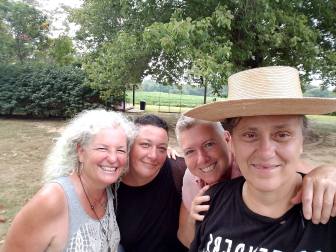
Kim and I with our hosts and new family friends

I’ve known for years and years that on my wife’s, Kim, bucket list was to see a total eclipse of the sun. She began over a year ago researching weather conditions and making reservations, researching camera equipment, buying the special eclipse lens so that she could shoot the sun.

By the time we left on our road trip to visit first our tribe of sister family in the Midwest at an annual gathering, and then to visit various friends, she had four reservations for the eclipse viewing—all in different states. She patiently explained to me (again) that she would be checking weather conditions and “chasing” the eclipse if need be. I understood, because as I said, I’d heard about the eclipse for a while (lol). I knew we’d be making friends with the NASA weather page which I checked continuously for the last two weeks. I would put in the different locations where Kim had made reservations over six months ago, cities near the center line of totality: Illinois, Nebraska, Missouri…then there were cloud predictions in all of those states and it seemed she should have stayed on the west coast and gone to Oregon or Wyoming.   Continue reading “A Total Eclipse of My Heart by Marie Cartier”

When Community Eclipses Polarity by Kay Bee

I recently accepted a new position at my local public library and yesterday the duties of that position happened to include staffing our library’s Eclipse Viewing Party. From about 10am to 1pm, I answered countless questions about the eclipse, helped people of all ages make pinhole projection viewers out of everything from cardstock to saltine crackers, loaded & reloaded NASA’s footage that we live streamed on the big screen, & handed out moon pies. And, of course, encouraged the couple hundred folks who had descended on our little library to be good neighbors and share the fifty pairs of NASA-approved eclipse glasses we’d managed to get our hands on the week prior.

The eclipse was stunning. We were able to experience the temperature drop, the change in the quality of light, and a safe view of the peak of the eclipse, which was at about 80% here in the Four Corners area. But what really struck me about the experience was the spirit of community I witnessed.

Image courtesy of NASA/GSFC/CI Lab

Folks shared eclipse glasses with each other freely, passing them around beyond the friends or family they had come with to people they didn’t necessarily even know. “Did you get to take a look?” was a phrase I heard everywhere I went as I wove through the crowd, helping wherever I was needed. “Here, use these and then pass them on.” Kids broke moon pies together, splitting them into pieces to share with those who hadn’t snagged one before we ran out of those as well. People spotted shadows of the eclipse naturally projected onto the ground or on one gentleman’s white cowboy hat by the sun’s light as it passed between tree leaves and happily showed each other. Elders taught children they didn’t know how to use their pinhole projectors just like they did when they were young. Everyone cheerfully & excitedly helped each other get a different perspective on this moment in time in order to better appreciate the ever-shifting relationship between our Earth, Moon, & Sun.   Continue reading “When Community Eclipses Polarity by Kay Bee”

A Marriage Blessing by Carol P. Christ

Asked the secret of her long and happy marriage, Dorothy Hartshorne, wife of the philosopher Charles Hartshorne, posed a question:  “What do you think you must never do in a marriage?” The young woman thought for a moment and replied, “Never hurt each other?” “Oh no,” Dorothy responded, “you will hurt each other all the time. What you must never do is bore each other.”

In the years since I first heard this story, I have come to understand that a good marriage requires that both partners have their own interests and be willing to share them, and that each partner be interested in at least some of the interests of the other. Happy people share an interest in life in all of its diversity and difference. A person who is interested in life may ask herself why her neighbor is so unhappy and offer an ear to listen to her story. Or he may ask about the birds that come into his garden—learning their names and behaviors, while delighting in their beauty. It doesn’t matter if the things you are interested in are large or small, but you must be interested in life.

Second, each you must be interested in yourself and in your partner. If conflicts are to be resolved, if hurts are to be assuaged, you must always be willing to ask: why was I angered or hurt in this situation, and why did my partner act or react in a particular way? This will not always be easy. Often one of the partners will feel more comfortable talking about feelings. Patience and deep listening may be required of one of you, and moving into unfamiliar territory of the other. If you are not interested in your own feelings and those of the other, your relationship is likely to founder—not only in hurt and anger, but also in boredom.

Dorothy’s husband Charles Hartshorne was fond of saying that the golden rule to love your neighbor as yourself implies that you love yourself. This is wise counsel. We are often told that marriage involves loving another, but less often that it requires loving yourself as well.

As you, Shelby and Mark, enter into marriage, I offer you these blessings:

May you always retain your interest in life.

May love yourself as well as the other.

May you never bore each other.

May you have many long and happy years together.

* * *

 Carol gave this blessing at the wedding of Shelby Carpenter and Mark Miller on August 3, 2017 in Molivos, Lesbos.

a-serpentine-path-amazon-coverGoddess and God in the World final cover design


Carol’s new book written with Judith Plaskow, is  Goddess and God in the World: Conversations in Embodied Theology.

FAR Press recently released A Serpentine Path: Mysteries of the Goddess.

Join Carol  on the life-transforming Goddess Pilgrimage to Crete. Space available on the fall tour.


Sacred Water by Molly Remer

“Drinking the water, I thought how earth and sky are generous with their gifts and how good it is to receive them. Most of us are taught, somehow, about giving and accepting human gifts, but not about opening ourselves and our bodies to welcome the sun, the land, the visions of sky and dreaming, not about standing in the rain ecstatic with what is offered.”

–Linda Hogan in Sisters of the Earth

The women have gathered in a large open living room, under high ceilings and banisters draped with goddess tapestries, their faces are turned towards me, waiting expectantly. We are here for our first overnight Red Tent Retreat, our women’s circle’s second only overnight ceremony in ten years. We are preparing to go on a pilgrimage. I tell them a synopsis version of Inanna’s descent into the underworld, her passage through seven gates and the requirement that at each gate she lie down something of herself, to give up or sacrifice something she holds dear, until she arrives naked and shaking in the depths of the underworld, with nothing left to offer, but her life.

In our own lives, I explain, we face Innana’s descents of our own. They may be as difficult as the death of an adult child, the loss of a baby, the diagnosis of significant illness, or a destroyed relationship. They may be as beautiful and yet soul-wrenchingly difficult as journeying through childbirth and walking through the underworld of postpartum with our newborns. They may be as seemingly every day as returning to school after a long absence. There is value in seeing our lives through this mythopoetic lens. When we story our realities, we find a connection to the experiences and courage of others, we find a pattern of our own lives, and we find a strength of purpose to go on. Continue reading “Sacred Water by Molly Remer”

As We Bless the Source of Life in Midsummer by Carol P. Christ

August 1 is the Neo-pagan and Wiccan holiday known as Lammas. For many witches and pagans this is the time when the young male God identified with the harvest of the seasonal wheat crop is sacrificed in the interest of the larger cycles of birth, death, and renewal. Here in Greece August 15 is a major holiday celebrating the Dormition and Assumption (death and rebirth) of the Panagia, She Who Is All Holy.

In her ground-breaking book The Spiral Dance: A Rebirth of the Ancient Religion of the Goddess, Starhawk identified the ancient religion of the great Goddess with Wiccan tradition defined by the Englishman Gerald Gardner and transmitted to her through her initiation into the Faery (or Feri) tradition of the Americans Victor and Cora Anderson. In her vision, the ancient religion of the great Goddess is understood to be a magical tradition in which spells play a prominent role. Continue reading “As We Bless the Source of Life in Midsummer by Carol P. Christ”

Mulling over Movies: Moana, Pt. 2 by Elise M. Edwards

elise-edwardsEvery summer in the US, movie theatres show their newest big budget films, hoping to draw in large audiences. While I appreciate an air-conditioned theatre on a hot day, I love the opportunity to go to an outdoor movie screening.  These screenings are usually community-oriented opportunities for social gathering.  In my previous post, I talked about Moana, a Disney film I saw at an outdoor screening earlier this summer.  I enjoyed watching this movie with my friends and their families and I was delighted by the story itself.  It has several religious and spiritual themes and strong female characters. Previously, I spoke of the significance of myths in this movie.  Today, I’m focused on depictions of nature in Moana and their remarkable beauty.

Many feminist and womanist theologians and religion scholars have raised concerns about the interrelated dominations of women and nature, as well as the disproportionate hardships women and children are exposed to with increasing climate change and environmental degradation.  Our changing environment affects all life on the planet, but it is the people who are most vulnerable (physically, economically, politically) who at most at risk.  Obviously, animals and plants are endangered, too. Ethicists like me are interested in finding ways to address these concerns because we are committed the preservation of life.  As feminists, there’s more to it, though.  We recognize the way nature itself is often feminized (“Mother Nature”), which makes it even more troubling when it is cultivated without respect for the wellbeing of existing ecosystems and the life forces dependent upon them.

Continue reading “Mulling over Movies: Moana, Pt. 2 by Elise M. Edwards”

Star Tree – Star Goddess by Judith Shaw

judith shaw photo

In a world where humans were small and nature was big, surrounded by forests of trees of immense size and stature, it’s not surprising that the ancient Celts came to hold trees as sacred. Like many others, the Celts revered the World Tree or the Tree of Life as the mythic bridge between heaven and earth. The roots reach down and ground with the Earth while the branches spread their canopy up to the heavens.

Continue reading “Star Tree – Star Goddess by Judith Shaw”