Feminism and My Existentialist Leanings by Xochitl Alvizo

In light of so much destruction in our world – from the violence inside individual homes to beyond and between national borders – how is it still possible to hope for and to live toward a vision of beauty and peace for the world?

It was at a community college in LA in my Psychology 4 class that I first formally encountered existentialism. When it came to the time of the semester to teach on that topic, our professor, Eric Fiazi, came alive in a new way, energetically teaching us about existentialism and Jean-Paul Sartre. Professor Fiazi dramatically gestured and sketched on the board as he explained the concept of ‘nothingness’ and Sartre’s well-known proposition that “existence precedes essence.”  Teaching psychology was for him a means of teaching what he truly loved, art and existentialism. He believed these subjects helped expand students’ horizons and helped make them happy and productive members of society. And so these class sessions were his favorite to teach – and mine to experience. Immediately, I was hooked.

I remember the moment he hit the chalk to the board – leaving a speck of a mark – telling us that the tiny little mark left on the great wide chalkboard was like our galaxy, tiny  against the great vastness of the universe; the earth, a particle of chalk-dust in comparison, and our individual lives, imperceptible in its midst (it now reminds me of Carl Sagan’s pale blue dot monologue). Engaging the students, he countered each one of their assertions that humans indeed have an essence, a meaning. “Humans are good by nature” – “Humans are inherently selfish beings” – “Humans are created in the image of god” – “We are each created for a purpose”; for each of these he gave a clear and logical retort. I was fascinated! What would it mean to live a life with no inherent meaning – with no essence to determine or guide our existence? How might it be different to live my life stripped of any assumed or inherited sense of meaning or purpose – to instead give these up and start from a presupposition of nothingness? Continue reading “Feminism and My Existentialist Leanings by Xochitl Alvizo”

Extending Compassion and Vegetarianism by Xochitl Alvizo

“I did not know to recognize you as individuals when I bought you, but I know to recognize you as individuals now…”

I had been a vegetarian, and sometimes pescatarian, for more than 10 years before becoming vegan. Despite the length of my vegetarianism, in all that time I had not been inclined to go vegan. First, I really didn’t know too much about veganism and only began meeting a few vegans about five or six years ago here in Boston, none of whom had shared a compelling enough reason for their choice (at least not compelling to me). Further, I had no imagination for life without cheese or Cherry Garcia ice cream(!), and so I happily continued with my vegetarian ways. Then enters Carol Adams…

In a teleconference that WATER had with Carol Adams on March 14, 2012  (Women’s Alliance for Theology, Ethics and Ritual), the beauty of her veganism moved me to a new understanding of my food choices. I listened to the WATER audio recording some months after the actual event (these teleconference audio recordings are a great resource you should all access), and although I had been familiar with some of her work and had heard her speak before, I had not heard her talk about the compassion element of veganism. Her emphasis on increasing compassion, which I witnessed in action during her conversation with one of the listeners, was what moved me to my new practice. Continue reading “Extending Compassion and Vegetarianism by Xochitl Alvizo”

Can We Honor Inanna and Her Gifts? by Judith Shaw

Judith Shaw photoSpring has arrived and my garden begins to emerge once more.  The world greens and blooms all around, reminding me that Mother Earth remains constant in Her desire to bless us with Her bountiful abundance. I am also reminded of Inanna and Her love for humanity.

Inanna, Goddess of Heaven and Earth, a Sumerian Goddess who encompasses all aspects of life, was greatly revered by the  people of Uruk as she brought them the gifts of civilization.

Inanna painting by judith shaw
Inanna in Her Boat of Heaven, pastel and beeswax on paper

This part of her story begins when she visits her father, Enki, God of Wisdom.   As they share drinks and a meal, Inanna proceeds to drink Enki under the table.  Once he’s well into His cups He gives Her the sacred me, the gifts of civilization.   Inanna rejoices as she claims these gifts for Her people, gifts such as:
kingship, the divine queen priestess,
the art of the hero, the art of treachery,
the rejoicing of the heart, the art of lovemaking,
the craft of the builder, the perceptive ear,
fear, dismay,
the kindling of fire, the making of decisions.

Continue reading “Can We Honor Inanna and Her Gifts? by Judith Shaw”

A Calling, A Vocation by Elise M. Edwards

Elise Edwards

In my previous post The Feminist Influence, I began discussing what a feminist perspective might bring to a theological study of architecture.  I asserted that a feminist perspective on the ethical function of architecture offers at least two contributions: (1) it provokes questioning about what flourishing is for all peoples and the Earth, and (2) it provokes examination of systems of power and privilege and how they are constructed into our built landscape.  I think a feminist vision of architecture could help all of us (even those of us who are not design professionals) promote design that respects and responds to our environment, addressing the harm we have done.  I do want to give some thought, though, to what it means especially for architects and other design professionals. Continue reading “A Calling, A Vocation by Elise M. Edwards”

For the Love of Gaia by Jassy Watson

For the Love of Gaia Jassy WatsonOn January 26, 2013 a rare, devastating tornado hit our community in Queensland, Australia, a coastal town on this sub-tropical coast. My family experienced nature’s elemental force firsthand and hopefully will never again. The tornado viciously shattered houses, peeled away roofs, uplifted cars and trees, and took down power lines, tearing apart everything in its path. With absolutely no warning, literally out of the blue, it formed over the churning sea, rapidly intensifying before striking land, awakening the vulnerability and fragility of all life in its midst.

When it struck, our four kids and I were waiting in our car while my husband ducked into a mate’s house to borrow a tool. We heard the sound of a roaring jet plane overhead, as my husband came running, screaming at us to get out of the car. Turning to my left, in a vision imprinted forever, a spiral of debris flew toward us. Scrambling, we got the kids out of their harnesses and safely indoors. I lagged behind, taking care of the children first, and fell out of the side door of the van with the wind’s impact. As I got up to run, a large piece of roofing tin flew straight for my head. I dove, seeking safety under the front of our running car. My life flashed before my eyes. All of us in a state of shock, the tornado was gone as quickly as it had come, we were unscathed except for a few minor cuts and bruises. It was only a few moments before the immediate danger passed. We ventured outside to inspect the damage, destruction surrounded us. Continue reading “For the Love of Gaia by Jassy Watson”

The Danger of the Patriarchal Domination Mindset: Can We Do Anything About It? by Thea Iberall

The Danger of the Patriarchal Domination Mindset: Can We Do Anything About It? By Thea Iberall The Swallow and the Nightingale

At the confluence of misogyny, prejudice, homophobia, religious intolerance, environmental destruction, and violence is the patriarchy. We all know this and talk about it here from our own perspectives. I come as a scientist and writer. I have a love of history and science as well as a skill at simplifying complicated things. I abhor what some people are doing to our planet and the arrogance with which they do it. Unfortunately, because we want the stuff they are manufacturing, because there are too many of us, and because we are letting them do it, they do it with our blessings. I want to help change this situation with a novel I’ve been working on for almost 15 years.

In the year 2000, I sat in a dinghy in the caldera of the active underwater volcano at Santorini helping my geologist sister count the bubbles coming from below us. The experiment was part of my father’s research into the origins of life. I had had the seed for a novel thirteen years earlier when I heard Mimi Fariña sing The Swallow Song, talking with her about her deceased husband Richard Fariña and how lost his music has become. I began developing ideas, learning about the nightingale connection and discovering a 12th century Sufi master’s epic allegory about god. Sitting in that dinghy, everything coalesced: the story of how western civilization went off course. My book of contextual poems, The Sanctuary of Artemis, explores the roots of Western patriarchal culture and tells some of it. The novel would have a backdrop of a world collapsing as ornithologist Dr. Deborah Wright is unwittingly guided by the Sufi to figure out why the Capistrano swallows are dying. It would include an underlying history of an egalitarian world lost when this volcano erupted in 1628 BC. Richard Farina’s song would be playing throughout the pages.  Continue reading “The Danger of the Patriarchal Domination Mindset: Can We Do Anything About It? by Thea Iberall”

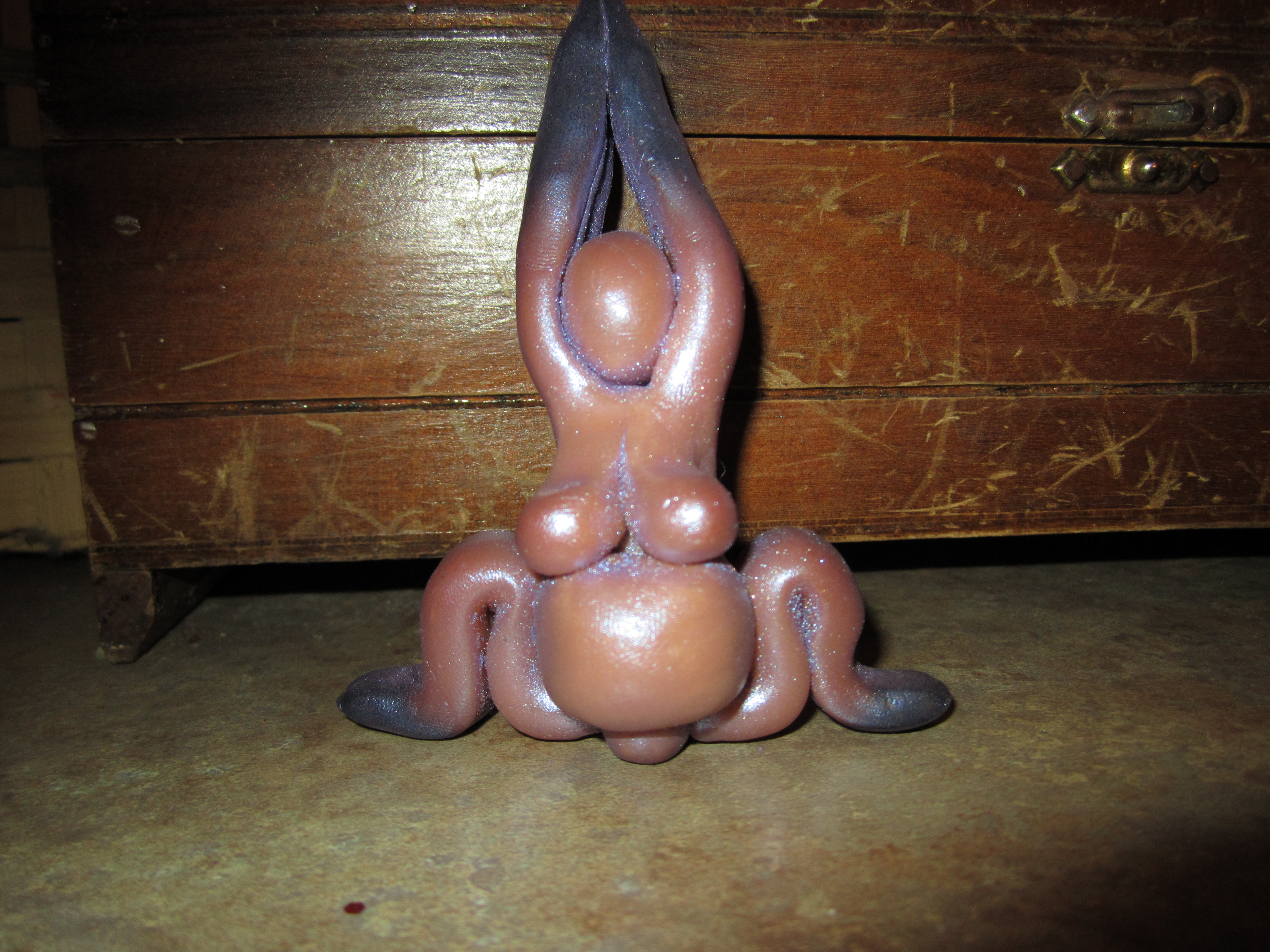
Goddess Mother by Molly

Mamapriestess

She who changes
She who expands and contracts
She who stretches her limits
She who digs deep
She who triumphs and fails
Every day
Sometimes both within a single hour
She who tends her own hearth
She who comforts and connects and enfolds
She who opens wide

She whose heart cracks open at birth
She who tension bunches her shoulders
And lines her face
She who laughs
She who carries the world
She who sings with her sisters
Molly Remer mamapriestess Triple goddessAnd circles in ceremony
She who holds precious her daughters and her sons

She who defends and protects
She who opens her heart just a little wider
She who trusts
She who tries again
She who gathers to her breast
She who gathers women in ritual
She who hopes
Prays
Fears
She who loves so deeply
That it crosses all boundaries
To eternity. Continue reading “Goddess Mother by Molly”

Do Women’s Circles Actually Matter? By Molly

“We need rituals of memory…because a political movement, the public policy and tactics of our movement, does not come from our ideas, but from the bloody and joyful substance of our lives. We need to be conscious about what our lives have been, to grieve and to honor our strength, in order to break out of the past into the future.” –Minnie Bruce Pratt

I’ve been feeling depressed and discouraged lately after reading some really horrifying articles about incredible, unimaginable violence and brutality against women in Papua New Guinea who are accused of being witches as well as a book about human trafficking around the world (I wrote about this book in a recent post for Pagan Families). Then, I finished listening to David Hillman on Voices of the Sacred Feminine, in which he issued a strong call to action to the pagan community and to “witches” in the U.S. to do something about this violence, essentially stating that it is “your fault” and that rather than spending energy on having rituals to improve one’s love life (for example), modern witches should be taking to the streets and bringing abusers to justice. And, he asserts, the fact that they don’t, shows that they don’t really “believe”—believe in their own powers or in their own Goddess(es). Continue reading “Do Women’s Circles Actually Matter? By Molly”

Blessed By Gratitude and Sharing by Xochitl Alvizo

Incarnation, Goddess spirituality, Xochitl Alvizo,  god became fleshCarol Christ’s post yesterday has gotten me thinking about the differences between Christianity and earth-based spiritualities. Of course, there are many differences, that goes without saying. However, being someone who comfortably stands at the intersection of them both I am usually more aware of the ways in which they seem to intersect in life-changing and inspiring ways for me. Nonetheless, Carol has me thinking…

Over the course of the last year here on Feminism and Religion, Carol has written a lot about the importance of ancestors – how when speaking about embodiment and interdependence it is crucial we acknowledge all the ways in which ancestors make us who we are. Mothers literally give us our bodies and our ancestors’ genes, connecting us to a long line of people both materially/biologically as well as historically. Ancestors give us a sense of connection to places and ground us to lands that were meaningful to them and thus become meaningful to us. And Carol also reminds us that our family and ancestors transmit to us memories that impact us psychically and in powerful ways. These emphases on connection, interdependence, rootedness, and embodiment flow from her earth-based Goddess practice and thealogy. Her spirituality leads her to a greater sense of appreciation and gratitude for the Source of Life and for all the sources of life, and she affirms that because of this deep awareness of interdependence and relationality people who practice earth-based spiritualities are “moved to share what has been given to [them] with others.” Continue reading “Blessed By Gratitude and Sharing by Xochitl Alvizo”

We Are All Earthings: Speciesism and Feminist Responsibility Toward Animals by Amy Levin

Amy2“earth’ling: n. One who inhabits the earth.” – Earthlings, 2006

“We need another and a wiser and perhaps a more mystical concept of animals. Remote from universal nature, and living by complicated artifice, man in civilization surveys the creatures through the glass of his knowledge and sees thereby a feather magnified and the whole image in distortion.” -Henry Beston, The Outermost House

I was passing out leaflets at Columbia University a couple weeks back, when a passerby who took a pamphlet on veganism and the cruel uses of animals turned back around to approach me. He said, “I am a vegetarian, so I understand not eating meat. But what is wrong with some of the uses of these animals? What is wrong with seeing eye dogs?”  A valid question indeed, and one I had to pause for a moment to answer. I mustered up something along the lines of the ways that many of the seeing eye dogs in the industry are unfairly treated or neglected. “Oh, he said.” He seemed content with an answer he could relate to – suffering. In my experience leafleting and participating in animal rights advocacy, I receive a number of questions, many of them wanting to know the same thing, what is WRONG with the horse-drawn carriages at Central Park? And each time I (and I presume many other activists) offer similar answers, the suffering answer. But there is another layer, beyond the quick, violent spark of imagination that connects physical pain with empathy. And it has to do with power and structural inequality, and the use of one group for the benefit of another. And it has everything to do with feminism. Continue reading “We Are All Earthings: Speciesism and Feminist Responsibility Toward Animals by Amy Levin”