What is the Nature of the Hope that Can Trump Despair in the New Year? by Carol P. Christ

carol-christ“All hope abandon, ye who enter here.” These words posted on the gates of hell in Dante’s Inferno have an eerie resonance in our time. 

Marie Cartier recently posted a blog on children and hunger with facts so devastating I could not finish reading it. Earlier in the month Jassy Watson wrote about her deep feelings of grief on hearing Luisah Teish’s “Prayer for Disappearing Species.” Grief, despair, and sadness about the injustices in our world can be overwhelming.

A friend of mine has recently fallen into a deep depression. When I try to talk her out of it, she repeats that they are threatening to cut down the last remaining old growth forest in her home state of Oregon and that she can no longer eat fish because radioactivity released in the Fukishima nuclear plant disaster is reaching the seacoast of Oregon.

When I tell my friend she should not dwell only on these things and that she must remember that the world is still a beautiful place, she responds, “I do not want to give up my feelings. I know I must find a way to acknowledge my sadness and make a place for joy, but I don’t know how to do it.”

I have been in the grip of deep grief about the planet myself, not once but many times. But this happens less frequently than it used to.  When I think about the differences between how I once felt and how I feel now, I think the difference is that I have come to terms with and accepted the likelihood that “the world as we know it” is “going to hell in a handbasket”—as I put it.

I believe that the most likely conclusion of the choices human beings are making on planet earth today is massive environmental destruction leading to great suffering and probable extinction for human and many other species on planet earth. This is what I believe, but I also remind myself that I cannot know for sure. The earth and its species including human beings may have resources of resistance and survival, transformation and adaptation,that I do not know about and cannot imagine.

When I began to accept that the world I know and love (where spring follows winter, where birds sing, and where there is hope that injustice can be rectified) may not exist in the very near future, I had an astonishing insight. The death of the world I know and love will not mean the death of our planet or the end of the evolution of the universe.

Thinking about the disappearance of species and the death of human beings from starvation often feels too much to bear. None of this should be happening. Still, it can be strangely comforting to remind myself that the world I love is not the only possible world. There have been other worlds on this very planet—the time when the first cells were formed, the time of the dinosaurs, and many others. Evolution will continue on planet earth for several billion more years, and when our sun burns out, other suns will most likely still be shining in the universe.

This insight was followed by another. The reason for hope is not the conviction that we will be able to save the world we love. The reason for hope—and the reason to keep trying to save our world—is the deep knowing that it is right to try. Even if we cannot save the world we love for all time, we can savor the gift of life, and we can continue to try to create a world in which the gift of life is shared widely today and tomorrow.

I have written many times that we must learn to love a life that ends in death. I was speaking about accepting that each one of us will surely die. I do not fear death. Overcoming this fear has opened me to a greater and more clear-sighted love for life.

Can we learn to love life while accepting that the world we love may be dying? Can we continue to work to improve the conditions of life for individuals and species knowing that the world as we love it may not survive? Do we have any other choice?

For me the hope that can trump despair in our time begins in gratitude for a life that has been given to us, a life that has come down to us through the generations, and through billions of years of the evolutionary process on our planet.

Let us bless the Source of Life.

Let us bless the Source of Life, and the cycles of birth, death, and regeneration.

Let us turn back from despair.

Let us embrace the gift of life and share it with as many others as possible in the new year.

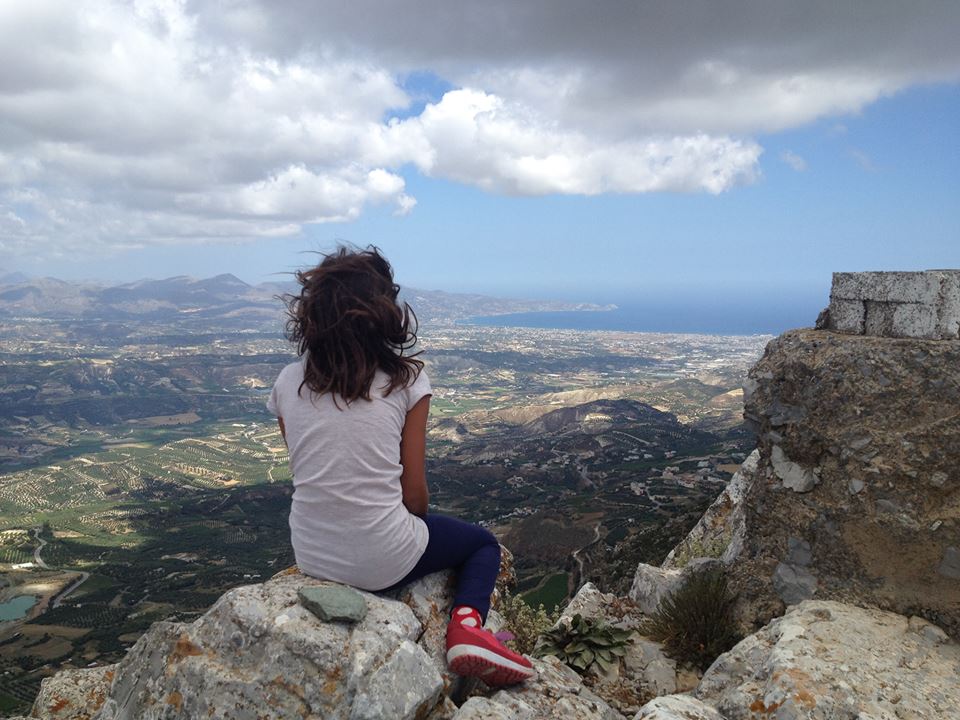
Carol P. Christ  learned to be grateful for the gift of life in Crete on the Goddess Pilgrimage to Crete she leads through Ariadne Institute.  It is not too early to sign up for the spring or fall pilgrimages for 2014.  Carol can be heard on a WATER Teleconference.  Carol’s books include She Who Changes and Rebirth of the Goddess and the widely-used anthologies Womanspirit Rising and Weaving the Visions. She wishes you great joy in the new year.

ETHICS OF INDIVIDUAL RIGHTS AND CARE SENSITIVE ETHICS IN THE CONTEXT OF THE GAY MARRIAGE DEBATE by Carol P. Christ

carol-christIs care the beginning of ethics? Has traditional western ethical thinking been wrong to insist that in order to reason ethically, we must divorce reason from emotion, passion, and feeling?

In Ecofeminist Philosophy, Karen Warren criticizes traditional ethical thinking–advocating a “care-sensitive” approach to ethics.  Traditional ethics, as Warren says, are based on the notion of the individual rights of rational moral subjects. Like so much else in western philosophy traditional ethics are rooted in the classical dualisms that separate mind from body, reason from emotion and passion, and male from female.  In addition to being based in dualism, western philosophy focuses on the rational individual, imagining “him” to be separable from relationships with others.  Western ethics concerns itself with the “rights” of “rational” “individuals” as they come into relationship or conflict with the “rights” of other “rational” “indiviudals.”

Those who would think ethically are advised to “rise above” the “emotions” and “passions” or “feelings” of the body, in order to reason dispassionately about the rights and responsibilities of rational individuals.  According to this theory, emotions and passions “get in the way” of rational thinking.  Continue reading “ETHICS OF INDIVIDUAL RIGHTS AND CARE SENSITIVE ETHICS IN THE CONTEXT OF THE GAY MARRIAGE DEBATE by Carol P. Christ”

WANGARI MUTA MAATHAI AND SACRED MOUNT KENYA by Carol P. Christ

carol-christWangari-Maathai-1September 25, 2013 is the second anniversary of the death of environmental, peace, justice, and democracy advocate and Nobel Peace Prize recipient Wangari Muta Maathai.

Wangari Muta was born in 1940 in a round hut in rural tribal Kenya.  Wangari’s tribe considered the fig tree to be holy, and she was taught that one is never to cut a fig tree down or to use its branches for firewood.  Wangari spent many happy childhood hours in the shade of a fig tree that grew by a nearby stream.  Fig trees play an important role in the ecological system of the Rift Valley of Kenya.  Their roots penetrate the hard rock surface of the mountains to find underground water, thus opening channels where the water flows upward to fill streams and rivers.

As an adult Maathai learned that the fig tree she played under had been cut down by a settler with the result that the river had dried up.  This was happening all over Kenya on a massive scale to make room for cash crop plantations.  Rivers were silting up and widespread erosion threatened to turn the fertile Rift Valley into a desert. Crops were failing, animals were starving, there was no wood for cooking fires, and rural people were suffering.

Maathai  says that as she was thinking about this problem “It just came to me: ‘Why not plant trees?’ … This is how the Green Belt Movement began.”  Continue reading “WANGARI MUTA MAATHAI AND SACRED MOUNT KENYA by Carol P. Christ”

Birth Warrior by Molly

editMollyNov 083“In this culture…a woman can be made to feel foolish for emphasizing the centrality of giving birth to her identity or her personal religiousness, her ‘womanspirit…’” –Stephanie Demetrakopoulos (Listening to Our Bodies)

After the birth of my daughter in 2011, I received a small package from a Birthing from Within mentor friend. In it was a sweet little t-shirt imprinted with the words, My Mama is a Birth Warrior. The words on the shirt surrounded a labyrinth image, which I love as a metaphor for birth and life

Written on the enclosed card was the following:

Imagine a tribe in which a woman is prepared for childbirth in the same way warriors are prepared for battle. Imagine a Ceremony for this woman before she gives birth, a grand send-off with holy songs and fire. Imagine a feast, prepared just for her.

Her tribe tells her, they say to her “Go to your journey, you have prepared. We have prepared you. If you fall from your horse once or a hundred times, it does not matter. All that matters is that you come back to us, that you come home.

Throughout your journey–your labyrinth of Great Love, Great Determination, Great Faith and Great Doubt—you rode on!

The Great Tribe of Mothers welcomes you back from your birth journey with honor.

Modeling her little t-shirt.

Imagine, indeed. After I read this note I reflected that I did feel I embarked on a mighty journey during my last pregnancy, I did pass through those Gates, and I did ride on. I AM a birth warrior!  Continue reading “Birth Warrior by Molly”

Eco-Theology and the Dave Matthews Band by Gina Messina-Dysert

Gina Messina-Dysert profileFeminist theologian Sallie McFague argues that we must give the earth the attention it is due and recognize its subjectivity rather than having an arrogant viewpoint that assumes we have the right to control the planet.  She states that by refusing to accept our place on earth we are sinning.  I think it is fair to say that the Dave Matthews Band has a perspective that is similar to McFague’s.  Song after song offers lyrics that acknowledge the earth as our holy Mother and demands that we recognize our place in the ecosystem and our personal responsibility for its continuation.  For instance, “One Sweet World” calls us to be cognizant of the fact that without the wonders of nature we would be unable to sustain ourselves.  We have taken the earth for granted and yet our very survival is dependent on the wellbeing of our planet.  In this song, DMB ponders the question “if the green should slip to gray, would our hearts still bloody beat?”

Continue reading “Eco-Theology and the Dave Matthews Band by Gina Messina-Dysert”

Feminism and My Existentialist Leanings by Xochitl Alvizo

In light of so much destruction in our world – from the violence inside individual homes to beyond and between national borders – how is it still possible to hope for and to live toward a vision of beauty and peace for the world?

It was at a community college in LA in my Psychology 4 class that I first formally encountered existentialism. When it came to the time of the semester to teach on that topic, our professor, Eric Fiazi, came alive in a new way, energetically teaching us about existentialism and Jean-Paul Sartre. Professor Fiazi dramatically gestured and sketched on the board as he explained the concept of ‘nothingness’ and Sartre’s well-known proposition that “existence precedes essence.”  Teaching psychology was for him a means of teaching what he truly loved, art and existentialism. He believed these subjects helped expand students’ horizons and helped make them happy and productive members of society. And so these class sessions were his favorite to teach – and mine to experience. Immediately, I was hooked.

I remember the moment he hit the chalk to the board – leaving a speck of a mark – telling us that the tiny little mark left on the great wide chalkboard was like our galaxy, tiny  against the great vastness of the universe; the earth, a particle of chalk-dust in comparison, and our individual lives, imperceptible in its midst (it now reminds me of Carl Sagan’s pale blue dot monologue). Engaging the students, he countered each one of their assertions that humans indeed have an essence, a meaning. “Humans are good by nature” – “Humans are inherently selfish beings” – “Humans are created in the image of god” – “We are each created for a purpose”; for each of these he gave a clear and logical retort. I was fascinated! What would it mean to live a life with no inherent meaning – with no essence to determine or guide our existence? How might it be different to live my life stripped of any assumed or inherited sense of meaning or purpose – to instead give these up and start from a presupposition of nothingness? Continue reading “Feminism and My Existentialist Leanings by Xochitl Alvizo”

Extending Compassion and Vegetarianism by Xochitl Alvizo

“I did not know to recognize you as individuals when I bought you, but I know to recognize you as individuals now…”

I had been a vegetarian, and sometimes pescatarian, for more than 10 years before becoming vegan. Despite the length of my vegetarianism, in all that time I had not been inclined to go vegan. First, I really didn’t know too much about veganism and only began meeting a few vegans about five or six years ago here in Boston, none of whom had shared a compelling enough reason for their choice (at least not compelling to me). Further, I had no imagination for life without cheese or Cherry Garcia ice cream(!), and so I happily continued with my vegetarian ways. Then enters Carol Adams…

In a teleconference that WATER had with Carol Adams on March 14, 2012  (Women’s Alliance for Theology, Ethics and Ritual), the beauty of her veganism moved me to a new understanding of my food choices. I listened to the WATER audio recording some months after the actual event (these teleconference audio recordings are a great resource you should all access), and although I had been familiar with some of her work and had heard her speak before, I had not heard her talk about the compassion element of veganism. Her emphasis on increasing compassion, which I witnessed in action during her conversation with one of the listeners, was what moved me to my new practice. Continue reading “Extending Compassion and Vegetarianism by Xochitl Alvizo”

Can We Honor Inanna and Her Gifts? by Judith Shaw

Judith Shaw photoSpring has arrived and my garden begins to emerge once more.  The world greens and blooms all around, reminding me that Mother Earth remains constant in Her desire to bless us with Her bountiful abundance. I am also reminded of Inanna and Her love for humanity.

Inanna, Goddess of Heaven and Earth, a Sumerian Goddess who encompasses all aspects of life, was greatly revered by the  people of Uruk as she brought them the gifts of civilization.

Inanna painting by judith shaw
Inanna in Her Boat of Heaven, pastel and beeswax on paper

This part of her story begins when she visits her father, Enki, God of Wisdom.   As they share drinks and a meal, Inanna proceeds to drink Enki under the table.  Once he’s well into His cups He gives Her the sacred me, the gifts of civilization.   Inanna rejoices as she claims these gifts for Her people, gifts such as:
kingship, the divine queen priestess,
the art of the hero, the art of treachery,
the rejoicing of the heart, the art of lovemaking,
the craft of the builder, the perceptive ear,
fear, dismay,
the kindling of fire, the making of decisions.

Continue reading “Can We Honor Inanna and Her Gifts? by Judith Shaw”

A Calling, A Vocation by Elise M. Edwards

Elise Edwards

In my previous post The Feminist Influence, I began discussing what a feminist perspective might bring to a theological study of architecture.  I asserted that a feminist perspective on the ethical function of architecture offers at least two contributions: (1) it provokes questioning about what flourishing is for all peoples and the Earth, and (2) it provokes examination of systems of power and privilege and how they are constructed into our built landscape.  I think a feminist vision of architecture could help all of us (even those of us who are not design professionals) promote design that respects and responds to our environment, addressing the harm we have done.  I do want to give some thought, though, to what it means especially for architects and other design professionals. Continue reading “A Calling, A Vocation by Elise M. Edwards”

For the Love of Gaia by Jassy Watson

For the Love of Gaia Jassy WatsonOn January 26, 2013 a rare, devastating tornado hit our community in Queensland, Australia, a coastal town on this sub-tropical coast. My family experienced nature’s elemental force firsthand and hopefully will never again. The tornado viciously shattered houses, peeled away roofs, uplifted cars and trees, and took down power lines, tearing apart everything in its path. With absolutely no warning, literally out of the blue, it formed over the churning sea, rapidly intensifying before striking land, awakening the vulnerability and fragility of all life in its midst.

When it struck, our four kids and I were waiting in our car while my husband ducked into a mate’s house to borrow a tool. We heard the sound of a roaring jet plane overhead, as my husband came running, screaming at us to get out of the car. Turning to my left, in a vision imprinted forever, a spiral of debris flew toward us. Scrambling, we got the kids out of their harnesses and safely indoors. I lagged behind, taking care of the children first, and fell out of the side door of the van with the wind’s impact. As I got up to run, a large piece of roofing tin flew straight for my head. I dove, seeking safety under the front of our running car. My life flashed before my eyes. All of us in a state of shock, the tornado was gone as quickly as it had come, we were unscathed except for a few minor cuts and bruises. It was only a few moments before the immediate danger passed. We ventured outside to inspect the damage, destruction surrounded us. Continue reading “For the Love of Gaia by Jassy Watson”