A Celebration of Gender Studies for the First Night of Ḥanukah.

On the 21st of November, I took part in a faculty panel as part of the 20th anniversary celebration of the Gender Studies Master’s Program, the program in which I teach, at the Faculty of Humanities (FHS) at Charles University in Prague, Czech Republic.  The event featured the afore-mentioned faculty panel, a panel of program graduates, and an invited lecture entitled “Care as Taking Part,” by Prof. Estelle Ferrarese of the Institut Universitaire de France, organized in cooperation with CEFRES and CETE-P.  After the formal part of the program, we all enjoyed refreshments and socializing with current and former students, faculty, and staff.

Perhaps the reader of this blog has not heard about the existence of a Gender Studies Master’s Program in the heart of Central Europe.  I would like to take some time in my post this month to explain what we do and why we are, in the spirit of Ḥanukah, bringing more light into the world.

Continue reading “A Celebration of Gender Studies for the First Night of Ḥanukah.”
Let’s Have The Talk – What Does “The Birds and The Bees” Actually Mean: By Zoe Carlin

Recently, I have thought about a common idiom that has been used to refer to sexual reproduction, the birds and the bees. I became curious why animals that appear in most gardens were used as an example to explain where babies come from, until I did some research. It turns out that since the birds lay eggs, that is their representation of the female body and the bees represent the sperm due to pollination. It is a very subtle, overlooked message that can be disguised as being more age-appropriate to young children. However, I decided to dig a bit deeper. Ed Finegan, a USC professor of linguistics and law, has stated that this phrase has existed a lot longer than one might think. There is evidence of it being used in a somewhat sexual context going back to at least two authors, Samuel Coleridge Taylor (1825) and an entry from John Evelyn’s The Evelyn Diary (1644). 

In Work Without Hope, Samuel Coleridge Taylor quotes, “All nature seems at work . . . The bees are stirring, birds are on the wing . . . and I the while, the sole unbusy thing, not honey make, nor pair, nor build, nor sing.” This separation of the birds and bees is indicating the loneliness and sadness of missing out on a potential romantic connection. When going even further back in time to 1644, it was noticed in the Evelyn Diary that there was an entry discussing the interior design of St. Peter’s in Rome: “That stupendous canopy of Corinthian brasse; it consists of 4 wreath’d columns, incircl’d with vines, on which hang little putti [cherubs], birds and bees.” This description is illustrating that there is a possible sensual or sexual meaning of the architecture in St. Peters.

Continue reading “Let’s Have The Talk – What Does “The Birds and The Bees” Actually Mean: By Zoe Carlin”

BOOK REVIEW: Religion is Not Done With You by Esther Nelson

Goodwin, Megan and Ilyse Morgenstein Fuerst, Religion Is Not Done With You: Or, The Hidden Power of Religion on Race, Maps, Bodies, and Law. Boston, Massachusetts, Beacon Press, 2024, 165 pages.

If I were still teaching university classes in Religious Studies, I would certainly choose Goodwin and Fuerst’s book as an introduction to this broad, often misunderstood, subject we call religion. Their writing style has a youthful familiarity—probably purposively done—to broaden their reach to all audiences.  The theme running throughout their work is religion is what people do.”  “Religion isn’t just feelings or beliefs—it’s systems and assumptions…that shape our lives every day.”

Both authors have master’s degrees and doctorates in religion. Goodwin focuses on gender, sexuality, and American religions.  Fuerst puts her attention on Islam, race and racialization, and South Asia.  Both women claim to be religious people who “care about justice and repairing our broken world.”  They understand that “religion is a force for change—not always bad, not inherently good, but always changed and changing.”  It’s important, they assert, “to call out bullshit takes on religion: takes that insist religion is always and everywhere good and takes that want to write religion off as irrelevant, irrational, or regressive.”

Continue reading “BOOK REVIEW: Religion is Not Done With You by Esther Nelson”

From the Archives: Writing: Changing the World and Ourselves. By Ivy Helman

This was originally posted on October 12, 2014

20140903_180423

I still remember the first time I read Mary Daly’s Gyn/Ecology. It awoke something within me. Her use of language, the power of her writing and the ease with which she created new words taught me so much about the world around me and about the way the language, and subsequently its use in writing, shapes lives, choices, abilities and destinies. She also taught me about myself.

I was hooked, but not just on Mary Daly. Shortly after I finished her book, I moved onto other feminists writing about religion like Katie Cannon, Judith Plaskow, Alice Walker, Carol Christ, Rita Gross, Gloria Anzaldua, Audre Lorde, Adrienne Rich, Margaret Farley and Starhawk to name just a few. All of them, in fact every feminist I’ve ever read, has shown me the way in which words have power and how words speak truth to power. Ever since, I’ve wanted to be the kind of writer whose words carry a power that not only affects people but also inspires a more just, more equal, more compassionate and more humane world. In other words, I wanted to be a writer activist.

Continue reading “From the Archives: Writing: Changing the World and Ourselves. By Ivy Helman”

Children Are The Future by Judith Shaw

If the saying “Children are the future” is true, then it must also hold true that exposing children to a worldview which supports a loving world is important. Authors, illustrators, animators, musicians, and film and tv producers are hard at work creating stories that nurture children’s capacity to follow their dreams, to share, to resolve conflict peacefully, and to love and accept themselves and others. 

Continue reading “Children Are The Future by Judith Shaw”

Label or Be Labelled Part 3: Toward Embodied Presence

In Part 1 of this series on labelling, I highlighted the difference between naming and labelling, and the search for a personal label as ‘participation ticket’ for life.

In Part 2 on professional and spiritual identity, I looked at what we can learn from the autoethnographic practice of disclosing various selves in research situations. I also discussed the effects of Christianity on the suppression of pagan traditions in northwestern Europe, and nature-based spirituality as part of our generic spiritual DNA.

Today I share a few final reflections including what groups celebrate their differences with ‘prides and games’, and which ones remain invisible? What are the effects of woke ideology on fear of expression and loss of voices, and an invitation for embodied presence as one characteristic of our shared humanity.

Continue reading “Label or Be Labelled Part 3: Toward Embodied Presence”

Label or Be Labelled Part 2: Professional and spiritual identity

This post continues from Part 1, where I situated this essay as a reflection on Xochitl Alvizo’s article Human, Just HumanThere, I questioned the difference between the power of naming versus the pressure to label. I then described my search for a personal identifier as ‘participation ticket’ to life. This feels important nowadays to join the conversation and not be dismissed by default. However, I wondered whether looking for things that set us apart emphasises otherness rather than shared humanity.

Today, I question what can we learn from autoethnography about the many selves we bring to different professional situations and how they might hide more than they reveal. I also describe the challenges of naming nature-based practices in a geographical area where 2000 years of Christianity forced our pagan traditions underground.

Continue reading “Label or Be Labelled Part 2: Professional and spiritual identity”

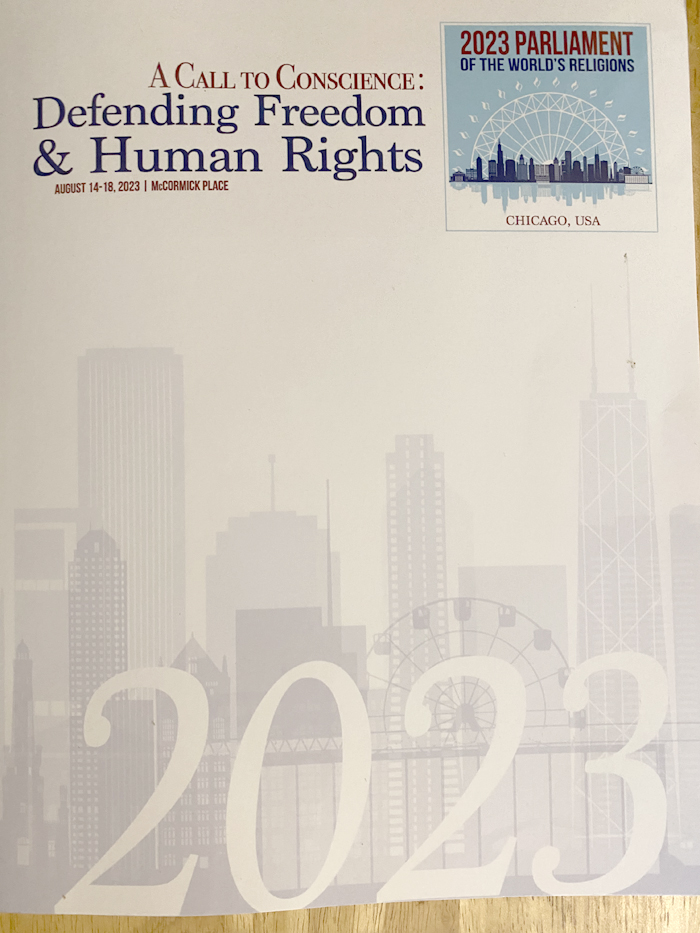
Snapshots from the Parliament of World Religions by Janet Maika’i Rudolph

The Parliament of World Religions ran from Aug 14th to the 18th  in Chicago.  I returned with my head spinning having met new people, connected with inspiring beliefs, discussed fascinating ideas, watched meaningful performances, engaged in sacred play, danced, sang, cried, ate, and mostly experienced . . . just experienced. It is still overwhelming to sort out individual experiences. I am going to write up a few of my impressions, snapshot style. They scratch the surface, not only of my individual experience but of the Parliament in general where upwards of 7,000 people attended. It was incredible

Setting the tableau: As I was going down the escalator, a woman was followed by 2 groups were heading up. The woman was beautiful and young in full Mayan dress with white blouse, long orange skirt along with headdress and belt with Mayan symbols. Her thick dark hair was flowing down her back.

She was followed by five Sikh men who were dressed head to foot in white. Their heads and hair were covered by white turbans.

They were followed by two Buddhist nuns dressed in grey robes carrying beads. Their heads were shaved.

Such scenes were common.

Continue reading “Snapshots from the Parliament of World Religions by Janet Maika’i Rudolph”

The Pleasure of Education and New Beginnings

BUT GOD/DESS—it is also enjoyable, passionate, and fun. Learning and teaching is fun; and I love having fun with my students. Even when the topics are hard and when the lessons hurt, it is the pleasure of relatedness to them, to text, to new understanding that facilitates the process. And without that pleasure, the work is unsustainable.

In graduate school, I fell in love with the book Teaching to Transgress by bell hooks. My memory of what I specifically loved about that book has blurred over time, particularly as I read more and more of her work. But what remains is a sense of how challenging and how real the writing was—how inclusive of whole experiences and truths, comfortable and uncomfortable.

hooks doesn’t shy away from the pain or pleasure of education, indicating how learning and those we learn from can induce passion: Audre Lorde’s erotic, which is so hard to distinguish from the sexual because, as Lorde explains, we are taught to limit our sense of the erotic to the sexual or pornographic.

Continue reading “The Pleasure of Education and New Beginnings”

Gratitude

This is a privilege of being a teacher: to walk along the side, to journey with another while he (she/they) navigates his (her/their) own road, to see how far he (she/they) has come.
And I am so grateful for it.

I hooded my first graduate advisee this week; and I am so happy for him. My student worked hard for over a year; and as the date for his final draft submission approached, I was privileged to witness his growing excitement and pride. I felt my own growing pride. Over that year, I had talked about my advisee many times with my family, “going to a meeting with so and so again,” “so and so sent me an updated draft that I need to get to” etc., so much so that on the day of his defense my older sister said she was crossing her fingers for him and my brother asked me if I’d told him that they were rooting for him. I hadn’t; though clearly working with this man had touched me in a way that also touched them.

This is a privilege of being a teacher: to walk along the side, to journey with another while he (she/they) navigates his (her/their) own road, to see how far he (she/they) has come.
And I am so grateful for it.

Continue reading “Gratitude”