

Today the hawk is back, tail feathers lit gold and black by a bright and welcome sun. It stays only a moment before tilting out of the tree and continuing on its way, but this moment is enough to spark a sense of joy and wonder in my chest, the awake kind of glee that fuels and feeds me, that inspires and holds me. This feels like the Year of the Hawk to me, of clear focus and intentional commitment. I watch it glide away between the trees and take a deep breath of release and freedom. I re-center myself into my body and reconnect to the sacred What Is. I am open to clarity. I am open to trust. I am present with this day’s unfolding.
Continue reading “Listening to Our Landscapes, by Molly Remer”Category: Embodiment
A Recipe for Dancing Your Soul Home
When you hear the word ‘soul’, what is your first association?
Soul is a complex and much-debated word, that often brings up strong feelings. Without going into religious or philosophical discourse, it is often associated with the breath, and with that mysterious spark of life force that animates the body. I discussed soul in a previous post Untangling the Triad of Life Force, Spirit and Soul. Today I write about soul as a fluid concept, an essence that can get dispersed and also retrieved, and propose a light self-retrieval through dance as remedy that you can do by yourself.
Continue reading “A Recipe for Dancing Your Soul Home”Legacy of Carol P. Christ: As It Might Have Been: Ancestor Stories in the Dreamtime
This was originally posted January 9, 2017
In the middle of the night in waking sleep, I asked my great-great grandmother Annie Corliss to tell me the story of how she met and married James Inglis. This story came through me in a place I have come to call the Dreamtime. The Aboriginal term feels right. As I understand it, this is not a place where the dead speak to the living but rather a space where boundaries blur as the ancestors speak in us.
Annie Corliss’s Story: As It Might Have Been
Continue reading “Legacy of Carol P. Christ: As It Might Have Been: Ancestor Stories in the Dreamtime”Label or Be Labelled Part 3: Toward Embodied Presence
In Part 1 of this series on labelling, I highlighted the difference between naming and labelling, and the search for a personal label as ‘participation ticket’ for life.
In Part 2 on professional and spiritual identity, I looked at what we can learn from the autoethnographic practice of disclosing various selves in research situations. I also discussed the effects of Christianity on the suppression of pagan traditions in northwestern Europe, and nature-based spirituality as part of our generic spiritual DNA.
Today I share a few final reflections including what groups celebrate their differences with ‘prides and games’, and which ones remain invisible? What are the effects of woke ideology on fear of expression and loss of voices, and an invitation for embodied presence as one characteristic of our shared humanity.
Continue reading “Label or Be Labelled Part 3: Toward Embodied Presence”Label or Be Labelled Part 2: Professional and spiritual identity
This post continues from Part 1, where I situated this essay as a reflection on Xochitl Alvizo’s article Human, Just Human. There, I questioned the difference between the power of naming versus the pressure to label. I then described my search for a personal identifier as ‘participation ticket’ to life. This feels important nowadays to join the conversation and not be dismissed by default. However, I wondered whether looking for things that set us apart emphasises otherness rather than shared humanity.

Today, I question what can we learn from autoethnography about the many selves we bring to different professional situations and how they might hide more than they reveal. I also describe the challenges of naming nature-based practices in a geographical area where 2000 years of Christianity forced our pagan traditions underground.
From the Archives: Rosh Hashanah and the Goddess by Joyce Zonana
Moderator’s Note: This was originally posted on Rosh Hashanah Sept 10, 2015. Rosh Hashanah this year begins on Sept. 15th but FAR will be taking a 16 day hiatus at that time so we are posting today.
When I was growing up in the 1950s in my Egyptian Jewish immigrant
My father, an Orthodox man who prayed each morning and went regularly to the local Sephardic synagogue in Brooklyn, privately followed the tenets of his faith. But it was my mother, unconsciously devout, who brought the public rituals of our religion to life. As a child, I longed to be at prayer with my father and was envious of the men and boys who studied and recited the sonorous ancient Hebrew; I did not want to be confined to polishing the silver and setting the table. But today, as an adult, I am grateful for the silent teachings bequeathed to me by my mother.
Continue reading “From the Archives: Rosh Hashanah and the Goddess by Joyce Zonana”From the Archives: Sacred Water by Molly Remer
This was originally posted on August 9, 2017
“Drinking the water, I thought how earth and sky are generous with their gifts and how good it is to receive them. Most of us are taught, somehow, about giving and accepting human gifts, but not about opening ourselves and our bodies to welcome the sun, the land, the visions of sky and dreaming, not about standing in the rain ecstatic with what is offered.”
–Linda Hogan in Sisters of the Earth
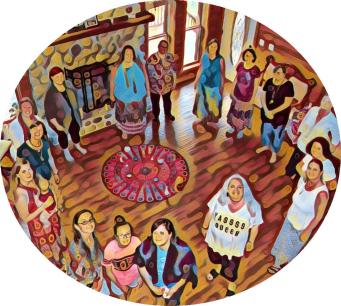
The women have gathered in a large open living room, under high ceilings and banisters draped with goddess tapestries, their faces are turned towards me, waiting expectantly. We are here for our first overnight Red Tent Retreat, our women’s circle’s second only overnight ceremony in ten years. We are preparing to go on a pilgrimage. I tell them a synopsis version of Inanna’s descent into the underworld, her passage through seven gates and the requirement that at each gate she lie down something of herself, to give up or sacrifice something she holds dear, until she arrives naked and shaking in the depths of the underworld, with nothing left to offer, but her life.
Continue reading “From the Archives: Sacred Water by Molly Remer”Legacy of Carol P. Christ: Transcendence, Immanence, and the Sixth Great Extinction
This was originally posted August 4, 2014

In my recent blog “The Flourishing of Life and Feminist Theology” I discussed Grace Jantzen’s view that theology should focus on “natality” or birth and life, rather than life after death or life apart from this world. This week Tikkun magazine published its summer issue with a feature called “Thinking Anew about God.” In it two male thinkers, one Buddhist and one Christian, argue for a similar turn toward the world in their traditions. Their calls for religions to focus on this world were published the same week scientists warned that the world stands on the brink of the sixth great extinction.
I have come to believe that any religion espousing cosmological dualism (devaluing this world in favor of a superior reality such as heaven) and individual salvation (the idea that what ultimately happens to me is disconnected from what ultimately happens to you) is contributing to our world’s problems rather than offering a solution. … [Religions should] stop emphasizing the hereafter and focus instead on how to overcome the illusion that we are separate from this precious, endangered earth. –David Loy, Buddhist, writing in Tikkun Summer 2014
Continue reading “Legacy of Carol P. Christ: Transcendence, Immanence, and the Sixth Great Extinction”Legacy of Carol P. Christ: The Flourishing of Life and Feminist Theology
This was originally posted on July 28, 2014
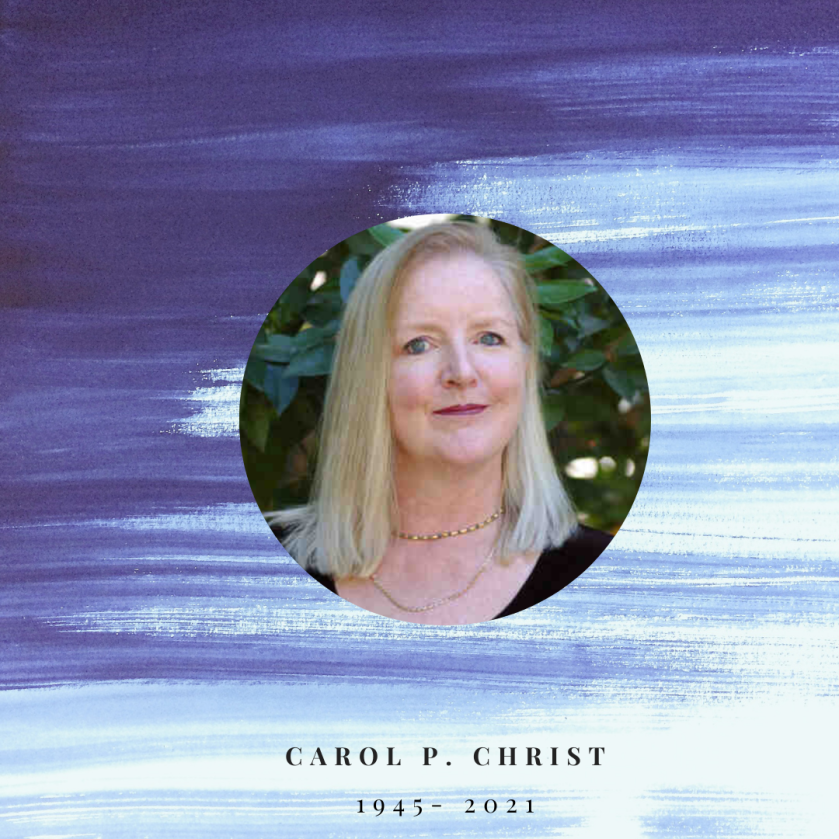
I first encountered the image and concept of “flourishing” in Grace M. Jatzen’s feminist philosophy of religion, Becoming Divine. For Jantzen “flourishing” is a symbol of a theology of “natality” or birth and life, which she contrasts to the focus on death and life after death in traditional Christian theologies.
Jantzen argues that the focus on death and life after death is a rejection of birth. Birth is rejected because birth through a body into a body implies finitude. Birth ends in death. Jantzen argues that embracing natality means embracing finitude and death.
Continue reading “Legacy of Carol P. Christ: The Flourishing of Life and Feminist Theology”From the Archives: Oakness as a Metaphor for the Wild Soul: the Dance Between Life Force, Personality and Original Nature by Eline Kieft
This was originally posted June 16, 2022

The process of fitting in and learning what is required to participate in society teaches us many useful skills such as math and language. All too often, this happens at the expense of developing expressive and intuitive abilities and trust in our unique contributions and points of view, or what I call the ‘Wild Soul’. This represents our original blueprint or essential spark that makes us into who we are.
Continue reading “From the Archives: Oakness as a Metaphor for the Wild Soul: the Dance Between Life Force, Personality and Original Nature by Eline Kieft” Feminism and Religion