Enlivened Truth by Safa Plenty

aqua and red


My joy is rebellion, and so is my passion,
my excitement, and even my sexuality,
but only here where truth is kept secret.

Where joy exploding in my vocal cords
and coursing through my limbs is
silenced or censored looked upon as foreign
in this house haunted by sad spirits.


Where my passion rising above the lull
of everyday existence, more in tune with
childlike exuberance is drowned out by
the endless buzz of television noise.

Where my excitement for learning is
relegated to four walls of my blue bedroom,
and conversation and connection propels
me from our first floor to my sister’s
basement apartment.

Where my sexuality is cloistered inciting
fear that even its refined expression would
lead to some mythical disaster in which
men would prey on my delicate femininity.

Where my mind has constricted from being,
asked why I can’t force myself to be satisfied
with a linear spiritual existence or someone’s else
fears and expectations for my life.

My joy is rebellion, and so is my passion,
my excitement, and even my sexuality,
but with love as my fuel, I will be
a rebel with a cause and that cause
will be enlivened truth.

Safa N. Plenty ©2014


Postlude:
As an American Muslim women of African Caribbean, Native American, and European decent, this poem is a reflection on the remnants of both historical trauma and being partially raised in an ultra-conservative community . An experience I am still continuing to heal from. In essence, this is a deeply personal and poetic reflection on my own experience of how intergenerational trauma is often compounded by the practice of literalist interpretations of religion, particularly in my case, Islam. I am continuing a ten year journey in rediscovering my true cultural and spiritual heritage that had been partly denied me.  In writing this piece, I hoped to gain clarity on my path to heal and becoming a healer through a more fluid engagement with my own faith, while learning and benefiting from other faith traditions. Through a full engagement with  Sufism, an integral part of Islam’s sacred tradition, also known as the science of purification (Ihsan), I hope to continue on my journey of spiritual renewal and healing and to aid the world in healing from the fear and numbness that plagues us as moderns.

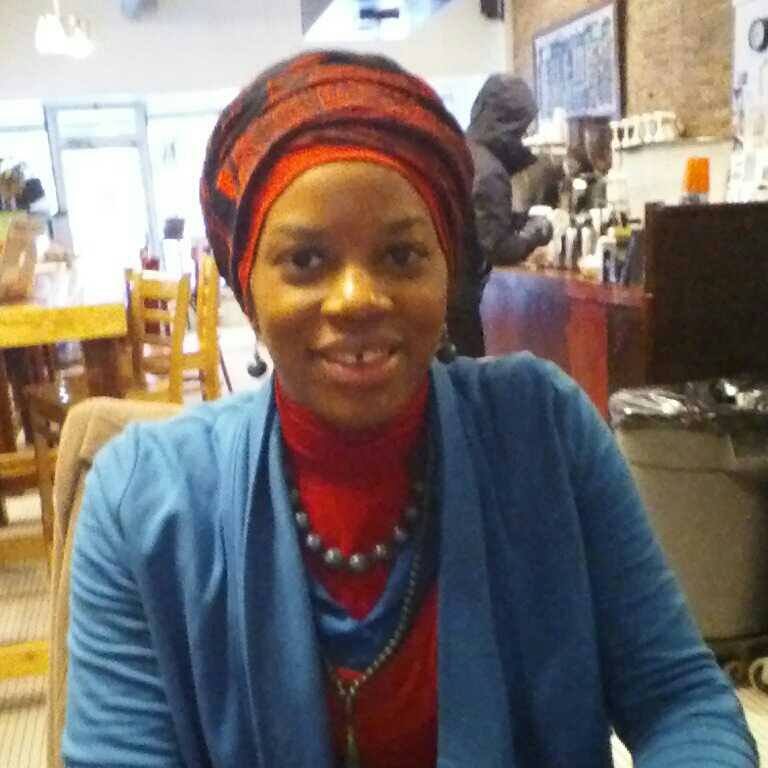
Safa N. Plenty is an educator and mental health counselor, who will be pursuing a Ph.D at Claremont Lincoln School of Theology with a focus in spiritual formation and peacebuilding.  She holds a Masters of Social Work from Columbia University and an undergraduate degree in interdisciplinary studies with a minor in Africana Studies. For the past two years, she has worked as a K-12 educational contractor and assistant counselor at a local community college. Her research interest include Sufism, Attachment to God, indigenous cosmology, particularly Native American and Somatic psychology. She is also interested in religious mysticism, mindfulness practice in Buddhism and the role of feminism and religion in cultivating a peacebuilding capacity among young Muslim women. She is currently working to develop a faith based healthy relationships program for Mothers and daughters. She enjoys writing poetry, research, and contemplative practice in art.


Book Review: Hild & The Patron Saint of Ugly by Mary Sharratt

OLYMPUS DIGITAL CAMERA

Literature touches our spirit in a way that film, television, and even art cannot. Instead of presenting the passive viewer with a visual image, good writing demands our participation and co-creation. The words become the springboard for our own imagined vision of other worlds and other lives. In this imagined space, we can experience profound insights and revelations–soul-growing experiences we carry with us forever.

Books that try too hard to be spiritual can have the opposite effect. Discerning women demand books that respect us instead of preaching to us. Too often religion has been interpreted by and for men, but when women writers reveal their spiritual truths, a whole other landscape emerges, one we haven’t seen enough of.

Marie Manilla’s The Patron Saint of Ugly (Houghton Mifflin Harcourt, June 17, 2014) and Nicola Griffith’s Hild (Farrar, Straus and Giroux 2013) are two such transporting novels. They both draw on the lives of female saints in fresh and evocative ways.

Continue reading “Book Review: Hild & The Patron Saint of Ugly by Mary Sharratt”

Love Facing by Safa Plenty

aqua and red

This piece titled, ‘Love Facing’ is a meditation on the intergenerational dynamics of family violence and our need to move beyond labels in order to understand the complexities of American violence. It begins with a narrative critic of spanking as a corrective measure and its propensity to escalate into other forms of violence. The poem continues with reflection on how male privilege and power impact the disempowerment of women and girls. It signals forgiveness as a possible means of understanding intergenerational trauma and stress, however.  The piece advocates an understanding of male privilege and dynamics of power and control, as a means of empowering women and children, affected by family violence. Furthermore, it examines our societies failure to raise healthy men and boys, who are comfortable openly expressing their emotions. In the end, the poem signals our human need for unconditional love, respect, and honor and need for religious and spiritual practice imbued with compassion, mercy, and kindness, or feminine attributes of the Divine.

“When the power of love overcomes the love of power, the world will know peace.” ― Jimi Hendrix

Continue reading “Love Facing by Safa Plenty”

Monkey See…by amina wadud

amina 2014 - cropped

When I was a little girl the Washington D.C. Zoo did not have that extra security fence between gawking spectators and the cages of certain animals.  My mother used to climb up onto the cage and hand peanuts to the monkeys.  I don’t know, maybe that was the beginning of my lifelong love of monkeys.  When I moved to Malaysia as Assistant Professor at the International Islamic University I was driving down a main roadway and along the side of the road I saw a monkey scurrying along much like we see squirrels in the US.  A new phase in my life began.  How many ways to repeat my mother’s antics?  Could I possibly top that? This introduction might seem silly but I just have to share one of the most sublime experiences of my life and for that I need to give you a feeling for just how much I love monkeys.

When monkeys are in the wild they are not always amenable to such antics as we humans can do or imagine.  I think that’s probably part of survival, don’t you?  Anyway, in Malaysia, even though they were as plentiful as squirrels and just as accessible, like squirrels they are not at our beck and call either.  We were pretty much limited to the evenings at a local park when they would come down from the trees and let us feed them. Like children do with Canadian geese at Merritt Lake Park here in Oakland, or any where they roam.  Once we climbed up more than 1000 stair-steps to the top of the Batu Caves a Hindu temple and tourist spot, to see the sights and feed the monkeys.  That time one wily monkey snatched the whole bag of food from my daughter’s hand while she wasn’t looking and that was the end of it.  No way to go back to the car and run back with more!  Continue reading “Monkey See…by amina wadud”

Whose Sharia Is It? by Kecia Ali

dissertation, Advising, feminism and religionIt has been a lousy month for Islamic law.

First, there was the kidnapping and threatened sale of Nigerian girls by Boko Haram, which claimed religious acceptability for their acts. As Muslim theologian Jerusha Lamptey opined, this is not my sharia.

Then, the Sultan of Brunei’s horrific new penal code came into effect. Unlike the Nigerian girls, where a social media campaign garnered White House attention, the Brunei law gained visibility because the Sultan–who is dictating law that his track record suggests he does not observe–indirectly owns the famous Beverly Hills Hotel. Hollywood figures have objected to the rules, due to come into effect next year, which would punish proven male-male anal sex with death. (As far as I know, the code does not prescribe any particular punishment for lesbian acts, though the rhetoric has become that the new law prescribes “stoning gays and lesbians.”)

Claims like that of the Sultan or Boko Haram that “Islam” demands implementation of “sharia” ignore the complex reality in which there is not now nor has there ever been a uniform set of identifiable rules that Muslim scholars have agreed on much less that governments in Muslim majority countries have implemented over the centuries. As I wrote elsewhere, so-called sharia laws on the books in Brunei, Nigeria, Pakistan, Iran, Saudi Arabia, or Morocco are not directly revealed by God. They are human products with human histories negotiated in human contexts. The pretense that these laws are straightforward implementations of God’s will not only serves to justify these otherwise unjustifiable rules but also feeds the demonization and dehumanization of Muslims. Though happening on two continents and perpetrated by two quite distinct sorts of actors – a multibillionaire monarch enmeshed in global capitalism and a militant anti-Western, anti-government insurgency – the Nigerian kidnapping and the Brunei law became exhibits A and B for the vilification of sharia. Continue reading “Whose Sharia Is It? by Kecia Ali”

Songs for the Soul by Elise M. Edwards

Elise EdwardsDuring the Christian season of Lent, many Christians focus on spiritual practices or disciplines that bring them closer to God. This year, I did not really engage in this type of reflection until the end of Lent. I have been wrapping up my first year teaching college students full-time, I’ve been focused on several writing projects, and I’ve been traveling. I did not intentionally think about spiritual practices until I participated in a silent retreat before Holy Week and traveled first to spend the holiday with my family and then again to mourn and remember the life of my aunt.  I reflected on them when I most needed them.

Continue reading “Songs for the Soul by Elise M. Edwards”

A Family Conceived, Lost, and Resurrected by Gina Messina-Dysert

Gina and SarahGood Friday marks the second anniversary of one of the most significant dates in my life – the adoption of my daughter, Baby S – who by the way is no longer a baby (she will be turning 5 this May).  On Easter Sunday, 2012 I wrote about the resurrection of my family.  In the last few years that I have been blogging, this is by far my favorite post and I have been so grateful for the many wonderful responses I have received from it.  With today being Good Friday, it seems an appropriate time to revisit this incredible experience and once again, give thanks for the blessings in my life.  Continue reading “A Family Conceived, Lost, and Resurrected by Gina Messina-Dysert”

Sanctuary of Echoes by Natalie Weaver

Natalie WeaverTomorrow I will have the unique opportunity to hear my son recite a poem I wrote before his class. The students were invited to select a poem to memorize and perform along with props or costumes as suited the material. The only conditions were that the poem be a minimum of twelve lines, published in a book, and in good taste. A poorly chosen poem, he said, would result in perpetual detention.

I was excited when he expressed enthusiasm for the assignment. I asked him what kind of poem he would like to learn. Something humorous? Something dramatic? Something tragic? Something about love? War? I read to him first those famous opening words of Virgil’s Aeneid: Arma virumque cano (I sing of arms and a man…). I thought surely he would be intrigued by the rhythm and the promise of such a tale. He asked for some other options, so I presented favorites from the Medieval Hebrew canon. I taught him Adon Olam, since he was curious about learning poetry in a foreign language. He liked it quite a bit and learned how to pronounce the Hebrew, but this was not his choice. I pulled out selections from Catullus’ eulogies for his brother. I searched Sappho for something playful. We read more contemporary options from the usual suspects in an anthology of poetry that I had used in a college course: Frost, Dickinson, Poe. I even introduced him to the seductive “duende” of the great early 20th century Spanish poet Federico Garcia Lorca in his Poet in New York.

Continue reading “Sanctuary of Echoes by Natalie Weaver”

“Inheriting Our Mother’s Gardens”: Trans/lating, Trans/planting and Trans/forming Life by Sara Frykenberg

Sara FrykenbergThis Friday, March 7, 2014, the Women’s Caucus (WC) of the American Academy of Religion, Western Region will be hosting its annual “Professional Development Panel and Workshop” in Los Angeles, CA.  During the workshop panelists and attendees will consider what ‘gardens’ we have grown in, who our ‘mothers’ are and how this impacts what we bring to the table or what ‘gifts’ we bring to the table when dialoging with and across differences.  Our title and praxis at this event is also meant to honor our feminist mothers.  Specifically I would like to recognize and honor Letty Russel, Katie Geneva Cannon, Kwok Pui Lan and Ada Maria Isasi-Diaz.  Among many other accomplishments, these women edited the 1988 volume entitled: Inheriting Our Mothers’ Gardens: Feminist Theology in Third World Perspective.  This book helps to give voice to women marginalized within feminist theological discourses and is the inspiration for our panel’s title this year. 

Preparing for this panel, I reflected that many of those who contribute to this blog have written about their mothers (biological or non-biological) and mothering.  (Most recently I found myself inspired by Marie Cartier’s meditation on aging, health, her mother and religion.)  I realized that I have said very little about my own mom; my mom, who I am so like, who I look like, and who is both my mother and my friend.  I have definitely ‘inherited her garden,’ so to speak: flowers, herbs, weeds, rocks and all.  So, momma, this blog is for you.

Continue reading ““Inheriting Our Mother’s Gardens”: Trans/lating, Trans/planting and Trans/forming Life by Sara Frykenberg”

A Not So Ideal Deal: Perspectives On Sexism In “Islamic Marriage” by Vanessa Rivera de la Fuente

Vanessa Rivera de la Fuente. Marriage in IslamOne topic that emerges from the discussions I have with other Muslims and people in general relates to marriage. Starting with, I don’t agree with marriage. Not because I think married life is negative but because, under the prevailing patriarchal logic, marriage is not conducive to full relationships. Patriarchy has also polluted Islam and, therefore, the way in which gender relations are understood as part of a Muslim’s life including the concept of marriage.

Since I converted to Islam, I have received 11 marriage proposals. I have refused them all. Many people have seen in my attitude a sign of pride and rebellion. They are wrong. I do not rebel against married life, but against the terms in which it is presented to me and the role I am supposed to have because I am a woman in it. Manly-man-male ideas about women, prejudices related to the fact that I am not “pure Muslim, but converted,” “not Arab,” and stereotypes about Hispanic-Latina women, have all played a major role in the deep indignation and disgust with which I have rejected each prospect. Continue reading “A Not So Ideal Deal: Perspectives On Sexism In “Islamic Marriage” by Vanessa Rivera de la Fuente”