From the Archives: Through the Eyes of the 21st Century Bird Goddess by Carolyn Lee Boyd

Moderator’s note:Today’s blogpost was originally posted March 14, 2018. You can visit it here to see the original comments.

When I raise my eyes to a bird soaring over me in flight, I am no longer bound to the Earth by gravity. I stop my round of daily tasks and widen my vision to view myself and our world from above through birds’ eyes. For just a moment, as I observe beyond my usual narrow horizon, I perceive truths about myself and others that have been hidden and grasp wisdom that has previously eluded me.

From Neolithic times onwards in cultures stretching across the globe, as described by Judith Shaw, bird-shaped goddesses have embodied life, death, rebirth, and more. More recently, as noted by Miriam Robbins Dexter, these beautiful winged beings were perceived of as monsters and flying through the air was one of the accusations made against the women persecuted as witches in the Burning Times. What greater demonstration could there be of the intense terror this powerful relationship between women and birds creates in those who demand dominion over women’s bodies and souls?

Continue reading “From the Archives: Through the Eyes of the 21st Century Bird Goddess by Carolyn Lee Boyd”

On The Baby and The Bathwater by Liz Cooledge Jenkins

It wasn’t until seminary—and even then, only sporadically—that I learned that many of the foundational figures in Western Christianity held some incredibly sexist attitudes. Somehow, in all my years of attending church, hearing sermons, participating in (and leading) Bible study groups, reading Christian books, and working in ministry, I had missed this historical reality. I just hadn’t thought about it. And the (mostly white male) Christian leaders who shaped my own faith apparently hadn’t thought about it, either. That, or they didn’t think it was important enough to talk about. Or they intentionally tried to keep it on the down low. Or some combination of these things.

In seminary, when influential theologians’ sexist views came up in class, inevitably someone would say—in a wise-sounding tone—“Well, we don’t want to throw out the baby with the bathwater, do we?”

Continue reading “On The Baby and The Bathwater by Liz Cooledge Jenkins”

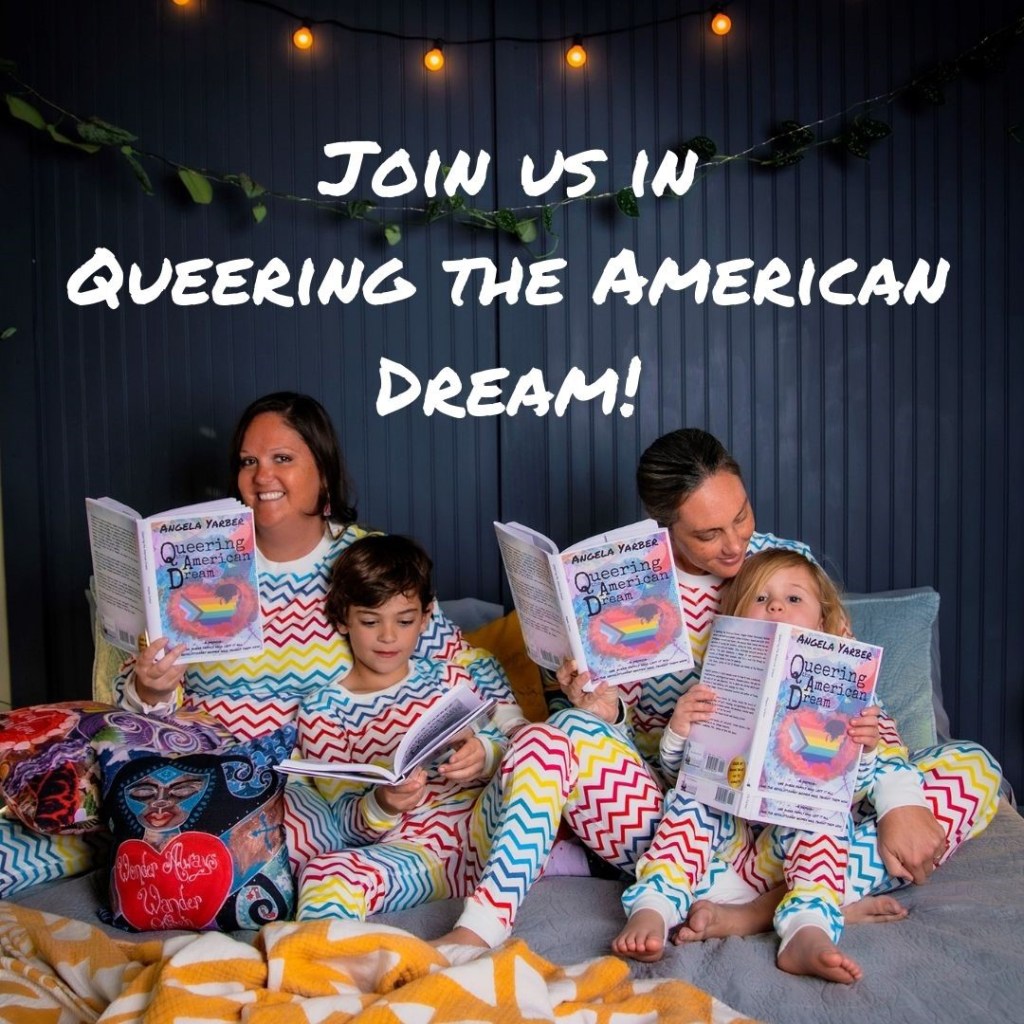
Queering the American Dream by Angela Yarber

As Florida politicians try to ban teachers from including LGBTQ+ issues in the curriculum, admonishing them, “Don’t Say Gay” at school, I’m shouting “GAY!” from the rooftops. Because I’m celebrating the release of my eighth book and first memoir, Queering the American Dream. It’s my queer family’s story of leaving it all and the revolutionary women who taught us how.

Our story began the day the Supreme Court ruled our marriage legal and ended the moment my younger brother’s addiction spiraled into a deadly overdose. In-between were eighteen months of full-time travel with a toddler in tow. Criss-crossing the American landscape, my wife and I came face to face with jaw dropping natural beauty on the one hand, which contrasted with the politics, policies, and people who continued to discriminate against marginalized families like ours on the other. At each stop along the way, a different revolutionary woman from history or mythology guided our footsteps, reminding us that it’s not simply our family who dared to queer the American dream, but a subversive sisterhood of saints who have upended the status quo for centuries. From Vermont to Hawai’i, and everywhere in between, the beauty of the American landscape bore witness to a queer clergywoman whose faith tradition was not enough to sustain her. But the revolutionary women were.

Continue reading “Queering the American Dream by Angela Yarber”

Carol P. Christ’s Legacy: The Keepers and the Roman Catholic Church featuring Jean Hargadon Wehner

Moderator’s Note: Jean Hargadon Wehner, who is referenced and quoted by Carol in this post will be available to respond in the comments section. Feel free to ask her any questions. Jean has a new book out about her experiences. The link is at the bottom of the post.

Carol’s work continues through her non-profit foundation, the Ariadne Institute for the Study of Myth and Ritual and the Goddess Pilgrimage to Crete. This blog was originally posted July 10, 2017. You can read it along with its original comments here.

He told me his “come” was a sacrament… He made the sign of the cross with it on my breasts. Jean Hargadon Wehner in The Keepers

I sat glued to my television last weekend watching seven episodes of The Keepers one after the other. Out of all the horrific information in this Netflix documentary, these words stick in my mind. Jean Hargadon Wehner said Father A. Joseph Maskell told her that she was sinner after she confessed to him that her uncle had molested her. Father Maskell explained that her case was so severe that ordinary absolution might not work. Thus, he told her, she must participate in ritual sex with him in order to purify her soul. Jean Hargadon was too young and naive to question his authority. She only knew that she dreaded hearing her name called out on the school loudspeaker with instructions to report to Father Maskell’s office.

Continue reading “Carol P. Christ’s Legacy: The Keepers and the Roman Catholic Church featuring Jean Hargadon Wehner”

Behold! The Treasures of Eden by Janet Maika’i Rudolph

The place and purpose of the Garden of Eden is a topic of endless fascination and interpretation. This blogpost looks at two biblical passages and the word eden itself to see what we can learn about its meanings. At its most basic, Eden is a garden of treasure and delight.

As I’ve written before, the written form of Ancient Hebrew words comes from the hieroglyphic tradition of Egypt. The pictures of the letters form a picture puzzle or rebus. The word roots are generally two or three letters. I use script called Semitic Early for my baseline of study.

Continue reading “Behold! The Treasures of Eden by Janet Maika’i Rudolph”

Carol P. Christ’s Legacy: Women And Weeding, The First 10,000 Years* by Carol P. Christ

Moderator’s Note: We here at FAR have been so fortunate to work along side Carol Christ for many years. She died from cancer in July, 2021. Her work continues through her non-profit foundation, the Ariadne Institute for the Study of Myth and Ritual and the Goddess Pilgrimage to Crete. To honor her legacy, as well as allow as many people as possible to read her thought-provoking and important blogs, we are pleased to offer this new column to highlight her work. We will be picking out special blogs for reposting. This blog was originally posted February 10, 2014. You can read it long with its original comments here.

Mary, Mary, quite contrary, how does your garden grow? With silver bells and cockle shells, and pretty little maids all in a row.

From the beginning of horticulture about 8000 BCE or earlier to the present day, weeding has been women’s work. Women, who were the gatherers and preparers of food in traditional nomadic societies, no doubt were the first to discover that seeds dropped at a campsite one year sometimes sprung up as plants the next year. When this discovery was systematized, agriculture was invented, and human beings began to settle down in the first villages and towns.

Continue reading “Carol P. Christ’s Legacy: Women And Weeding, The First 10,000 Years* by Carol P. Christ”

The Patriarchy of Ki Tisa and a Call to Reimagine Divinity by Ivy Helman.

This week’s Torah portion is Ki Tisa, Exodus 30:11-34:35.  Its events revolve around the theme of creation, destruction, and recreation.  From a feminist perspective, it is quite clear that this cyclical process is a result of a patriarchal understanding of the divine as jealous, distant, and rage-filled.  

Ki Tisa begins soon after the Israelites have been delivered from Egyptain slavery.  This delivery creates a new people devoted to this divine liberator.  Yet, Ki Tisa starts with both that deity and their leader, Moses, nowhere to be found. So, what do the Israelites do being in such a vulnerable spot?  They create a golden calf in order to have a spiritual connection to something.  

Continue reading “The Patriarchy of Ki Tisa and a Call to Reimagine Divinity by Ivy Helman.”

From the Archives: Women’s Bodies and the Bible by Janet Maika’i Rudolph

Moderator’s note: This marvelous FAR site has been running for 10 years and has had more than 3,600 posts in that time. There are so many treasures that have been posted in this decade that they tend to get lost in the archives. We are beginning this column so that we can all revisit some of these gems. Today’s blogpost was originally posted May 20, 2019. You can click here to see the original comments.

Trigger Alert:  The bible on its face is quite violent to women.

Amidst the ugliness that is American politics in general and abortion politics specifically, I began to look for guidance to understand what is happening. I ended up pulling out two books that I read long ago. The first is Woe to the Women-The Bible Tells Me So by Annie Laurie Gaylor. Gaylor, in turn, was inspired by the work of Elizabeth Cady Stanton in her The Women’s Bible which was originally published in two parts (1895 and 1898).

I had forgotten how inspired I have been by both books. Together, they motivated me to begin looking at how the bible is a foundational paradigm of our culture. I started researching how translations have been altered from original meanings. I have already written a few blogs about how the representations of Eve have been changed to strip Her of the roots of Her original power. Take a look here and here.

Continue reading “From the Archives: Women’s Bodies and the Bible by Janet Maika’i Rudolph”

To Nurse at the Same Breasts: Muslim-Jewish Kinship in Literature and Life by Joyce Zonana

It is tempting to read these recurring images of milk twins in Arab-Jewish literature as no more than a symbol, albeit a powerful one, of the profoundly intimate “brother- (and sister-)hood” of Jews and Muslims in the  pre-partition culture of the Middle East and North Africa.

But the image of “milk twins” is much more than a metaphor or a symbol: it represents a reality. For it seems that many Jewish and Muslim women, living side by side as they did, had in fact regularly nursed one another’s children.

Joyce Zonana. headshotTobie Nathan’s panoramic novel about Jews and Muslims (and Christians) in early twentieth-century Egypt, A Land Like You, revolves around one central image: two infants—one Jewish, one Muslim; one male, one female—peacefully nursing at the breasts of a young Muslim woman, Oum Jinane (“Mother Paradise”).

After the birth of her long-desired daughter Masreya (“The Egyptian Woman”), Jinane travels from her poor Muslim neighborhood to a poor Jewish neighborhood to help another young mother whose long-desired infant son is languishing because she has no milk.  “It’s a miracle, a great miracle,” the Jewish boy’s relatives declare:

images

Never had any neighborhood in Cairo been so excited by a baby’s nursing. Until bedtime, the child nursed three more times at the breasts of abundance. He took hold of one nipple, little Masreya  another, and the two children’s hands sometimes touched. You would have thought they were two lovers entering Paradise as they held each other’s hands.

Continue reading “To Nurse at the Same Breasts: Muslim-Jewish Kinship in Literature and Life by Joyce Zonana”

In Memoriam: bell hooks by Elizabeth Ann Bartlett

In a world where the words of black women writers, even our very names are often soon forgotten, it is essential and necessary that we live through writing and teaching the words of our great and good writers, whose voices must no longer be silenced, even by death.[i]

                                                                                    – bell hooks

On December 15, 2021, the world lost the great feminist theorist, teacher, activist, and writer bell hooks.  As a white feminist theorist, I valued immensely the ways her work widened my partial perspective, challenged my blind sports, and gave me important viewpoints on everything from sexism, racism, classism, pedagogy, militarism, work, and parenting.   Her piece on feminist solidarity is the best I know — examining not just the ways we are divided by classism and racism, but also by sexism, addressing the very real and destructive ways that women undermine, abuse, and disregard each other, and how important it is to unlearn this with each other. She used the term “feminist movement,” rather than the feminist movement, knowing it not to be one thing, but rather a verb, a process of moving, changing, and transforming. Championing the power of coming to voice, she spoke truth to power, engaging in honest exploration of often difficult and divisive topics. It was this honest, liberatory voice that spoke throughout her work and made her voice so compelling, and so valuable.

Continue reading “In Memoriam: bell hooks by Elizabeth Ann Bartlett”