I’m not a historian or sociologist, but I’ve noticed something about civilizations. They always seem to think they are more special than other civilizations. It’s not important to my purpose here to name names, but so many groups have had a superiority complex of one kind or another that I wonder if a need to feel more special is written into human DNA.
There may be biological explanations for why people draw distinctions and make rankings for each other, but I’m going to speculate about a psychological or spiritual one. I wonder if this hunger for superiority stems from a lack of security about one’s value as a human being. The first temptation of Christ started with the words “If thou be the son of God…” and if we are to believe Christ’s temptations were real it means that even Jesus must have, at least momentarily, been able to question his identity. He was tempted to believe the lie that he was not who he knew himself to be. We mere mortals experience that temptation not infrequently, and unlike Jesus, we sometimes succumb to it.
One strategy people have for dealing with insecurities about their identity is to artificially elevate themselves above others. As in, if I’m not special at least I’m more special than (fill in the blank). This has caused so much pain and injustice. And regardless of culture, time, or place, women seem to always be on the losing side of this equation. Continue reading “Why I am a Mormon Feminist by Emily U.”
Oh, so many people cannot figure out why/how in the hell I can be a feminist AND a practicing Catholic. And, I must admit there are days when I, too, am perplexed.
For example, one recent Sunday after Mass I waited outside the Cathedral while my children ran and climbed and smelled flowers around a statue of St. Therese. After a few minutes, two modestly dressed women with clipboards walked up to me and asked: “Would you like to sign a pro-life petition?” I snappishly said no. (Still wishing I would have asked more questions. How do you define pro-life? What good will a petition do?)
I sensed a little surprise from them. I’m sure I was the picture of Catholic motherhood, if you didn’t notice the electric blue toe nails. Only about 30 minutes earlier, I was on the altar reading Scripture to the congregation — something I’ve done since I was 17, when I realized that was likely the closest I would get to priesthood. Also during Mass, my two older children were altar servers (the gender-neutral of “altar boys). And, we were waiting outside because my husband was washing chalices as part of his duties as Eucharistic minister. So, I certainly appeared to be someone who would gladly sign their petitions. Continue reading “Feminism + Catholicism = ? By Dawn DiPrince”
It was a humid yet windy day in Broward County, South Florida. My long pants and sleeves were becoming hostile towards me as I proceeded to slip off my shoes, don my borrowed headscarf, and set up shop just outside the modest mosque in Pembroke Pines. I waited patiently for prayers to end, hoping that my “Register to Vote” sign was placed in optimal eyesight of the female worshippers as they exited the prayer hall. All of my hope to expand the Florida electorate to help re-elect President Barack Obama was bundled in my mix of clipboards, voter registration forms, pens, and volunteer sign-up sheets. Just moments after the Imam wrapped up the Friday afternoon prayers, two young women wearing full hijab sauntered out. “Oh, I’ve been meaning to register to vote,” one of them said. “Perfect.” Continue reading “Blessed Are The Organized, by Amy Levin”
It is very disappointing to share that Fr. Roy Bourgeois was excommunicated, dismissed, and laicized by the Vatican as a result of his support for women’s ordination and the eradication of sexism in the Catholic Church. The following was sent out for immediate release by Maryknoll on November 19, 2012. Additional information will be shared once released.
FOR IMMEDIATE RELEASE
The Congregation For The Doctrine Of The Faith
Canonically Dismisses Roy Bourgeois
Maryknoll, New York – November 19, 2012 – The Vatican’s Congregation for the Doctrine of the Faith, on October 4, 2012, canonically dismissed Roy Bourgeois from the Catholic Foreign Mission Society of America, also known as the Maryknoll Fathers and Brothers. Continue reading “BREAKING NEWS: Fr. Roy Bourgeois Excommunicated”
Are violence and domination innate in human nature? We have been told that we are the “naked ape” descended from “apes” who, like the chimpanzees with whom we share 98% of our DNA, were male dominant and violent. Do we, then, have any hope not to be violent and dominant?
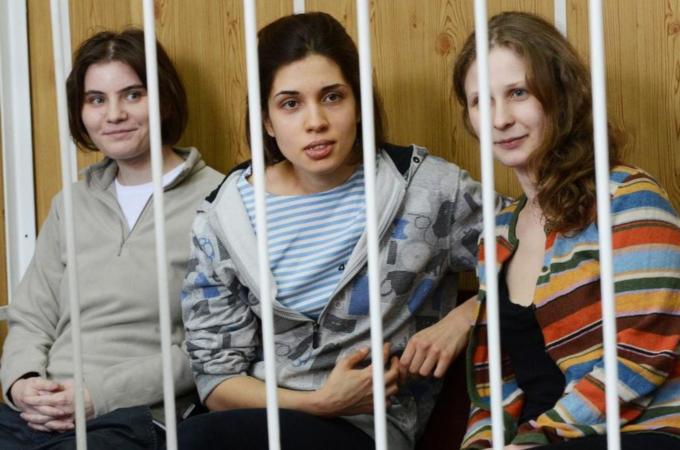
In a country that was willing to [sic] its secular court on a “religious” cause, Pussy Riot are true revolutionaries. Nonetheless, it was not until they delivered these closing statements that their supporters—and opponents—heard what these three brave women stand for. Although they are being crushed in the jaws of the system—and know it!—their courage and steadfast sincerity are sufficient cause for (impossible) hope. If not for the Russian state, then at least for the Russian people. —Bela Shayevich
“When religion puts people in jail it’s unjust” – David Gross
The intermix of religion and politics are familiar, especially after this year’s presidential election. Many supported Mitt Romney out of concern for religious freedom; a stance that had the potential to marry religion and politics in a dysfunctional union. We also witnessed a veiled attempt by the Catholic Church to emphasize and sway the faithful to vote for the one true moral candidate; a stance contradicted by Obama’s ability to carry the Catholic vote. I believe what we see in Russia is a shining example that shows what happens when regulations and laws do not segregate between secular law and church law. Freedoms do not exist, rather, rules and restrictions are imposed creating an institutional prison.
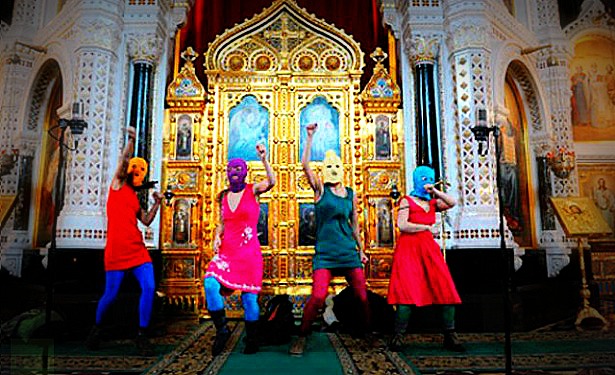
The prosecution of an all girl punk band named Pussy Riot [i] demonstrates a “complete fusion of the institutions of the state and church,” which devalues “women’s rights and freedom of speech.”Members of Pussy Riot are serving a two year sentence of hard labor for “hooliganism motivated by religious hatred.” What was their crime? They went into a Cathedral in Moscow and started singing a punk prayer – “Mother of God, Chase Putin Out!”
They danced, kneeled, and crossed themselves in front of the Church’s high altar. This occurred the day before the re-election of Vladimir Putin. While I do not support going into a sacred space with relics to make a protest, what I find problematic is their harsh sentence. However, it should be noted that with the coverage of the trial and the outpouring of support received from many organizations, and musicians, they did manage to bring to the forefront issues surrounding the government and the Church.
Male feminists must be aware that we not only engage in an ongoing struggle against sexual and gender inequality, but more importantly an ongoing fight with ourselves.
I have often struggled with that little voice, call it my conscience if you will, that speaks to me during times of distress. Although I consider myself a proud feminist, I still struggle with aspects of what I call, internalized misogyny, or more aptly defined as a male born characteristic trait that imparts the idea that men are not only dominant but also more powerful than the other 50% of the species.
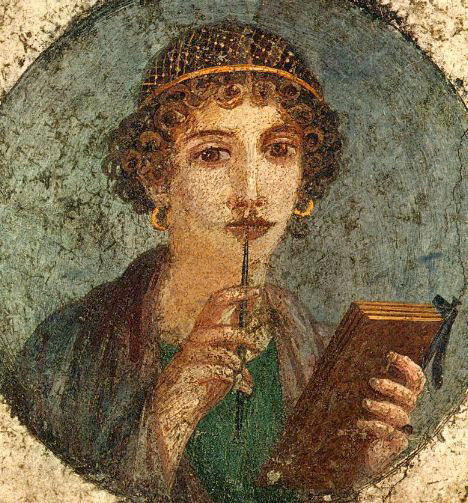
We have been taught to speak of war and the heroes of war in hushed tones. We have been told that evil Helen’s choice was the cause of the Trojan war. 2600 years ago Sappho, known as the greatest lyric poet of ancient Greece, spoke truth to power and unmasked the lies told at the beginning of western tradition.
*
In a poem addressed to Anactoria, Sappho writes:
Some say a cavalry corps
some say infantry, some, again,
will maintain that the swift oars
of our fleet are the finest
sight on dark earth …
Here, Sappho invokes the heroic tradition celebrated in the epic poems of Homer that shaped the values of ancient Greek culture and all the cultures that followed it, including our own. This tradition tells us that to serve in a war and to be remembered as a hero is the highest goal to which a man can aspire. Sappho does not agree:
On Tuesday, President Obama’s acceptance speech included the following statement about coming together as a country across differences of opinion. He said, “We will disagree, sometimes fiercely about how to get [toward the future we hope for]…by itself, the recognition that we have common hopes and dreams won’t end all the gridlock or solve all our problems or substitute for the painstaking work of building consensus and making the difficult compromises needed to move this country forward…”
How do we really do this work? How do we come together across difference to make change? How do we foster productive dialogue that produces genuine and real results? In this dialogue, what principles do we use? What values do we honor? What criteria do we use to judge opinions of others? When is an opinion wrong or when is an opinion just different from our own? Continue reading “Building a Bridge toward the Future: Will You Meet Me in the Middle? By Ivy Helman”
Each month I focus my article on one of my Holy Women Icons with a folk feminist twist. Virginia Woolf , the Shulamite, Mary Daly, Baby Suggs, Pachamama and Gaia, and Frida Kahlo have reputations that match their lived realities relatively closely, so my paintings have attempted to reflect these realities. The subject of this month’s article, however, has been misrepresented and misunderstood throughout the ages. Her “name” is Salome and we read of her dancing story in the Gospels of Matthew and Mark.
If you carefully read Mark 6:17-29 or Matthew 14:3-11, you’re probably wondering why this article features an icon of someone named Salome. There was no mention of anyone named Salome in the text. Rather, in the Markan text both the dancing daughter and her mother are named Herodias. In Matthew’s text, the daughter is nameless. It wasn’t until later when Josephus, a Jewish historian, named her Salome and stated that she was responsible for the beheading of the John the Baptist. Continue reading “Painting Salome By Angela Yarber”


 I’m not a historian or sociologist, but I’ve noticed something about civilizations. They always seem to think they are more special than other civilizations. It’s not important to my purpose here to name names, but so many groups have had a superiority complex of one kind or another that I wonder if a need to feel more special is written into human DNA.