
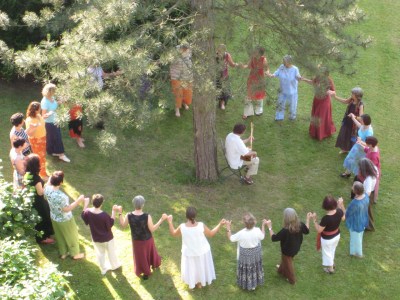
Dancing for Forgiveness and Reconciliation – Part Two By Laura Shannon

In Part One of this article, I described dancing Jewish, Romani, and Armenian dances for forgiveness and reconciliation with groups in Germany and all over the world. I also offered danced rituals of remembrance at former concentration camps and other places scarred by the atrocities of war.
I went to camps including Dachau and Auschwitz, to genocide memorials and sites of massacre throughout Eastern Europe, in Australia, and the Americas. At first, my prayers were private: I brought flowers, lit candles, danced my grief, and spent time in meditation. I tried to visualise the prisoners in those places, sending them my deep sorrow and regret back through time. I wanted to let them know that they are remembered and mourned by people from their future. My prayers contained a fervent apology as well as a soul commitment to do my part in this lifetime to overcome prejudice and stand for peace.
In time I invited others to dance with me for healing and peace. We danced at former camps in Germany, including Bad Gandersheim, a subcamp of Buchenwald, and on many occasions in Steyerberg, a former prison camp and forced-labour munitions factory which is now the site of an intentional community called Lebensgarten (‘Garden of Life’), a centre for permaculture, non-violent communication, and other ecologically and spiritually oriented ways of living.

Continue reading “Dancing for Forgiveness and Reconciliation – Part Two By Laura Shannon”

Vote, Vote, Please Vote! American Democracy Is at Stake by Carol P. Christ

Like many of you, I am weary this election season. In the early part of the Democratic primaries I was enthused. Elizabeth Warren, Bernie Sanders, and also Kamala Harris, and sometimes Amy Klobochar were articulating progressive political positions with which I agreed. Joe Biden, who eventually won, was not my candidate. Though I understood that defeating Donald Trump was the most important thing, I stopped following the campaign.

I have resisted writing this blog because I am so disgusted by Republican moves to suppress the vote, Trump’s attempts to slow the delivery of mail-in ballots, his declaration that mailed ballots are likely to be fraudulent (there is no evidence supporting this), and his unwillingness to say that he will accept the election results. The possibility that the election could be stolen or that Trump will refuse to leave office turns my stomach and frankly terrifies me because many of Trump’s white male supporters have guns and are willing to use them. Continue reading “Vote, Vote, Please Vote! American Democracy Is at Stake by Carol P. Christ”

A Story to Inspire Hope by Elizabeth Chloe Erdmann

These days deep emotions seem to burst forth at unexpected moments.

While in the car between visiting a pumpkin farm owned by friends and the local cider mill, I decided to pull out a crumpled paper with my brief presentation on the history of Crete.  “Does anybody want to hear a story?” I asked my captive audience of one of my best friends and her three boys. “Yes!” As the fall foliage whirled by, I started reading, thinking that attention would wander soon, and I’d put it away. To my surprise the boys wanted me to keep reading and even asked that I continue the story when we returned to the car after a break to feed ducks.

When I finished, the youngest boy exclaimed “that was the best story I’ve ever heard!” I was thrilled I had related it in a way that he enjoyed so much and recognized in his giddy exclamation that mysterious emotional pull of the story of Crete that seemed to reach into his soul.  Later he said to me as we watched the moon together, “you have to finish that story and add more about hope and the positive.” I told him, “The hope is in those who hear this story and others like it and strive to create a better world.”

So would you like to hear a story? Continue reading “A Story to Inspire Hope by Elizabeth Chloe Erdmann”

Matriarchal Manifesta by Heide Goettner-Abendroth

What is the STATUS of WOMEN today?

To cite a brief summary of the 1980 UN Report:

 WOMEN make up half of the world population, work nearly two thirds of all hours worked, receive one tenth of worldwide income, and own less than one hundredth of worldwide property.                             (United Nations Report 1980)

What a SCANDAL that is! Yet no one seems to get worked up about it.

But if we women believe a lot has changed in the meantime, then we are mistaken.

In 2010, the President of the UN Economic and Social Council cited the following figures:

WOMEN work 66% of all hours worked worldwide and produce 50% of the  food.  But they get 10% of the world income, own 1% of the property and represent 60% of the world’s poorest.” (Hamidon Ali, UN Press Conference on June 25, 2010)

This was the sitaution in 2000, in 2010, in 2018. The U.N.report is published annually, but nothing changes.  The SCANDAL continues, and we are outraged! Continue reading “Matriarchal Manifesta by Heide Goettner-Abendroth”

Yes, there are Goddesses in the Bible, Part 5 by Janet Maika’i Rudolph


As I wrote my last blog post, the Great Goddess of the Canaanites, Ashera was honored and worshipped (according to the bible) within and through groves of trees. Ashera and El, the “great bull god” were deeply connected. In fact, in Canaanite mythology, El and Ashera were married.

But before delving into their relationship, I would like to start in a different (but connected) direction – the lovely archetype of the morning star and the evening star. The planet Venus, named for her namesake Goddess (or vice versa), is both the planetary vision of the morning star and the evening star. Whether She be Goddess, planet or evening/morning star, when She appears in one form, She embodies them all. Continue reading “Yes, there are Goddesses in the Bible, Part 5 by Janet Maika’i Rudolph”

“Fertility” and the Regeneration of Life by Carol P. Christ

Prehistoric and indigenous religious traditions are often disparagingly mischaracterized as primitive fertility religions, concerned not with higher morality, but rather with the processes of reproduction of humans, animals, and plants. When these religions feature a Great Mother Goddess, it may be assumed that these religions are primarily focused on birthing human babies. Nothing could be farther from the truth.

Indeed, archaeologist Marija Gimbutas discovered that in the symbol systems of Old Europe, the Goddess is only rarely imaged as pregnant or giving birth. Nor is She portrayed solely in human form. Rather, She is portrayed with a bird head, wings, and a plethora of other animal and plant features. If She is a Great Mother Goddess, She is revered as the Source of Life, not simply as a mother of human babies. Gimbutas states that in Old Europe the Goddess was worshiped in as a symbol of the powers of birth, death, and regeneration in all of life. Gimbutas said these societies were matrilineal and probably matrilocal. Continue reading ““Fertility” and the Regeneration of Life by Carol P. Christ”

Write on Lilith! (Write on Eve!) by Ivy Helman

Over the past few months, I’ve been struggling to write posts.  This month is no different.  I am currently sitting with four different half-drafts on three semi-related topics, none of which I seem to be able to complete.  I’ve gone back to each of them numerous times.  I write.  I erase.  I rewrite.  I copy bits of one into another to save for some other time.  I’m left with one sentence:  this week’s Torah parshah is Bereshit (Genesis 1:1-6:8).  Great.  Glad to know that.  Now what?  

When writing, I often find myself in one of two camps given the current state of the world.  Either, I have so much to say that I have no clear idea where to start, so I write three pages of more or less nonsense.  Or, I find myself just so inundated with information that I don’t know where my opinion begins and another’s ends.  I write another 3 pages of completely different nonsense.  I get fed up with both.  I start praying better thoughts will just write themselves.  They don’t.  

Continue reading “Write on Lilith! (Write on Eve!) by Ivy Helman”

Patriarchy as a System of Male Dominance Created at the Intersection of the Control of Women, Private Property, and War by Carol P. Christ


Recently feminist scholar Vicki Noble said this is the best definition of patriarchy she has read–but she hadn’t known of it earlier! I am am republishing it now in hopes that all of you will share it on your social media so that it becomes more widely known. Thanks!

Patriarchy is often defined as a system of male dominance. This definition does not illuminate, but rather obscures, the complex set of factors that function together in the patriarchal system.  We need more complex definition if we are to understand and challenge the the patriarchal system in all of its aspects.

Patriarchy is a system of male dominance, rooted in the ethos of war which legitimates violence, sanctified by religious symbols, in which men dominate women through the control of female sexuality, with the intent of passing property to male heirs, and in which men who are heroes of war are told to kill men, and are permitted to rape women, to seize land and treasures, to exploit resources, and to own or otherwise dominate conquered people.* Continue reading “Patriarchy as a System of Male Dominance Created at the Intersection of the Control of Women, Private Property, and War by Carol P. Christ”

The Quality of Mercy by Barbara Ardinger


The quality of mercy is not strained;
It droppeth as the gentle rain from heaven
Upon the place beneath. It is twice blest;
It blesseth him that gives and him that takes…

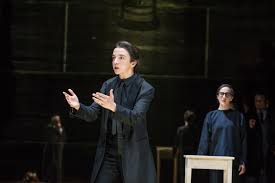
This speech (Act IV, scene 1) from The Merchant of Venice, given by Portia in disguise as a boy lawyer (and Bassanio doesn’t even recognize her!), may be one of Shakespeare’s most famous. In the play, as we know, Shylock, a Jewish moneylender, and Antonio, a merchant waiting for his ships to come in, make a bargain, one part of which is that if Antonio doesn’t pay on time, Shylock gets to collect one pound of his flesh. Antonio’s ships don’t come in, the case is taken before the Duke of Venice, and Portia appears in disguise to solve the legal issues. She goes immediately to Shylock and speaks this speech to him.

Portia, The Merchant of Venice Act IV, sc. 1, Royal Shakespeare Company production

Continue reading “The Quality of Mercy by Barbara Ardinger”

Feminist Parenting, Part 2 — What are Children? Are Children Human? by Trelawney Grenfell-Muir

The first thing I do in parenting courses is ask students their most basic beliefs about children. Students are startled by this opening slide, “what are children?” The obvious, knee-jerk response to the question, “Are children human?” is “Of course!” It seems like an unnecessary, bizarre question to ask.

However, many parents and societies treat children as though they are not fully human. Children are valuable, but they are not given the respect, trust, and basic human rights that we generally say humans should receive. Actually, most people treat children with coercion, humiliation, and distrust – as though children are willfully bad and thoughtless. Every time parents give a “consequence” (imposed punishment) for “bad behavior,” they are telling the child that she is a bad person, who needs to be “kept in line” by punitive measures. Every time parents tell children to eat this before they can eat that, or that they must put on a coat if they are to go outside, parents are sending the message that children do not deserve bodily autonomy, do not have the right to make basic decisions about their own bodies, are incompetent. That is anti-feminist parenting. Continue reading “Feminist Parenting, Part 2 — What are Children? Are Children Human? by Trelawney Grenfell-Muir”