

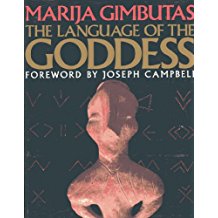
 Marija Gimbutas coined the term “Old Europe” c.6500-3500 BCE to describe peaceful, sedentary, artistic, matrifocal, matrilineal and probably matrilocal agricultural societies that worshipped the Goddess as the power of birth, death, and regeneration in all of life. Gimbutas argued that Old Europe was overthrown by Indo-European speaking invaders who began to enter Europe from the steppes north of the Black Sea beginning about 4400 BCE. The Indo-Europeans were patrilineal and patriarchal, mobile and warlike, having domesticated the horse, were not highly artistic and worshiped the shining Gods of the sky reflected in their bronze weapons.
In the fields of classics and archaeology, Gimbutas’s work is often dismissed as nothing more than a fantasy of a “golden age.” In contrast, scholars of Indo-European languages, Gimbutas’s original specialty, are much more likely to accept the general outlines of her hypothesis. The German linguist and cultural scientist Harald Haarmann is one of them. Continue reading “Was There a “Golden Age” before Patriarchy and War? by Carol P. Christ”
 While waiting to get off a plane last week, I overheard a serious young woman explaining a recent theological insight to her half-asleep and equally young husband. “You see,” she began, “what I just learned is that though He owes us nothing and does not reward us for our good deeds, nonetheless, He takes pleasure in them.”
 In her 1975 manifesto, “
 This time last year our move was for me to take a job. No more football. And a move not for football meant massive shifts in the daily life of our family.
 The concept of divine omnipotence is the ultimate expression of male dominance as control. Divine omnipotence is the view that everything that happens in the world happens according to the will of a divinity, who is in control of everything that happens in the world. When someone dies or great suffering occurs, we are told, “everything happens for a purpose,” “it was meant to be,” or “everything happens according to the will of God—or Goddess.” In our recent book
 It is, I think, quite common knowledge that most Jewish holidays relate to the seasonal cycles of the Earth. Sukkot celebrates the fall harvest. Chanukah sheds light on the winter darkness. Tu B’Shevat marks the end of the dry season and so begin the prayers for rain in Israel. For Purim, we throw off our winter doldrums and let off a little steam to settle our cabin fever. Pesach is no exception: welcome spring: birth, renewal and even creation. The leaves return to the trees, baby animals are born, flowers bloom, warmer weather arrives and somehow the possibilities of the coming summer are endless.
 “I’m not ready to make nice
 Like many other thousands of Americans, I watched the newest offering from the Star Wars legacy last autumn and was re-inspired to be an active part of the rebellion against oppression. Viewing the movie through my feminist lens I was cheered on by the choice of actors and actresses in lead roles and was reminded of Margaret Mead’s famous quote,
 Reflecting on our different choices to “stay or leave” the religions of our upbringings while writing Goddess and God in the World with Judith Plaskow, I was prompted to think again about the social and ethnic structures of denominationalism. One of the things Judith has been saying to me since we began discussing this question years ago, is that for her being Jewish is an identity that deeply affects her choice to stay within her religion.
 Feminism and Religion